What Is Impressionism?
The movement that made painting a record of light rather than of subject — who started it, when, and the five things to look for.

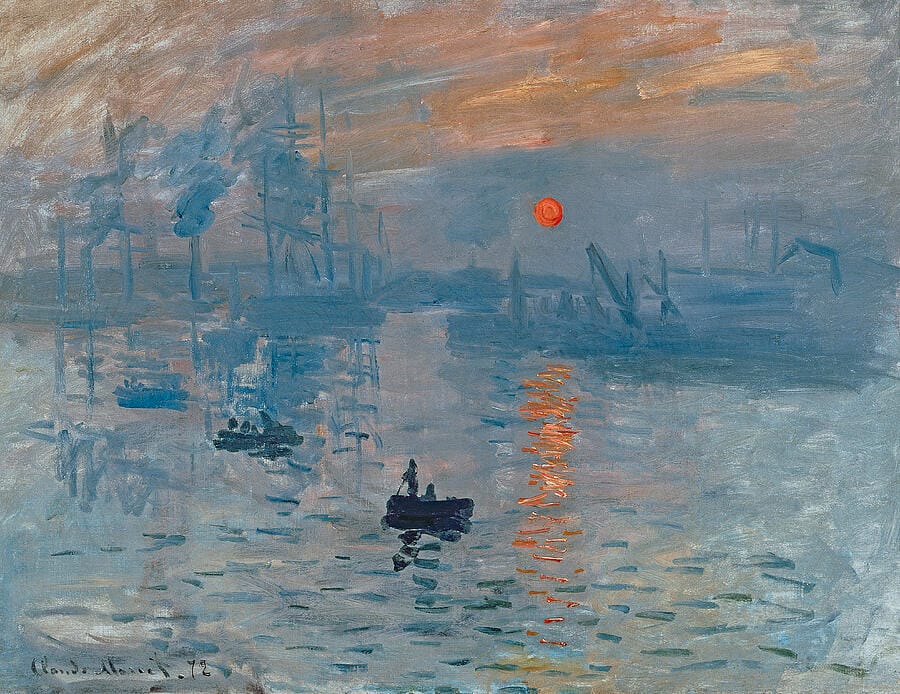
Impressionism was a French painting movement that ran from 1874 to 1886, built on visible brushstrokes, bright unmixed color and light observed outdoors rather than invented in a studio. Its core group — Monet, Renoir, Degas, Pissarro, Morisot and Sisley — held eight independent exhibitions in Paris, and took its name from a hostile review of Monet’s Impression, Sunrise.
What Impressionism actually was
Nineteenth-century French painting ran through one institution: the Salon, the state exhibition in Paris. A jury decided what hung, and it rewarded smooth finish, historical or mythological subjects and a brown studio tonality. Painters who worked otherwise were not shown at all.
At the end of 1873 about thirty of them stopped asking. Calling themselves the Société anonyme des artistes peintres, sculpteurs et graveurs — a deliberately flat name borrowed from company law — they rented the photographer Nadar’s former studio at 35 boulevard des Capucines and opened their own exhibition on April 15, 1874. It ran a month and lost money.
The critic Louis Leroy reviewed it for the satirical paper Le Charivari on April 25, seizing on the title of one canvas — Monet’s Impression, soleil levant — to dismiss the whole room as the work of “Impressionists.” The insult stuck. By the third exhibition in 1877 the painters were using it themselves.
What they were after was narrower and more technical than the legend suggests: to set down one particular light, at one hour, in one place, before it changed. That is why the pictures look unfinished. They had to be quick.
When and where: the eight exhibitions
Impressionism has unusually precise dates for an art movement, because the group defined itself through a run of exhibitions rather than a manifesto. There were eight, all in Paris, between 1874 and 1886.
| # | Year | What happened |
|---|---|---|
| 1 | 1874 | 35 boulevard des Capucines; about 30 exhibitors. Louis Leroy coins “Impressionist.” |
| 2 | 1876 | Durand-Ruel’s gallery, rue Le Peletier; roughly 20 exhibitors. Caillebotte joins. |
| 3 | 1877 | The first show the group itself billed as an exhibition of Impressionists. |
| 4 | 1879 | Avenue de l’Opéra. Mary Cassatt’s debut; Renoir and Sisley go back to the Salon. |
| 5 | 1880 | Monet absent, showing at the Salon instead; Degas and his circle dominate. |
| 6 | 1881 | Only thirteen exhibitors. Monet, Renoir, Sisley and Caillebotte all stay away. |
| 7 | 1882 | Durand-Ruel reassembles the landscape painters; Degas and Cassatt do not take part. |
| 8 | 1886 | The last. Seurat shows A Sunday on La Grande Jatte; Monet and Renoir are absent. |
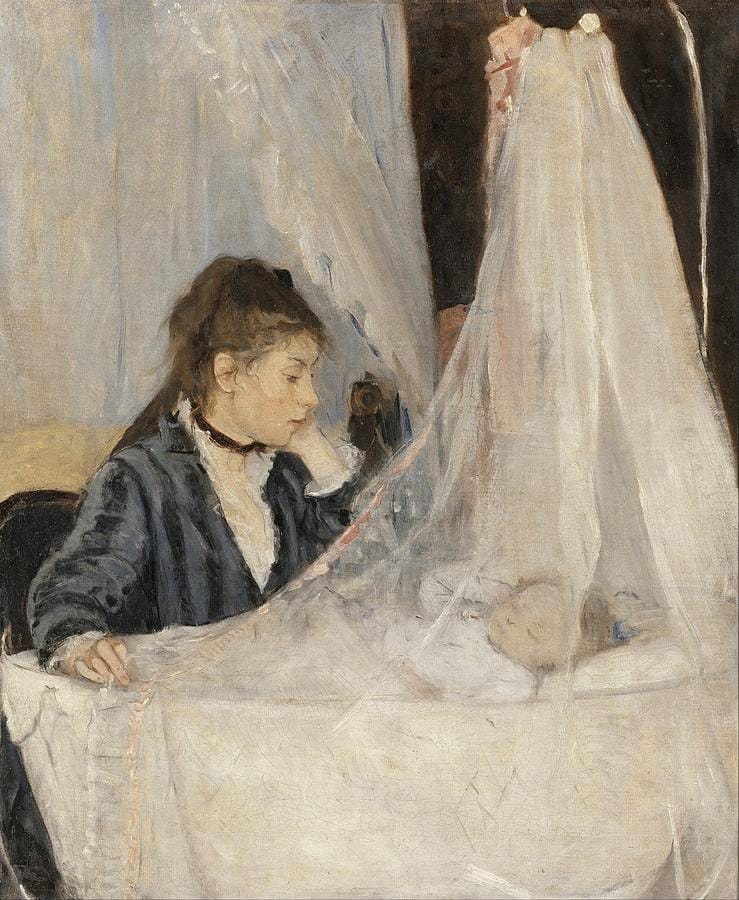
Camille Pissarro is the only painter who exhibited in all eight, which is why he is often called the group’s anchor. Berthe Morisot showed in seven, missing only 1879, the year after her daughter was born. Édouard Manet — routinely filed under Impressionism ever since — never exhibited in any of them, preferring to fight for the Salon from inside.
Who the Impressionists were
“Impressionist” covers painters who disagreed with each other about almost everything except the Salon.
| Painter | Dates | Known for |
|---|---|---|
| Claude Monet | 1840–1926 | Series painting: haystacks, poplars, Rouen Cathedral, water lilies |
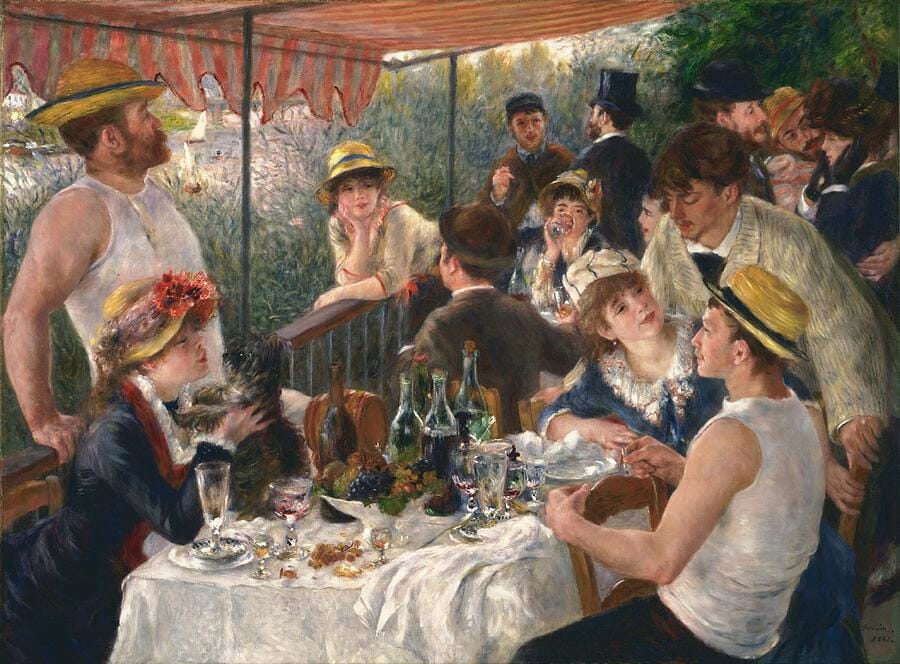
| Pierre-Auguste Renoir | 1841–1919 | Crowds and figures under dappled light; dance halls and riverside lunches |
| Edgar Degas | 1834–1917 | Dancers, laundresses, racecourses — indoors, drawn, under artificial light |
| Camille Pissarro | 1830–1903 | Orchards, village roads and Paris boulevards; the only member in all eight shows |
| Berthe Morisot | 1841–1895 | Gardens and domestic interiors, painted with the loosest brush in the group |
| Alfred Sisley | 1839–1899 | Landscape only: snow, floods, river towns, and a great deal of sky |
| Gustave Caillebotte | 1848–1894 | Paris streets in hard perspective; also the group’s collector and paymaster |
| Mary Cassatt | 1844–1926 | Mothers and children, theater boxes; the American in the circle |
Degas disliked the label all his life and preferred “Realist” or simply “Independent.” He rarely painted outdoors and thought the whole cult of sunlight faintly ridiculous — a useful reminder that the movement was an alliance of convenience, not a school with a house style.
How to spot an Impressionist painting
Six markers, in rough order of reliability. Three or four together and you are almost certainly looking at Impressionism.
- Separate, visible brushstrokes. The paint is not blended on the canvas. Stand close and the surface breaks into distinct touches; step back and they fuse. That optical mixing is the whole technique.
- No black, and colored shadows. Shadows are blue, violet or green — the complementary of whatever light is falling on the object — never brown or gray.
- A pale ground left showing. Canvases were primed white or light gray rather than the traditional dark brown, and gaps are left uncovered so the ground lifts the color.
- Ordinary modern life. Railway stations, boulevards, boating parties, laundries, back gardens. No gods, no battles, no moral.
- A cropped, off-center composition. Figures cut by the frame, high viewpoints, empty foregrounds — habits taken directly from photography and Japanese prints.
- Dissolved contour. Edges are found where two colors meet, not drawn first and filled in afterward.
One more test, less about technique than intent: an Impressionist picture records a single hour. If you can guess the time of day and the weather but not the story, that is the movement working exactly as designed.
Why it still matters
The paintings ridiculed in 1874 are now the most crowded rooms in any museum that owns them, and the shift is worth understanding, because it was not only about taste. Impressionism established three things modern art still runs on: that artists can exhibit outside official channels, that a dealer rather than a jury can make a reputation, and that a painting can be a record of how something was seen rather than of what it means.
It also holds up unusually well on a domestic wall. The palette is high-key and warm, the subjects are calm, and because the pictures were built to be read from a distance they settle into a room instead of demanding the whole of it — which is why an Impressionist landscape works above a sofa where a darker, more detailed painting fights you.
The works themselves are long out of copyright, so the good ones are widely available as prints. Browse Impressionist art, or start with Monet, Renoir, Degas and Pissarro.
Frequently asked questions
What is Impressionism in simple terms?
Impressionism is a style of painting that tries to capture the effect of light at a particular moment rather than describe a subject in detail. Painters worked quickly, often outdoors, leaving brushstrokes visible and using bright unmixed color with colored rather than black shadows. It began in Paris in the 1870s.
When did Impressionism start and end?
The movement is usually dated from the first independent exhibition in Paris on April 15, 1874 to the eighth and last in 1886. Its roots go back to the late 1860s, when Monet and Renoir painted side by side at La Grenouillère, and individual painters — Monet above all — carried on in the style for decades afterward.
Who were the Impressionists?
The core group was Claude Monet, Pierre-Auguste Renoir, Edgar Degas, Camille Pissarro, Berthe Morisot, Alfred Sisley, Gustave Caillebotte and Mary Cassatt. Édouard Manet is usually associated with them and influenced them heavily, but he never exhibited in any of the eight Impressionist exhibitions.
Why is it called Impressionism?
From an insult. Reviewing the 1874 exhibition for Le Charivari, the critic Louis Leroy took the title of Monet’s Impression, Sunrise and used it to mock the whole group as painters of mere impressions rather than finished pictures. The artists adopted the name themselves within three years.
What are the characteristics of Impressionist painting?
Visible separate brushstrokes, bright unmixed color, no black, shadows painted in blue and violet, a pale ground left showing through, subjects taken from ordinary modern life, cropped off-center compositions, and soft dissolved edges. Above all, the picture records one specific quality of light at one moment.
What is the difference between Impressionism and Post-Impressionism?
Impressionists painted what the eye registers at a given moment. Post-Impressionists — Cézanne, Van Gogh, Gauguin and Seurat — kept the bright color but rejected the fleeting surface, restoring firm structure, strong outline and color chosen for emotional or symbolic effect rather than accuracy. Post-Impressionism runs from about 1886 to 1905.
Impressionism is the rare movement that reads as clearly on a wall at home as it does in a gallery. Browse Impressionist prints on canvas, framed, or as framed — printed to order in sizes up to 72 inches. For what happened next, read What Came After Impressionism? and Impressionism vs Post-Impressionism.