Impressionism vs Post-Impressionism
Impressionism recorded what the eye saw. Post-Impressionism kept the color and put structure, feeling and symbol back in. Here is where the line falls.

Impressionism (c. 1872–1886) painted what the eye actually sees — light, weather and fleeting moments, recorded outdoors in broken strokes of pure color. Post-Impressionism (c. 1886–1905) kept that bright color but put structure, emotion and symbolism back in. Monet is the Impressionist; Cézanne, Van Gogh, Gauguin and Seurat are the Post-Impressionists.
The difference in one line — and why the name is misleading
Impressionism was an argument about perception: paint the sensation of light on the retina, honestly and quickly, before it changes. Post-Impressionism was the generation that accepted the new color and then complained that pure sensation was not enough — that a painting also has to be built, and has to mean something.
The awkward part is the name. Nobody called themselves a Post-Impressionist. The term was invented in London in 1910 — twenty years after the fact and seven years after Gauguin’s death — by the critic Roger Fry, who needed a title for an exhibition of recent French painting at the Grafton Galleries and settled on Manet and the Post-Impressionists. It is a label of convenience for four or five artists who had almost nothing in common except a starting point.
That starting point is 1886, a date worth memorizing. It is the year of the eighth and final Impressionist exhibition, the year Seurat showed A Sunday on La Grande Jatte there, and roughly the year Van Gogh arrived in Paris and discovered color. Before 1886, Impressionism. After it, four painters going four different directions.
Impressionism vs Post-Impressionism at a glance
| Impressionism | Post-Impressionism | |
|---|---|---|
| Dates | c. 1872–1886 | c. 1886–1905 |
| Named by | Critic Louis Leroy, 1874, as an insult | Critic Roger Fry, 1910, for a London exhibition |
| Core figures | Monet, Renoir, Pissarro, Sisley, Morisot, Degas, Caillebotte | Cézanne, Van Gogh, Gauguin, Seurat, Toulouse-Lautrec |
| Aim | Record an optical sensation truthfully | Use what the eye sees to say something else |
| Brushwork | Small, rapid, broken; mixed by the viewer’s eye | A deliberate system — dots, spirals, blocks, flat fields |
| Color | Naturalistic, keyed to real daylight | Often arbitrary — a green face, a red sky, pink sand |
| Outline | None; forms dissolve into each other | Often returns, hard and dark, especially in Gauguin |
| Composition | Casual, cropped, snapshot-like | Constructed, weighted, held together on purpose |
| Where made | Outdoors, fast, in front of the motif | Studio as often as not; memory and imagination allowed |
| Subject | Modern leisure, weather, the suburbs of Paris | Inner life, symbol, structure, the search for elsewhere |
If you only keep one row, keep the fourth. Impressionism is about looking. Post-Impressionism is about what you do next.
Impressionism: painting the light
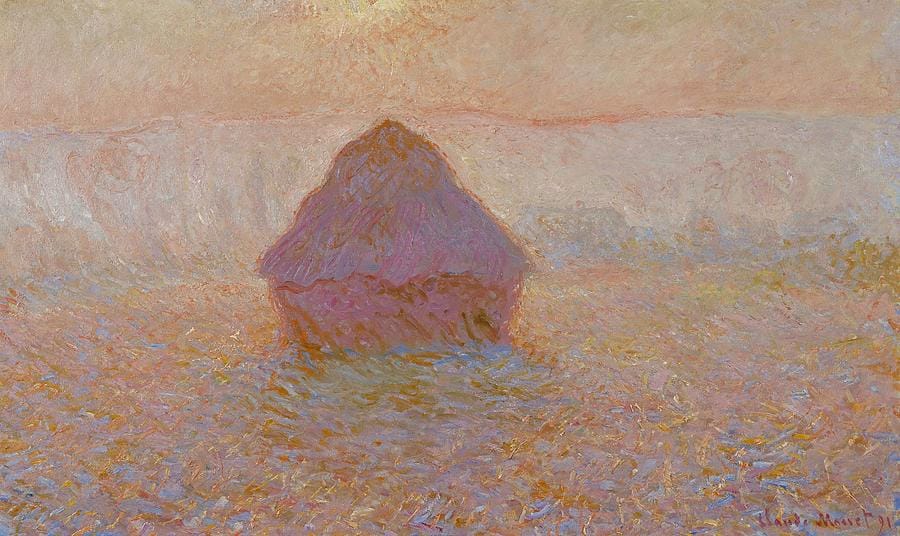
The technical program was small and strict. Work outdoors, directly from the subject. Abandon the brown underpainting the academies used, and start from a light ground. Put strokes of unmixed color side by side and let them blend at viewing distance rather than on the palette. Build shadows from blue and violet instead of black — because a shadow in daylight is not an absence of light, it is light of a different color.
The results looked unfinished to 1874 eyes, which is exactly what the critics said. The group held eight exhibitions between 1874 and 1886; Monet appeared in five of them, Degas in seven, Pissarro in all eight. What they shared was less a style than a refusal — of the Salon, of history painting, of the finish that the Salon required.
Their subject was ordinary and contemporary: a railway station under glass, a suburban regatta, dancers waiting in the wings, a café-concert, a garden in August. Impressionism made everyday modern life a legitimate subject, and that turned out to matter more than the brushwork. See the range across Impressionist prints and Degas.
Post-Impressionism: four painters, four exits
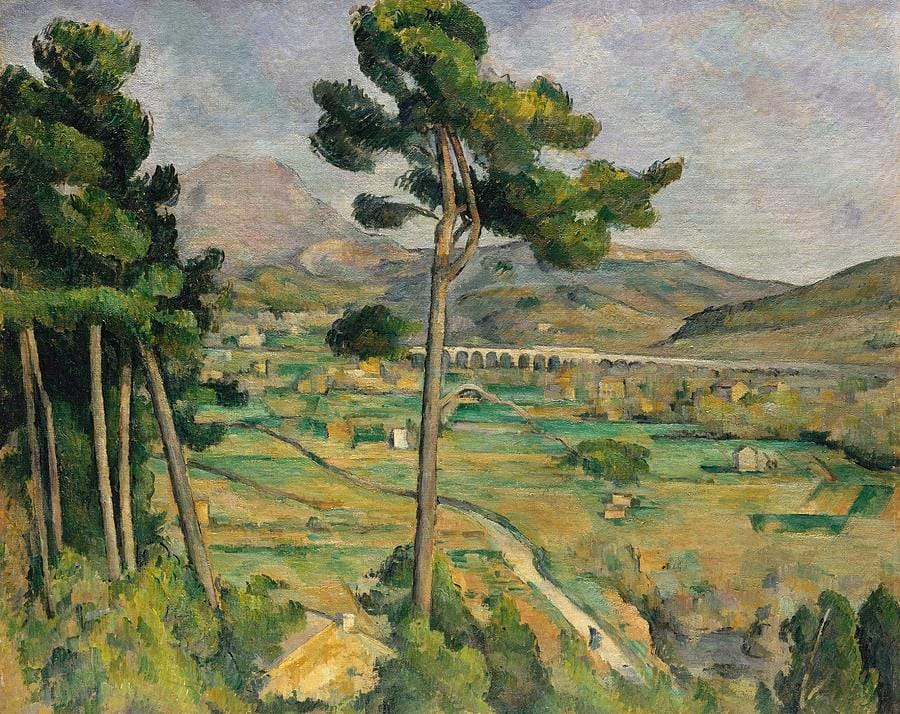
There is no Post-Impressionist style, only four solutions to the same complaint. The brushwork is the quickest way to tell them apart, because each man built a different mark.
Cézanne wanted structure. He painted Mont Sainte-Victoire more than sixty times, not to catch the light but to work out how to make a mountain sit solidly on a flat canvas. His mark is a small parallel patch, laid like masonry, and his advice to a younger painter in 1904 was to treat nature “by the cylinder, the sphere, the cone”. Cubism starts here.
Seurat wanted science. Divisionism — thousands of measured dots of unmixed pigment, applied according to contemporary color theory. This strand has its own name, Neo-Impressionism, and it is a subset of Post-Impressionism rather than a synonym for it.
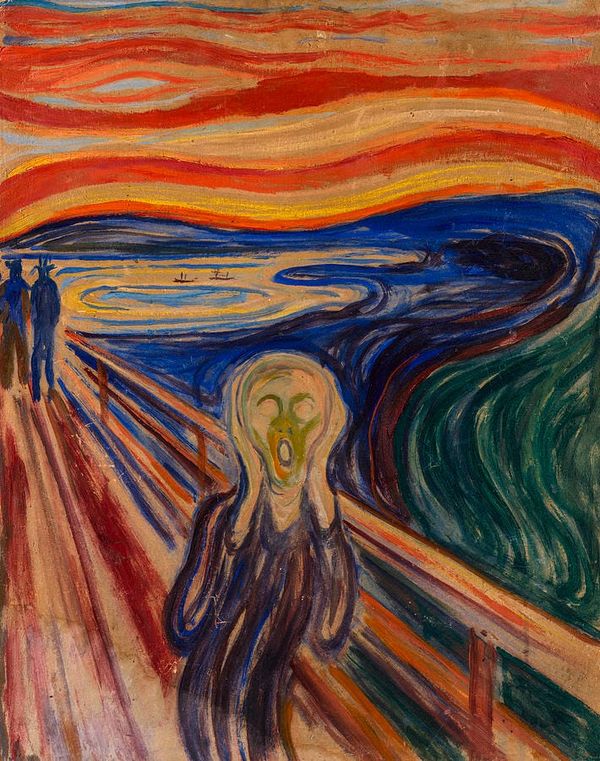
Van Gogh wanted feeling. Thick ridged impasto, every stroke directional, color pushed past what the eye reported because of what it did to the nerves.
Gauguin wanted symbol. Flat unmodelled fields of color inside heavy dark contours — the technique borrowed from stained glass and Japanese prints and known as cloisonnism — with no attempt at depth at all. Browse Post-Impressionist prints to see the four side by side.
How to tell them apart at a glance
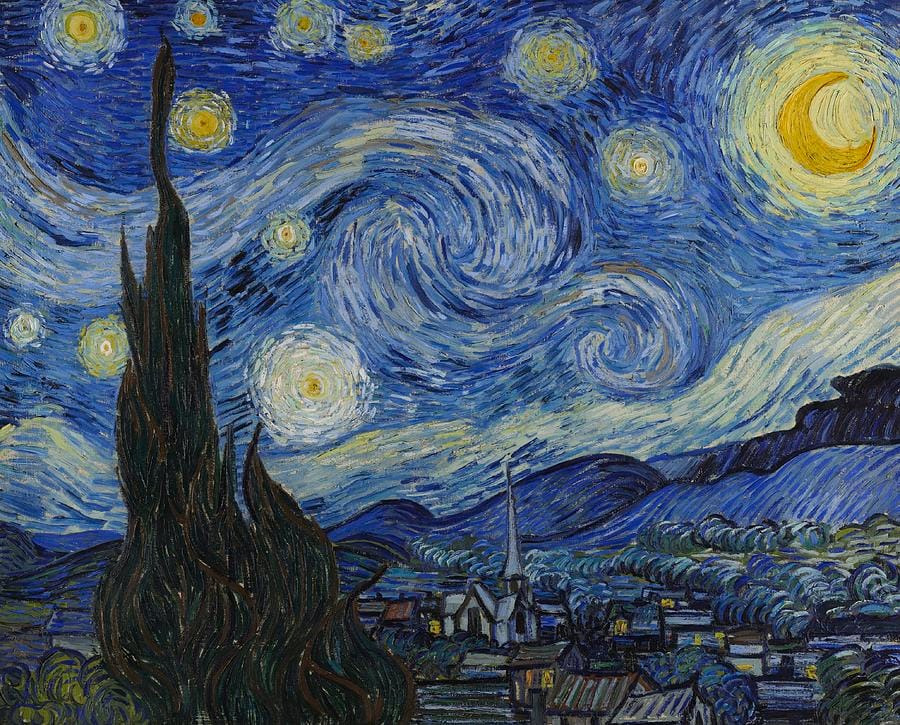
Six quick tests, in the order that resolves fastest.
- Squint at it. If it collapses into a soft, believable scene, it is Impressionist. If the shapes stay bold and graphic when blurred, it is Post-Impressionist.
- Look for an outline. A dark contour around a figure or a field is close to conclusive for Post-Impressionism. Impressionists have no lines at all.
- Check the sky’s color. An Impressionist sky is a color a sky can be. A Post-Impressionist sky may be lemon yellow or bottle green.
- Read the brush marks. A uniform all-over flicker means Impressionism. A visible system — dots, spirals, stacked planes — means Post-Impressionism.
- Ask what it is of. A moment of weather is Impressionist. An idea, a mood or a symbol is Post-Impressionist.
- Check the date. Before 1886 is almost certainly Impressionism; after 1890 almost certainly is not.
Two honest complications. Cézanne exhibited with the Impressionists in 1874 and 1877 before his mature style arrived, so his early work genuinely is Impressionist. And Degas, always classed as an Impressionist, worked indoors from drawings and rarely painted outdoors at all — a reminder that these labels were applied to people, not agreed to by them.
Frequently asked questions
What is the main difference between Impressionism and Post-Impressionism?
Impressionism tried to record an optical sensation truthfully — light, weather and movement, painted quickly outdoors. Post-Impressionism kept the bright unmixed color but rejected the idea that a painting should only report what the eye sees, restoring structure, emotion and symbolic meaning. Impressionism is about looking; Post-Impressionism is about what the painter does with what he saw.
Is Van Gogh an Impressionist or a Post-Impressionist?
Van Gogh is a Post-Impressionist. He learned Impressionist color in Paris in 1886–88, but his mature work at Arles and Saint-Rémy uses thick directional impasto and emotionally driven, non-naturalistic color — a green sky, an orange field — which is the opposite of the Impressionist aim of faithful optical record.
Who coined the term Post-Impressionism?
The British critic Roger Fry, in 1910, as the title of an exhibition of recent French painting at the Grafton Galleries in London: Manet and the Post-Impressionists. None of the artists ever used the word about themselves — Van Gogh and Seurat had been dead for twenty years and Gauguin for seven.
Is Post-Impressionism the same as Neo-Impressionism?
No. Neo-Impressionism is the specific technique of Divisionism or Pointillism developed by Georges Seurat and Paul Signac from 1884, in which color is applied in small measured dots. It is one strand within the wider, looser grouping of Post-Impressionism, which also covers Cézanne, Van Gogh and Gauguin.
When did Impressionism end?
The usual date is 1886, the year of the eighth and last Impressionist group exhibition in Paris. The movement did not stop — Monet painted for another forty years and produced his greatest series afterward — but 1886 is when the group dissolved and the younger painters began working in the directions now called Post-Impressionism.
Is Cézanne an Impressionist or a Post-Impressionist?
Both, in sequence. Cézanne exhibited in the first Impressionist show of 1874 and the third in 1877, and his work of that decade is genuinely Impressionist. From the early 1880s he moved toward the built, patch-by-patch construction of the Mont Sainte-Victoire paintings, and that mature work is the foundation of Post-Impressionism.
The two movements hang very differently. Impressionist work rewards a wall with real daylight on it and looks best at a size you can stand close to; Post-Impressionist work is graphic enough to carry a room from across it. Browse Impressionist and Post-Impressionist reproductions as canvas, framed or art prints.