Who Was Slim Aarons?
The combat photographer who spent fifty years photographing the opposite of war — and invented a biography for himself along the way.

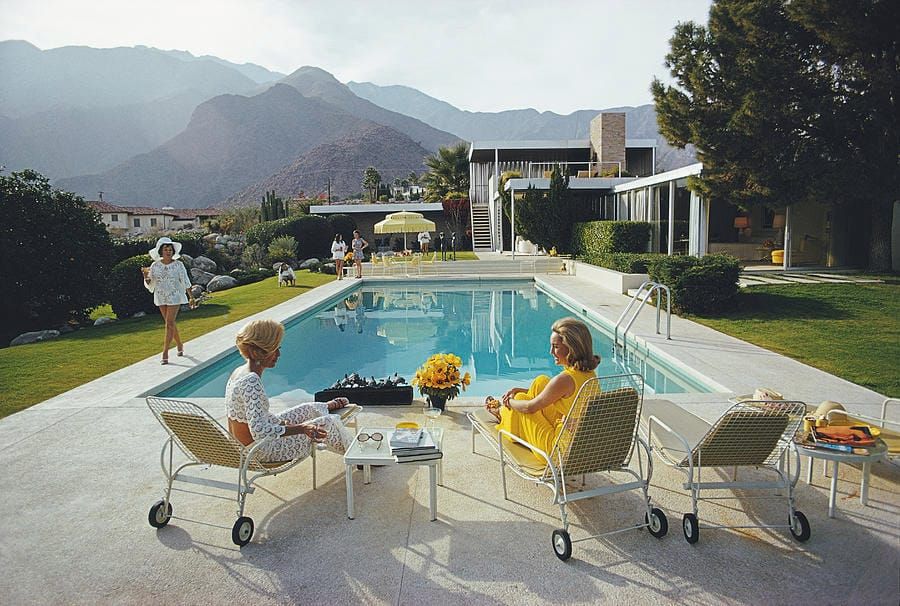
Slim Aarons (1916–2006) was an American photographer who spent fifty years documenting the private leisure of the rich — a beat he summarized as photographing attractive people doing attractive things in attractive places. He was a decorated Second World War combat photographer first, and he shot society in available light, on color film, always as an invited guest.
From the Anzio beachhead to the Beverly Hills pool
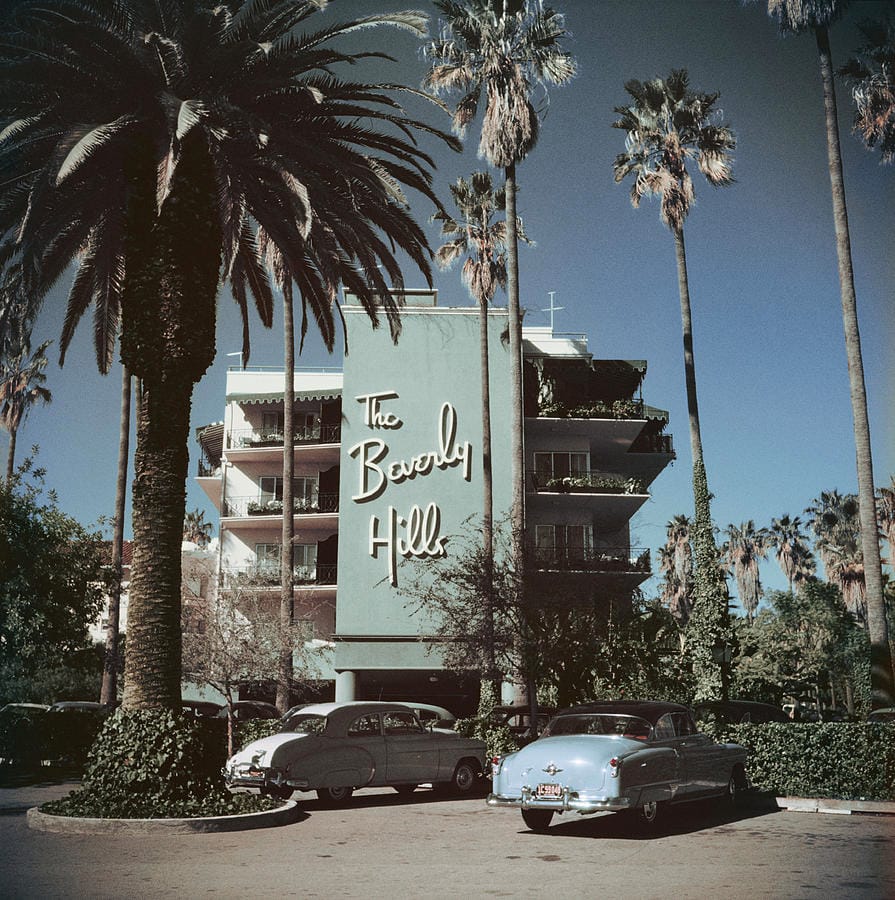
He was born George Allen Aarons in Manhattan on October 29, 1916, to poor immigrant parents, and spent his adult life saying otherwise. He told people he had been raised an orphan in New Hampshire with no living relations — a version his own widow and daughter discovered to be untrue only after his death. The man who spent fifty years photographing other people’s enviable lives had first invented one for himself.
He enlisted in the United States Army at eighteen, worked as a photographer at West Point, and then spent three years as a combat photographer in the Second World War, across North Africa, the Middle East and Italy. He photographed the siege of Monte Cassino, was wounded at Anzio — for which he received a Purple Heart — and was in Rome when the city fell in June 1944.
That biography is the key to everything after it. Aarons did not drift into photographing swimming pools; he chose them, with the alternative fresh in mind. His account of the decision has been quoted ever since: combat had taught him that the only beach worth landing on was one decorated with beautiful, semi-nude girls tanning in a tranquil sun. By the early 1950s he was working for Holiday, Town & Country, Life and Harper’s Bazaar.
Attractive people doing attractive things in attractive places
The famous line is usually quoted as a joke about frivolity. It is better read as a working method, applied with real discipline.
No crew. He worked without stylists, hair or make-up, and — rarely for a magazine photographer of his generation — without artificial light. Everything is daylight, which is why the shadows fall where the sun put them and the color behaves like memory rather than advertising.
No ambush. The paparazzi were working the same years on the principle that a picture is worth more if the subject does not want it taken. Aarons worked on the opposite one. “I knew everyone,” he said. “They would invite me to one of their parties, because they knew I wouldn’t hurt them.” Nobody in a Slim Aarons photograph is caught. Everyone is comfortable, and the comfort is the subject.
Architecture gets equal billing. Look at how little of the frame the people occupy. A terrace, a mountain, a pool, a portico — the setting gets as much space as the guests, often more. This is why the pictures work on a wall when most celebrity photography does not: they are landscapes that happen to contain socialites.
Six photographs that define him
| Photograph | Year | Where | What is in it |
|---|---|---|---|
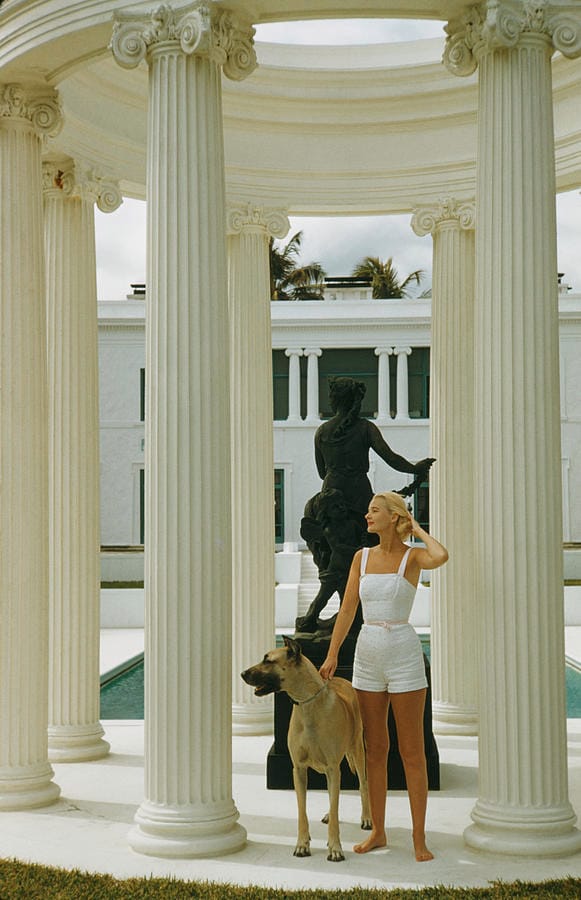
| C.Z. Guest at Villa Artemis | 1955 | Palm Beach, Florida | The socialite by the pool of her ocean-front estate, beside a neoclassical portico |
| Kings of Hollywood | 1957 | Beverly Hills | Clark Gable, Van Heflin, Gary Cooper and James Stewart in black tie, laughing at a bar on New Year’s Eve |
| Penthouse Pool | 1961 | Athens | A rooftop pool party, a yellow bathing cap, the Acropolis dissolving into haze |
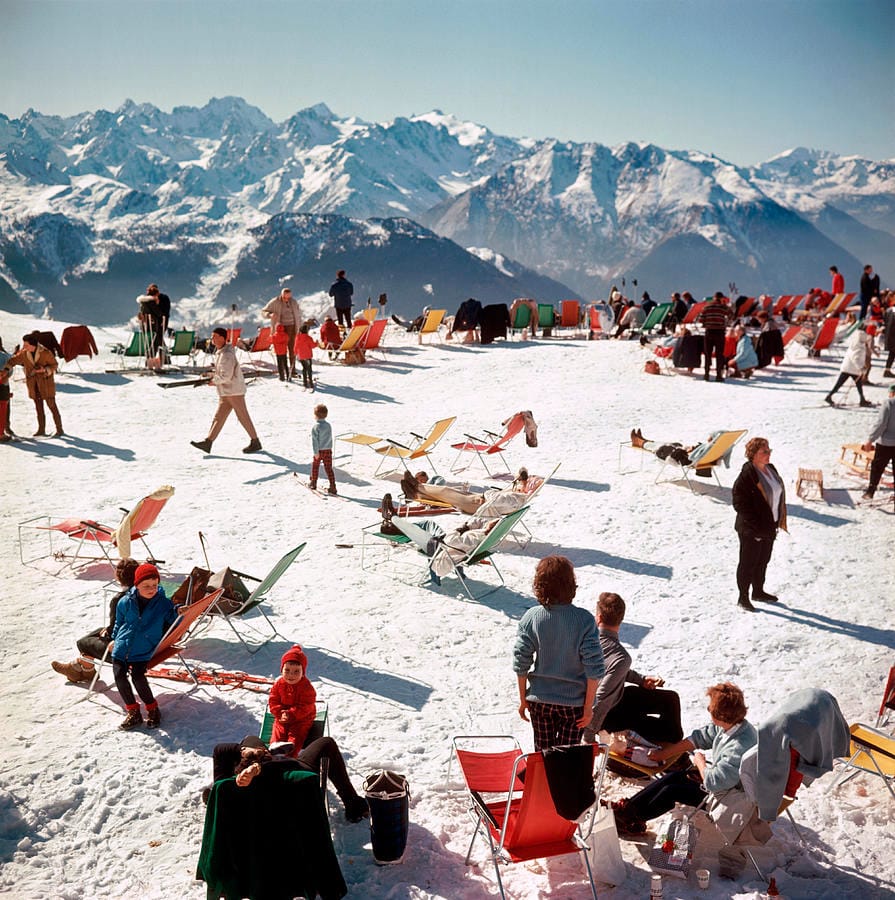
| Verbier Vacation | 1964 | Verbier, Switzerland | Skiers lunching on a snowfield in primary colors, Alps stacked up behind |
| Poolside Gossip | 1970 | Kaufmann Desert House, Palm Springs | Nelda Linsk and Helen Dzo Dzo beside Richard Neutra’s 1946 house, Lita Baron walking in from the left |
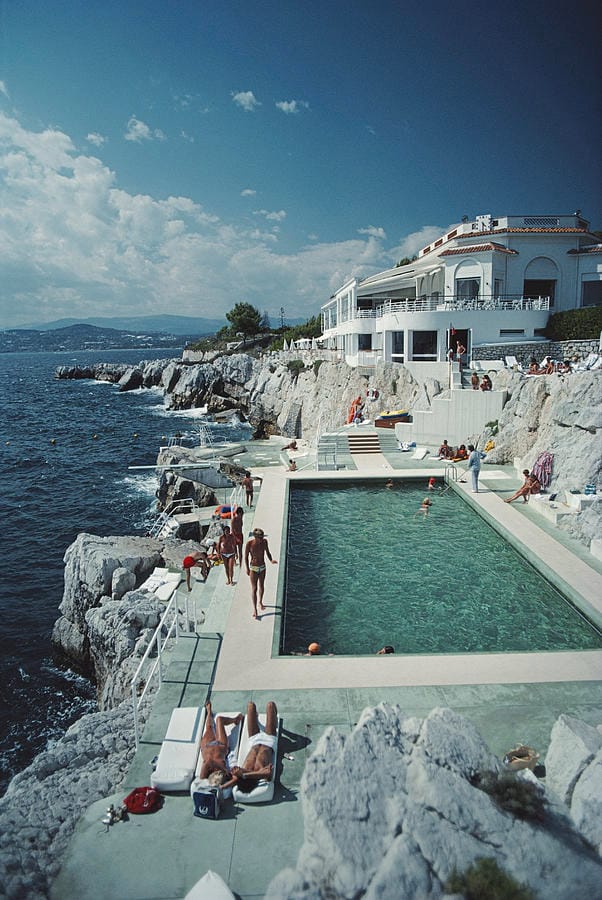
| Hotel du Cap, Eden-Roc | 1976 | Antibes, France | Bathers on the rocks and diving boards above the Mediterranean |
Half of these contain nobody most people could name. What Aarons was recording was not celebrity but a proposition about how life could be arranged, and the figures in the frame are largely there to prove it was inhabited.
Why the pictures outlasted the world they show
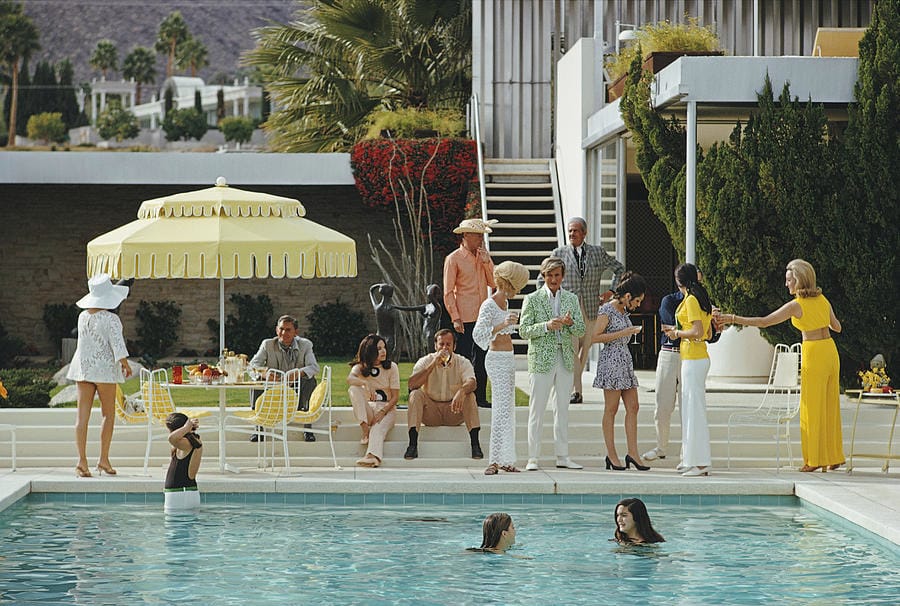
Aarons shot color transparency film through the decades when serious photography was expected to be black and white, and the palette is now inseparable from the work: pool water in a particular blue-green, white stucco, terracotta, the exact yellow of 1960s poolside upholstery. Saturated without being loud, because it is daylight rather than studio light.
They also contain almost nothing that dates them the way clothes date a fashion shoot: no screens, no branding, no logos. A terrace in Antibes in 1976 looks much as one looks now, so the eye reads the image as a place rather than a period. That is most of why the work survived the fashion cycle that consumed his contemporaries.
Then the world caught up with him. The mid-century revival of the 2000s rediscovered exactly the architecture he had been photographing incidentally for forty years, and the Kaufmann Desert House became a pilgrimage site. Aarons had, without meaning to, made the fullest photographic record of mid-century modern buildings in use by the people who lived in them.
It is worth being clear-eyed about what the archive is. It documents an extremely narrow world — wealthy, largely white, entirely at leisure — without a flicker of criticism. Aarons was not a reporter on that world but its guest.
Where the archive lives now
In 1997 Mark Getty, co-founder of Getty Images, bought Aarons’ entire archive. Aarons kept working into his eighties and died in Montrose, New York, on May 30, 2006, aged 89. His pictures now circulate as licensed images rather than as collectable vintage prints, printed on demand rather than pulled from an edition he made himself.
Three books are the standard route in: A Wonderful Time (1974), assembled at the height of his career with his own captions, and the two retrospectives that drove the current revival, Once Upon a Time (2003) and A Place in the Sun (2005).
For a wall, the archive prints across canvas, framed, acrylic and metal. Buy horizontal — almost everything he shot is landscape format — and buy large, because these are deep-focus scenes whose far-distance detail disappears at small sizes.
Frequently asked questions
Who was Slim Aarons?
Slim Aarons was an American photographer, born in New York in 1916 and died in 2006, who spent fifty years photographing the leisure of the wealthy for Holiday, Life and Town & Country. He served first as a combat photographer for the US Army weekly Yank in the Second World War, and was awarded a Purple Heart after being wounded at Anzio.
What is Slim Aarons’ most famous photograph?
Poolside Gossip, taken in 1970 at the Kaufmann Desert House in Palm Springs, is the best known. It shows Nelda Linsk and Helen Dzo Dzo beside the pool of the house Richard Neutra designed in 1946, with Lita Baron walking into frame. Kings of Hollywood, from New Year’s Eve 1957, is the closest rival.
What did Slim Aarons mean by “attractive people doing attractive things in attractive places”?
It was his description of his own beat, and in practice a method rather than a slogan. He photographed people who had invited him, in daylight, without stylists or artificial lighting, in settings he considered beautiful. He said openly that he never photographed anything ugly, and the archive bears that out.
Was Slim Aarons a paparazzo?
No, and he was working in deliberate opposition to them. Paparazzi photography depends on the subject not consenting. Aarons was invited, knew his subjects socially, and traded on the understanding that he would not embarrass them. His own explanation was that people invited him to their parties because they knew he would not hurt them.
Who owns the Slim Aarons archive?
Getty Images. Mark Getty, the company’s co-founder, bought Aarons’ complete archive in 1997. That is why his photographs circulate as licensed prints rather than as limited vintage editions made by the photographer himself.
Why do Slim Aarons photographs work so well as wall art?
Because they are essentially landscapes. The people usually occupy a small part of the frame while architecture, water and sky take the rest, so the image reads at a distance the way a painting does. They are almost all horizontal, shot in daylight with deep focus, and hold detail that only appears at larger print sizes.
The archive is browsable as prints under Slim Aarons, and the world he documented continues through Palm Springs, swimming pool and Hollywood photography of the same decades. If you want the look rather than the pictures, our guide to the Palm Springs look at home covers the palette and the framing.