What Came After Impressionism?
Four painters took four different exits from Impressionism — and between them produced most of twentieth-century art.

Post-Impressionism came next, from about 1886 to 1905. Cézanne, Van Gogh, Gauguin and Seurat kept Impressionism’s bright color but rejected its fleeting, structureless surface, and each solved the problem differently. Their four solutions led directly to Neo-Impressionism, Fauvism, Expressionism, Cubism and, within twenty years, to abstract painting.
1886: the year it ended and the year it started
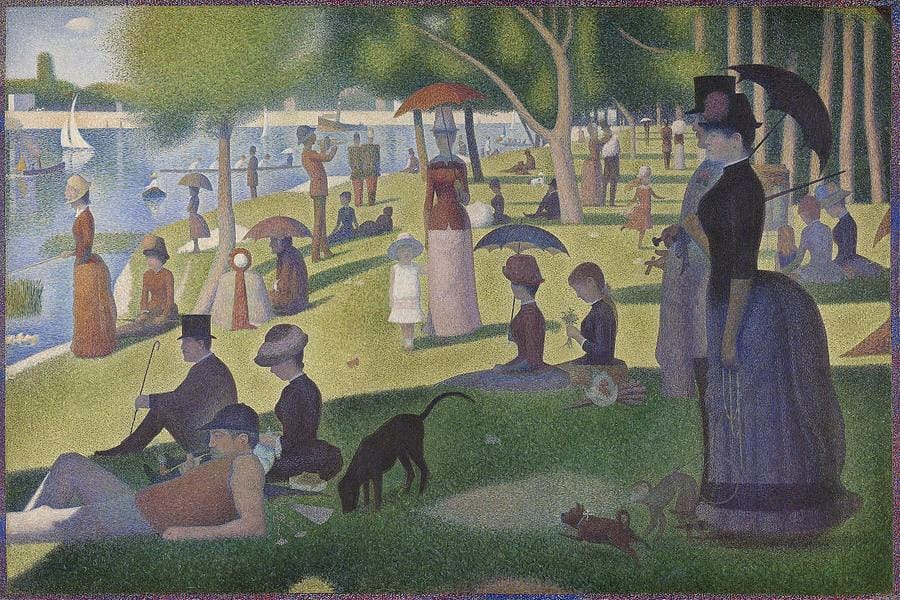
The eighth and final Impressionist exhibition opened in Paris in May 1886. Monet and Renoir did not take part. The picture everyone argued about was by a 26-year-old who had never exhibited with the group before: Georges Seurat’s A Sunday on La Grande Jatte, a ten-foot canvas of Parisians on a riverbank, built entirely out of small separate dots of color and as still as a frieze.
That is the hinge. Impressionism had set out to record a passing moment; Seurat used its own color theory to produce something deliberately motionless and permanent. Within the same year Van Gogh arrived in Paris and saw Impressionist painting for the first time, and Gauguin spent his first summer in Brittany.
The label came much later, and from England. In 1910 the critic Roger Fry organized an exhibition at the Grafton Galleries in London and needed a title for a room full of French painters who were plainly not Impressionists. He called it Manet and the Post-Impressionists. It was a stopgap, and he knew it — the name says only that these painters came afterward.
The four painters, and the four exits
They were not a group. They barely overlapped, and two of them fell out badly. What they shared was a diagnosis: Impressionism had freed color but lost everything else.
| Painter | Kept | Changed | Led to |
|---|---|---|---|
| Georges Seurat | Broken color, outdoor light | Turned it into a system: measured dots, geometric composition | Neo-Impressionism, 1884 |
| Paul Cézanne | The motif observed from life | Rebuilt it as architecture — planes, tilted tabletops, parallel strokes | Cubism, 1907 |
| Paul Gauguin | Bright, unnatural color | Flattened it into symbolic fields inside dark outlines | Symbolism and the Nabis, 1888 |
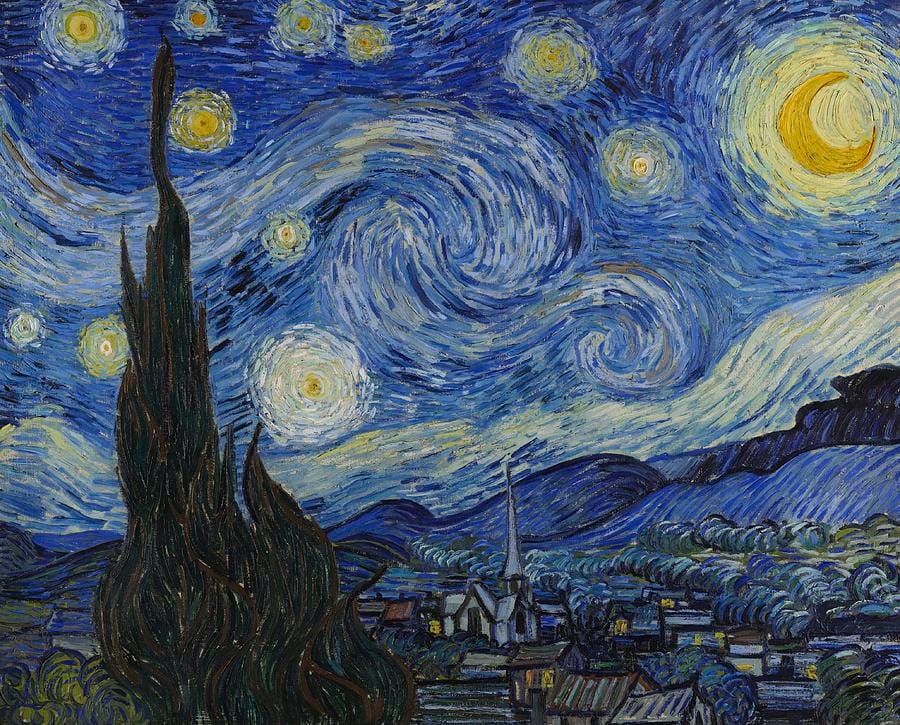
| Vincent van Gogh | The loaded brush | Made stroke and color carry emotion rather than appearance | Expressionism, 1905 |
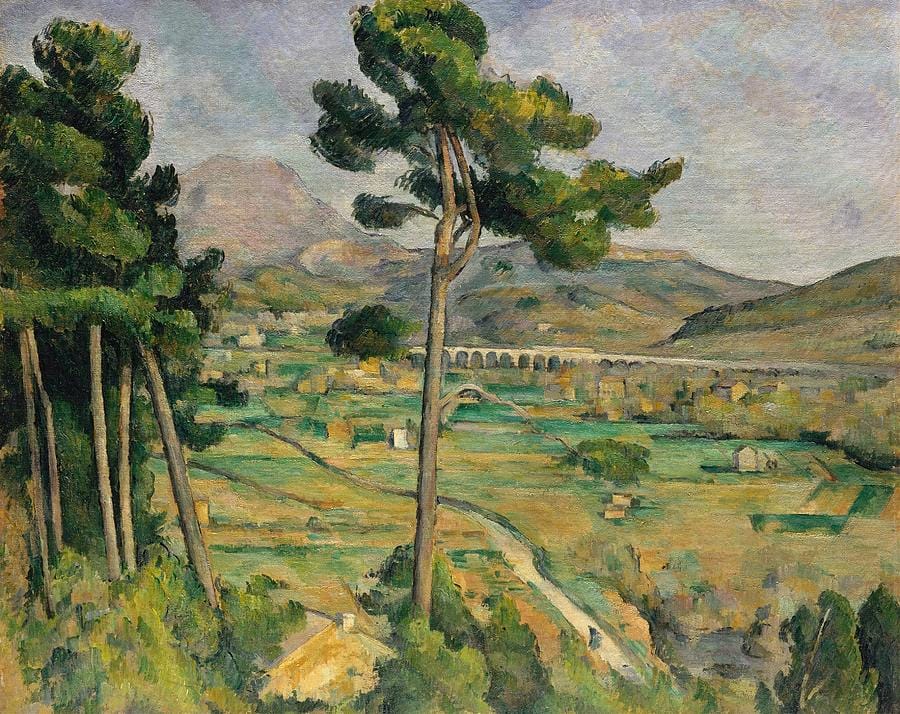
Cézanne is the one who matters most to what followed. He spent thirty years painting the same mountain outside Aix, looking for a way to make a picture as solid as a building without abandoning what the eye actually sees. In 1904 he wrote to the painter Émile Bernard that nature should be treated “by the cylinder, the sphere, the cone.” Picasso and Braque read that as an instruction.
How to tell the two apart in five seconds
Impressionism dissolves; Post-Impressionism builds. Four tests, in order of speed:
- Edges. Impressionist contours melt into their surroundings. Post-Impressionist ones are restored — Gauguin outlines in dark blue, Cézanne states an edge in a flat plane, Van Gogh in a rope of paint.
- Color. Impressionist color is observed, however heightened. Post-Impressionist color is chosen: a pink tree, a red sky, a green face, because the picture needs it.
- Stroke direction. Impressionist touches go every which way. Post-Impressionist ones are organized — Cézanne’s diagonal hatching, Seurat’s even dots, Van Gogh’s currents that follow the form.
- Time. An Impressionist picture is one hour of one day. A Post-Impressionist picture is not a moment at all.
For a longer side-by-side, see Impressionism vs Post-Impressionism; for the movement itself, What Is Impressionism?
The family tree, drawn out
Each of the four exits found successors within twenty years, and in most cases the successors said so out loud.
From Seurat came Neo-Impressionism — Signac, Cross, and briefly Pissarro, who converted at sixty and later changed his mind — and through Signac the young Matisse, and later the color experiments of Delaunay and the Italian Futurists.
From Cézanne came Cubism. Picasso and Braque took his shifting viewpoints and faceted planes and pushed them until the object broke apart. Cézanne died in 1906, and the memorial display of his work at the Salon d’Automne the following autumn was decisive — particularly for Braque. Picasso had already painted Les Demoiselles d’Avignon that summer; the two strands met in 1908, and Cubism proper follows.
From Gauguin came Symbolism and the Nabis, which formed in 1888 around Paul Sérusier, who had painted a small panel under Gauguin’s direction at Pont-Aven and carried it back to Paris. From there, the flat saturated color of Fauvism.
From Van Gogh came Expressionism: the German painters of Die Brücke in Dresden from 1905, and Der Blaue Reiter in Munich from 1911, who took his premise — that color and mark can carry feeling directly — and dropped the last obligation to describe anything.
Where it lands: a timeline to 1914
Between the last Impressionist exhibition and the First World War, roughly thirty years, Western painting travels from the riverbank at Asnières to pure abstraction.
| Year | What happens |
|---|---|
| 1884 | Seurat begins La Grande Jatte; Neo-Impressionism starts |
| 1886 | Last Impressionist exhibition; Van Gogh reaches Paris |
| 1888 | Gauguin at Pont-Aven; the Nabis form; Van Gogh moves to Arles |
| 1890 | Art Nouveau emerges across Europe |
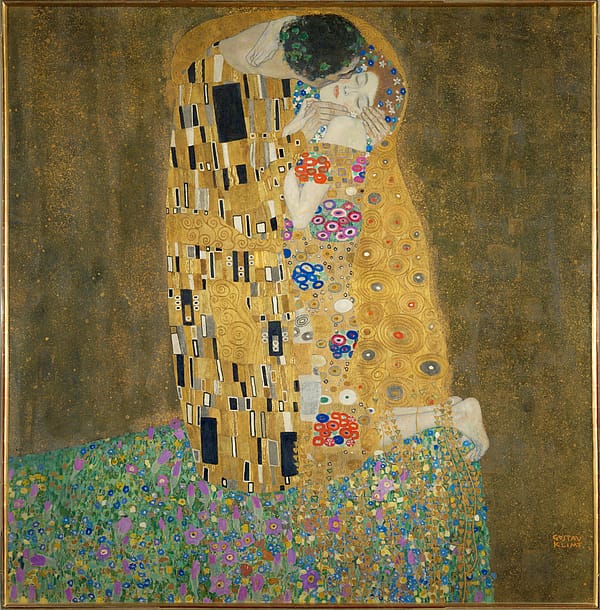
| 1897 | The Vienna Secession is founded, with Klimt as its first president |
| 1905 | Fauvism named at the Salon d’Automne; Die Brücke founded in Dresden |
| 1907 | Picasso paints Les Demoiselles d’Avignon; Cézanne memorial display at the Salon d’Automne |
| 1909 | Marinetti publishes the Futurist manifesto in Le Figaro |
| 1910 | Roger Fry’s London show coins “Post-Impressionist” |
| 1911 | Der Blaue Reiter forms in Munich; Kandinsky publishes On the Spiritual in Art |
The name “Fauvism” arrived the same way “Impressionism” had: at the 1905 Salon d’Automne the critic Louis Vauxcelles saw a conventional sculpture surrounded by violently colored canvases and remarked that it was Donatello among the wild beasts — les fauves. Three years later, reviewing Braque, the same critic reached for the word “cubes.” Two of the biggest movements in modern art are named after jokes made by one reviewer — which is a fair indication of how loosely these labels were fixed.
Frequently asked questions
What came after Impressionism?
Post-Impressionism, roughly 1886 to 1905. Its four central figures — Paul Cézanne, Vincent van Gogh, Paul Gauguin and Georges Seurat — kept Impressionism’s bright color but restored structure, outline and deliberate composition. Each took a different route, and between them they led to Fauvism, Expressionism, Cubism and abstraction.
What is Post-Impressionism?
Post-Impressionism is a term for French painting from about 1886 to 1905 that grew out of Impressionism but rejected its aim of recording a passing moment. Post-Impressionist painters used color for emotional or symbolic effect, restored firm outlines and built pictures to be permanent rather than fleeting. It was never an organized movement.
Who coined the term Post-Impressionism?
The English critic Roger Fry, in 1910, for an exhibition at the Grafton Galleries in London titled Manet and the Post-Impressionists. He needed a label for painters who clearly were not Impressionists, and settled for one that says only that they came afterward. None of the artists ever used the term.
Was Van Gogh an Impressionist?
No. Van Gogh only encountered Impressionism when he reached Paris in 1886, and his brightened palette comes from it, but his mature work in Arles and Saint-Rémy uses thick directional brushwork and color chosen for emotional effect rather than observed accuracy. He is classified as a Post-Impressionist.
How did Cézanne lead to Cubism?
Cézanne built his late paintings from flat planes and shifting viewpoints, tilting tabletops up toward the viewer and stating form through blocks of color rather than outline. Picasso and Braque pushed that method until objects broke into facets, and the memorial display of Cézanne’s work at the 1907 Salon d’Automne, the year after his death, sharpened it further — especially for Braque.
What movement came after Post-Impressionism?
Several at once, which is the point. Fauvism was named in 1905, Expressionism began the same year with Die Brücke in Dresden, Cubism followed in 1907, Futurism in 1909, and Kandinsky was moving into full abstraction by 1911. Post-Impressionism does not have one successor; it has a fan of them.
Post-Impressionism produced the most reproduced paintings in the world, and all of them are long out of copyright. Browse Post-Impressionist prints, or start with Van Gogh, Cézanne, Gauguin and Seurat — on canvas, framed, art or framed.