Art Nouveau Explained
The whiplash curve, the poster, and the twenty years around 1900 when Europe tried to redesign everything at once.
Art Nouveau was an international decorative style that ran from about 1890 to 1910, organized around the “whiplash” curve taken from plant and insect forms. It covered architecture, glass, jewelry, furniture, typography and above all the printed poster, and its best-known figures are Alphonse Mucha, Gustav Klimt, Hector Guimard, Louis Comfort Tiffany and Antoni Gaudí.
What it was reacting against
By the 1880s European design had two problems. Architects were recycling historical styles — a Gothic town hall, a Renaissance bank, a Louis XVI drawing room — and industry was churning out ornament that nobody had drawn and nobody enjoyed. The Arts and Crafts movement in Britain, led by William Morris, argued that the answer was honest handwork. Art Nouveau took that argument and made it a visual style.
The name came from a shop. In December 1895 the dealer Siegfried Bing opened Maison de l’Art Nouveau in Paris, selling furniture, glass and prints in the new manner; French critics used the gallery’s name for the whole movement, and it stuck. The first fully realized building in the style had appeared two years earlier — Victor Horta’s Hôtel Tassel in Brussels, finished in 1893, where the iron structure itself curls into tendrils.
The governing idea was that a room should be designed all at once: staircase, door handle, wallpaper, chairs, the lettering on the invitation. Nothing was too small to be drawn, and no material outranked another. That ambition is also why the style burned out so fast — it was, by construction, expensive.
When and where: the names it went by
Art Nouveau went international almost immediately, and each country named it differently. The regional labels are less variants of one style than local answers to the same question, which is why a Glasgow chair and a Barcelona balcony look so little alike.
| Name | Where | Key figures |
|---|---|---|
| Art Nouveau | France, Belgium | Hector Guimard, Victor Horta, Émile Gallé, René Lalique |
| Jugendstil | Germany | Named after the Munich magazine Jugend, founded 1896 |
| Secessionsstil | Austria | Gustav Klimt, Josef Hoffmann, Koloman Moser, Joseph Maria Olbrich |
| Stile Liberty | Italy | Named after Liberty & Co. of London, which sold the goods |
| Modernisme | Catalonia | Antoni Gaudí, Lluís Domènech i Montaner |
| Glasgow Style | Scotland | Charles Rennie Mackintosh, Margaret Macdonald |
| Secese | Bohemia | Alphonse Mucha, Jan Kotěra |
The high-water mark is easy to date: the Exposition Universelle held in Paris in 1900, where Guimard’s cast-iron Métro entrances went up around the city and the style was, for one summer, simply what modern looked like. Ten years later it was over.
The people who made it
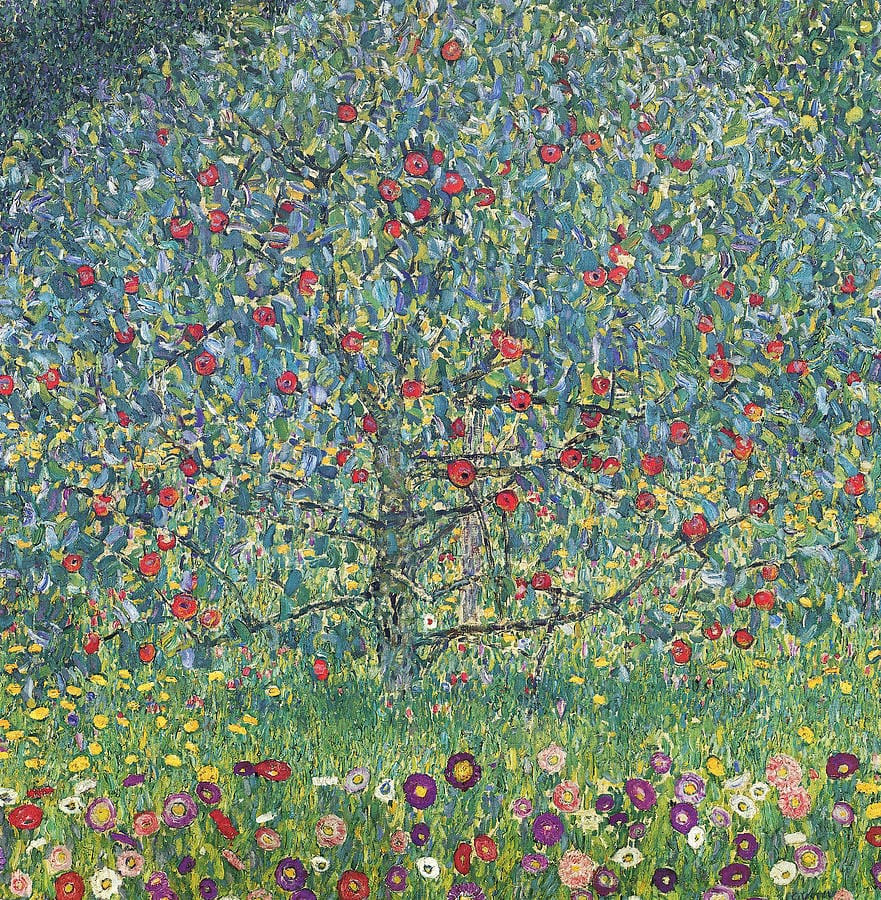
Alphonse Mucha (1860–1939) invented the look most people picture. In December 1894 he was the only designer available over the Christmas holiday when Sarah Bernhardt needed a poster for her play Gismonda; the finished sheet — a life-size figure, a halo-like arch, hand-drawn lettering — went up on Paris walls on New Year’s Day 1895 and made him famous inside a week.
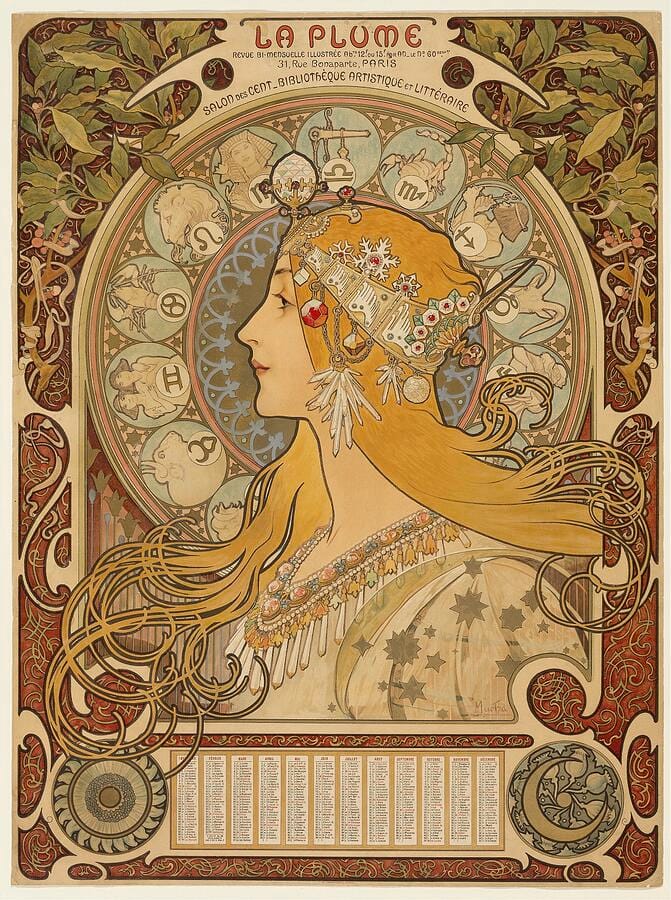
Gustav Klimt (1862–1918) led the Vienna Secession, founded in 1897 by artists who walked out of the city’s conservative artists’ association. Its building carried the motto To every age its art, to art its freedom. Klimt’s golden portraits belong to Art Nouveau’s Austrian branch, where the curve is disciplined by squares and mosaic.
Hector Guimard (1867–1942) gave Paris its Métro entrances; Louis Comfort Tiffany (1848–1933) gave New York iridescent Favrile glass and the leaded lampshade; René Lalique (1860–1945) put dragonflies and orchids into jewelry, in horn and glass where others used diamonds; Antoni Gaudí (1852–1926) built Casa Batlló and began the Sagrada Família; and Charles Rennie Mackintosh (1868–1928) took the same instincts the opposite way, toward long verticals and near-empty white rooms.
Working alongside them in Montmartre, Henri de Toulouse-Lautrec was doing something sharper and flatter, which is why his Moulin Rouge sheets are so often filed here too.
How to spot Art Nouveau
Seven markers. The first is the one that decides it.
- The whiplash line. A long asymmetrical curve that gathers speed and then snaps back on itself, drawn from stems, tendrils and hair. If the dominant line is a lazy S with a sting in it, you are in Art Nouveau.
- Plants and insects, stylized. Lily, iris, orchid, poppy, wisteria, thistle; dragonfly, peacock, swan. Always simplified into pattern, never botanical illustration.
- Flat color inside a firm contour. Areas of unmodelled color bounded by a dark drawn line — a habit taken straight from Japanese woodblock prints.
- Asymmetry. The composition balances, but the two halves are never the same.
- Lettering as ornament. Type is hand-drawn to fit the picture, stretched and curved into the design rather than set beside it.
- The woman with the flowing hair. A single idealized female figure, usually in profile or three-quarter view, framed by an arc or a halo disc.
- Muted, chalky color. Sage, ochre, dusty rose, olive, peacock blue, gold. Rarely a primary, almost never a pure white.
One structural tell: the ornament grows out of the object rather than being applied to it. If the banister is the vine, rather than having vines carved on it, that is the real signature.
What Art Nouveau left behind
The style was buried quickly and thoroughly. Between the wars it was treated as decadent, over-decorated and slightly embarrassing; Guimard’s Métro entrances were dismantled by the dozen, and Mucha spent his last decades painting nationalist history that nobody wanted. He died in 1939, shortly after being interrogated by the Gestapo.
The recovery began in the 1960s. Museum retrospectives put the posters back in front of designers, and the San Francisco concert-poster artists — Wes Wilson, Victor Moscoso, Stanley Mouse and Alton Kelley — lifted the vocabulary wholesale: hand-drawn lettering squeezed to fit the frame, long-haired figures, borders that grow out of the image. The psychedelic poster is Art Nouveau at 1967 saturation, and it is why the style now reads as youthful rather than antique.
What survives is a way of thinking as much as a look: ornament should be structural, lettering is drawing, a poster is worth designing as carefully as a building. Art Nouveau also hangs unusually well, because it was made in poster proportions — tall, narrow, meant to be read from across a street. That suits the awkward vertical wall beside a door or at the top of a stair.
Where does Art Nouveau stop and Art Deco start? Short version: Art Nouveau curves, Art Deco does not. Long version: Art Deco vs Art Nouveau.
Frequently asked questions
What is Art Nouveau in simple terms?
Art Nouveau is a decorative style from around 1890 to 1910 based on flowing curves taken from plants and insects. It was applied to everything — buildings, furniture, glass, jewelry, posters and typefaces — with the aim of designing a whole environment in one consistent manner rather than decorating objects after the fact.
When did Art Nouveau start and end?
It emerged around 1890, with Victor Horta’s Hôtel Tassel in Brussels (1893) usually cited as the first complete building in the style, and it took its name from Siegfried Bing’s Paris gallery, opened in December 1895. It peaked at the Paris Exposition Universelle of 1900 and was largely finished by 1910.
What is the difference between Art Nouveau and Art Deco?
Art Nouveau (c. 1890–1910) is built on asymmetrical organic curves drawn from nature, in muted colors, made by hand. Art Deco (c. 1910–1939) is built on symmetrical straight-edged geometry — chevrons, zigzags, stepped forms — in high-contrast color, designed for machine production. Curved and organic versus straight and geometric.
Who were the most famous Art Nouveau artists?
Alphonse Mucha for posters, Gustav Klimt for painting, Hector Guimard and Victor Horta for architecture, Antoni Gaudí in Barcelona, Louis Comfort Tiffany for glass, René Lalique for jewelry, Émile Gallé for furniture and glass, and Charles Rennie Mackintosh in Glasgow.
What is the whiplash line?
The whiplash line is Art Nouveau’s signature form: a long asymmetrical curve, derived from a plant stem or a strand of hair, that gathers momentum and then snaps back on itself. It appears in wrought iron, in poster borders, in furniture legs and in the hair of Mucha’s figures, and it is the single most reliable way to identify the style.
Why did Art Nouveau end?
It was expensive by design. Every element was drawn and made by hand, which made it impossible to scale and vulnerable to the economics of the First World War. Taste also turned: by the 1910s the organic curve looked sentimental beside the machine-age straight line, and Art Deco took its place.
Art Nouveau was made for reproduction — the poster was its native form — so it prints better than almost any other movement. Browse Art Nouveau prints, or go straight to Alphonse Mucha and Gustav Klimt. Available as framed, canvas, framed prints and art. For the movement that fed it, see What Is Ukiyo-e?