Art Deco vs Art Nouveau
One curves and one doesn’t. The full difference between the two styles either side of the First World War — motifs, colors, dates and how to date a piece.
Art Nouveau (c. 1890–1910) is curved, organic and hand-made: whiplash lines, stems, tendrils and long-haired women drawn from nature. Art Deco (c. 1920–1939) is straight, geometric and machine-made: chevrons, sunbursts, ziggurats and chrome. Nouveau came before the First World War, Deco after it. If it curves, it is Nouveau.
The difference in one line, and the war in between
Art Nouveau curves; Art Deco does not. That single test settles the great majority of cases, because the two styles disagree at the level of the line itself. Nouveau’s line is the “whiplash” — an asymmetric, accelerating curve copied from a plant stem or a wave. Deco’s line is a straight edge set at an angle: the chevron, the zigzag, the stepped ziggurat, the fan of a sunburst.
They are also separated by a war. Art Nouveau is the style of the 1890s and 1900s, peaking at the Paris Exposition Universelle of 1900 and effectively finished by 1914. Art Deco belongs to the 1920s and 1930s. The four years between them changed what modern was supposed to look like: after industrial mechanised war, hand-drawn tendrils looked like a fairy tale, and speed, metal and geometry looked like the future.
Both names arrived sideways. Art Nouveau was borrowed from Siegfried Bing’s Paris gallery, the Maison de l’Art Nouveau, which opened in 1895. Art Deco is a back-formation from the 1925 Exposition Internationale des Arts Décoratifs et Industriels Modernes in Paris, but the phrase was not in general use until the 1960s revival — nobody working in 1928 said they were doing Art Deco. They said moderne.
Art Deco vs Art Nouveau at a glance
| Art Nouveau | Art Deco | |
|---|---|---|
| Dates | c. 1890–1910 | c. 1920–1939 |
| Line | Curved, asymmetric, the “whiplash” | Straight, angular, symmetrical |
| Drawn from | Plants, insects, waves, the female figure | Machines, ocean liners, skyscrapers, Egypt, Cubism |
| Signature motifs | Lilies, irises, vines, peacocks, dragonflies, loose hair | Chevrons, sunbursts, ziggurats, zigzags, speed lines |
| Color | Muted and earthy — olive, mustard, lilac, sage, gold | High contrast — black, cream, jade, coral, chrome, gold |
| Materials | Wrought iron, stained glass, carved wood, ceramic | Chrome, Bakelite, lacquer, ebony, steel, mirror |
| How it was made | Craft — one at a time, by hand | Industry — designed for machine production |
| Lettering | Hand-drawn, organic, uneven | Geometric sans-serifs — Broadway, Cassandre’s Bifur |
| Buildings | Paris Métro entrances, Casa Batlló, Hôtel Tassel | Chrysler Building, Empire State Building, Miami Beach |
| Other names | Jugendstil, Secession, Modernisme, Stile Liberty | Style Moderne, Streamline Moderne, Zigzag Moderne |
| Named after | Siegfried Bing’s Paris gallery, 1895 | The 1925 Paris Exposition — retroactively, in the 1960s |
The most reliable rows for dating an unsigned object are materials and how it was made. Chrome and Bakelite did not exist as decorative materials in 1900; hand-beaten copper and leaded glass had largely stopped being economic by 1930.
Art Nouveau: nature, drawn by hand
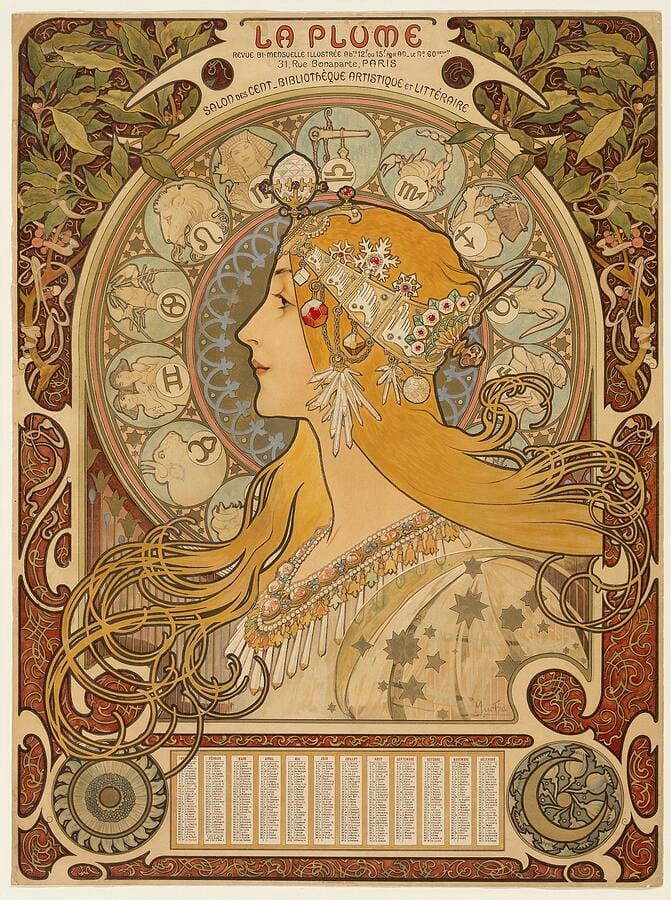
Art Nouveau was the first international style consciously designed to be new — to break with the historical revivals that had filled the nineteenth century. Its answer to “what should modern ornament look like?” was: look at plants. Structure, growth, tendril, bud.
It was also a total style, applied at every scale at once. Hector Guimard’s cast-iron Paris Métro entrances (1900) grow out of the pavement like green stalks. Victor Horta’s Hôtel Tassel in Brussels (1893) runs the same curve through the banister, the mosaic floor and the wall stencil. Gaudí’s Casa Batlló in Barcelona (1904–06) has almost no straight lines in it. Tiffany did it in glass, Lalique in jewelry, Beardsley in ink.
In posters it belongs above all to Alphonse Mucha, whose 1894 poster for Sarah Bernhardt made him famous overnight and fixed the format: a tall narrow panel, a woman with impossible quantities of hair, a decorative arch behind her head, muted colors, and lettering drawn by the same hand that drew the flowers. Browse Mucha and Art Nouveau prints.
Art Deco: geometry, made by machine
Art Deco kept Art Nouveau’s ambition — decorate everything, from a cigarette case to a skyscraper — and inverted its vocabulary. Where Nouveau looked at a lily, Deco looked at a turbine, a liner’s prow, a Cubist canvas and the newly opened tomb of Tutankhamun. The result is symmetrical, hard-edged, and confident about mass production in a way the Arts-and-Crafts-descended Nouveau never was.
Three things to look for. First, the stepped setback: forms that climb in tiers like a ziggurat, from the Chrysler Building’s crown down to a mantel clock. Second, radiating fans — sunbursts over doorways, in mirrors, in wrought-iron gates. Third, speed: from about 1930 the style rounds its corners and grows horizontal parallel lines, a sub-style usually called Streamline Moderne.
Its great graphic figures are A. M. Cassandre, whose travel posters for the Normandie and the Nord Express reduce a ship or a locomotive to a few flat geometric masses, and Erté, who ran the same geometry through fashion illustration. In painting the closest equivalent is Tamara de Lempicka, whose sitters look machined out of chrome and satin. Browse Art Deco prints and framed Deco.
How to tell them apart at a glance
Work down this list. Most objects resolve on the first or second item.
- Trace the outline with your finger. Continuous asymmetric curve, Nouveau. Straight runs meeting at angles, Deco.
- Find the ornament and ask where it grew. A stem, a petal, an insect wing, a wave: Nouveau. A ray, a step, a zigzag, a repeated triangle: Deco.
- Look at symmetry. Nouveau ornament is deliberately off-balance. Deco is almost always mirrored about a center line.
- Look at the metal. Wrought iron, hammered copper, patinated bronze: Nouveau. Polished chrome, nickel, stainless steel: Deco.
- Read the lettering. If the type curls and varies like handwriting, Nouveau. If the letters are built from circles and straight strokes of even weight, Deco.
- Look at the woman. Both styles are full of them. Nouveau’s has loose hair, a long gown and a dreamy expression; Deco’s has a bob, a hard silhouette and somewhere to be.
One honest overlap: the years around 1910–20 produce genuinely mixed objects, and a few designers — René Lalique most famously — worked at a high level in both, moving from naturalistic Nouveau jewelry to geometric Deco glass. A piece with curves and a stepped geometric frame is probably from that transition rather than misattributed.
Frequently asked questions
What is the main difference between Art Deco and Art Nouveau?
Art Nouveau uses flowing, asymmetric curves drawn from nature — stems, tendrils, waves, flowing hair — and was made by hand. Art Deco uses straight lines and geometry — chevrons, sunbursts, stepped ziggurats — and was designed for machine production. In short: if it curves organically it is Art Nouveau, if it is angular and symmetrical it is Art Deco.
Which came first, Art Nouveau or Art Deco?
Art Nouveau came first, running from about 1890 to 1910 and peaking at the Paris Exposition Universelle of 1900. Art Deco followed after the First World War, from about 1920 to 1939, and took its name from the Exposition Internationale des Arts Décoratifs et Industriels Modernes held in Paris in 1925.
Is the Chrysler Building Art Deco or Art Nouveau?
Art Deco. Completed in 1930, it is the defining Art Deco skyscraper: a stepped, radiating stainless-steel crown of overlapping sunburst arches, symmetrical throughout, with eagle gargoyles modeled on Chrysler car ornaments. Its geometry and its industrial metal are both entirely alien to Art Nouveau.
Is Alphonse Mucha Art Nouveau or Art Deco?
Art Nouveau — he is close to its definition. His posters of the 1890s, beginning with the 1894 Sarah Bernhardt poster for Gismonda, established the format most people picture when they hear the term: a tall panel, a woman with elaborate flowing hair, a decorative arch behind her, muted colors and hand-drawn lettering.
Is Art Nouveau the same as Jugendstil?
Yes — Jugendstil is simply the German and Austrian name for Art Nouveau, taken from the Munich magazine Jugend. The same style went by different names across Europe: Secessionsstil in Vienna, Modernisme in Catalonia, Stile Liberty in Italy, and Modern in Russia. The vocabulary of curves and plant forms is common to all of them.
Where does the name Art Deco come from?
From the Exposition Internationale des Arts Décoratifs et Industriels Modernes, held in Paris in 1925. The abbreviation was not used at the time; designers of the 1920s and 1930s called their work moderne. The phrase Art Deco came into general use only with the style’s revival in the 1960s.
The two styles want different walls. Art Nouveau’s muted olive, mustard and lilac sit beautifully in warm, low-lit rooms and in tall narrow spaces — hallways, stairwells, between windows. Art Deco’s black, gold and jade needs contrast and symmetry, and looks best hung as a pair or a matched set. Browse Art Nouveau and Art Deco prints as art, framed prints or canvas prints.