What Is Ukiyo-e?
Japan’s “pictures of the floating world” — how the prints were made, who made them, and how to recognize one across a room.

Ukiyo-e means “pictures of the floating world.” It is a Japanese art form of woodblock prints and paintings made from the 1670s to the end of the nineteenth century, showing kabuki actors, courtesans, landscapes, ghost stories and travel. Hokusai’s Great Wave and Hiroshige’s views of the Tōkaidō road are its most famous works, and it reshaped European art after 1860.
What “the floating world” actually meant
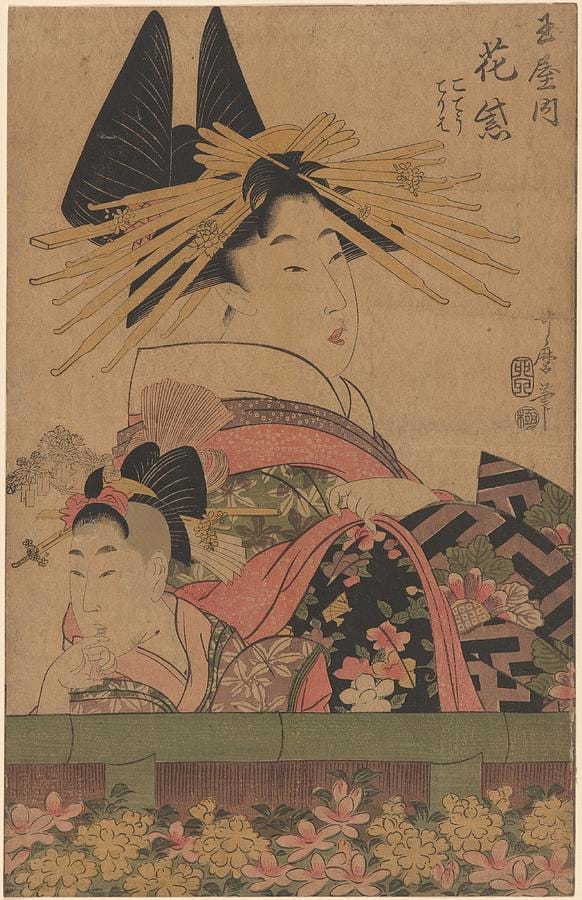
By the eighteenth century Edo — now Tokyo — had something close to a million people and a large, literate merchant class with money and no political power. What it spent that money on was entertainment: the kabuki theaters, the sumo ring, the teahouses and the licensed Yoshiwara pleasure district.
That world had a name. Ukiyo was originally a Buddhist term written with characters meaning “this sorrowful world” — the transient life you were supposed to escape. Writers of the period kept the sound and swapped the first character, so that it now read “the floating world”: the same transience, but embraced rather than renounced. Ukiyo-e is simply “pictures of it.”
The artist usually credited with establishing the single-sheet print is Hishikawa Moronobu, working in the 1670s and 1680s. Early sheets were printed in black ink alone and sometimes colored by hand. Full-color printing — nishiki-e, “brocade pictures” — arrived in 1765 with Suzuki Harunobu, and from then on ukiyo-e is a color medium.
Crucially, these were not luxury objects. They were commercial products, printed in the hundreds, sold cheaply, censored by the government and stamped with a censor’s seal — closer to a magazine cover than to a painting.
How a ukiyo-e print was made
A ukiyo-e print is the work of at least four people, and the one whose name appears on it did the least physical labor.
- The publisher (hanmoto) commissioned the design, paid for the materials, submitted it to the censors and sold the result. He carried the risk and usually chose the subject.
- The artist (eshi) supplied a brush drawing on thin paper. That drawing was destroyed in the process of transferring it to the block.
- The block cutter (horishi) pasted the drawing face down on a cherry-wood block and cut away everything that was not line — including, on a portrait, individual hairs.
- The printer (surishi) inked each block by hand, laid down damp paper and rubbed the back with a baren, once for every color.
The technical breakthrough that made color practical was the kentō: a matching L-shaped notch and straight notch cut into every block, so the printer could drop each sheet into exactly the same position and land impression after impression on top of one another. A complex design might need ten or more blocks and as many passes.
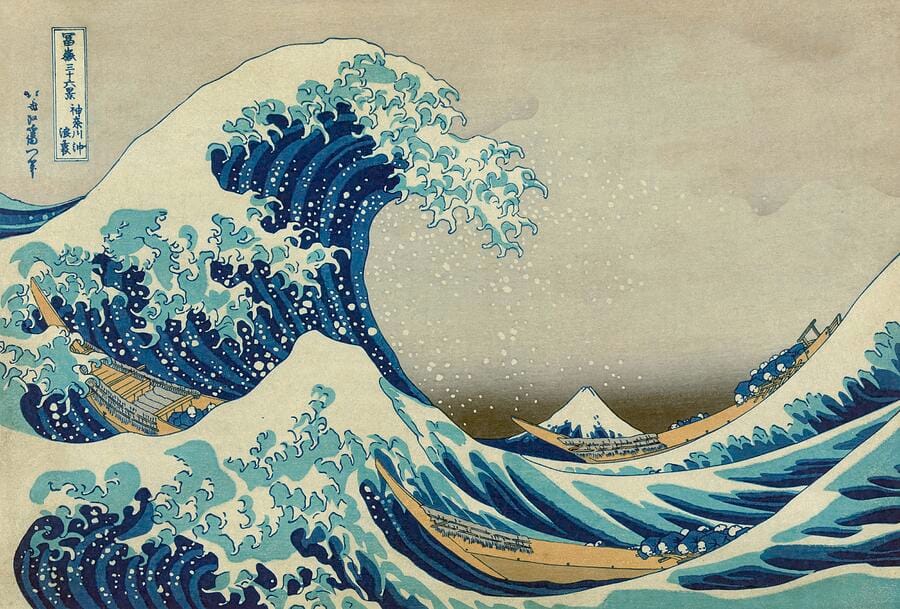
So, no: The Great Wave is not a painting. It is a print made in an edition, and surviving impressions differ from one another because they were pulled from blocks that gradually wore down.
The artists to know
| Artist | Dates | Known for |
|---|---|---|
| Hishikawa Moronobu | c. 1618–1694 | Established the single-sheet printed picture |
| Suzuki Harunobu | 1725–1770 | Full-color printing from 1765; slender, poetic figures |
| Kitagawa Utamaro | c. 1753–1806 | Bijin-ga — studies of beautiful women, often as close-up heads |
| Tōshūsai Sharaku | active 1794–95 | About 140 unsparing actor portraits, made in ten months, then silence |
| Katsushika Hokusai | 1760–1849 | Thirty-six Views of Mount Fuji, including The Great Wave |
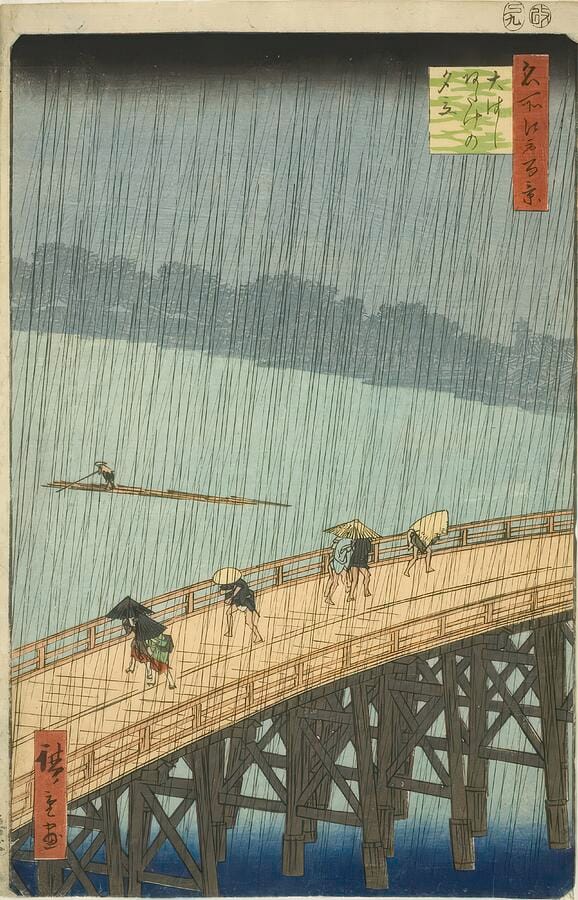
| Utagawa Hiroshige | 1797–1858 | Fifty-three Stations of the Tōkaidō; rain, snow and travel |
| Utagawa Kuniyoshi | 1797–1861 | Warriors, monsters, ghosts — and a great many cats |
Hokusai is the outlier even here. He worked under more than thirty names, published the Thirty-six Views in his seventies, and signed late work as “the old man mad about painting.” The Great Wave is not a tsunami, incidentally: it is a steep offshore swell, with three fast delivery boats beneath it and Mount Fuji sitting small and still in the trough.
How to recognize ukiyo-e
- Flat areas of unmodelled color. Each color is one block, so it prints as an even field. No blending, except for the deliberate graduated wash across a sky.
- A firm black outline. The key block carries the drawing, and every color sits inside it.
- No cast shadows and no modeling. Faces are described by line, not by light.
- Space by overlap and diagonal, not by vanishing point. Recession is handled with high viewpoints, stacked planes and steep diagonals running out of the frame.
- Radical cropping. Figures cut in half by the edge, a bridge entering at one corner, a huge foreground object against a tiny distance.
- Weather drawn as pattern. Rain is straight ruled lines; snow is white dots; water is a repeating scallop.
- Text inside the picture. A title cartouche, the artist’s signature and seal, the publisher’s mark and a censor’s seal, all sitting on the image rather than beside it.
- Prussian blue. The intense blue that dominates prints from about 1829 is an imported European pigment. Its arrival is datable, which makes it a useful clue.
One more: the standard sheet, ōban, is roughly 39 × 26 cm — about 15 × 10 inches. A large ukiyo-e is almost always a diptych or triptych of those sheets rather than one big piece of paper.
Why Western art changed after it arrived
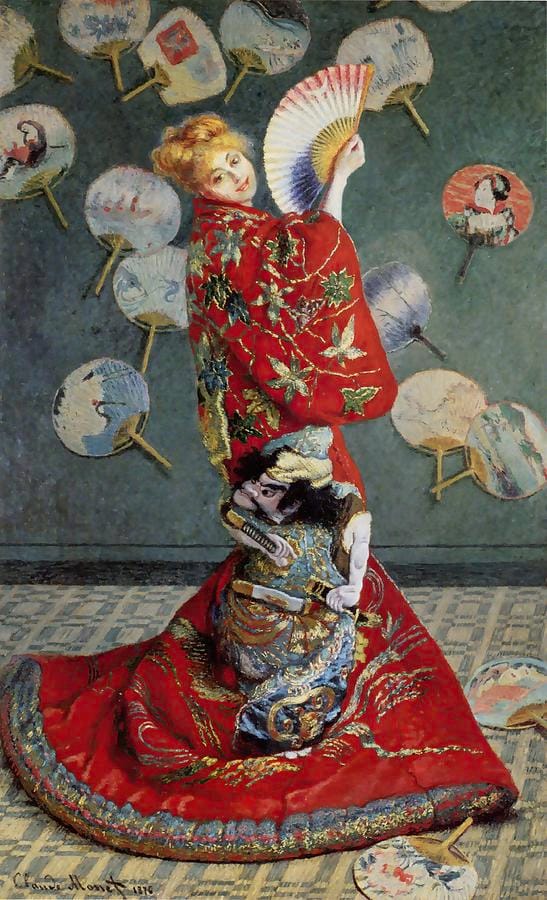
Japan reopened to foreign trade in the 1850s, and by the 1860s ukiyo-e prints were circulating in Paris and London. The Japanese pavilion at the 1867 Exposition Universelle in Paris put them in front of everyone at once, and the fashion that followed acquired its own name: japonisme.
The effect was structural, not decorative. Painters trained in single-point perspective and modeled form suddenly saw pictures that ignored both and worked anyway. What they took was flat color, hard outline, asymmetry, high viewpoints — and the nerve to crop a subject in half.
Degas rebuilt his ballet compositions around it. Whistler took the tonal harmonies. Manet flattened his figures. Van Gogh made painted copies of two Hiroshige prints in 1887. Monet hung his collection at Giverny and built a Japanese footbridge across the pond. Mary Cassatt’s color prints of 1890–91 are essentially ukiyo-e in French clothes, and Toulouse-Lautrec’s posters are unimaginable without it — as is Art Nouveau as a whole.
By then ukiyo-e itself was ending. Photography, imported lithography and the modernising Meiji state pulled the audience away, and by the 1890s the trade had largely collapsed. Its influence, by that point, had emigrated.
Frequently asked questions
What does ukiyo-e mean?
Ukiyo-e means “pictures of the floating world.” Ukiyo was originally a Buddhist term for the sorrowful, transient world; Edo-period writers kept the pronunciation but changed the characters so it read “floating world,” meaning the pleasure districts, theaters and fashions of city life. E simply means picture.
When was ukiyo-e made?
From roughly the 1670s, when Hishikawa Moronobu established the single-sheet print, until the 1890s. Full-color printing began in 1765 with Suzuki Harunobu, and the landscape masterpieces of Hokusai and Hiroshige belong to the 1830s and 1850s. The trade collapsed after Japan modernised in the Meiji period.
How were ukiyo-e prints made?
By four people working together: a publisher who commissioned and sold the design, an artist who supplied the brush drawing, a block cutter who cut a cherry-wood block for the outline and one for each color, and a printer who pressed damp paper onto each block in turn by hand. Matching kentō notches on every block kept the colors in register.
Who is the most famous ukiyo-e artist?
Katsushika Hokusai (1760–1849), because of The Great Wave, one of the most reproduced images in the world. Utagawa Hiroshige is his closest rival and was the more influential landscape artist in Europe; Kitagawa Utamaro is the best known for figures rather than landscape.
Is The Great Wave a painting or a print?
A print. It is a color woodblock print from Hokusai’s series Thirty-six Views of Mount Fuji, published around 1831, and it was produced in a commercial edition — thousands of impressions were pulled over the years. Surviving impressions vary because the blocks wore down as they were used.
How did ukiyo-e influence Western art?
Japanese prints reached Europe in the 1860s and gave painters an alternative to Renaissance perspective: flat color, strong outline, asymmetric composition, high viewpoints and bold cropping. Degas, Manet, Whistler, Monet, Van Gogh, Cassatt and Toulouse-Lautrec all absorbed it, and the whole of Art Nouveau follows from it.
Ukiyo-e was designed for reproduction from the start, which makes it one of the few historic art forms that loses nothing as a print. Browse ukiyo-e and Japanese woodblock prints, or go to Hokusai and Hiroshige directly — available as art, canvas, framed prints and framed prints.