Winslow Homer’s Ten Most Famous Paintings
Schoolyards, shipwrecks and the open Atlantic: ten paintings by the self-taught New Englander who became America’s greatest realist.

Winslow Homer (1836–1910) began as a jobbing illustrator. Apprenticed to a Boston lithographer and then freelancing for Harper’s Weekly, he was sent to the front during the Civil War and spent months among the Army of the Potomac, drawing soldiers waiting, cooking, sharpshooting and going home. He taught himself to paint more or less on the side, and the habits of the illustrator never left him: he thought in strong shapes, told a story with one figure, and cut a scene off wherever the meaning stopped.
After the war he painted the American summer — croquet on a lawn, boys let out of school, girls in white dresses on a hillside — before a stay in an English fishing village in the early 1880s turned him toward the sea and the people who worked it. He settled at Prouts Neck on the coast of Maine, where he lived plainly and largely alone, painting the Atlantic in winter and traveling to the Caribbean and Florida for light and color. By the time he died he was widely regarded as the finest painter America had produced. Here are ten of his most famous works.
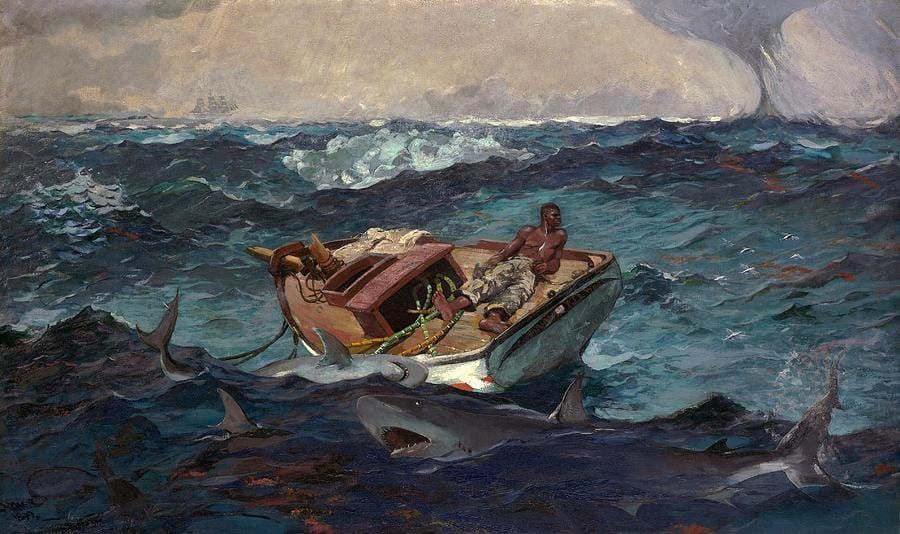
The Gulf Stream
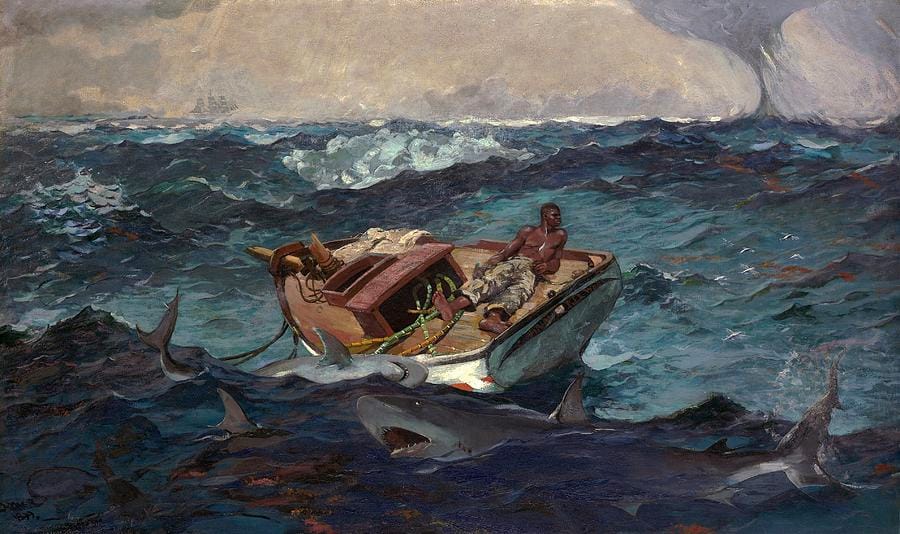
A Black sailor lies on the deck of a dismasted sloop, looking away from us toward nothing, while sharks circle the boat and a waterspout twists across the horizon. Homer finished The Gulf Stream in 1899 after several winters in the Bahamas and Florida, and the picture was so bleak that it did not sell. When buyers complained, he reworked it and added the faint sail of a distant ship at the far left — a rescue that may or may not arrive — and dryly told his dealer to reassure the ladies that the man would be saved. The Metropolitan Museum bought it in 1906, and it is now his most famous painting.
Snap the Whip
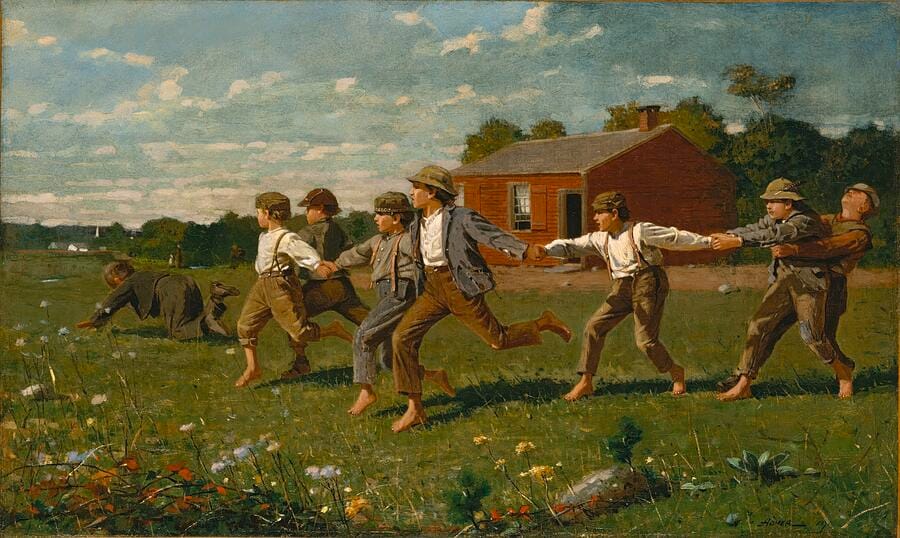
A line of barefoot boys in a summer meadow has joined hands to run the old playground game in which the chain whips round and flings the end of it off its feet — which is exactly what has just happened to the two sprawling in the grass at the left of the canvas. Behind them stands a one-room red schoolhouse. Painted in 1872, it is the most beloved of the pictures Homer made about country childhood, and it carried a real charge at the time: seven years after the Civil War, an image of American boys pulling together and just barely holding the line was not read as innocently as it looks now. He painted the subject twice.
The Veteran in a New Field
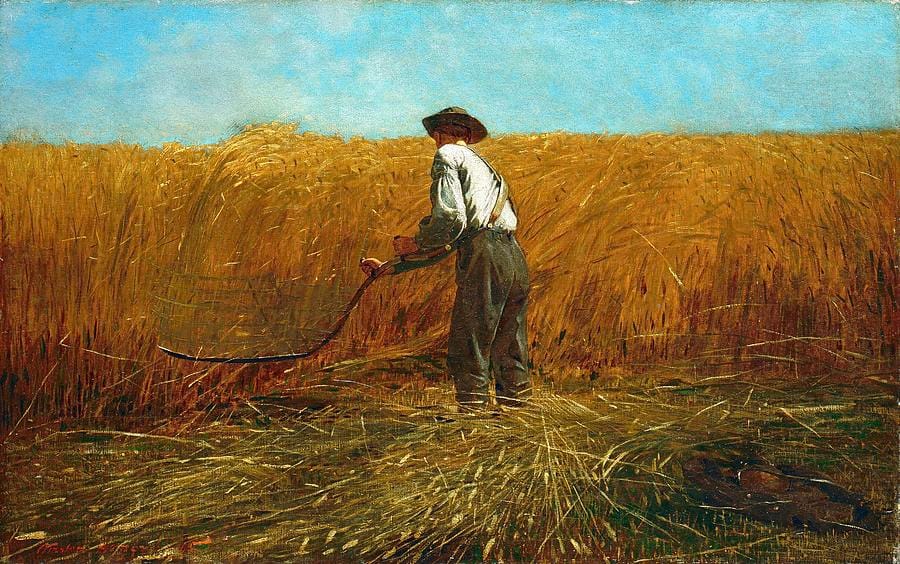
A man swings a scythe through a wall of ripe wheat, his back to us, in a field that fills nearly the whole canvas. His army jacket and canteen lie discarded in the lower right corner: he is a Union soldier gone home to the harvest in 1865, the year the war ended. X-rays have shown that Homer first painted a modern two-handled cradle scythe and then painted it out in favour of a single old-fashioned blade — the tool of the Grim Reaper. What looks at first like a picture of peaceful labor turns out to be a picture about how many men that harvest was missing.
Croquet Scene
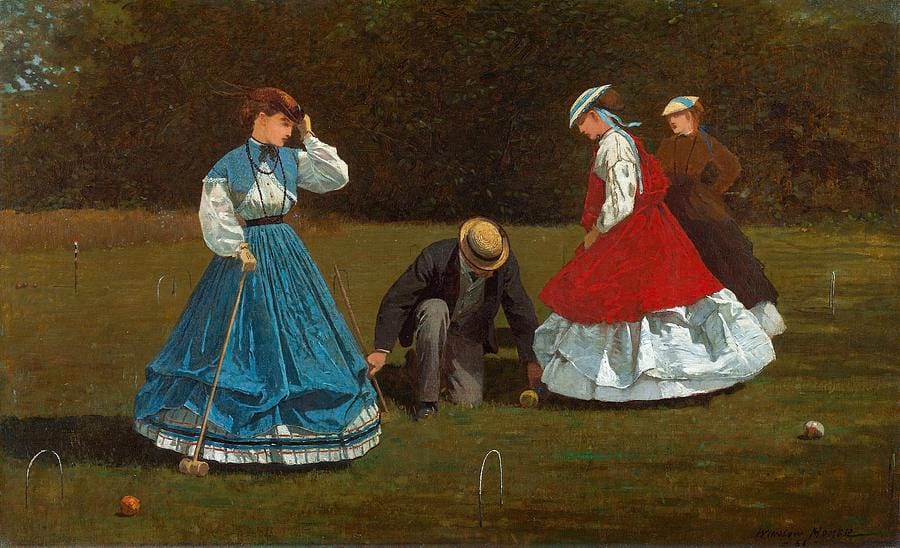
Three women in enormous hooped skirts of blue, red and white stand about on a green lawn in the late afternoon while a man in a straw boater crouches to set a ball for one of them. Painted in 1866, when croquet was the fashionable new game and one of the few that respectable men and women could play together, it is a small masterpiece of color: those three dresses do the work of a whole composition. Homer made a short series of croquet pictures in these years, and they capture, with very little fuss, the particular flirtatious idleness of an American summer just after the war.
A Visit from the Old Mistress
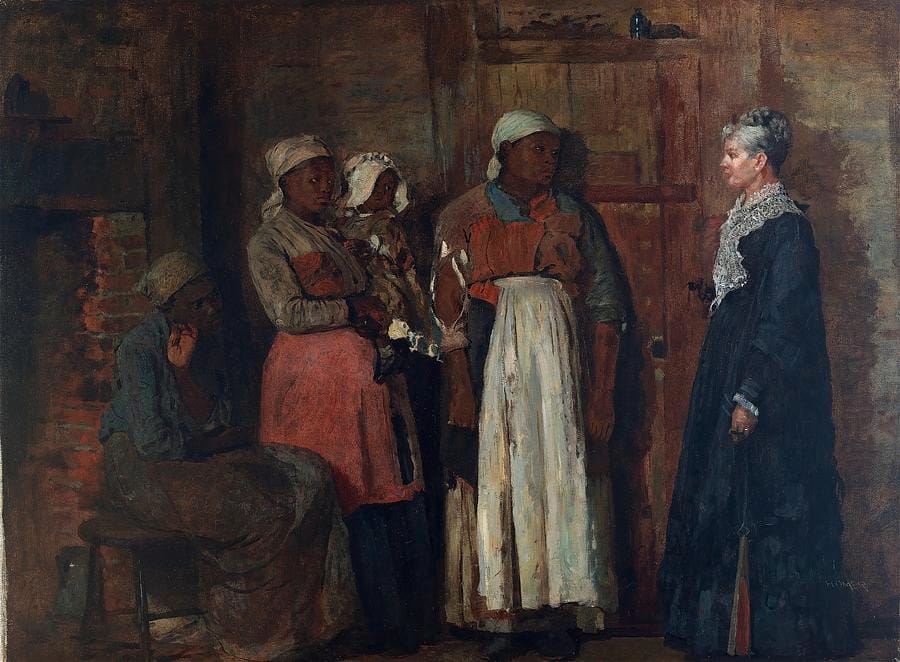
In the doorway of a plain cabin, a group of formerly enslaved women — one of them holding a baby, another seated in the shadows — face the white woman who once owned them. Nobody speaks; nobody yields ground; the two parties confront each other across a few feet of dirt floor with the frank, unresolved wariness of people whose relationship has just been legally rewritten. Homer painted it in 1876, having returned to Virginia a decade after the war, and he arranged the figures deliberately like the two sides in his earlier Civil War picture of captured Confederates. It is one of the very few American paintings of Reconstruction that refuses to take a comfortable position.
Dressing for the Carnival
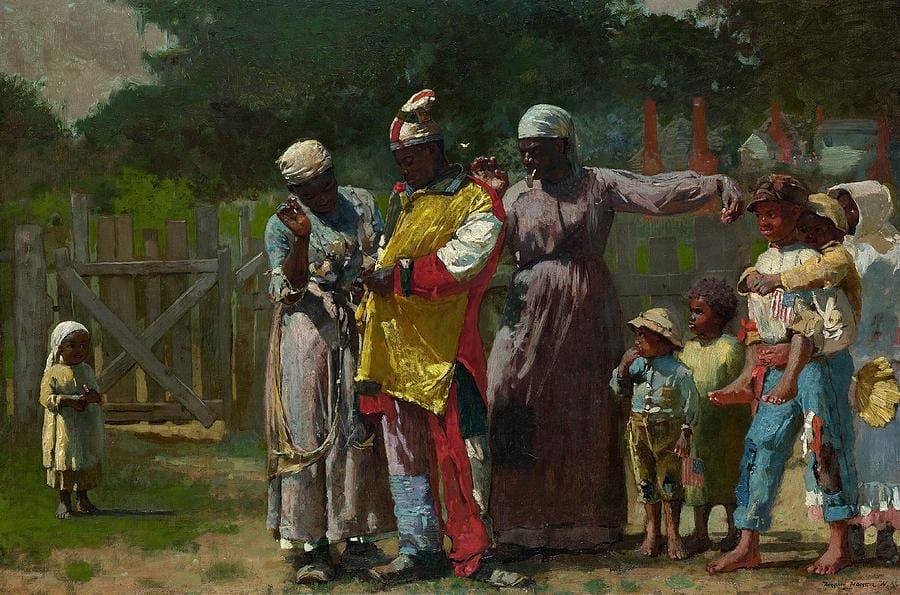
Two women stitch a man into a brilliant yellow-and-red costume trimmed with fluttering strips of cloth, while a group of children gathers at the fence to watch and two of the smallest hold up American flags. The costume belongs to a Christmas-season masquerade with roots in West Africa that survived among Black communities in the American South, and Homer, who saw such celebrations in Virginia, painted this version in 1877. It is one of the brightest canvases he ever made, and one of the most respectful: the figures are individuals, absorbed in a real occasion, painted with the same seriousness he gave to fishermen and soldiers.
The Life Line
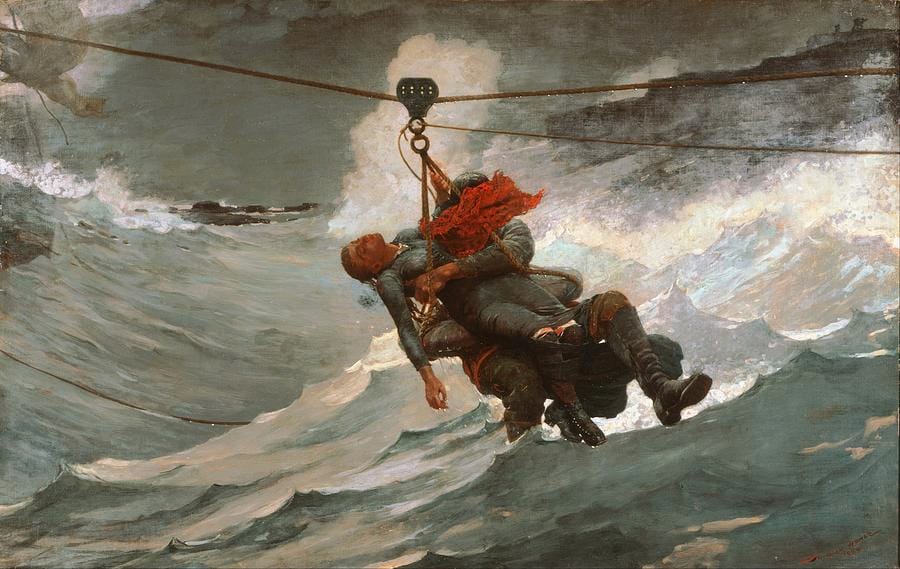
Slung from a rope stretched between a wrecked ship and the shore, a rescuer carries an unconscious woman across a boiling sea in a breeches buoy. Her red scarf has blown across his face, hiding it completely, so that the man becomes anonymous and the drama belongs entirely to her limp body and the water below. Homer painted it in 1884, shortly after settling in Maine, having watched lifesaving crews at work and studied the new rescue apparatus closely. Exhibited in New York, it sold on the first day, restored his finances, and announced the great sea painter of his last twenty-five years.
Summer Night
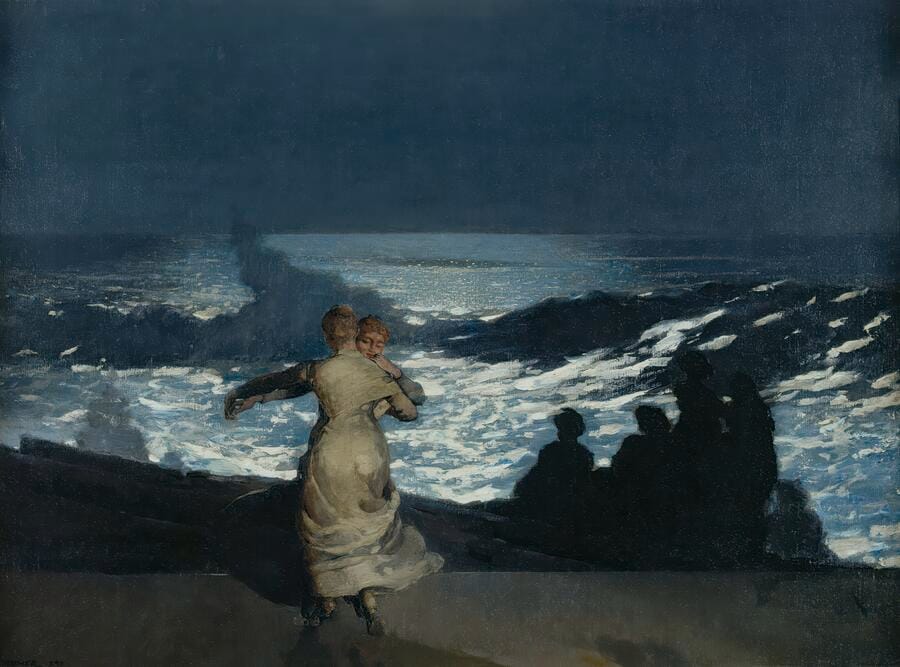
Two women dance together on a dark terrace above the sea while a group of silhouetted figures sits watching the moonlit surf break below. Painted at Prouts Neck around 1890, it is Homer’s most lyrical night picture and his least literal — the dancers are barely described, lit from an unseen source, and the whole left half of the canvas is given over to white water under a black sky. The French state bought it out of the great Paris exhibition of 1900, and it has remained in a Paris museum ever since — a rare honor for an American painter of his generation.
Northeaster
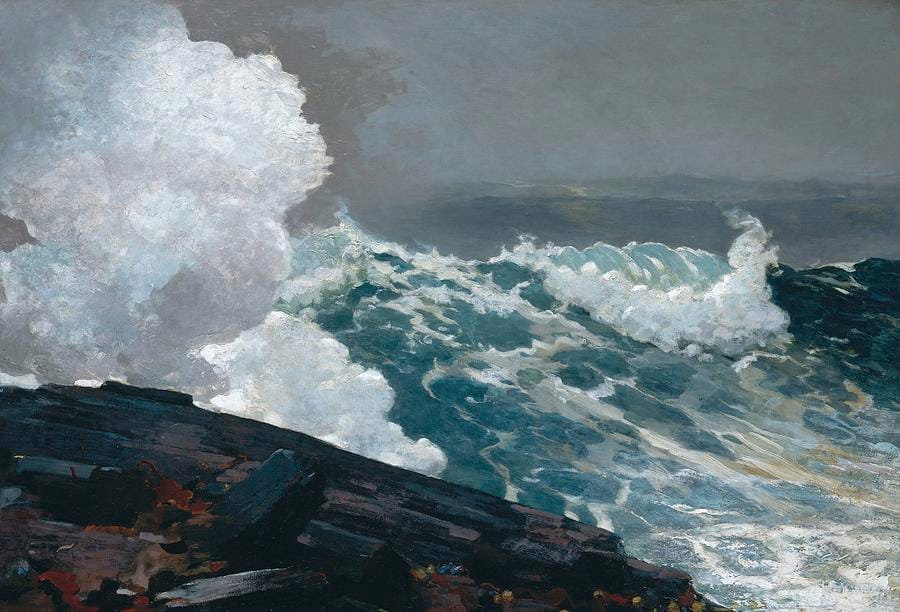
A heavy sea slams into the rocks below Homer’s studio and throws up a plume of spray that fills the upper right of the canvas; the water in the trough is a dense green-black, and the sky behind is the color of wet slate. There is no boat, no figure and no incident — just the weight of moving water, painted by a man who had watched this exact stretch of Maine coast in storm for a dozen years. He first exhibited it in 1895 with two figures on the rocks, then painted them out, and the picture became far stronger for having nothing human in it at all.
Right and Left
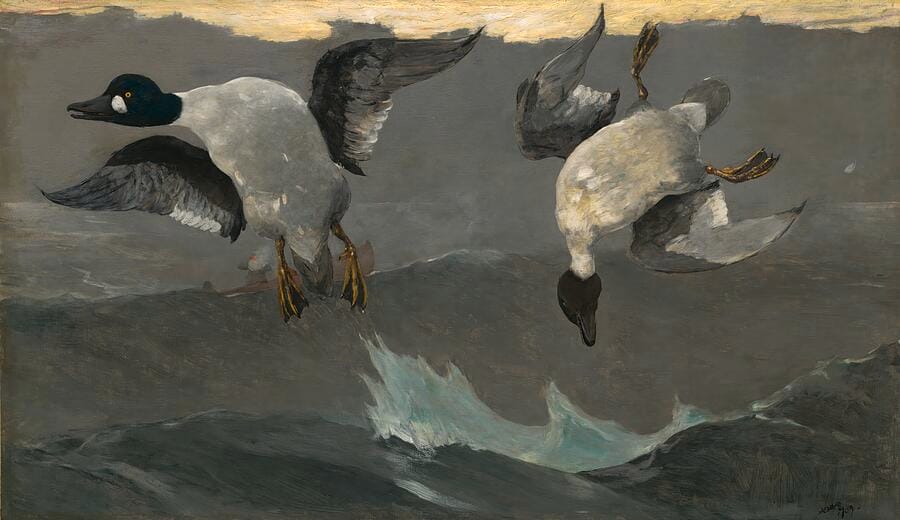
Two goldeneye ducks fill the canvas at eye level: one has just been hit and is dropping, the other is still climbing with its wings spread. In the trough of the wave behind them, almost invisible, sits a small boat with a hunter and the orange flash of his second barrel. The title is a shooting term for taking two birds with two shots. Painted in 1909, the year before his death, it is Homer’s last great picture and his most radical — the viewer occupies the position of the birds, and the painting asks us to be shot at rather than to watch.
Homer never explained his pictures and rarely gave interviews, which suits work this direct. Whether it is a schoolyard in July or the North Atlantic in February, the appeal is the same: honest observation, superb design, and a complete absence of sentimentality. Few artists look better on a wall you pass every day.
Shop Winslow Homer prints here, and explore the rest of our famous paintings collection for more of the world’s most beloved masterpieces.