William-Adolphe Bouguereau’s Ten Most Famous Paintings
Goddesses, angels, and barefoot peasant children, painted with unearthly polish: the ten works that define the great academic master.

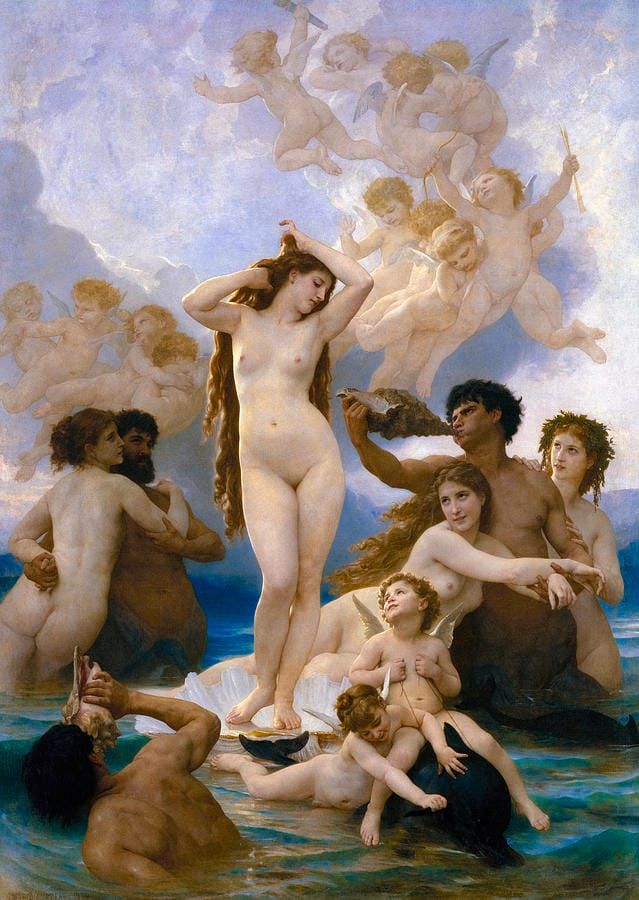
William-Adolphe Bouguereau (1825–1905) was, for most of his lifetime, the most admired painter in France. Born in La Rochelle to a family of wine and olive-oil merchants, he won the Prix de Rome in 1850, spent four years studying the Italian masters, and returned to build a career of almost unbroken triumph — medals, commissions, a professorship, and prices that few living artists could match. He completed more than eight hundred finished paintings, nearly all of them built around the human figure.
His technique was so smooth that the brushwork all but vanishes, and the young Impressionists made him their favorite target; Degas and his circle coined the sneer “Bouguereauté” for that glassy academic finish. After his death his reputation collapsed almost entirely, and it took until the 1970s and 1980s for museums and collectors to look at him again. What they found was a draftsman of extraordinary command and a picture-maker of real tenderness. Here are ten of his most famous works.
The Birth of Venus
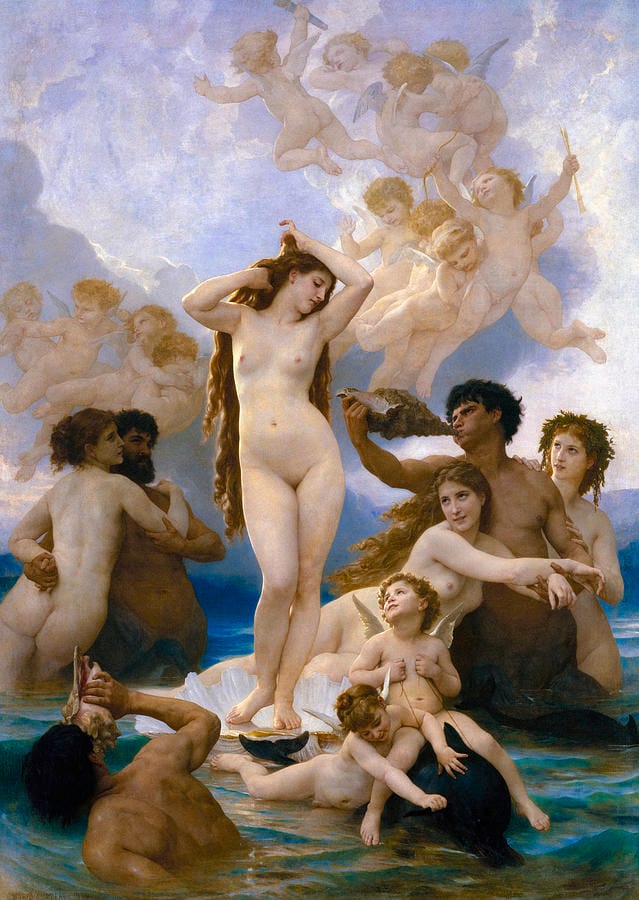
Bouguereau’s best-known painting, finished in 1879 and now in the Musée d’Orsay, shows Venus newly risen from the sea, standing on a scallop shell with her hair falling to her ankles while nereids, tritons, and a swarm of putti wheel around her. The pose is borrowed knowingly from classical sculpture, and the whole composition is an open salute to Botticelli and Raphael. It was an immediate sensation at the Salon. Nothing in it is accidental — the spiral of bodies, the pearly sky, the impossibly even light — and its confidence is exactly what its critics could not forgive.
The Song of the Angels
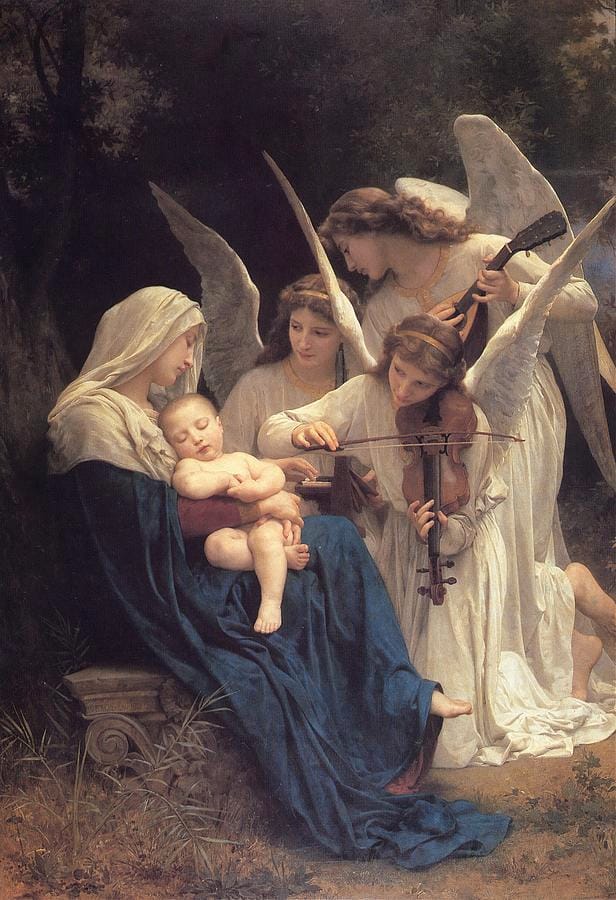
Three winged angels lean in over the Virgin and the sleeping Christ Child, one drawing a bow across a violin while the others hold lutes. Painted in 1881, it has hung for decades in a museum collection in Glendale, California, and it may be the most widely reproduced religious image of the nineteenth century. The picture succeeds on a simple idea: the music is a lullaby, the baby has already gone under, and the mother’s whole attention is on the small sleeping body in her lap. Bouguereau keeps the palette to deep blue, ivory, and the dark green of the wood behind, so nothing distracts from the hush.
The Abduction of Psyche
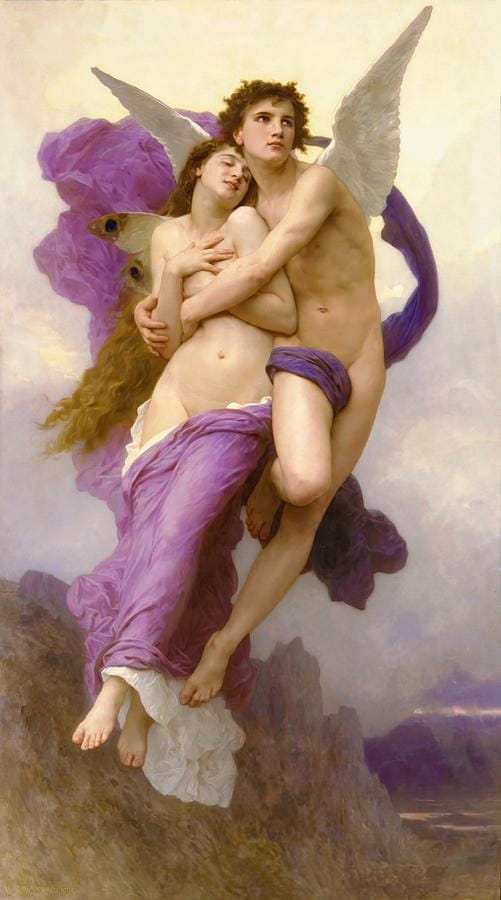
Cupid carries the swooning Psyche up into a pale gold sky, her body arched backward, her small butterfly wings just visible behind her shoulder and a violet cloak streaming away beneath them. Painted in 1895, late in Bouguereau’s life, it is the most airborne picture he ever made — the two figures are entirely unsupported, and the eye reads them as rising rather than falling only because of the direction of the drapery. The story comes from Apuleius by way of countless painters before him, but the vertical, weightless design is Bouguereau’s own invention.
Le Jour des Morts (All Souls’ Day)
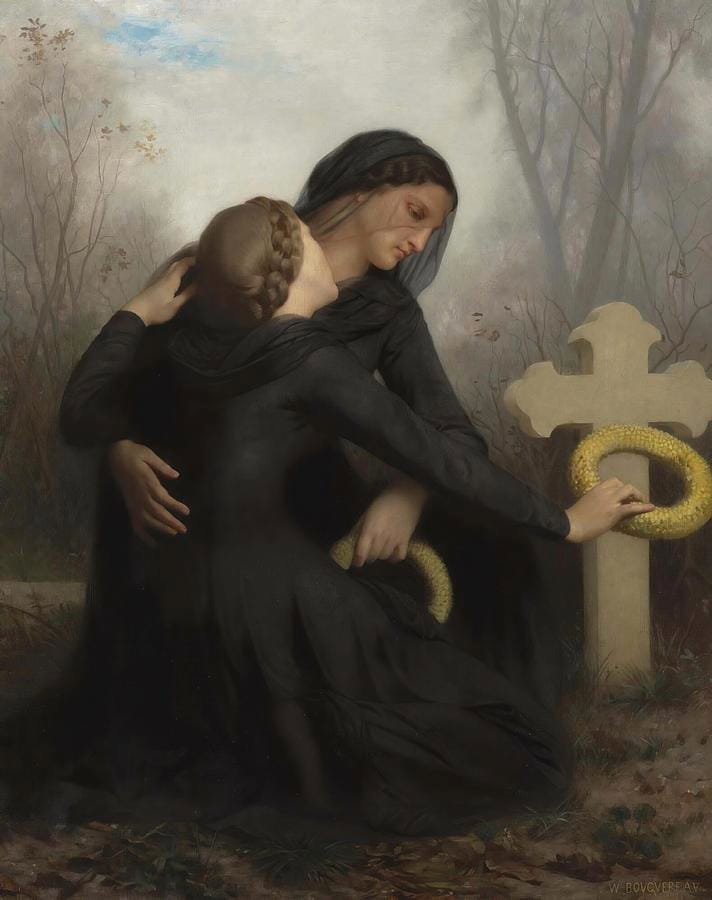
Two women in deep mourning kneel at a plain stone cross on the second of November, the day the French traditionally visit their family graves. The elder reaches out to settle a wreath of yellow immortelles against the arm of the cross while the younger collapses into her shoulder, her face hidden completely. Bouguereau painted it in 1859, early in his career, and grief was never an abstraction for him — he would go on to lose his wife and four of his children. Against the pale, misted autumn wood the two black figures read almost as one shape, which is the entire meaning of the picture.
Evening Mood
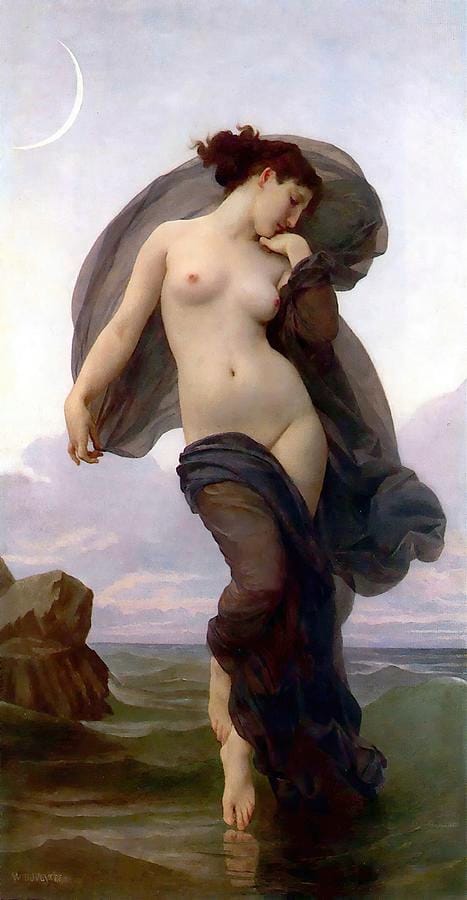
A young woman stands at the edge of the sea under a thin crescent moon, a length of dark drapery lifting behind her like a sail. Painted in 1882, it is one of Bouguereau’s allegories of the times of day, and the coolest picture in his catalog — a pale bruised sky, green shallow water, and skin lit by the last of the light rather than by the studio. The wind in the cloth gives the figure its movement, and the almost empty shoreline gives the picture a stillness he rarely allowed himself.
The Nut Gatherers
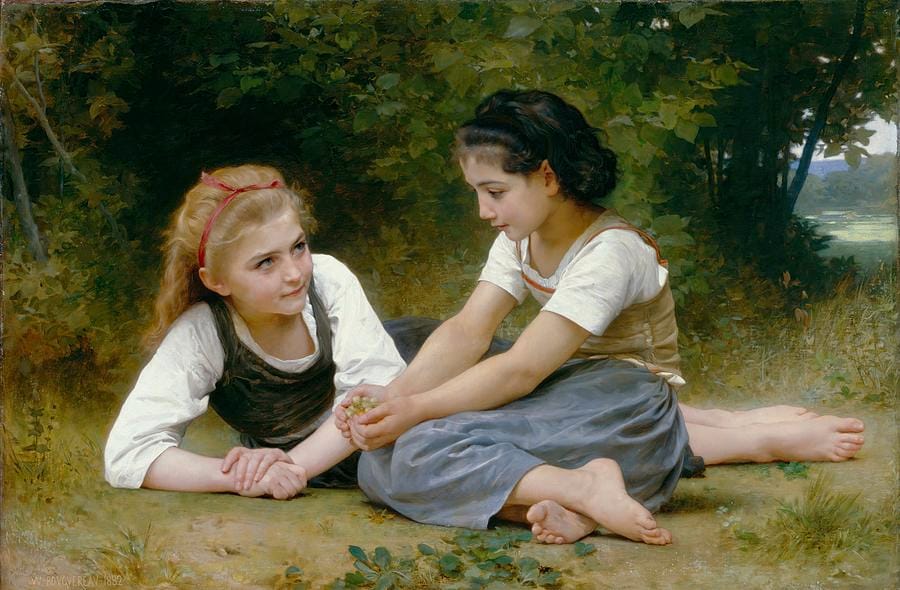
Two barefoot girls lie in the grass at the edge of a wood, one propped on her elbow, the other cross-legged, sharing a handful of hazelnuts and a private joke. Painted in 1882 and now in the Detroit Institute of Arts, it is the friendliest of all Bouguereau’s peasant subjects and one of the most beloved paintings in that museum. He painted rural children throughout his career, always clean, always composed, and always slightly idealized — but the easy physical comfort between these two, the way their limbs overlap in the grass, feels genuinely observed.
The Elder Sister
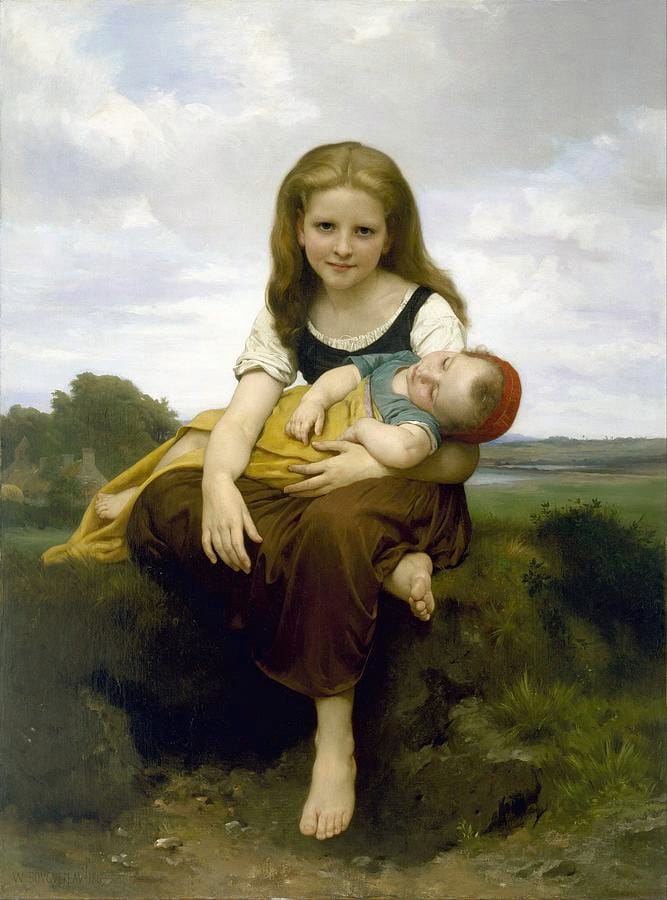
A girl of perhaps ten sits on a bank with her baby brother asleep across her lap, holding him steady with the practiced grip of someone who does this every day. Painted around 1869 and now in Houston, it is one of the earliest and best of the many pictures Bouguereau built around this arrangement. The models are traditionally identified as two of the painter’s own children, which may account for the unforced expression on the girl’s face. Behind them the ground drops away to a wide plain and a bank of cloud, giving a domestic subject the scale of a landscape.
L’Innocence
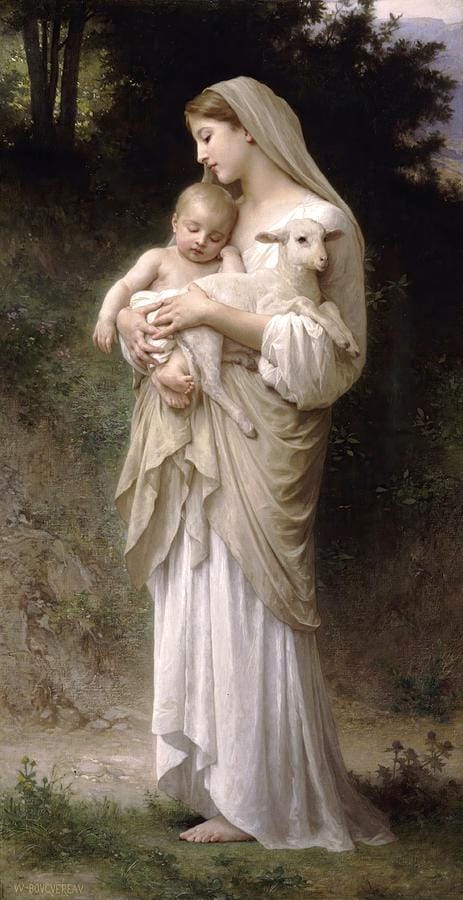
A young mother in white stands at the edge of a wood carrying two burdens at once: a sleeping infant on one arm and a lamb on the other. Painted in 1893, it makes its meaning through the oldest symbolism available — the lamb and the child as twin emblems of innocence, and the woman’s downcast eyes as the guardian of both. The picture is nearly monochrome, a column of white and ivory against dark trees, and the technical feat is that Bouguereau keeps a dozen shades of white legible without letting the figure dissolve into the drapery.
The Bathers
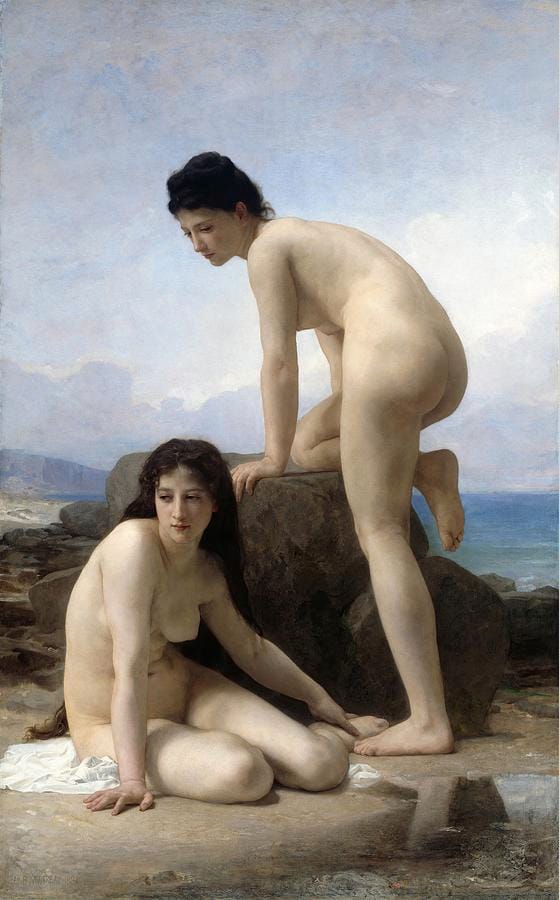
Two young women pause on the rocks at the water’s edge. One stands and steps down from a boulder, bent forward with a hand on the stone for balance; the other sits below her on a spread white cloth with her knees drawn up, glancing back over her shoulder. Painted in 1884, it belongs to the Art Institute of Chicago. Bouguereau exhibited it at the Salon at the height of his fame, and it distills his method: no story, no allegory, just two figures, sunlight, stone, and sea, arranged so that every contour answers another.
The First Mourning
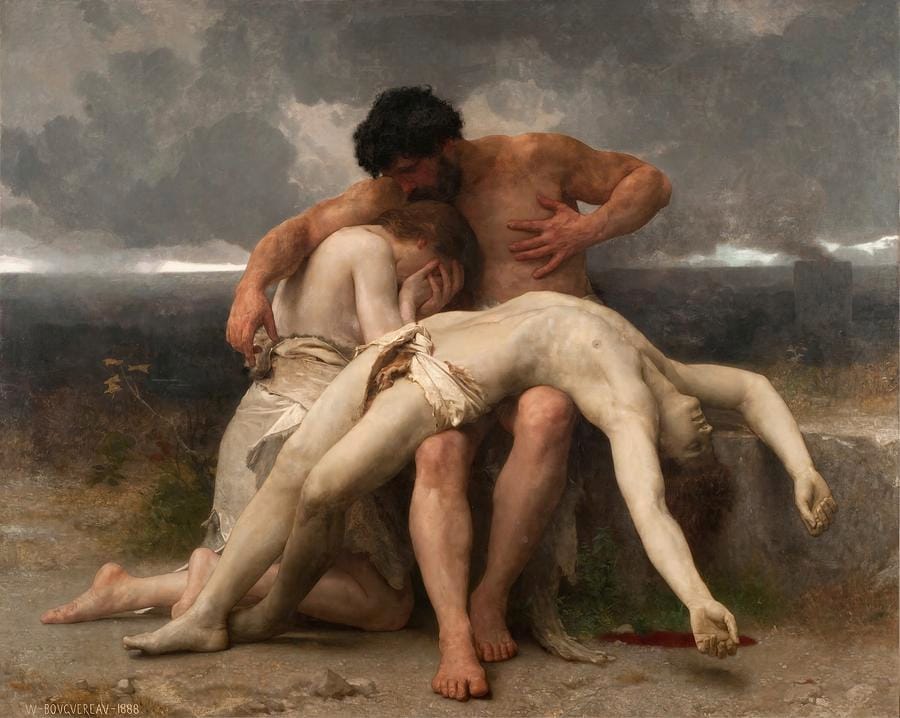
Adam and Eve huddle on a bare stone slab under a heavy gray sky with the body of their son Abel across Adam’s knees — the first death, and the first grief, in the biblical account. Painted in 1888 and now in Buenos Aires, it is the darkest and most unsparing picture Bouguereau ever made. Eve has collapsed against her husband with her face hidden, and Adam bows his head over her hair, so that neither parent’s face is visible at all. For a painter who built his career on faces, withholding both is a startling decision, and it is what gives the picture its force.
For a century Bouguereau was dismissed as everything modern art had left behind. Seen without that argument attached, his paintings are simply extraordinary objects — luminous, patient, and made with a level of craft that has become almost unrepeatable. They bring warmth and a sense of occasion to a room, and they hold up close, which is more than most decoration manages.
Shop William-Adolphe Bouguereau prints here, and explore the rest of our famous paintings collection for more of the world’s most beloved masterpieces.