Vincent Van Gogh’s Ten Most Famous Paintings
Starry Night, Sunflowers, Café Terrace and more: the ten paintings that made Van Gogh the most beloved post-Impressionist.

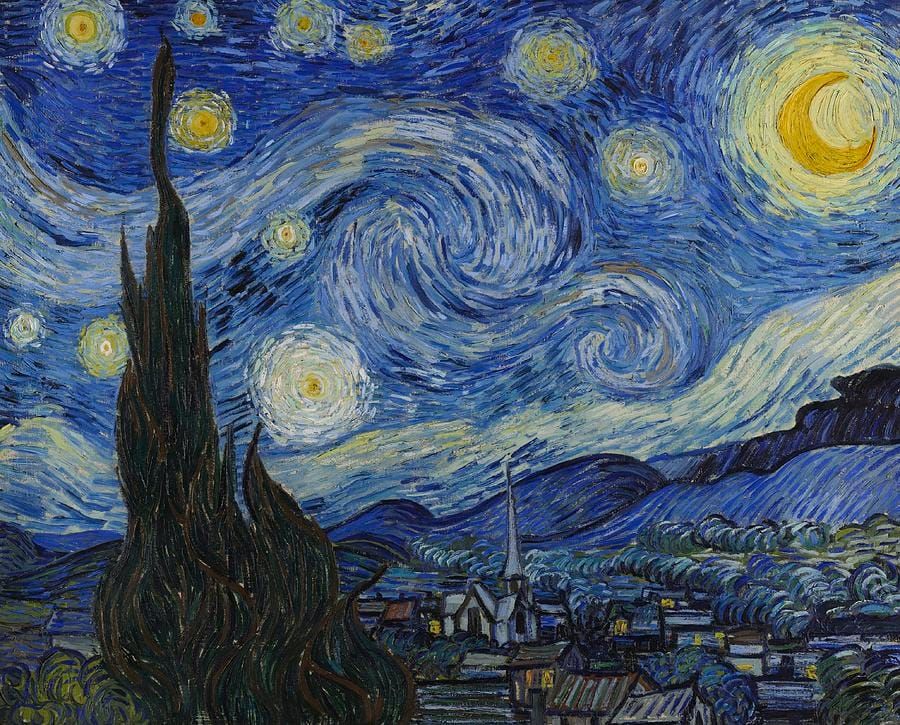
Vincent van Gogh (1853–1890) painted for barely a decade. He came to art late, after failing as an art dealer, a teacher, and a lay preacher in a Belgian mining district, and he was dead at thirty-seven. In those ten years he produced roughly 2,100 works, including some 860 oil paintings — most of them in the last two, at a pace that is difficult to comprehend.
His early canvases were dark, thick, and earthbound, painted among Dutch peasants. Then he moved to Paris, met the Impressionists, and discovered color; and when he went south to Arles in 1888 the light of Provence did the rest. The late work — sunflowers, wheat fields, night skies, his own worn face — pairs violent brushwork with a tenderness toward ordinary things that has made him the most widely loved painter who ever lived. Here are ten of his most famous paintings.
The Starry Night (1889)
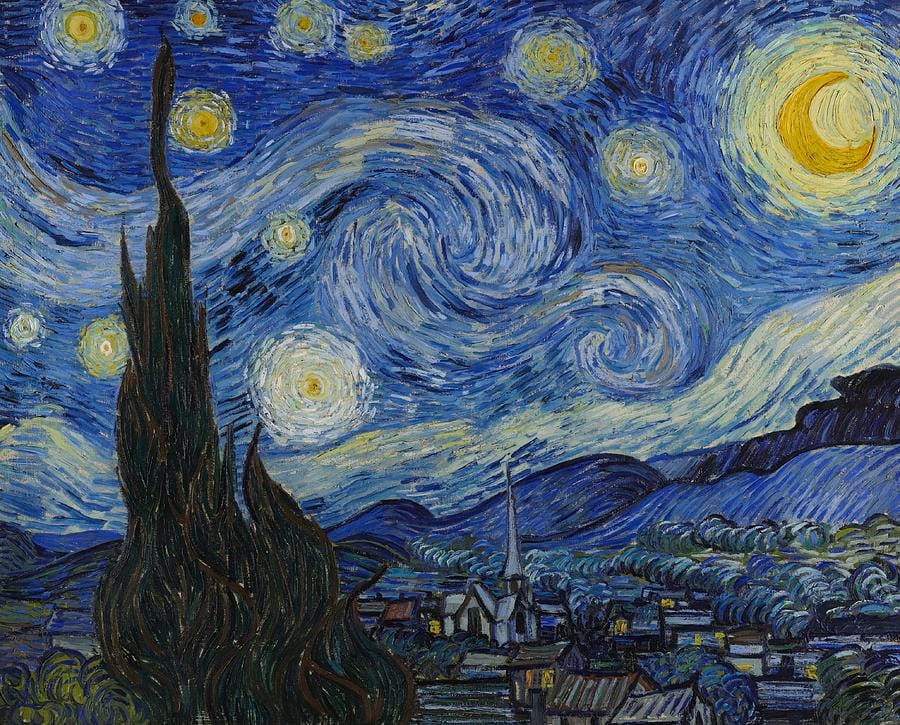
Van Gogh painted The Starry Night in June 1889 from a room in the asylum at Saint-Rémy-de-Provence, where he had admitted himself after the breakdown in Arles. The view from his barred window gave him the hills and the morning star; the cypress in the foreground and the little village with its church spire he added from memory and imagination. The sky is the thing — eleven stars and a crescent moon set in great rolling coils of blue and yellow that sweep across the canvas like weather or water. He thought the picture a failure. It is now one of the most recognized images on earth.
Sunflowers (1888)
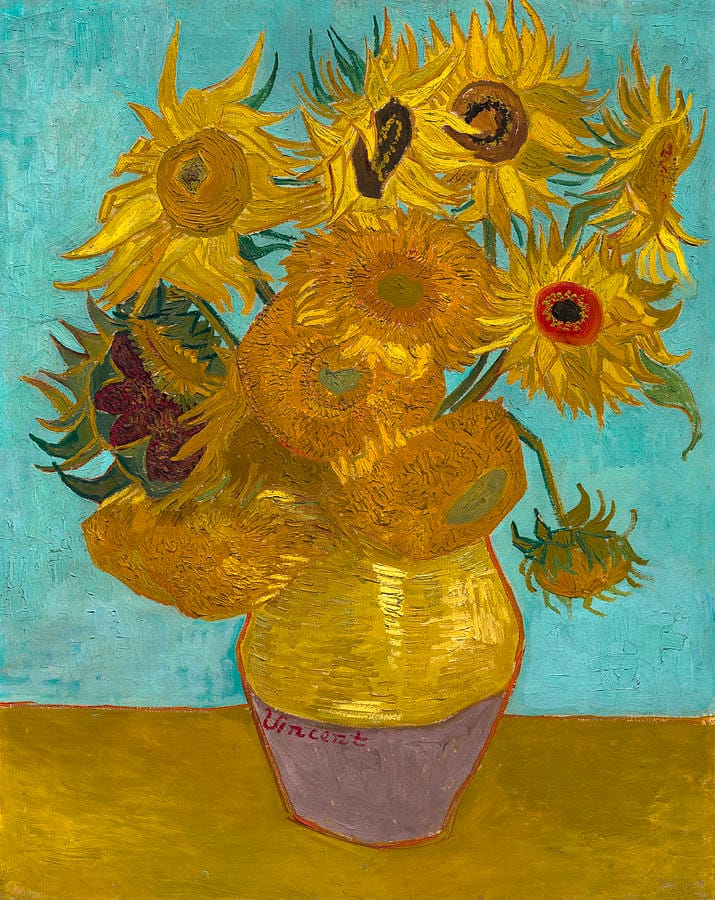
In August 1888 Van Gogh was expecting Paul Gauguin in Arles and decorated the guest bedroom of the Yellow House with a series of sunflower canvases, painting fast because the flowers were wilting as he worked. He used the newly available chrome yellows to set yellow blooms against a yellow background in a wall of color that should not work and completely does. The blossoms range from fresh and heavy-headed to shriveled and gone to seed. Van Gogh regarded the sunflower as his own signature motif, a symbol of gratitude, and these paintings became the emblem of everything people love in his work.
Irises (1889)
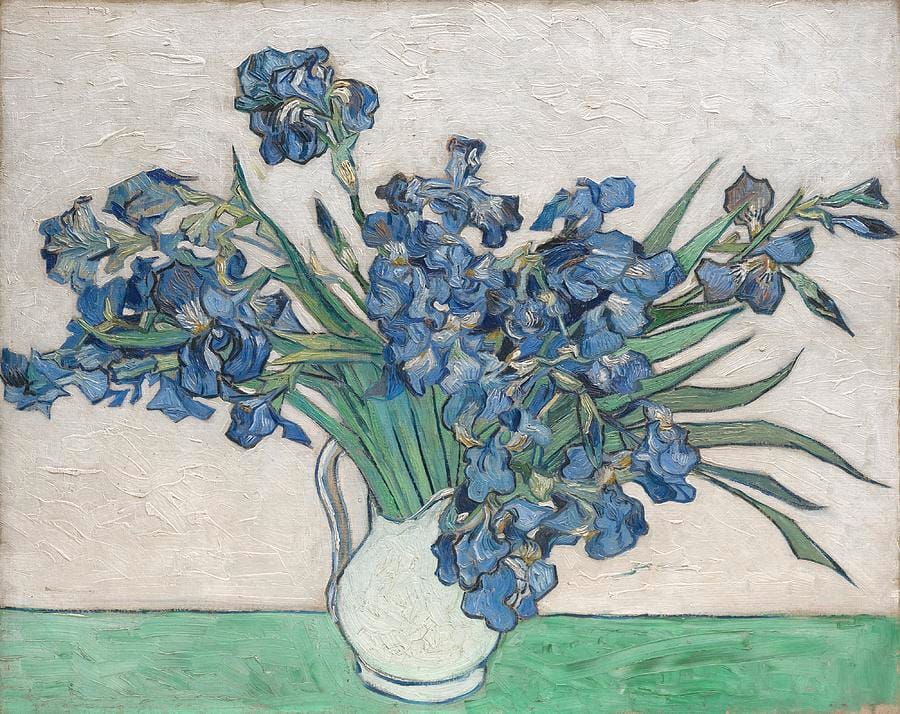
Painted in May 1889 during his first week at the Saint-Rémy asylum, before the worst of that year’s illness returned, Irises shows a bed of blue-violet flowers in the institution’s walled garden, crowded to the edges of the canvas with a single white bloom standing apart at the left. Van Gogh called painting “the lightning conductor for my illness,” and there is nothing troubled in this picture — only close, patient attention to the curl of each petal and leaf, with the drawing owing much to the Japanese prints he collected. His brother Theo submitted it to the Salon des Indépendants that autumn.
The Potato Eaters (1885)
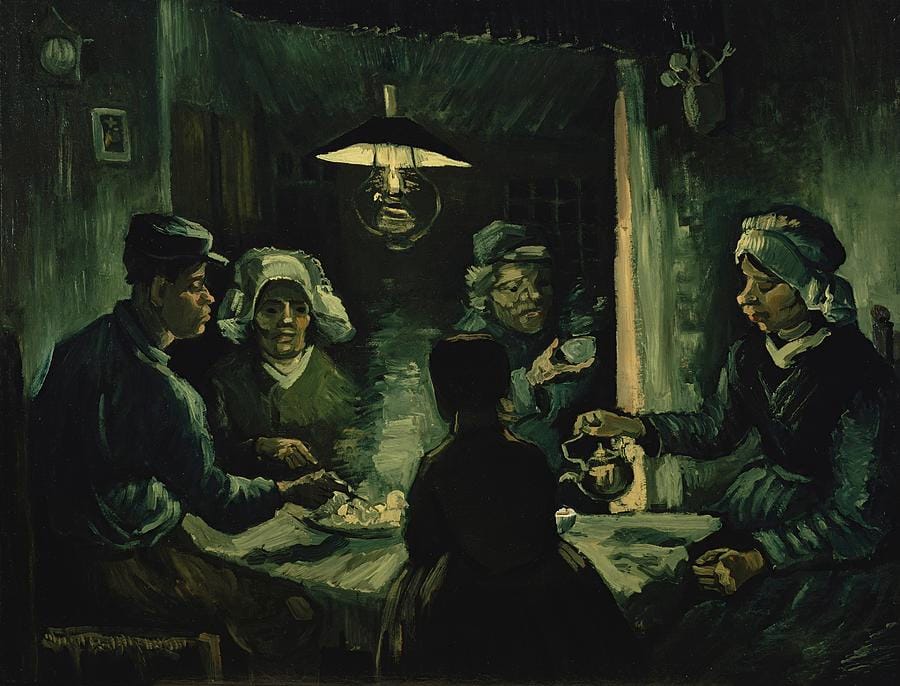
The Potato Eaters, finished in 1885 while Van Gogh was living in the Dutch village of Nuenen, was his first attempt at a major picture and for years he considered it his best. Five peasants sit around a rough table under a single oil lamp, sharing a dish of potatoes, their faces and hands knotted and heavy. He wanted the viewer to understand that these were the same hands that had dug the food from the earth, and he deliberately painted in the color of “a really dusty potato.” It is a world away from the Provençal blaze to come, and it explains everything about what he was after.
Café Terrace at Night (1888)
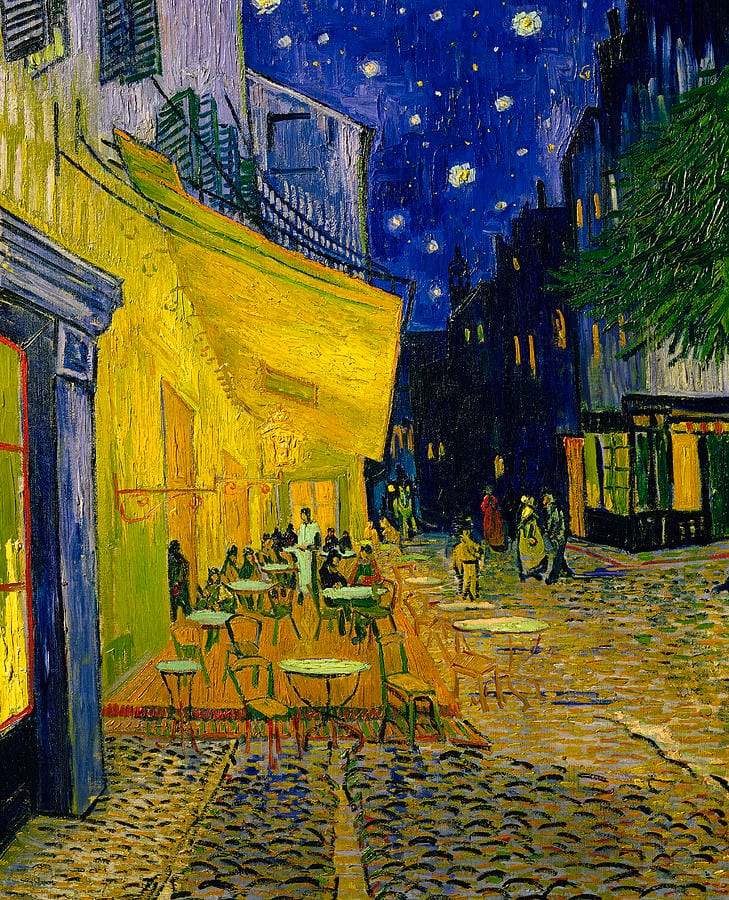
Painted on the Place du Forum in Arles in September 1888, this is the first of Van Gogh’s great night pictures and he made it outdoors, at night, working under gaslight. A café terrace glows acid yellow beneath its awning, waiters and drinkers scattered across the cobbles, while above the rooftops the sky is deep blue and pricked with stars. He was proud that he had managed a night scene without using any black at all. “The night is more alive and more richly colored than the day,” he wrote to his sister — a claim this painting more or less proves.
Wheatfield with Crows (1890)
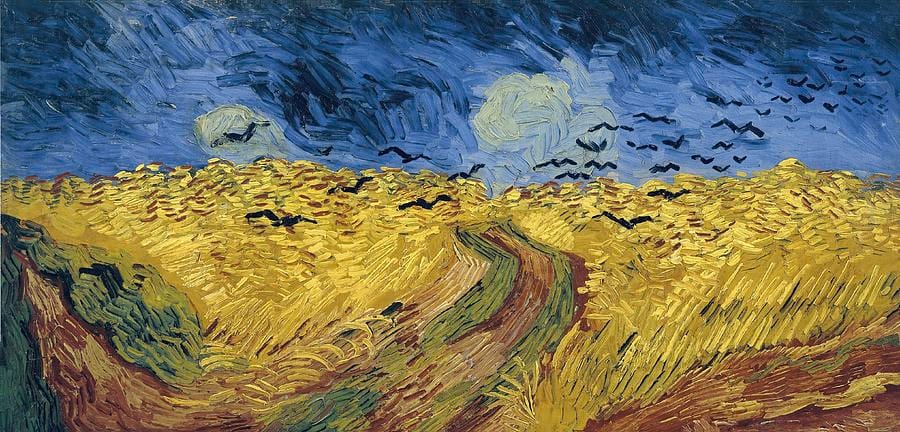
Made in July 1890 at Auvers-sur-Oise in the last weeks of his life, Wheatfield with Crows is his most argued-over painting. A double-square canvas holds a churning gold wheat field beneath a heavy blue-black sky, with a flock of crows scattering across it and three paths that lead nowhere in particular. It is often read as a suicide note in paint, though it was not his final work and he described the wheat fields of that summer as expressing “sadness, extreme loneliness” but also “the health and restorative forces that I see in the country.” Both things are visibly true of it.
The Sower (1888)
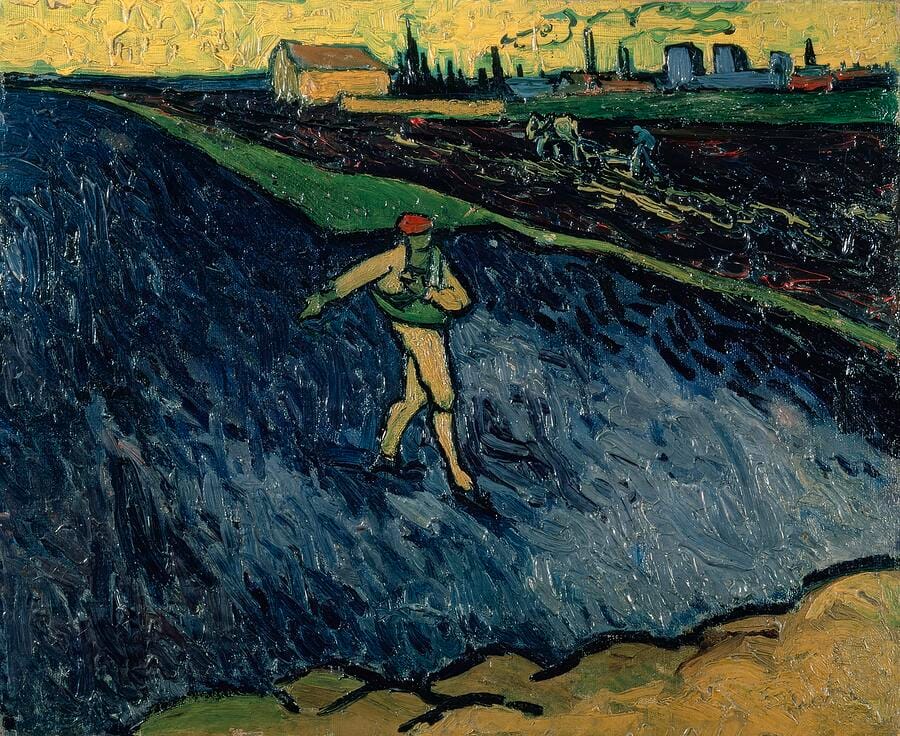
Van Gogh returned to the figure of the sower throughout his career, borrowing it from Jean-François Millet, whom he revered. This Arles version from 1888 pushes the borrowed motif into something entirely his own: an enormous yellow sun sits directly behind the sower’s head like a halo, the plowed field runs in violet furrows across the foreground, and the whole picture is built from two complementary colors pitched against each other at full strength. The sower himself is a dark, striding silhouette. For Van Gogh the subject was frankly religious — the labor of sowing standing in for hope, renewal, and the possibility of a harvest.
The Yellow House (1888)
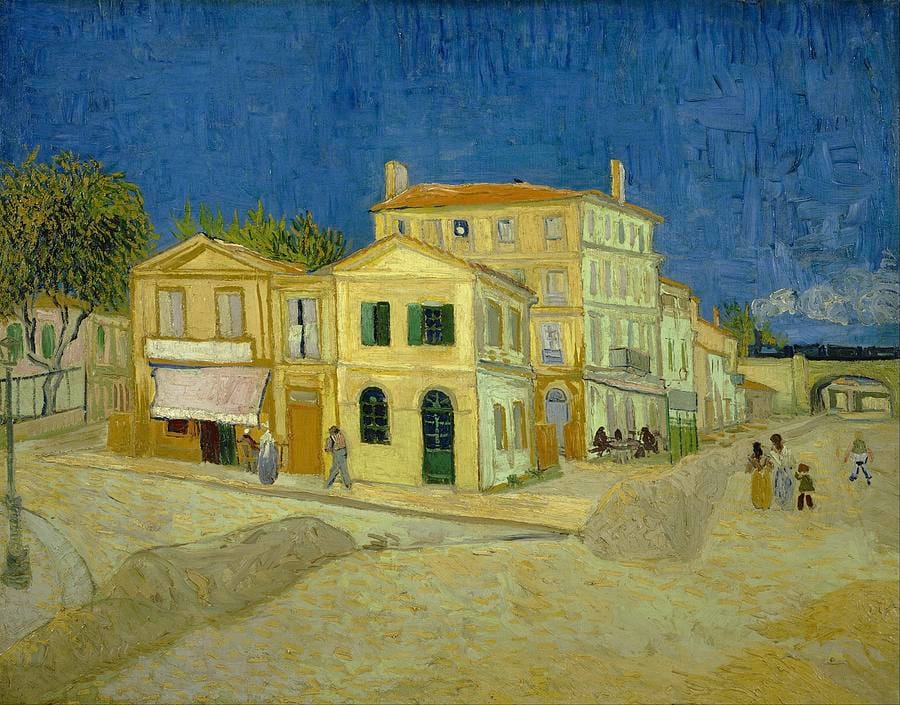
In May 1888 Van Gogh rented four rooms in a house on the Place Lamartine in Arles and painted its portrait that September. The building glows butter-yellow under an intense cobalt sky, with the railway bridge behind it and a few figures in the street. He meant it to be the Studio of the South, a working community of artists, and he furnished it with that in mind. Gauguin arrived in October; by Christmas the friendship had collapsed and Van Gogh had cut off part of his own ear. The house was destroyed by bombing in 1944, leaving this painting as its best likeness.
The Bedroom (1888)
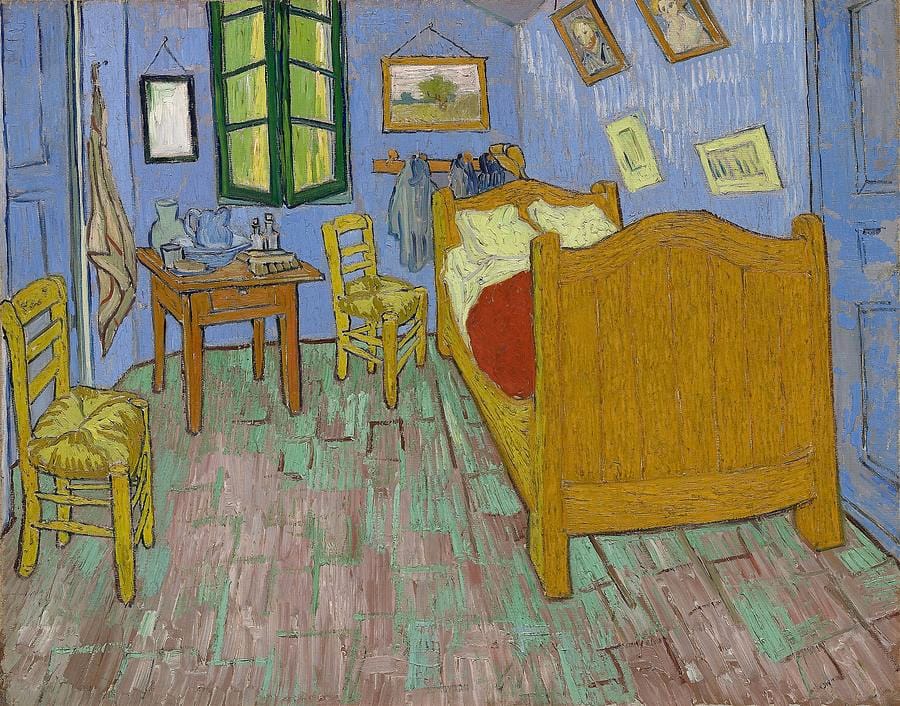
Van Gogh painted his own bedroom in the Yellow House three times, the first in October 1888. The room is spare — a wooden bed, two chairs, a washstand, his own pictures on the wall — and the perspective tilts alarmingly, the floor rushing away and the furniture crowding forward. He was explicit about the intent: the flat, frank colors were meant to “be suggestive of rest,” and he described the picture to Theo in loving detail, listing the lilac walls and the butter-yellow bed. Few paintings say so much about a person by showing so little of them.
The Harvest (1888)
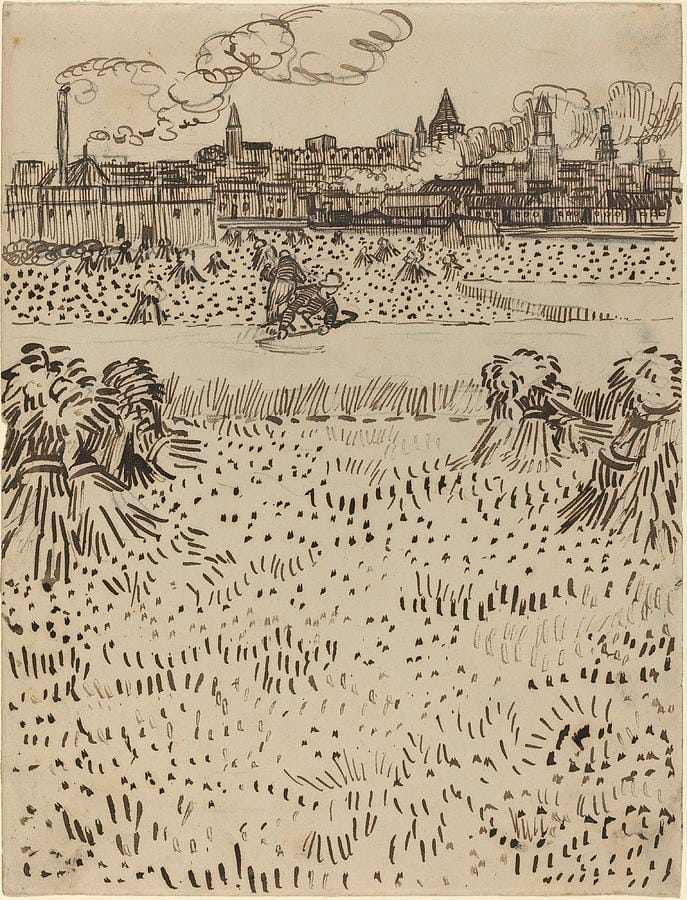
Painted in June 1888 on the flat plain of La Crau outside Arles, The Harvest is the great daylight landscape of Van Gogh’s Provençal year. Wheat is being cut and stacked across a patchwork of fields that recede for miles toward blue hills, with a blue cart, ladders, and haystacks placed like counterweights across the composition. There is no drama and no visible turbulence — just heat, distance, and an almost overwhelming sense of abundance. He rated it among the best things he had done and hung it in his own room, and it remains the clearest evidence of how happy the south initially made him.
Van Gogh sold almost nothing in his lifetime and died believing he had failed. The paintings he made in those last two years are now the ones people hang above their beds, their desks, and their kitchen tables — partly for the color, and partly because almost everyone recognises something of themselves in the way he looked at ordinary rooms, ordinary flowers, and ordinary fields.
Shop Vincent van Gogh prints here, and explore the rest of our famous paintings collection for more of the world’s most beloved masterpieces.