Van Gogh and Gauguin: The Friendship That Exploded
Nine weeks in a small yellow house in Arles, and the night it ended — plus how two painters who worked side by side made such completely different pictures.

Vincent van Gogh and Paul Gauguin shared Van Gogh’s Yellow House in Arles for nine weeks in the autumn of 1888. It ended on the night of December 23, when Van Gogh cut off part of his left ear. Gauguin left for Paris the next morning. They never saw each other again, though they wrote until Van Gogh’s death.
The Yellow House, and the invitation
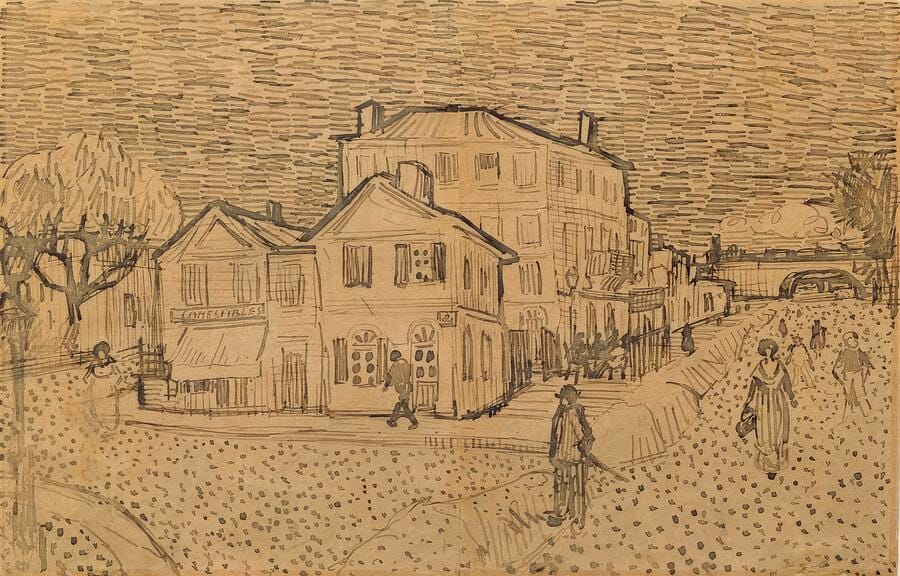
Van Gogh arrived in Arles on February 20, 1888, thirty-four years old, exhausted by Paris and looking for stronger light. In May he took the lease on the right-hand wing of a small house at 2 Place Lamartine, painted yellow, and by September he was sleeping in it.
He wanted it not as a studio but as the first house of what he called a Studio of the South — a community of painters in Provence, with Gauguin, five years older and far more experienced, as its head. The project was a plan to stop being alone.
Gauguin was broke in Brittany and reluctant, and what moved him was money: Vincent’s brother Theo van Gogh, a Paris dealer, offered him a monthly allowance in exchange for paintings if he went south. Meanwhile Vincent spent August painting a run of sunflower canvases specifically to decorate the bedroom Gauguin would sleep in. Gauguin stepped off the night train on October 23, 1888.
Nine weeks, October to December 1888
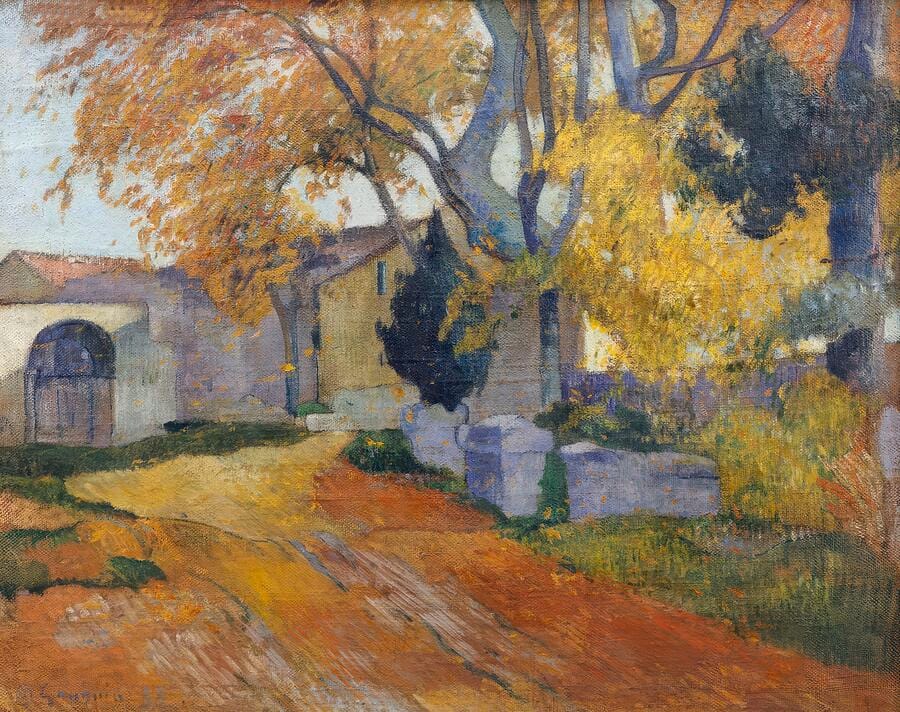
It began well. Gauguin took over the housekeeping and the accounts, imposed order on Vincent’s chaos, and bought a long roll of coarse jute which both men used as canvas — an easy way to identify work from these weeks. They painted the same subjects side by side: the Roman burial avenue of the Alyscamps in autumn; the women of Arles in the public garden opposite the house; Madame Ginoux, who kept the café, sitting for both of them in one session.
The argument that broke them was about method. Gauguin worked from memory and imagination in the studio and pushed Vincent to do the same; Vincent needed the thing itself in front of him. He tried it once, in Memory of the Garden at Etten, and disliked the result. He told Theo their discussions left them “exhausted, like an electric battery after it has run down”.
In November Van Gogh painted the two chairs — his own, plain and rush-seated, in daylight; Gauguin’s, curved and armed, with a candle burning on it at night. It is a double portrait with nobody in it. In early December Gauguin painted Vincent at his easel, Van Gogh Painting Sunflowers; Vincent’s reaction, as Gauguin told it, was that it was certainly him — but him gone mad.
The night of December 23: what is known and what is not
By mid-December Gauguin had written to Theo saying he intended to leave, then retracted it. On the evening of December 23, 1888 there was some sort of confrontation in the street, and Gauguin did not sleep at the house. That night Van Gogh cut off part of his left ear with a razor, wrapped it, and delivered it to a young woman at a house in the brothel quarter. He was found the next morning bleeding heavily and taken to the Hôtel-Dieu hospital in Arles, where a young doctor, Félix Rey, treated him. Gauguin telegraphed Theo, waited for him to arrive from Paris, and left. The local paper, Le Forum Républicain, reported it on December 30.
Those are the facts that hold. Several popular details are less secure.
- How much of the ear. The traditional account says the lobe. Dr Rey’s own sketch of the injury, published in 2016, indicates almost the whole ear was severed. The question is genuinely unsettled.
- Why. No explanation survives from Van Gogh, who said he could not remember. He had a serious undiagnosed illness — some form of epilepsy is the most common modern reading — worsened by absinthe, malnutrition and overwork, and he had just learned that Theo had become engaged, threatening his only support.
- Whether Gauguin did it. A 2009 book argued that Gauguin, an accomplished fencer, cut the ear during a fight and that both men agreed to conceal it. Almost no specialist accepts this, and the Van Gogh Museum does not. Gauguin’s own version, written fifteen years later in Avant et après, is self-serving enough to be treated carefully in the other direction.
The plainest reading is the best supported: a fragile man collapsed when the companionship he had staked everything on failed.
How the two men actually painted
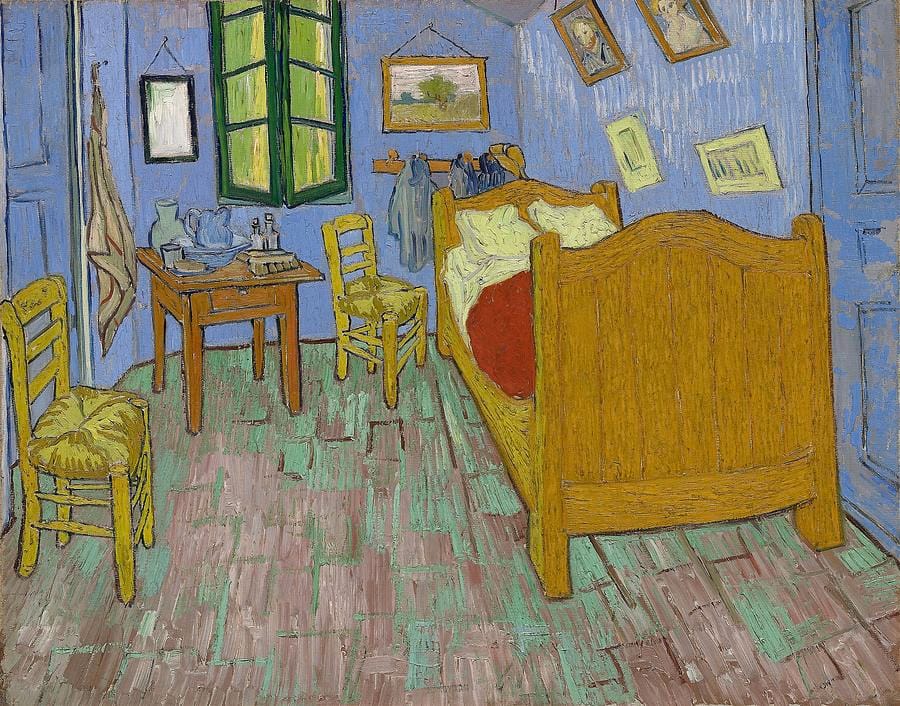
They are constantly filed together as Post-Impressionists, which obscures how little they agreed on.
| Vincent van Gogh | Paul Gauguin | |
|---|---|---|
| Born | 1853, Zundert, Netherlands | 1848, Paris |
| Age in Arles | 35 | 40 |
| Worked from | The motif, in front of him | Memory and imagination, in the studio |
| Speed | Very fast — about 200 canvases in fifteen months at Arles | Slow and deliberate |
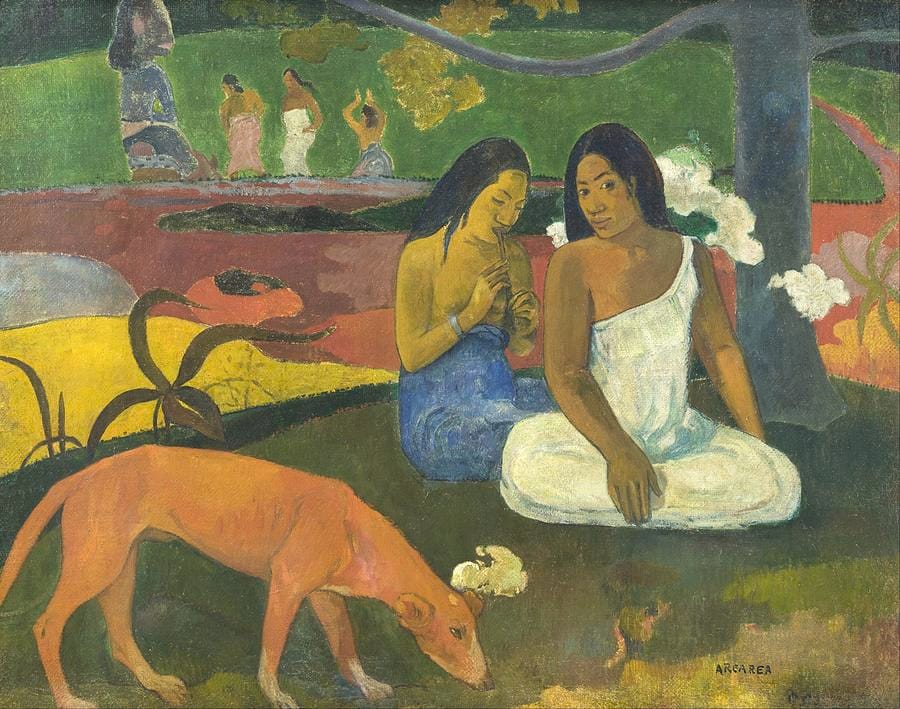
| Paint surface | Thick impasto; every stroke visible and directional | Thin, flat, smooth fields of color |
| Outline | None — form is built out of strokes | Heavy dark contours, the technique called cloisonnism |
| Color | Heightened, but tied to something he had seen | Frankly invented — pink sand, red dogs, violet shadow |
| Space | Deep, rushing, sometimes vertiginous perspective | Shallow and tapestry-like, almost no depth |
| Died | 1890, Auvers-sur-Oise, aged 37 | 1903, Marquesas Islands, aged 54 |
Telling them apart at a glance:
- Paint you could feel with a fingertip, laid in ridges — Van Gogh.
- Flat color with a dark line drawn round it — Gauguin.
- Every mark on the canvas pointing in a direction, the whole surface moving — Van Gogh.
- Figures arranged like a frieze, with no cast shadows — Gauguin.
- Yellow, cobalt and chrome green under a Provençal or Dutch sky — Van Gogh.
- Rose, orange and violet under a tropical one — Gauguin.
What happened to each of them afterward
Van Gogh was in and out of hospital through the spring of 1889 and admitted himself to the asylum at Saint-Paul-de-Mausole, Saint-Rémy, in May. The year that followed produced The Starry Night, the cypresses and the wheatfields — the most concentrated great work of his life. He moved to Auvers-sur-Oise in May 1890 and died there on July 29, 1890, aged 37, of a gunshot wound.
Gauguin returned to Paris, auctioned his work to raise a fare, and sailed for Tahiti in April 1891 — looking for what Van Gogh had looked for in Arles, somewhere cheaper, brighter and further from Europe. He came back once, then left for good, and died on May 8, 1903 at Atuona in the Marquesas Islands, aged 54.
They never met again, but they kept writing. In 1889 Gauguin asked whether he might have one of the sunflower paintings; Vincent refused — those particular canvases, he said, were his own. Browse Van Gogh and Gauguin reproductions, including the sunflowers painted for that bedroom.
Frequently asked questions
How long did Van Gogh and Gauguin live together?
Nine weeks. Gauguin arrived in Arles on October 23, 1888 and moved into Van Gogh’s Yellow House; he left on December 24, the morning after Van Gogh cut off part of his left ear. It is the only period the two men ever lived in the same place.
Why did Van Gogh cut off his ear?
No one knows, and Van Gogh said he could not remember. It happened on December 23, 1888 after weeks of escalating conflict with Gauguin, who had just announced he was leaving. Van Gogh had a serious undiagnosed illness — most modern readings suggest a form of epilepsy — worsened by absinthe and overwork.
Did Gauguin cut off Van Gogh’s ear?
Almost certainly not. A 2009 book proposed that Gauguin, a skilled fencer, severed the ear during a fight and that both men concealed it. The Van Gogh Museum and nearly all specialists reject it; the contemporary evidence, including the hospital record and the local newspaper report, describes a self-inflicted injury.
How much of his ear did Van Gogh cut off?
This is genuinely disputed. The traditional account is that he removed only the lobe. A sketch by Dr Félix Rey, who treated him at the hospital in Arles, came to light in 2016 and indicates almost the whole ear was cut away, leaving only part of the lobe.
Did Van Gogh paint the Sunflowers for Gauguin?
Yes. Van Gogh painted a run of sunflower canvases in August 1888 to decorate the bedroom Gauguin would occupy in the Yellow House. Gauguin admired them, painted Van Gogh at work on one in December 1888, and later asked for one — a request Van Gogh refused.
Did Van Gogh and Gauguin ever meet again?
No. Gauguin left Arles on December 24, 1888 and the two never saw each other again, though they exchanged letters until Van Gogh’s death in July 1890. Gauguin sailed for Tahiti in April 1891 and died in the Marquesas Islands in 1903.
Van Gogh’s surfaces are best seen large and close, where the ridges of paint still read; Gauguin’s flat color holds a room from a distance and pairs well in twos and threes. Browse Van Gogh and Gauguin reproductions as canvas, framed or art prints.