Thomas Moran’s Ten Most Famous Paintings
Yellowstone, the Grand Canyon and the cliffs of the Green River: the ten works that made Moran the painter of the American West.

Thomas Moran (1837–1926) was born in Bolton, in the English cotton country, and came to Philadelphia as a boy when his family emigrated. He trained first as a wood engraver, learned to paint largely on his own, and found his master in J. M. W. Turner, whose canvases he studied on a trip to London in his twenties. From Turner he took a lifelong conviction that a landscape painting should record the feeling of a place as faithfully as its geology — that light, weather and awe were facts too.
In 1871 he talked his way onto the Hayden Geological Survey of the Yellowstone country, and the watercolors he brought back — vivid, precise, unlike anything Congress had seen — helped persuade the government to set the region aside as the world’s first national park in 1872. He spent the next half-century traveling: the Grand Canyon, Utah, the Rockies, Mexico, Venice, the Long Island shore. He signed his work with a monogram that folded a Y into his initials, for Thomas “Yellowstone” Moran. Here are ten of his most famous works.
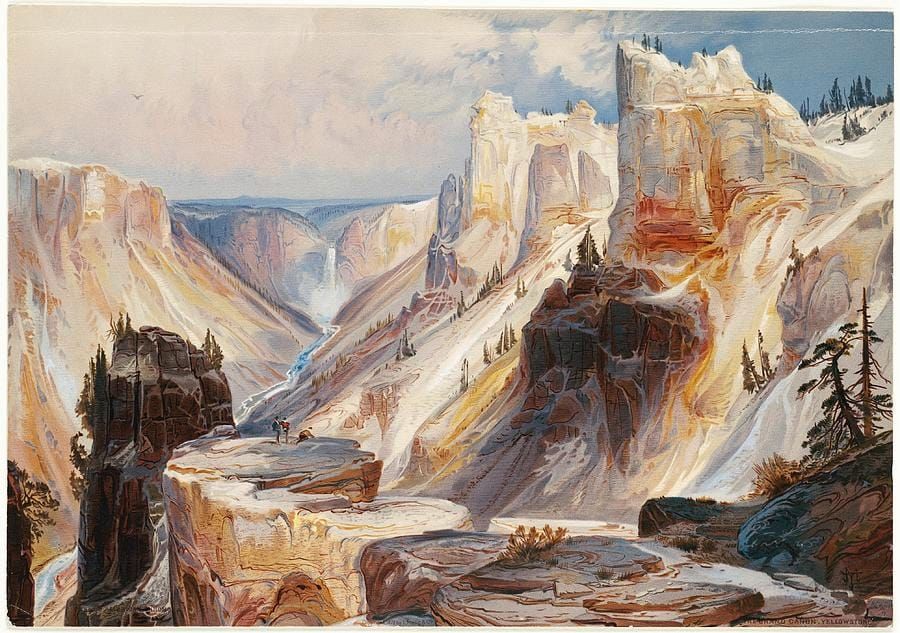
The Grand Canyon of the Yellowstone
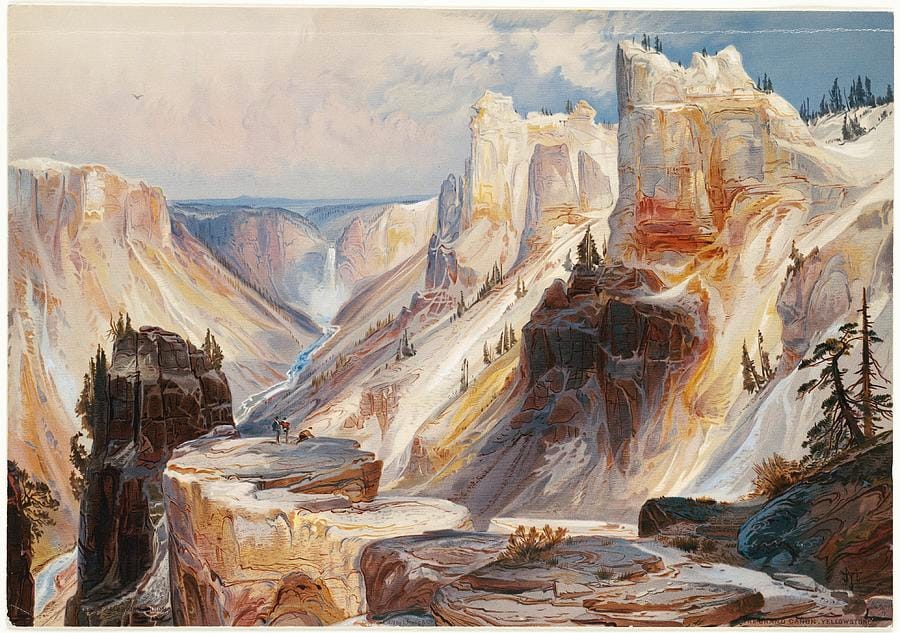
This is the painting that made Moran’s name and, arguably, made Yellowstone a national park. Working up sketches and watercolors from the 1871 survey, he produced an enormous canvas showing the gorge below the Lower Falls, its walls stained yellow, rose and rust by hot mineral water, the falls a white thread far back in the gorge, and two tiny figures perched on a rock ledge in the foreground to give the scale. Congress voted ten thousand dollars for it in 1872 and hung it in the Capitol. Moran was thirty-five, and he had been in the West for barely a month.
Grand Canyon of the Colorado River
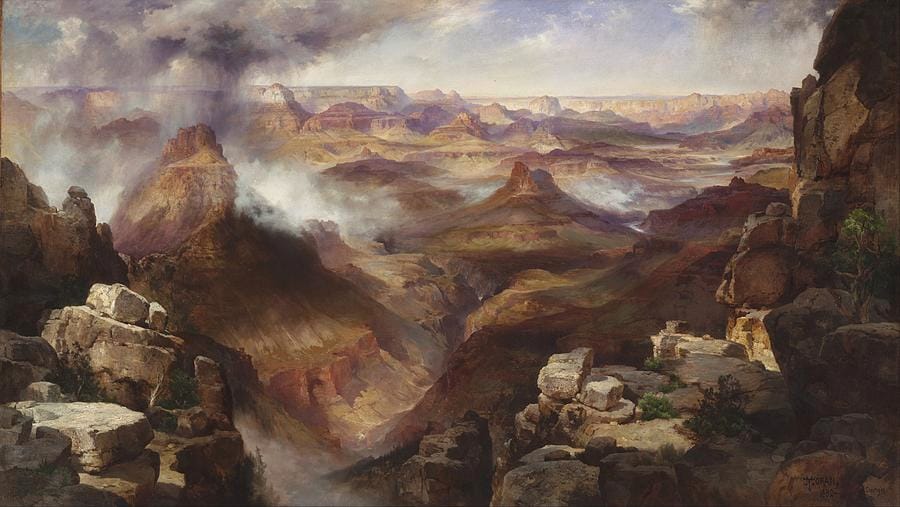
Moran first saw the Grand Canyon in 1873, traveling with John Wesley Powell’s survey of the Colorado, and he painted it for the rest of his life. This version shows the canyon under a broken storm sky, the far walls dissolving into violet haze while the near rim stands hard and dark against it. He was frank about his method: he arranged and heightened, moving a butte or a cloud where the composition needed it, because he believed a literal transcript would fail to convey the actual experience of standing on the rim. Few painters have found a more convincing way to draw a mile of empty air.
The Mountain of the Holy Cross
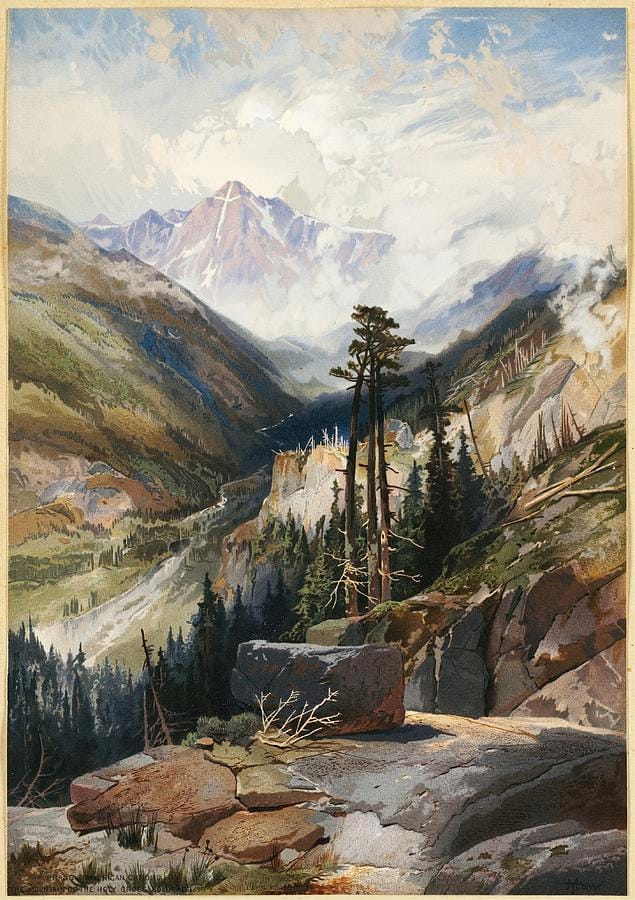
High in the Colorado Rockies, snow collects in two intersecting ravines on a remote peak and forms an enormous cross. A photograph of it by William Henry Jackson caused a sensation in 1873, and Moran traveled to see the mountain for himself the following year. His 1875 painting places the cross far off and high up, seen past a foreground of wet boulders, a broken pine and a tumbling stream, so that reaching it looks like a pilgrimage. Exhibited at the 1876 Centennial in Philadelphia, it struck a devout public as proof that God had signed the American landscape.
The Great Blue Spring of the Lower Geyser Basin, Yellowstone
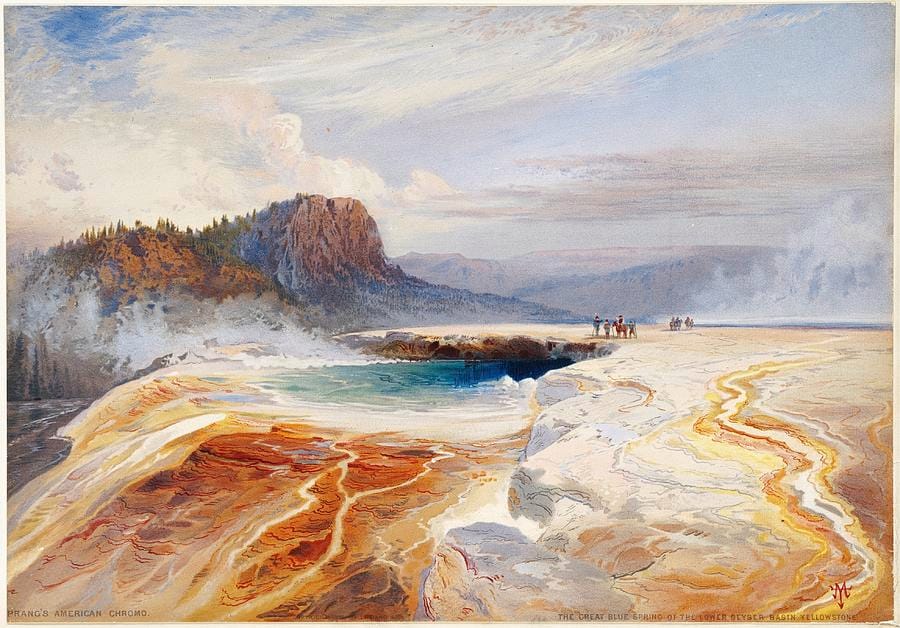
A hot spring lies in the middle of the picture like a hole cut into another world — deep blue at the center, ringed by shelves of white sinter and long streaming bands of orange and ochre where the mineral water runs away downhill. Steam drifts across the basin, and a line of small figures on the far bank measures how large it all is. Moran made this Yellowstone subject in the mid-1870s. The colors are so unlikely that early viewers accused him of inventing them; anyone who has since stood at Grand Prismatic knows he was, if anything, being restrained.
Green River Cliffs, Wyoming
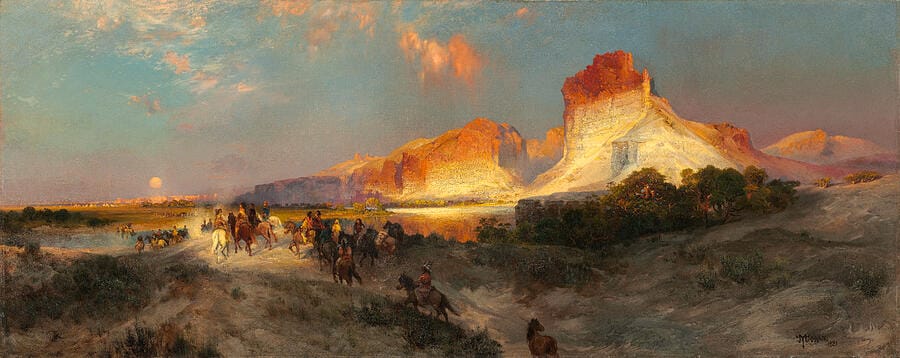
Moran got his first sight of the West at Green River, Wyoming, in 1871, when the train stopped and he sketched the strange banded buttes rising from the sagebrush. He painted them perhaps forty times over the next forty years and never tired of them. Here they burn orange and gold in low sunlight, with a party of riders strung out across the flats below. It is worth knowing that the actual view included a raw railroad town, which Moran left out every single time — he wanted the West as it had been before he arrived, and he simply painted the buildings away.
Valley of Babbling Waters, Southern Utah
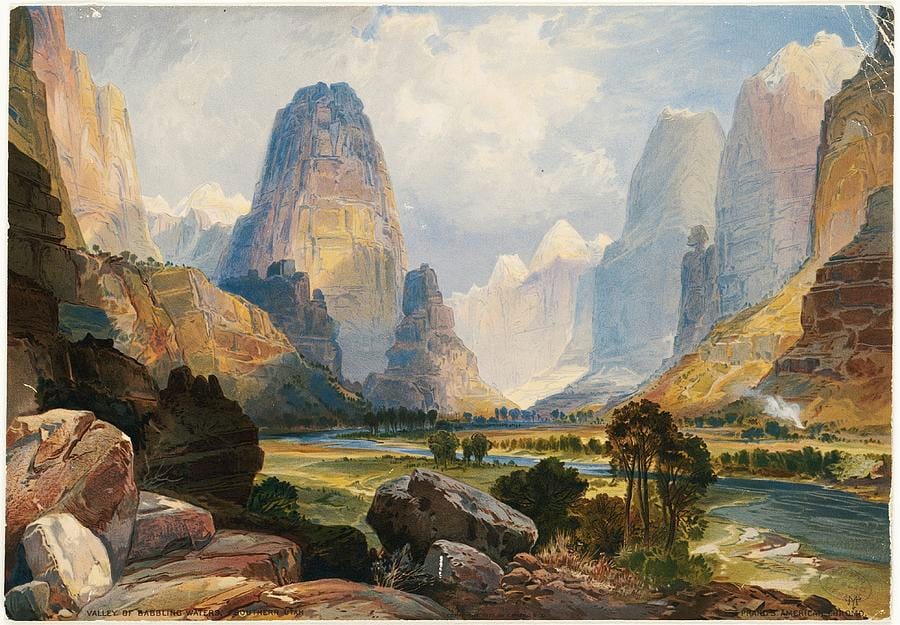
Towers and fins of pale rock rise on both sides of a green valley floor, with a stream winding through cottonwoods far below and cloud shadows crossing the cliff faces. The subject is the canyon in southern Utah later set aside as Zion National Park, which Moran visited in the early 1870s while traveling with Powell’s survey. Pictures like this one, widely circulated as color lithographs, gave an eastern public its first real idea of what the Colorado Plateau looked like — and helped build the political case for protecting the places they showed.
The Great Salt Lake of Utah
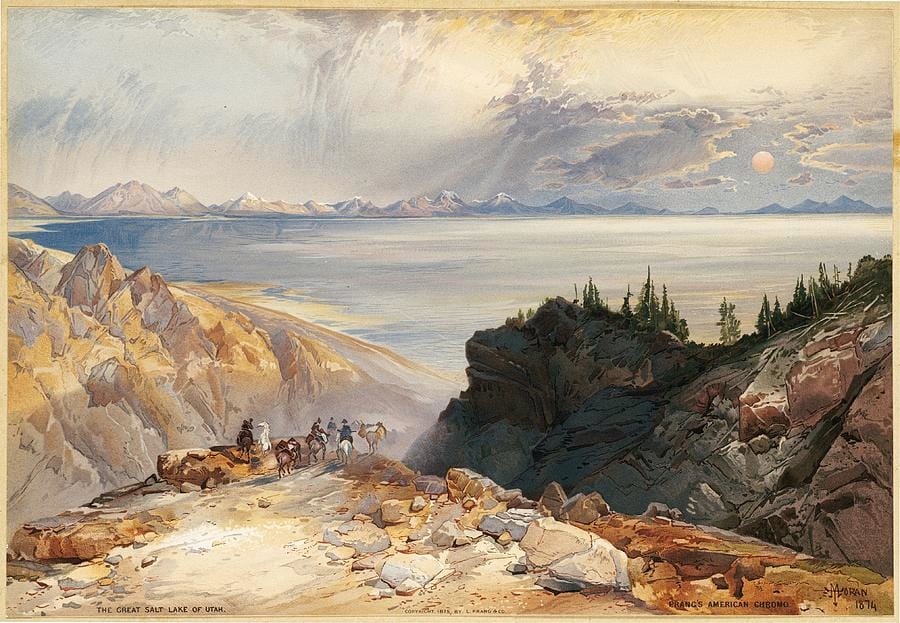
Riders pause on a rocky headland while the great inland sea stretches away beneath a hazy sun, its far mountains reduced to blue silhouettes and its surface an expanse of pale silver. Moran painted the lake in the 1870s, and the picture is a good demonstration of his debt to Turner: the light is the real subject, the land is a dark repoussoir at the edges, and the middle of the composition is very nearly empty. The tiny figures are doing what Moran’s figures always do — standing in for the viewer, dwarfed and looking.
The Much Resounding Sea
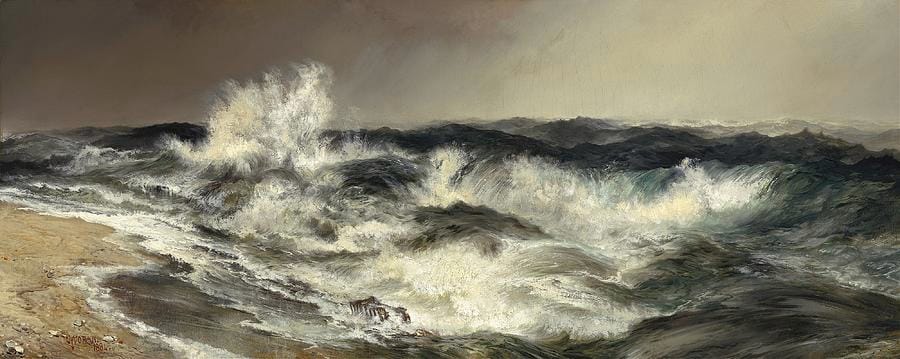
Moran spent his later summers at East Hampton on Long Island and painted the Atlantic there repeatedly. This wide, low canvas of 1884 shows nothing but heavy gray-green surf rolling in under a dim sky, wave behind wave, the foam blowing back off the crests. The title borrows a Homeric epithet for the sea, which tells you how he wanted it read: not a beach view but an old, indifferent force. Anyone who thinks of Moran only as the painter of red canyons should look at this one — it is as fine a seascape as any American of his century produced.
The Grand Canal, Venice
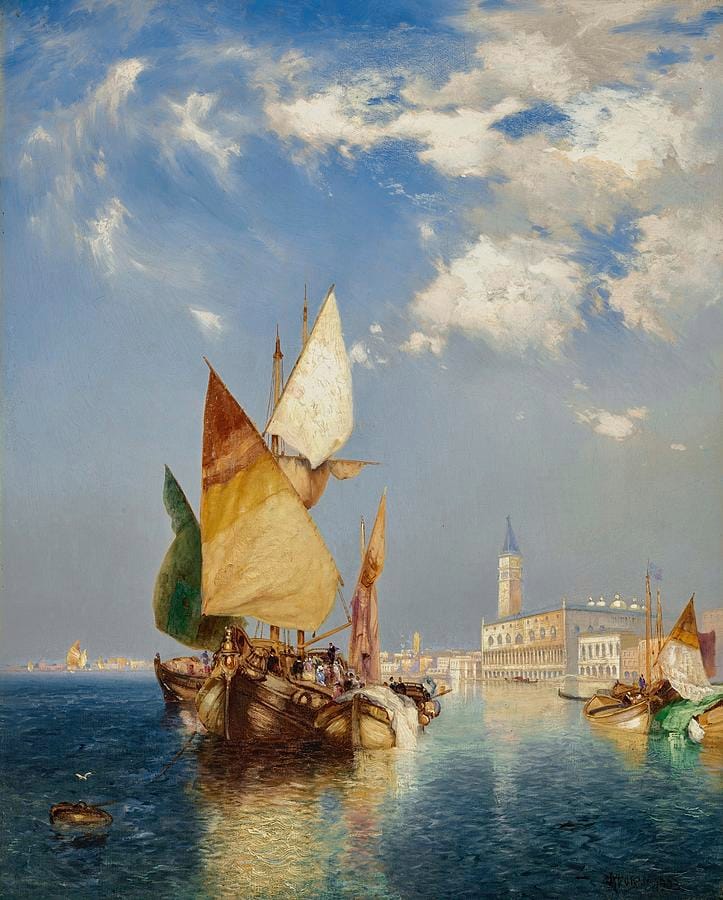
Moran first visited Venice in the mid-1880s and returned to it in paint for the rest of his career. Here a fishing boat with tall tawny sails rides in the foreground while the campanile and the domes stand in silvery haze across the water, the whole scene built out of reflected light. Turner had painted the same lagoon sixty years earlier, and Moran made no secret of the comparison he was inviting. The Venetian pictures also sold extremely well, funding the western travel that mattered more to him — a practical arrangement that suited both sides of his talent.
The Juniata, Evening
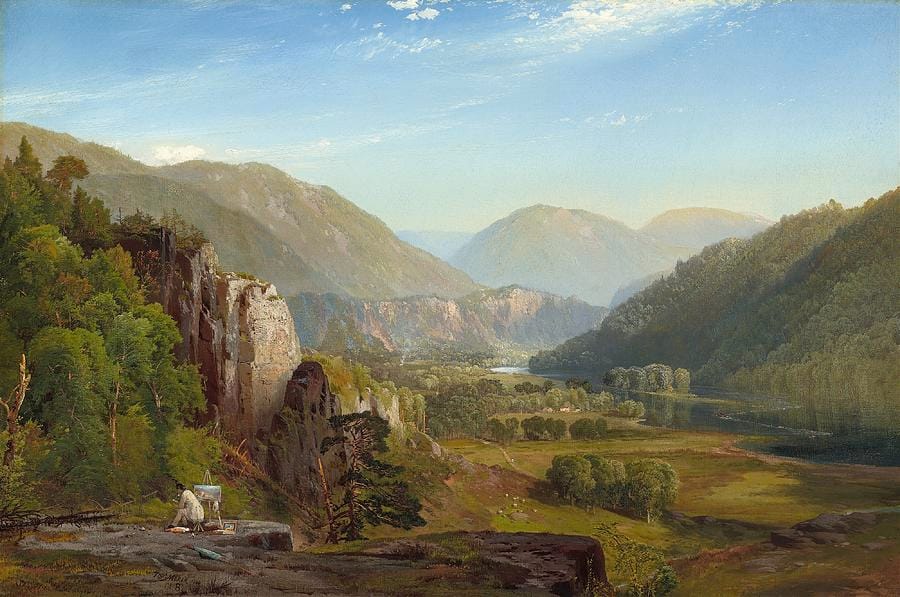
Before the West there was Pennsylvania. The Juniata River runs through the ridges of the central part of the state, and Moran painted this view of it in the 1860s: a broad green valley with the water curling away at the right, wooded ridges folding into blue distance, and a bluff of pale rock in shadow at the left. On that rock, small enough to miss, a painter sits at his easel working on the same scene. This is Moran before Yellowstone — quieter, more intimate, unmistakably schooled on English landscape painting. It is also a reminder that the man who became the great advertiser of the American West began by learning his craft on the modest country an afternoon’s ride from Philadelphia.
Moran gave Americans their first vivid picture of what lay west of the hundredth meridian, and the surprise is how well the paintings hold up as paintings — the color is daring, the light is genuinely observed, and the vast spaces are constructed with real skill. Framed above a mantel or a stairway, his canyons and river cliffs bring depth and warmth to a room, and his seascapes and Venetian views bring a cooler, quieter kind of light.
Shop Thomas Moran prints here, and explore the rest of our famous paintings collection for more of the world’s most beloved masterpieces.