Thomas Cole’s Ten Most Famous Paintings
The Course of Empire, The Voyage of Life, The Titan’s Goblet and more: the ten works by the painter who invented an American landscape tradition.

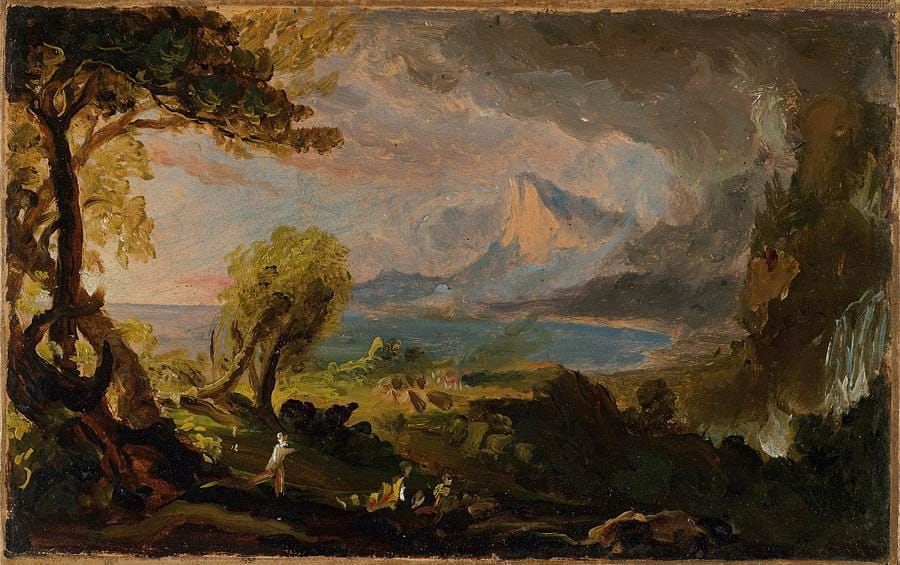
Thomas Cole (1801–1848) was born in Lancashire and came to America at seventeen, largely self-taught, working as an engraver's assistant and an itinerant portraitist before he found his subject. In 1825 he took a steamboat up the Hudson and came back with sketches of the Catskills. Three of the paintings he made from them were bought almost immediately by the leading figures of the New York art world, and his reputation was made in a season.
What followed was the first native school of American painting. Cole and the artists who came after him — Church, Durand, Bierstadt, Gifford — are known collectively as the Hudson River School, though Cole himself wanted more than scenery. He believed landscape could carry the weight of history painting, and his most ambitious works are moral arguments in the shape of views: cycles about empire, mortality, and what a young republic might be about to do to itself. He died at forty-seven in Catskill, New York. Here are ten of his most famous paintings.
The Course of Empire: The Savage State
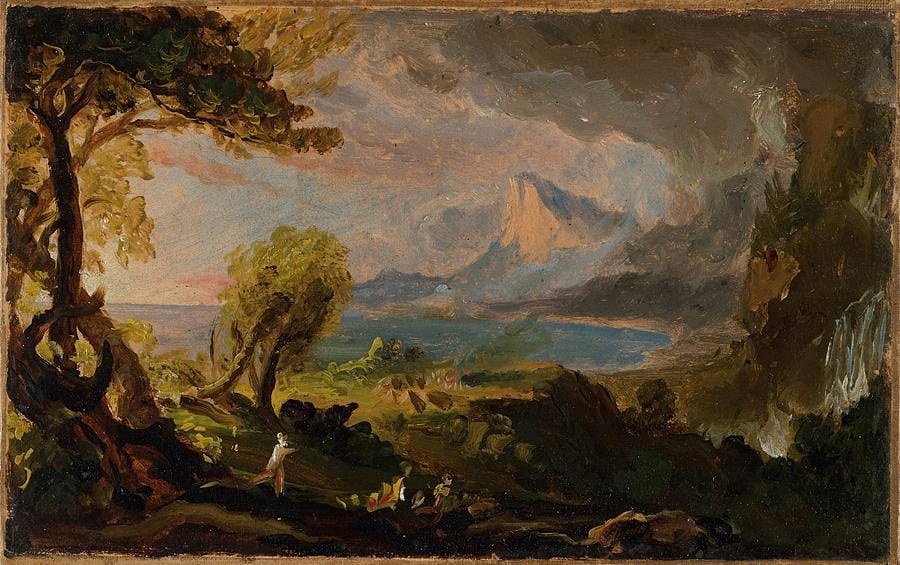
The opening scene of Cole's five-painting cycle of 1833–36, the most ambitious project he ever undertook. A wooded bay at dawn, storm clouds breaking, hunters in skins pursuing deer past a cluster of huts. The same distinctive boulder-topped peak appears in the background of all five canvases, fixing the viewpoint so the viewer watches one place across the whole arc of a civilization. Cole's patron Luman Reed gave him the freedom to attempt a work on this scale, and the series was conceived as an argument rather than a decoration.
The Course of Empire: The Consummation of Empire
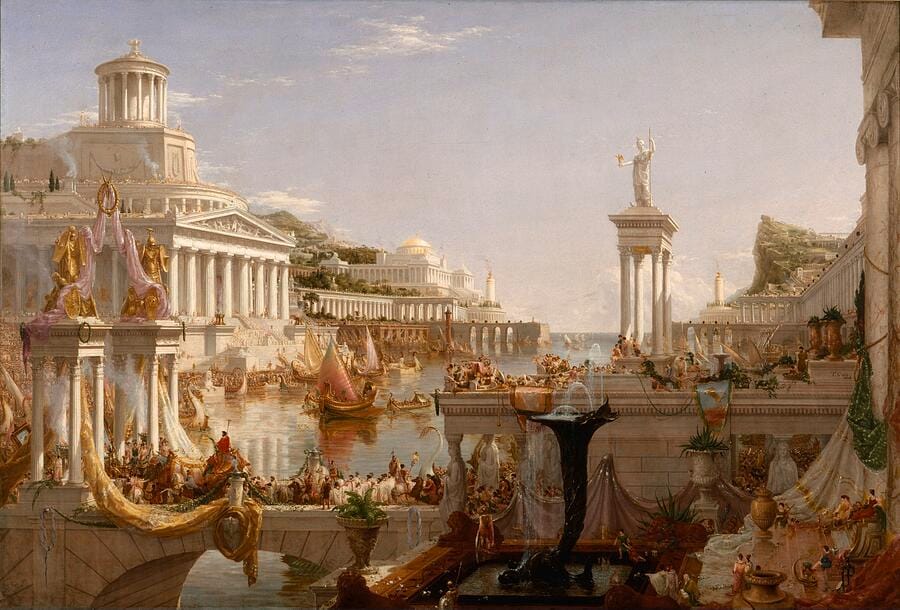
The third and largest canvas of the cycle, and the one everything else is measured against. The bay is now sheathed in white marble: colonnades, a triumphal procession crossing a bridge, crowds massed on every terrace, gilded statuary catching a high midday sun. Cole loads the picture until there is barely a square inch of unbuilt ground. Painted for an American audience in the 1830s, at a moment of aggressive national expansion, the sequence that follows it — destruction, then a moonlit ruin with nobody left in it — was not a subtle warning.
The Voyage of Life: Childhood
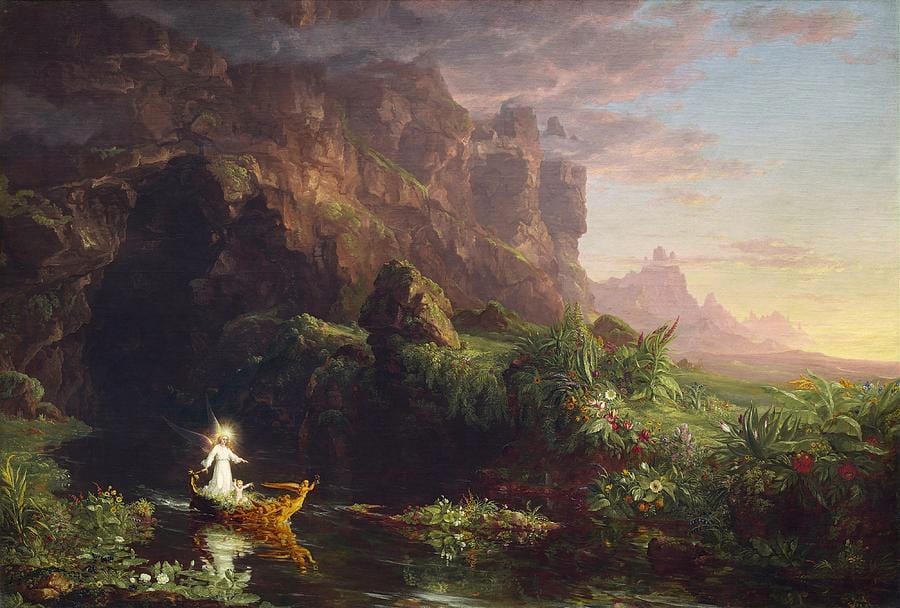
The first of a four-part allegory Cole painted in 1842, following a single soul down a river from birth to death. A boat carved with an hourglass figurehead emerges from a dark cave into a flowering landscape, steered by a guardian angel, with an infant reaching for the light. The river runs calm, the horizon is close, and the whole canvas is pitched in warm greens and golds. Each painting in the series takes a different hour and a different weather, and the storytelling is deliberately plain enough to read at a glance.
The Voyage of Life: Youth
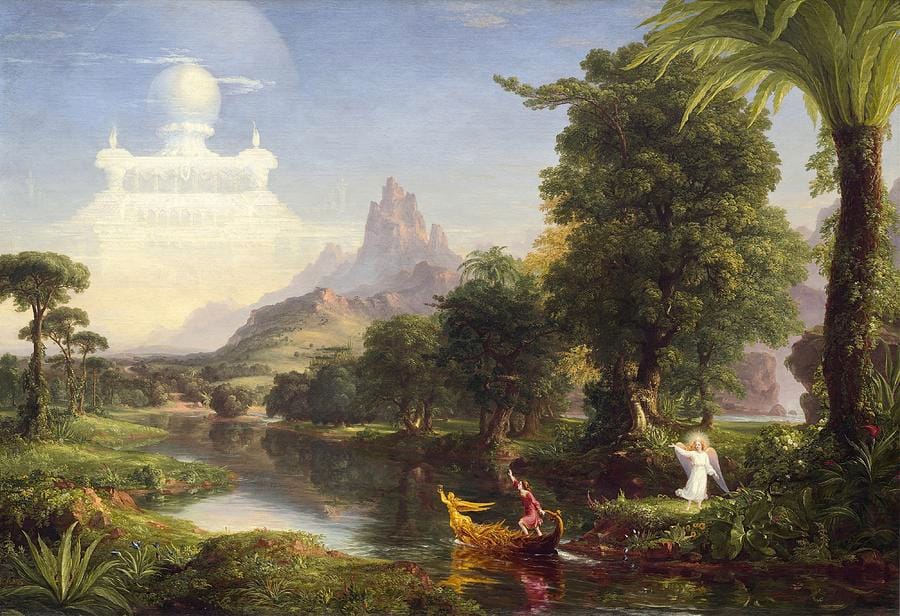
The second canvas, and the most seductive. The boy has taken the tiller himself; the angel has stepped ashore and watches from the bank. Ahead, floating in the sky above a widening river, is a shining palace of towers and domes — the ambition the young man is steering toward. Cole gives it just enough vagueness at the edges to read as a cloud formation. The river, meanwhile, has begun to bend away out of sight to the right, in a direction the traveler is not looking.
The Voyage of Life: Old Age
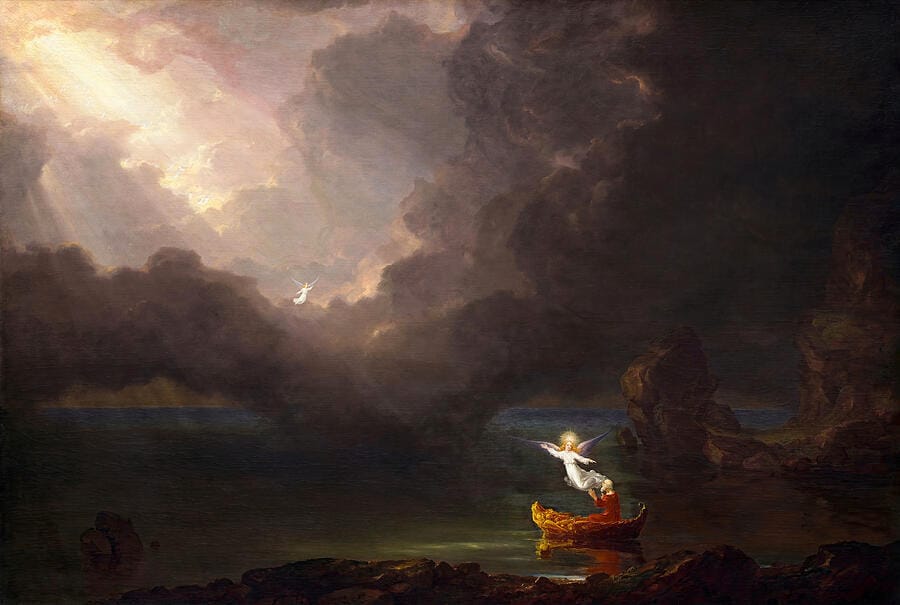
The last canvas. The boat has lost its figurehead and its rudder, the river has opened into a dark and featureless sea, and the traveler is an old man with his hands folded. The landscape has been stripped out entirely — no banks, no trees, only water and cloud — and the guardian angel returns, gesturing upward toward a break in the sky. It is the emptiest picture Cole ever painted, and the emptiness is doing the work.
Expulsion from the Garden of Eden
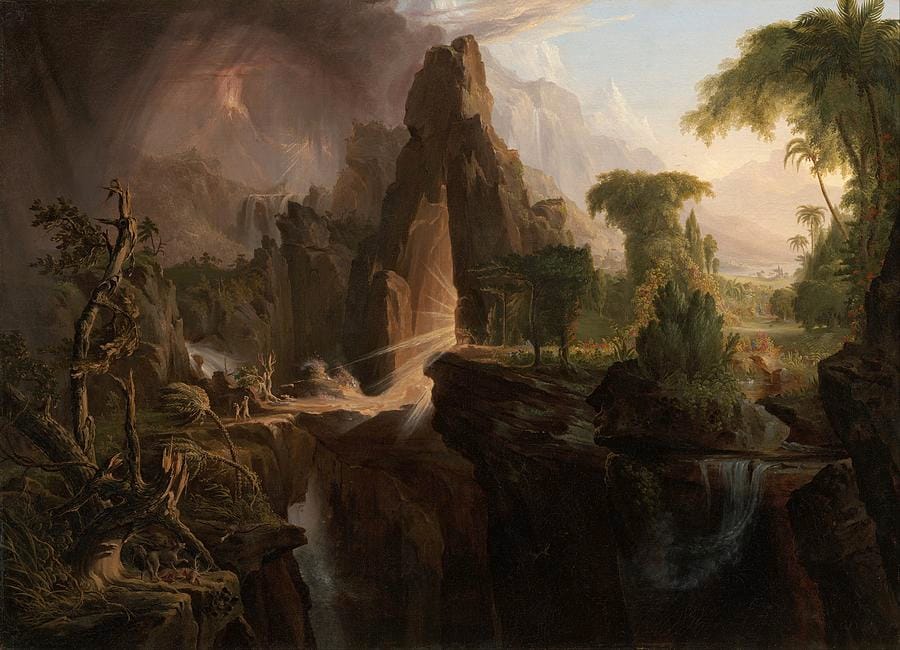
Painted in 1828, this splits the canvas down the middle into two climates. On the left, through a blazing arch of rock, lies Eden: soft light, still water, a swan. On the right is the world Adam and Eve are stumbling into — blasted trees, a wolf standing over a carcass, a volcano throwing smoke across the sky. The two figures are tiny, caught on the natural bridge between the halves. Cole was working out here the device that would drive The Course of Empire: let the landscape carry the whole moral argument, and keep the people small.
The Titan's Goblet
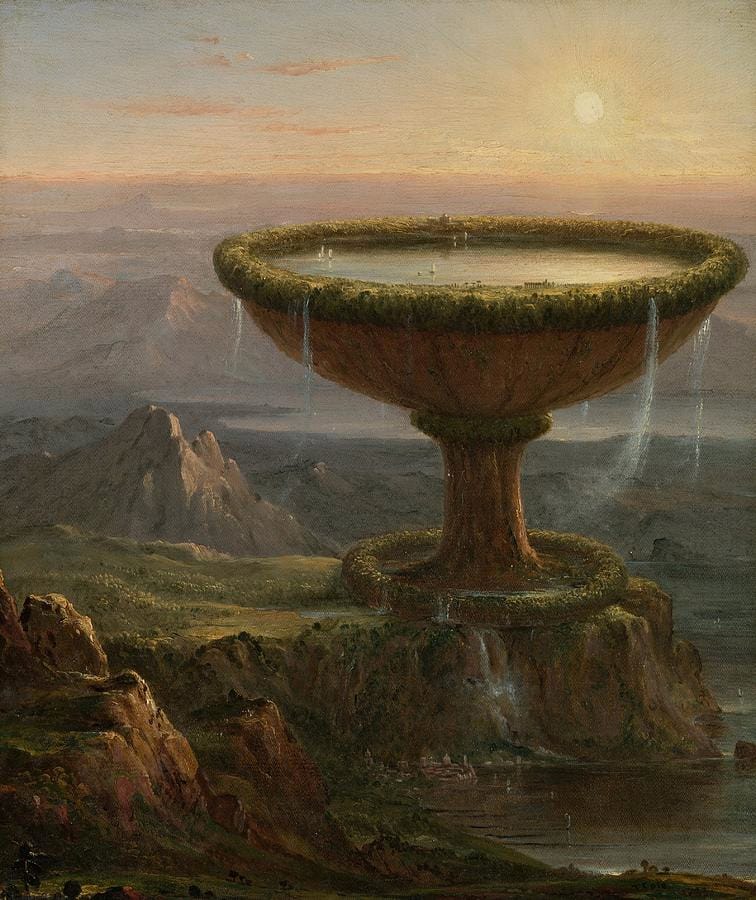
Painted in 1833, and unlike anything else in American art of the period. An enormous stone goblet stands in a landscape, and on the water held in its bowl there are boats, a shoreline, buildings, and trees — an entire inhabited world balanced on a stem above an ordinary bay with distant mountains. Cole left no explanation. Later writers have read it as a Norse world-tree, a fragment of classical myth, or a piece of pure invention, and its refusal to resolve into a single meaning is why it has stayed so interesting.
View on the Catskill, Early Autumn
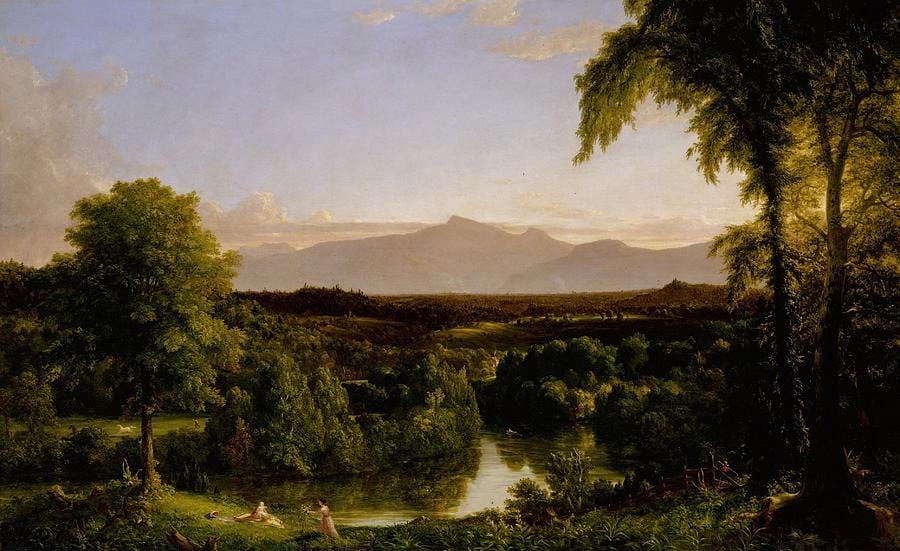
Painted in 1836–37, this is the Hudson Valley as Cole wanted it remembered: a broad meadow opening to the Catskill Mountains, a mother and child in the foreground, early autumn color just starting in the trees. It is also a picture with an argument in it. The railroad was then being cut through this exact stretch of valley, and Cole left it out. He wrote angrily about what was being done to the local landscape, and the serenity here is a deliberate act of preservation on canvas.
Distant View of Niagara Falls
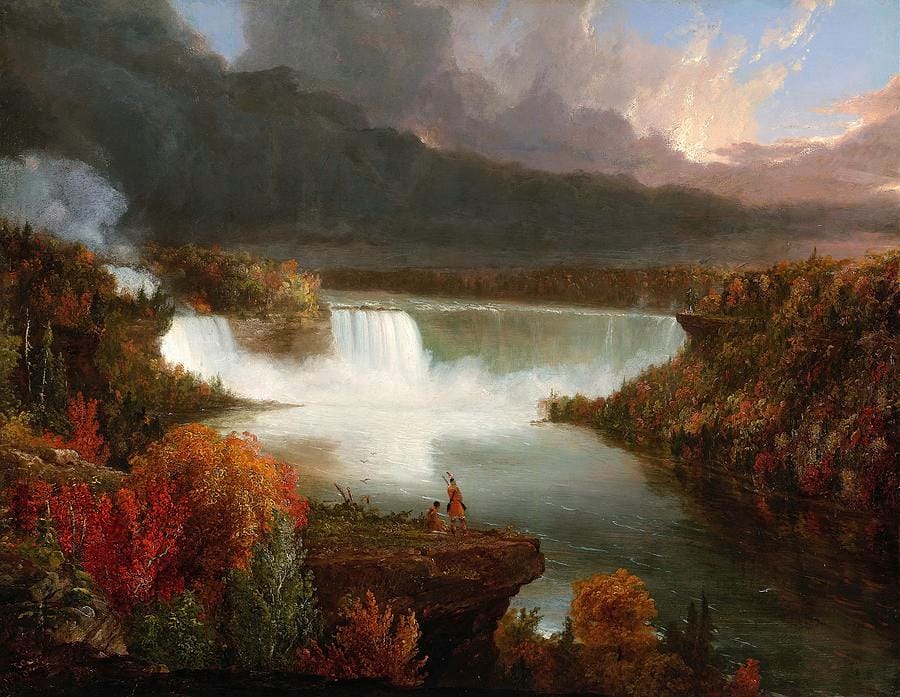
Painted in 1830, before Cole's first trip to Europe. Rather than putting the viewer at the rail, he pulls back and up, showing both cataracts from a high wooded bluff with two Native American figures on an outcrop in the foreground. The choice sets the falls in an unspoiled continent rather than a tourist destination — Niagara already had hotels and a souvenir trade by then. The curving sweep of the gorge and the tiny figures establish the scale that later American landscape painters would push much further.
Dream of Arcadia
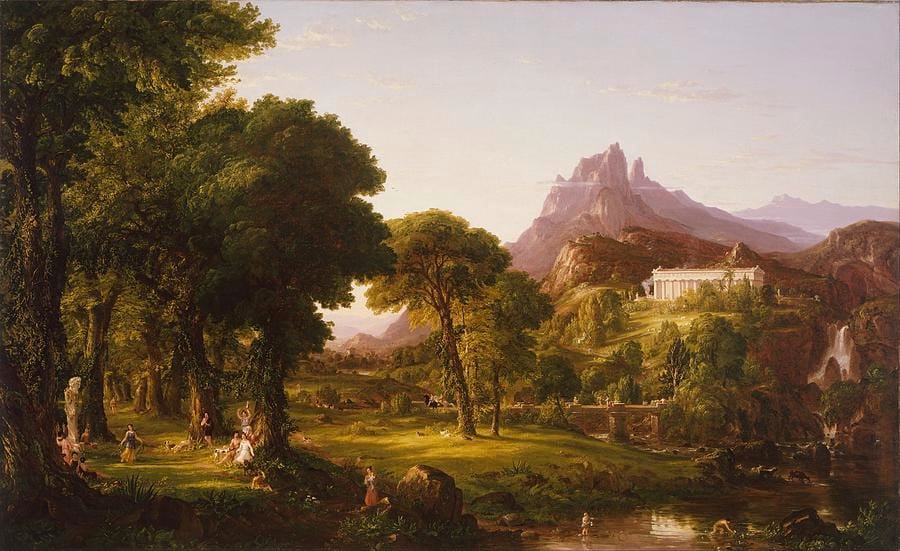
Painted in 1838, after Cole's years in Italy, this is his most frankly classical picture: a broad valley with a domed temple on a promontory, dancers in a ring, shepherds with their flocks, and a great peak rising through the haze at the back. It belongs to the tradition of Claude Lorrain, whose golden light Cole studied closely in Europe. Where The Course of Empire used the same vocabulary to warn about what civilization does to itself, here he simply lets the ideal stand — a landscape of the kind of harmony he did not believe was available in his own century.
Cole died in 1848, leaving a second, unfinished five-part cycle on his easel. His pupil Frederic Church and the painters who followed took his methods to the Andes, the Arctic, and the Rockies, and the tradition he began is still the standard picture of nineteenth-century America.
Shop Thomas Cole prints here, and explore the rest of our famous paintings collection for more of the world’s most beloved masterpieces.