The Story Behind Van Gogh's Starry Night
Painted in an asylum, indoors, by daylight, from memory — and Van Gogh thought it had failed.

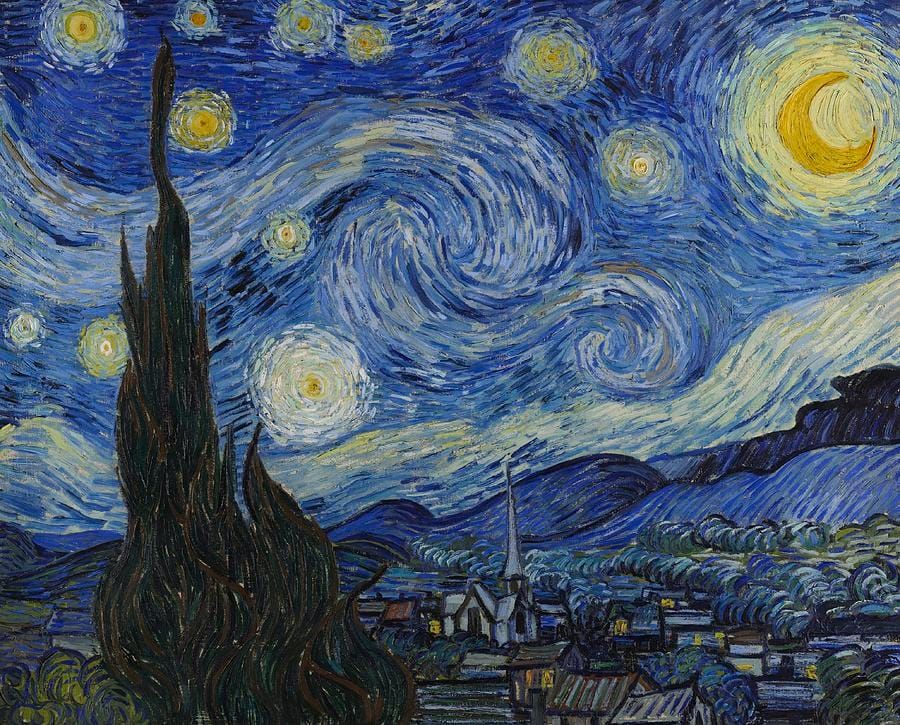
Van Gogh painted The Starry Night in June 1889, a month into a voluntary stay at the Saint-Paul asylum in Saint-Rémy-de-Provence. The view is the one from his barred bedroom window, looking east before dawn — but he painted it by day in a ground-floor studio, largely from memory, and the village below is invented.
How he ended up there
The road to Saint-Rémy runs through Arles. Van Gogh had gone south in February 1888 hoping to found a community of artists; Gauguin arrived in October; the arrangement collapsed, and on December 23, 1888 Van Gogh cut off part of his own left ear. After further breakdowns and a petition from his neighbors, he committed himself voluntarily to the asylum of Saint-Paul-de-Mausole, outside Saint-Rémy-de-Provence, on May 8, 1889.
This matters, because the asylum was not a prison and he was not in despair when he made the painting. The institution was less than half full, so he was given a bedroom upstairs and a second, ground-floor room to use as a studio. He was allowed to work during lucid periods and forbidden to work during attacks. In a year there he produced roughly 150 paintings.
His bedroom window faced east over a walled wheat field toward the low ridge of the Alpilles. It was barred, and it was his fixed viewpoint for a year — he painted variations on that one view at least twenty-one times.
The biggest myth: he did not paint it at the window, at night
The picture everyone carries in their head is Van Gogh at the barred window in the small hours, painting what is in front of him. That is not what happened.
Patients were not permitted to paint in their bedrooms. The work was done downstairs in the studio, in daylight, from memory, from earlier drawings, and from what he had watched on previous nights. Which is why the picture behaves as it does: no single moment of sky could look like this, because it is not one moment.
He described the source in a letter to his brother Theo at the start of June 1889 — that he had seen the countryside from his window a long time before sunrise, with nothing but the morning star, which looked very big. The large white body at center-right, ringed with light, is generally taken to be Venus at dawn. This is a pre-sunrise sky, not a midnight one.
None of that makes the painting less truthful. It makes it a different kind of truth: a year of looking at one patch of sky, compressed and rebuilt indoors.
What is real and what he invented
Real: the ridge of the Alpilles on the horizon, the direction of view, the morning star, the rough position of the moon low on the right.
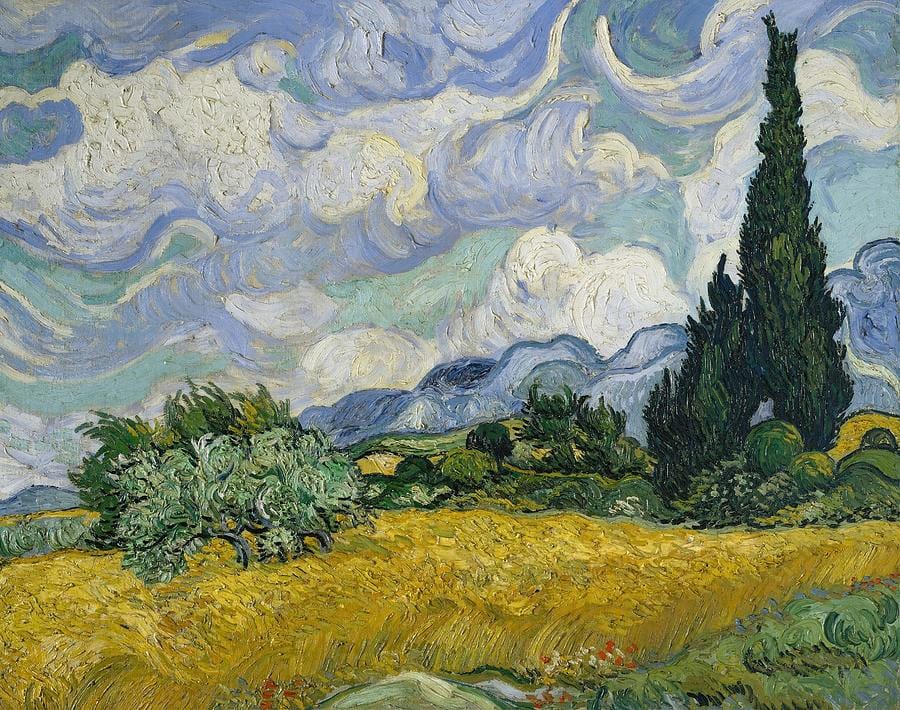
Adjusted: the cypress. Cypresses grew in the fields around the asylum and he was painting them obsessively that summer, but this one is scaled up and pulled into the immediate foreground, where it works as a dark vertical joining earth to sky. In Provence cypresses are planted in graveyards, and readers have taken the tree as a figure for death ever since — though Van Gogh, writing to Theo about cypresses that same month, talked about their line, their proportions and their beautiful black, not about mortality.
Invented: the village. There is no settlement in that position, and the church has a steep narrow spire of a kind found in the Netherlands rather than in Provence, where bell towers are squat and open. He put a piece of home into the south of France.
Misremembered: the moon. Astronomers who have tried to date the sky place it around June 19, 1889, when the moon was waning gibbous — not the thin crescent he painted.
Van Gogh thought it had failed
He never treated it as a triumph. He mentioned it to Theo almost in passing, as a study of a starry sky, and did not push to exhibit it. Writing to Émile Bernard from Saint-Rémy later that year, arguing against painting from imagination, he said he had once again let himself be led astray into reaching for stars that were too big — another failure — and that he had had his fill of it. Most scholars read that as a reference to this painting.
Which sets up the second myth worth dismantling: that The Starry Night is the work of a man in the grip of madness, a vision seized during an attack. It is the opposite. He could only work when he was well. The composition is carefully balanced, the brushwork systematic, and he built it up over days in a studio. What we read as delirium is technique.
The chronology gets compressed constantly, so it is worth having straight. The ear was December 1888. The Starry Night was June 1889. He died in July 1890, thirteen months later, in Auvers-sur-Oise. It is not a final work.
Why the sky looks like that
The most-repeated modern claim about the painting is that Van Gogh somehow captured turbulence — the physics of swirling fluid — before science had described it properly. There is a real result underneath, and it is narrower than the headlines.
In the mid-2000s a team led by the physicist José Luis Aragón analyzed the brightness variations in the swirling passages and found a statistical pattern close to Kolmogorov's scaling law for turbulent flow. A 2024 study in Physics of Fluids examined the whirls and reported a similar match. Both are legitimate measurements.
What they do not show is that Van Gogh understood turbulence or intended to depict it. Sceptics point out that thick directional oil brushwork produces this kind of luminance statistic fairly readily, and that the analyses measure perceived brightness rather than physical flow. The modest statement is the defensible one: a painter working intuitively, at speed, in heavy impasto, produced marks whose structure resembles the mathematics of moving air.
The painting entered the Museum of Modern Art in New York in 1941, acquired through the Lillie P. Bliss Bequest, and has hung there since.
Frequently asked questions
What is the story behind The Starry Night?
Van Gogh painted it in June 1889 at the Saint-Paul asylum in Saint-Rémy-de-Provence, where he had admitted himself voluntarily on May 8 after the breakdowns that followed the ear incident in Arles. The view is from his barred east-facing bedroom window before dawn, but he painted it downstairs in a studio, by daylight.
Did Van Gogh paint The Starry Night from his window at night?
No. Patients were not allowed to paint in their bedrooms. He observed the view over many nights and then worked in a ground-floor studio during the day, from memory and earlier drawings. A letter to Theo describes seeing the countryside before sunrise with the morning star looking very big.
Is the village in The Starry Night a real place?
No. The ridge on the horizon is the real Alpilles and the direction of view is real, but there is no village in that position and none was visible from his window. The church has a steep narrow spire of a Dutch type rather than the squat bell towers of Provence.
What do the swirls in The Starry Night mean?
There is no documented symbolic meaning; Van Gogh described the picture simply as a study of a starry sky. Physicists have shown the brightness variations follow patterns similar to turbulent flow, but that is a property of the brushwork, not evidence that he was depicting fluid dynamics.
Did Van Gogh paint The Starry Night after cutting off his ear?
Yes, about six months after. The ear incident was in Arles on December 23, 1888; the painting was made in Saint-Rémy in June 1889. It was not a final work either — he died in Auvers-sur-Oise thirteen months later. He could only paint during lucid periods, so it is the product of clarity.
Where is The Starry Night now?
The Museum of Modern Art in New York, which acquired it in 1941 through the Lillie P. Bliss Bequest. It is among the most visited single objects in any American museum. Van Gogh never sold it and appears to have considered it a failed experiment in painting from imagination.
Van Gogh's paintings are in the public domain, so the whole Saint-Rémy year — The Starry Night, the cypresses, the wheat fields, the olive groves — can go on a wall at a size that does the brushwork justice. Browse Vincent van Gogh prints, the Starry Night collection, or more Post-Impressionist art on canvas or framed paper.