The Hudson River School
America’s first native school of painting: how a young Englishman’s trip up the Hudson in 1825 turned landscape into a national argument.

The Hudson River School was America’s first native school of painting: a loose group of landscape artists working from about 1825 to 1875, first in the Hudson Valley and the Catskills, later across the American West. Thomas Cole founded it; Asher B. Durand, Frederic Edwin Church, Albert Bierstadt and Thomas Moran carried it on. It was never a school, and its members never used the name.
It started with one trip up the river
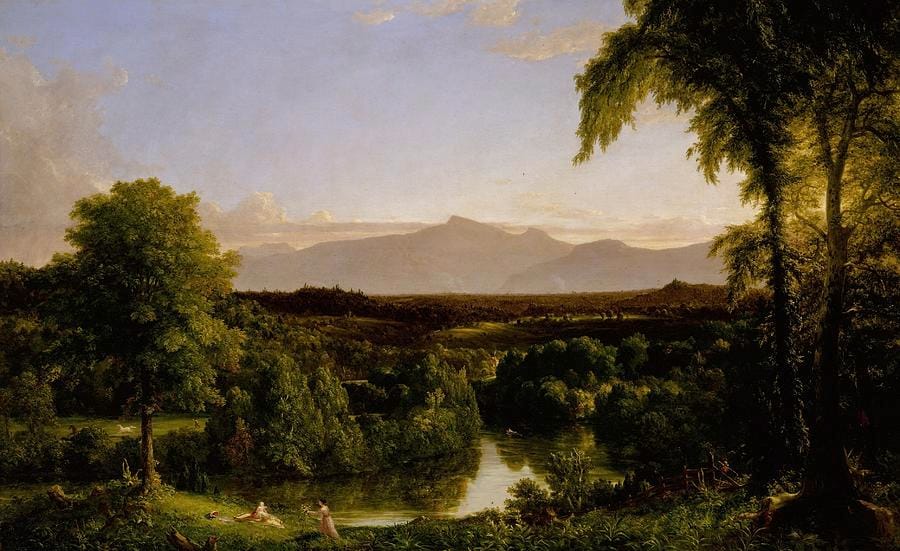
In the autumn of 1825 Thomas Cole — English-born, twenty-four, largely self-taught and broke — took a steamboat up the Hudson and walked into the Catskills with a sketchbook. He came back with three canvases and put them in a shop window on Broadway.
They were bought within days by three of the most important men in American art: John Trumbull, who had painted the Revolution; the critic William Dunlap; and Asher B. Durand, then an engraver. Trumbull is said to have remarked that this young man had done at once what he had spent a lifetime trying to do. Dunlap wrote it up. Cole had a career.
The point was not only that the pictures were good. It was that they were American. The country had no ruined abbeys, no aqueducts, no cathedral towns — the raw material of European landscape painting. What it had was wilderness, and Cole’s generation decided that was not a deficiency but the subject itself.
Nobody involved called it the Hudson River School. That name was applied from outside in the 1870s, more or less as a sneer, by critics who thought the style had become provincial and old-fashioned. It stuck anyway.
Two generations, and how far west they went
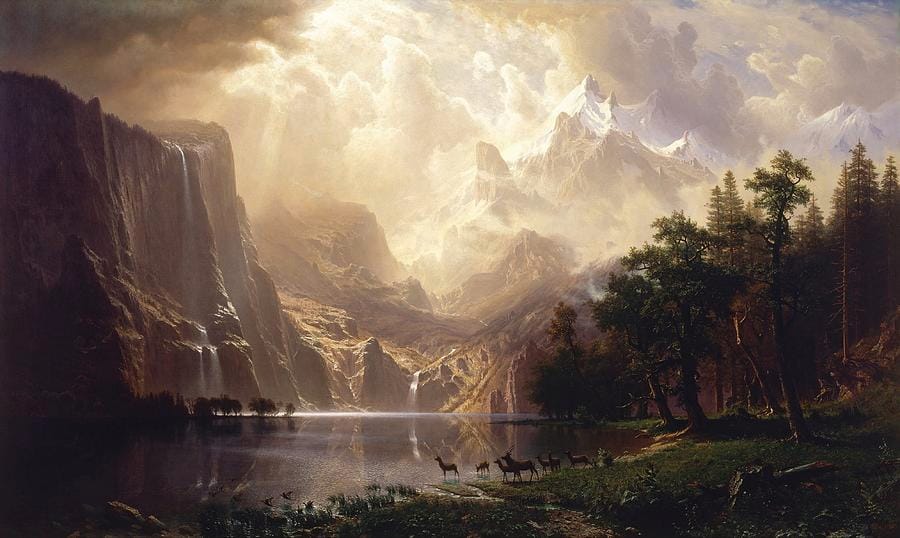
The first generation stayed close to home: the Catskills, the Adirondacks, the White Mountains. The second followed the railroads and the government surveys, and the canvases grew to match the country.
| Painter | Dates | Territory | Signature work |
|---|---|---|---|
| Thomas Cole | 1801–1848 | Catskills, Italy, allegory | The Course of Empire, 1833–36 |
| Asher B. Durand | 1796–1886 | Catskill woodland interiors | Kindred Spirits, 1849 |
| John F. Kensett | 1816–1872 | Newport, Long Island Sound, Lake George | Eaton’s Neck, Long Island, 1872 |
| Sanford R. Gifford | 1823–1880 | Catskills, the Nile, the Rockies | A Gorge in the Mountains, 1862 |
| Frederic Edwin Church | 1826–1900 | Niagara, the Andes, the Arctic, Maine | Heart of the Andes, 1859 |
| Albert Bierstadt | 1830–1902 | The Rockies, Yosemite, the Sierra Nevada | The Rocky Mountains, Lander’s Peak, 1863 |
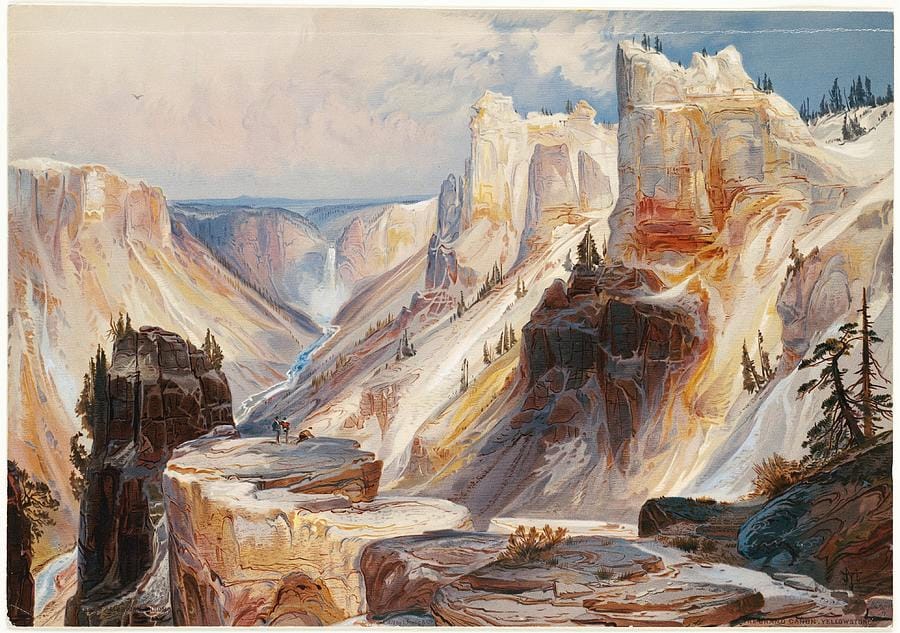
| Thomas Moran | 1837–1926 | Yellowstone, the Grand Canyon, Venice | The Grand Canyon of the Yellowstone, 1872 |
Church is usually described as Cole’s only formal pupil, giving the movement a line of descent from 1825 to 1900. Bierstadt and Moran are sometimes split off as the “Rocky Mountain School.” Membership is a matter of convention rather than record — nobody ever joined anything — but the method is the one Cole used in the Catskills, scaled up.
How to recognize a Hudson River School painting
The formula is consistent enough that once you know it you can identify one across a gallery.
- The sky takes the upper half. Often more. The light in the sky is the real subject; the land is what the light falls on.
- Distance dissolves into haze. Each successive range is paler, bluer and softer than the one in front — aerial perspective used as the main tool of depth.
- A dark framing element at one edge. A tree, a rock outcrop, an overhanging branch, kept in shadow to push everything else back.
- A broken or blasted tree in the foreground. Cole’s trademark, and a moral one: growth, decay and renewal in a single prop.
- Still water across the middle ground. A lake or river that doubles the sky and carries the light into the center of the picture.
- Tiny figures. Where people appear, they are small enough to make the landscape enormous — usually two or three, often on a ledge, looking at the view you are looking at.
- Invisible brushwork. The surface is smooth and enamel-like, with botanically and geologically accurate detail worked up from field sketches. The opposite of Impressionism, and contemporary with it.
- Warm autumn color. Gold, russet, copper. American autumn was itself treated as a national asset.
Formats are wide and often enormous — Church’s Heart of the Andes is nearly ten feet across — because these were exhibition machines, built to overwhelm.
The paintings that were news
The best of these pictures were not quietly hung in group shows. They were events — exhibited one at a time in a darkened, curtained room, lit, and charging admission.
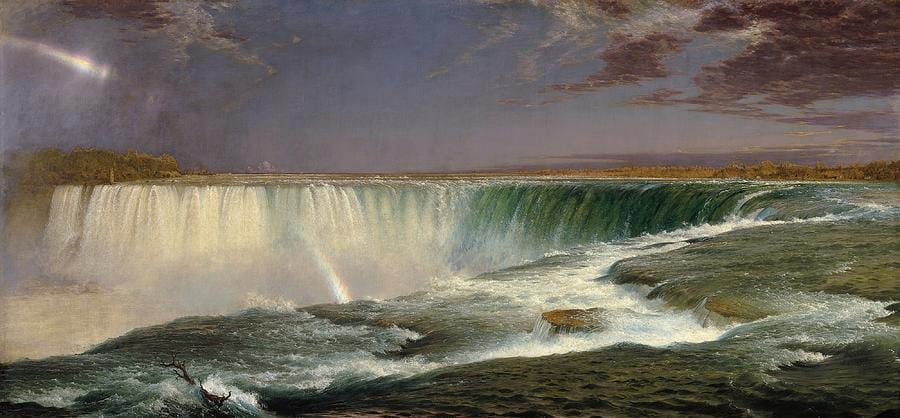
Church’s Niagara (1857) put the viewer out over the brink with no foreground to stand on, and went to London as proof that American painting had arrived. Heart of the Andes (1859) drew queues in New York, where visitors paid to file past it and were handed opera glasses to inspect the botany.
Bierstadt’s The Rocky Mountains, Lander’s Peak (1863) sold for $25,000, an enormous sum for an American painting at the time, and made him rich.
Moran went further and changed the map. He joined the 1871 Hayden Survey of the Yellowstone country, and his watercolors were shown to members of Congress as evidence of what was there. Yellowstone became the world’s first national park in March 1872. Three months later Congress bought his vast Grand Canyon of the Yellowstone for $10,000 and hung it in the Capitol.
It is a rare case of landscape painting doing practical work — the argument for conservation, made in oil before photography could make it.
Why it faded, and why it came back
By the 1880s the style looked finished. American collectors had discovered the Barbizon painters and then the Impressionists, and beside a loose French landscape the Hudson River manner seemed laborious. Bierstadt died in 1902 having outlived his market; Moran carried on into the 1920s as a survival from another century.
The revival came from the 1940s onward, as American museums began taking their own nineteenth century seriously. Part reappraisal, part recognition that the paintings are documents — records of specific valleys, glaciers and forests at specific dates, some of which no longer look like that.
They are also very good pictures to live with. The formats are wide, which suits the wall above a sofa; the palette is warm and near-neutral; and the deep hazy distance makes a small room feel as though it opens onto somewhere much larger.
Browse Hudson River School prints, or start with Bierstadt, Moran, Church and Cole.
Frequently asked questions
What is the Hudson River School?
The Hudson River School was America’s first native school of landscape painting, active from about 1825 to 1875. Its artists painted the Hudson Valley, the Catskills and later the American West in large, luminous, highly detailed canvases, treating wilderness as the country’s defining subject. It was never a formal school or an organization.
Who founded the Hudson River School?
Thomas Cole (1801–1848). In 1825 he sketched in the Catskills, and three resulting paintings displayed in a New York shop window were bought by John Trumbull, William Dunlap and Asher B. Durand — the moment usually given as the movement’s start. Cole’s only pupil, Frederic Edwin Church, became its greatest commercial success.
When was the Hudson River School active?
Roughly 1825 to 1875. The first generation — Cole, Durand, Kensett, Gifford — worked mainly in the north-east; the second — Church, Bierstadt, Moran — painted the Andes, the Arctic, the Rockies and Yellowstone. By the 1880s American taste had moved on to Barbizon and Impressionist painting.
Who were the main Hudson River School artists?
Thomas Cole, Asher B. Durand, John Frederick Kensett, Sanford Robinson Gifford, Jasper Francis Cropsey, Frederic Edwin Church, Albert Bierstadt and Thomas Moran. Church, Bierstadt and Moran are the best known today, largely because they painted the biggest and most spectacular canvases.
What are the characteristics of Hudson River School painting?
A sky filling the upper half of the canvas, distance dissolving into blue haze, a dark tree or rock framing one edge, a blasted stump in the foreground, still water across the middle, tiny human figures for scale, invisible brushwork, precise botanical and geological detail, and warm autumn color. Formats are wide and frequently very large.
Is Luminism the same as the Hudson River School?
No, though the two overlap. Luminism is a term coined by the art historian John Baur in the 1950s for a quieter strand — Kensett, Fitz Henry Lane, Martin Johnson Heade — marked by glassy still water, horizontal calm and invisible brushwork, with none of the drama of Church or Bierstadt. Several painters belong to both descriptions.
Hudson River School paintings were built wide and built to be seen from across a room, which makes them unusually easy to hang. Browse the movement as canvas, framed prints or art, in sizes up to 72 inches. If you are placing one above a sofa, our guide to how high to hang art above a sofa has the measurements.