Rosa Bonheur’s Ten Most Famous Paintings
The nineteenth century’s greatest painter of animals — horses, cattle, stags and lions, seen by an artist who knew them intimately.

Rosa Bonheur (1822–1899) was, for much of the nineteenth century, the most famous woman painter in the world. Born in Bordeaux and raised in Paris, she was taught by her father, a drawing master who belonged to a utopian sect that believed women should be educated exactly as men were. She learned her craft not in a studio but in cattle markets, stockyards and slaughterhouses, dissecting and measuring animals to understand how they were put together — and obtained an official permit to wear trousers so she could work in such places without being harassed.
Her animals are never props or symbols. They are individuals, painted with a knowledge of muscle, hide and temperament that no rival could match, and set in landscapes she studied with the same care. Success came early and never left: medals at the Salon, an international print trade that carried her images into thousands of homes, and the cross of the Legion of Honour delivered in person by the Empress Eugénie. Here are ten of her most famous works.
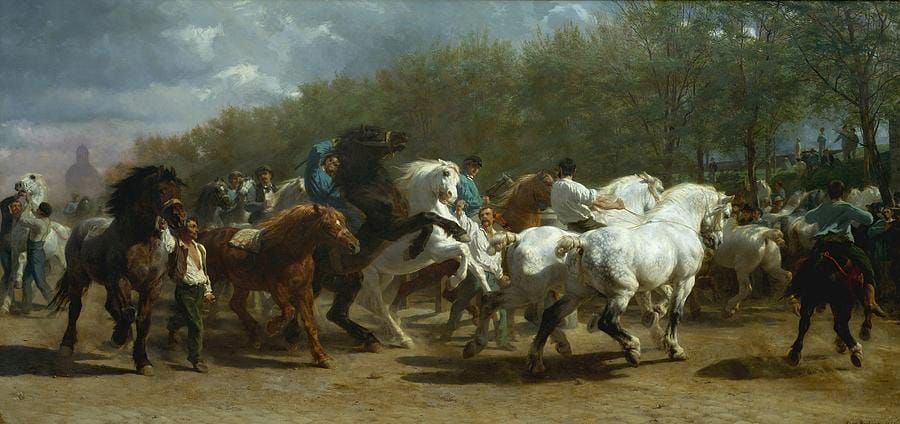
The Horse Fair
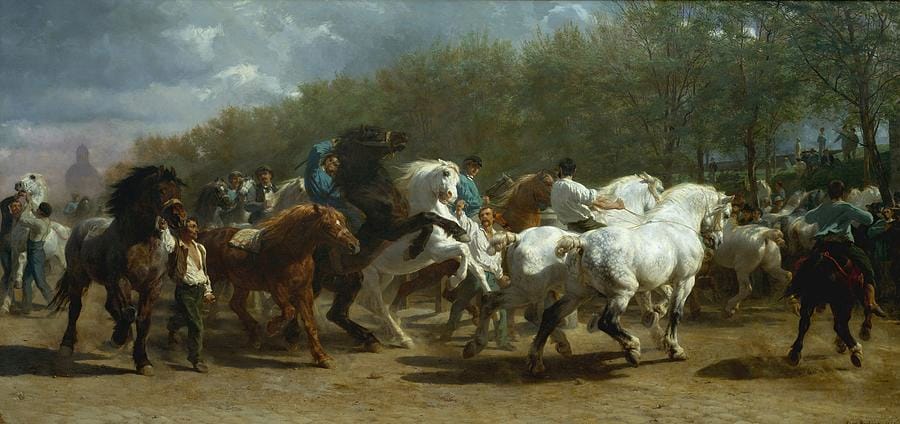
Percherons plunge and rear along a Paris boulevard as their handlers fight to hold them, a mass of muscle and dust rolling across a canvas over sixteen feet wide. Bonheur spent a year and a half at the horse market on the Boulevard de l’Hôpital gathering studies for it, dressed in men’s clothing to move safely among the dealers, and exhibited the finished picture at the Salon of 1853. It made her famous on two continents; engravings sold in enormous numbers, and the painting eventually reached the Metropolitan Museum of Art in New York, where it still dominates the room.
A Limier Briquet Hound
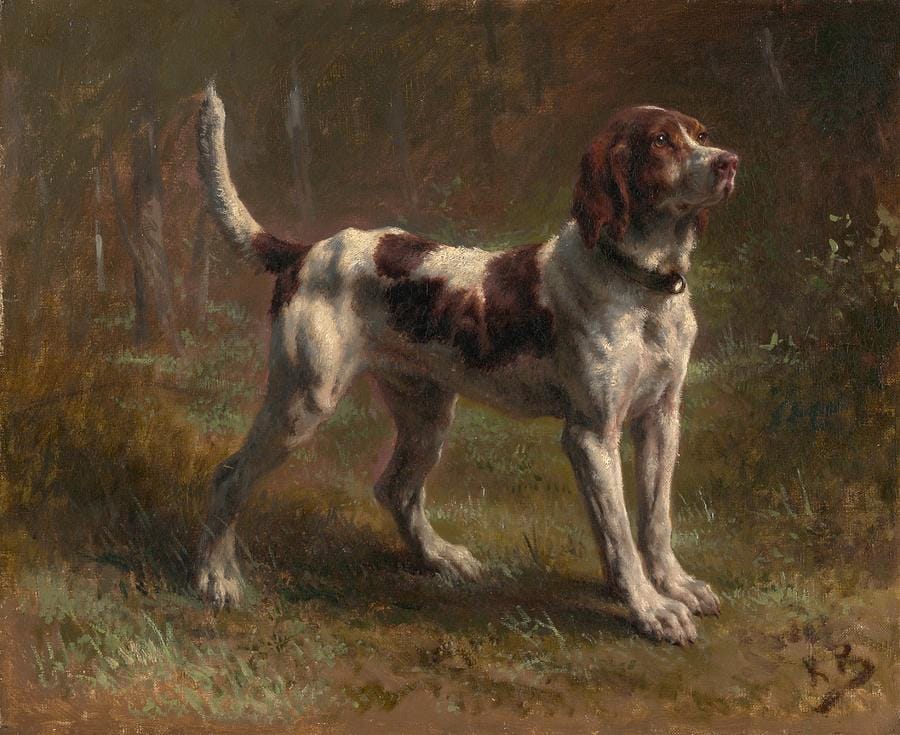
A liver-and-white hound stands alert at the edge of a wood, tail up like a flag, muzzle raised, its whole body angled toward something out of sight. Painted in the mid-1850s, it is a portrait in every sense that matters: the dog has a personality, a mood and a job. Bonheur understood hunting dogs from long observation in the forest of Fontainebleau, and she gives this one the dignity usually reserved for a general. The picture is now in the Metropolitan Museum of Art, and it is among the most beloved dog paintings of the nineteenth century.
Weaning the Calves
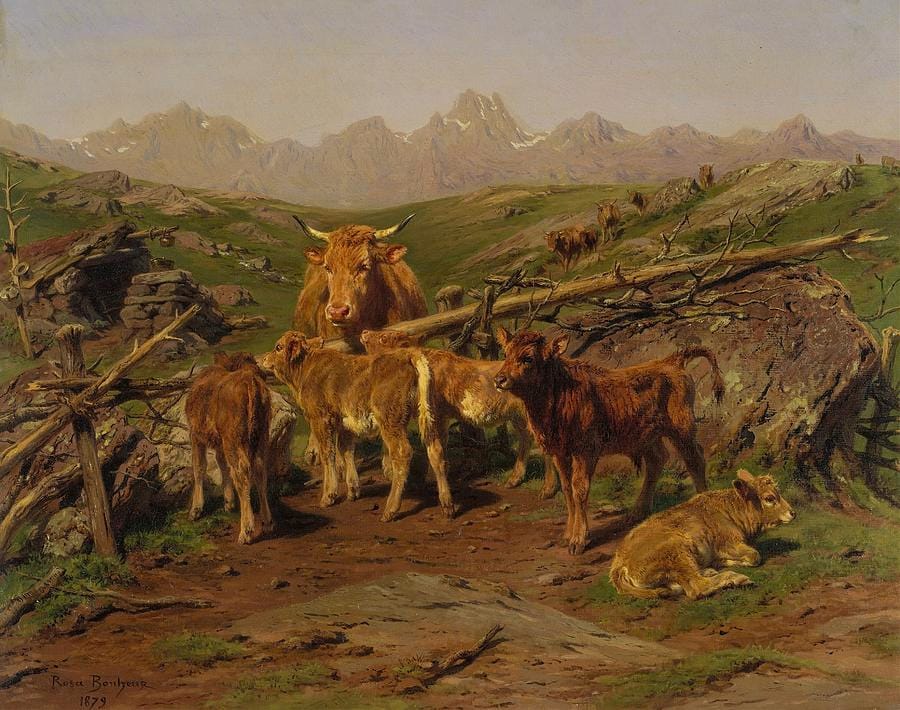
In a high Pyrenean pasture, cows and their half-grown calves are being separated, some pressing against a rough timber fence, others already lying resigned in the grass, with blue peaks stacked along the horizon. It is a scene of ordinary farm business that Bonheur turns into something close to a drama, simply by paying attention to which animal is anxious and which has given up. She painted it in 1879, and the canvas — now in the Metropolitan Museum of Art — shows how far her landscape painting had developed alongside her animals.
The Wounded Eagle
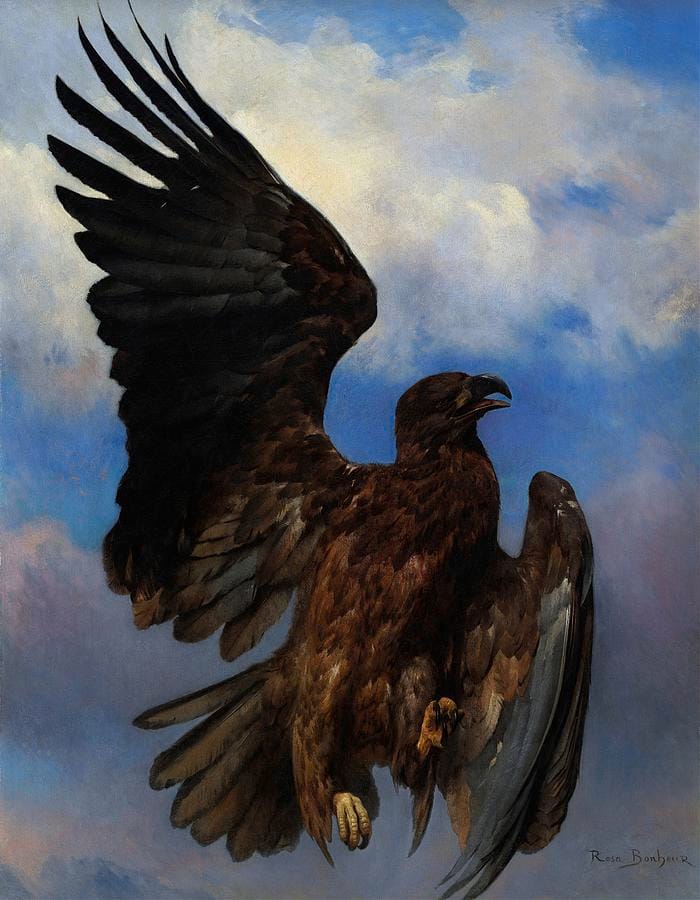
An enormous golden eagle beats one great wing high against a blue sky banked with cloud, the other dragging below it, head lifted and beak parted. There is no landscape at all — just bird and air. Painted around 1870, at the time of the Franco-Prussian War, it has often been read as an emblem of a defeated empire, though Bonheur left no explanation. Whatever it means, it is the most emotionally direct picture she ever made, and its combination of anatomical precision and raw feeling has kept it among her most reproduced works.
Relay Hunting
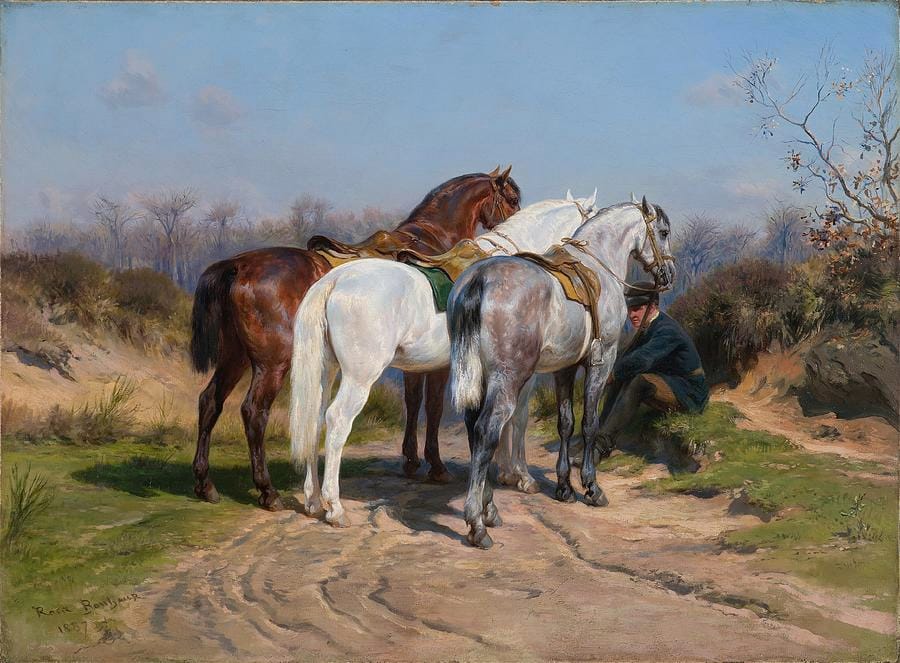
Fresh horses wait at the roadside for a hunt to come through, blanketed against the cold, their handler crouched beside them in the scrub while bare trees line a sandy track under a wide winter sky. Bonheur painted the subject in the 1880s, and it is characteristic of her mature work: she skips the chase entirely and paints the waiting. The picture is really about the horses’ patience and the pale, clear light of a French winter morning, and the grouping of the animals — gray, bay and dark brown — is a small masterclass in arranging a composition by color.
Highland Cattle
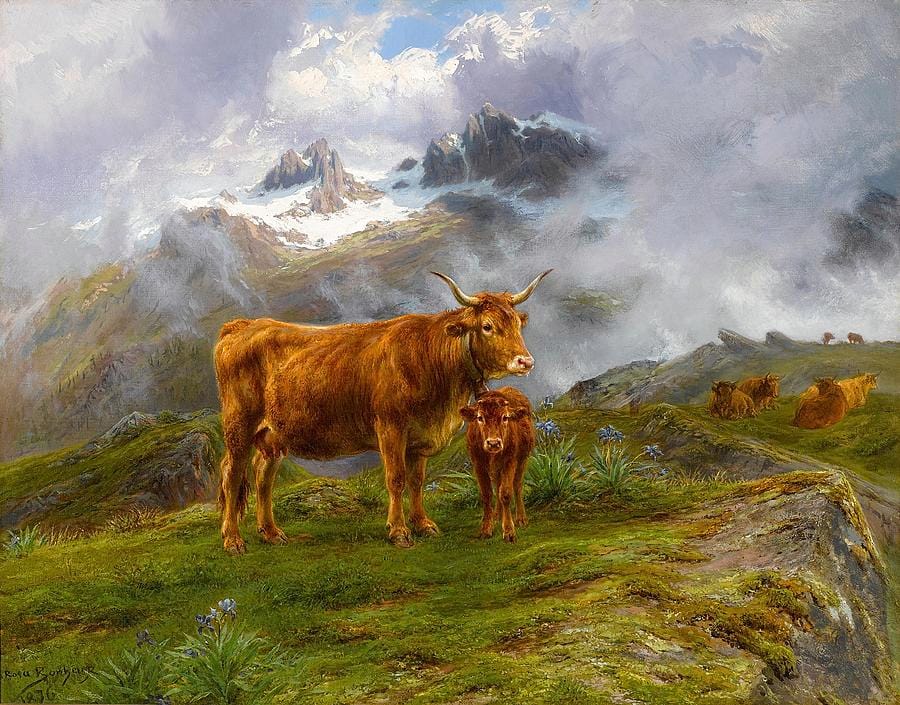
A shaggy red Highland cow and her calf stand on a rocky outcrop with mist boiling up from the glen behind them and a snow-streaked peak beyond. Bonheur traveled through Scotland in the 1850s and was captivated by the landscape and its livestock, returning to Highland subjects for the rest of her career; Queen Victoria was among the admirers of that work. The long horns and matted coats gave her exactly what she loved to paint — texture and character — and the picture pairs an intimidating animal with an unmistakably tender maternal moment.
Monarchs of the Forest
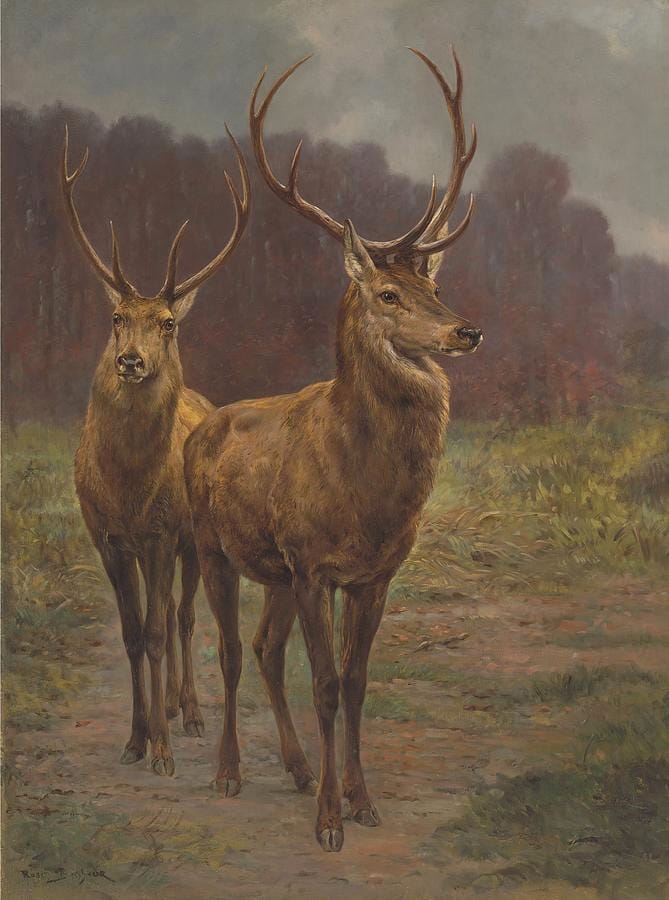
Two red deer stags stand together at the edge of a wood in autumn, antlers raised, both looking steadily out of the canvas at whoever has disturbed them. Bonheur kept deer among the animals at her estate near Fontainebleau, where they wandered the grounds and could be studied at close range for years rather than minutes — which is why her stags have none of the stiffness of pictures painted from taxidermy. The russet of the coats against the smoky autumn wood makes it one of her warmest and most decorative compositions.
Sheep in a Meadow
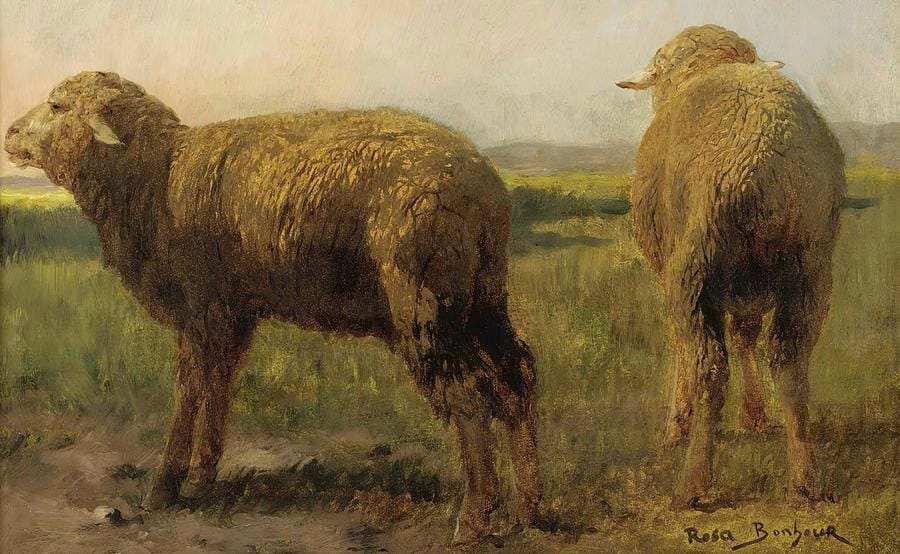
Two heavy-fleeced sheep graze in long grass, one facing the viewer and one turned away, with a flat green plain running back to a hazy line of trees. It could hardly be a simpler subject, and that is the point: Bonheur is showing what she can do with wool, with the weight of a standing animal, and with a summer light that has no drama in it whatsoever. Sheep were among her earliest and most constant subjects — she kept them on her own land — and small pastoral canvases like this one sold steadily throughout her career.
Lion in a Mountainous Landscape
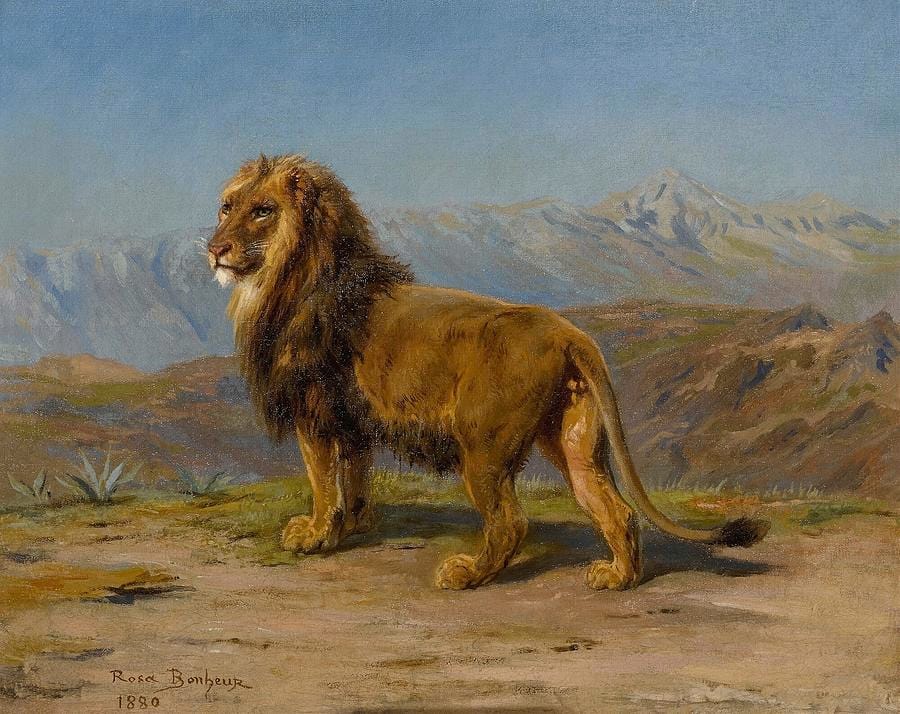
A full-maned lion stands squarely on a stony ridge, shown in profile with the head turned into the light, a wide valley and a range of snow-capped mountains stretching away behind him. Bonheur painted big cats from life: she kept lions at her château at By, near Fontainebleau, and was famously photographed with one of them lying at her feet like a house cat. Painted around 1880, this is one of a series of lion pictures from her later years in which the animal is treated as a portrait subject — imposing, but observed rather than romanticized, and set in a landscape that gives him room to be magnificent.
Oxen Pulling a Cart
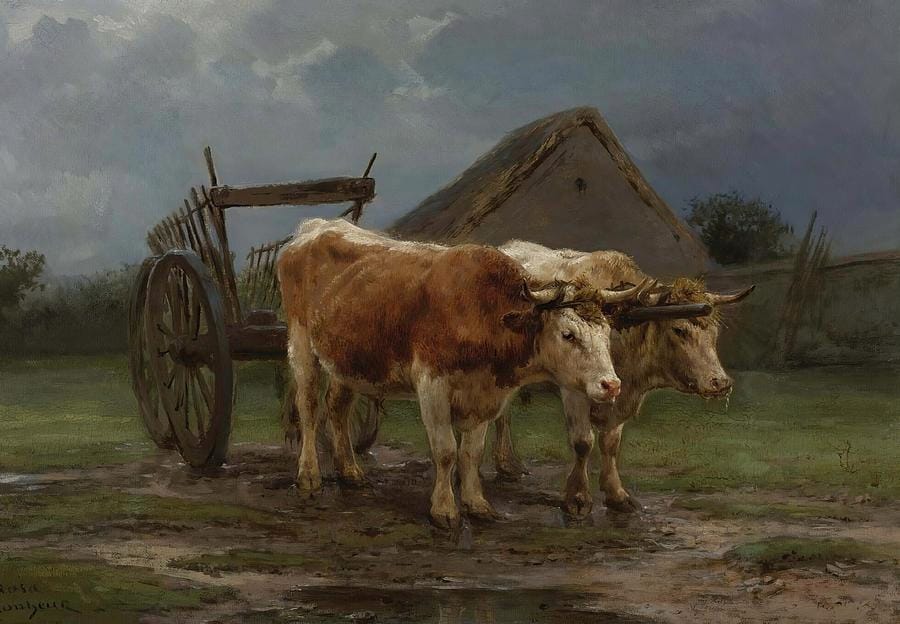
A yoked pair of oxen — one red and white, one pale cream — stand hitched to a two-wheeled wooden cart on a churned, muddy track, a thatched barn behind them and a bruised storm sky overhead. Working oxen made Bonheur’s name before horses did — her great early success was a picture of a plow team straining across a field in the Nivernais — and she returned to them all her life. The appeal is obvious in a canvas like this: enormous power held completely still, and a farmyard rendered with the plain, unhurried honesty that made her a hero to French country audiences.
Bonheur lived on her own terms — smoking, hunting, cropping her hair short, sharing her home first with Nathalie Micas and later with the American painter Anna Klumpke — and she did it while being one of the most decorated artists in France. Her paintings still have a rare warmth: they carry the outdoors into a room, and they suit a kitchen, a study or a country hallway as naturally now as they did in 1860.
Shop Rosa Bonheur prints here, and explore the rest of our famous paintings collection for more of the world’s most beloved masterpieces.