Pompeo Batoni’s Ten Most Famous Paintings
The painter every young Englishman on the Grand Tour wanted to sit for: ten works by the last great master of eighteenth-century Rome.

Pompeo Batoni (1708–1787) was born in Lucca, the son of a goldsmith, and went to Rome in his early twenties to draw after the antique. He never left. For half a century he was the most sought-after painter in the city, turning out altarpieces, mythologies and allegories in a clear, polished, deliberately classical style that stood against the froth of the Rococo — and that the next generation, Neoclassicism, would take as a starting point.
His lasting fame, though, rests on portraits. Rome was the final destination of the Grand Tour, and for decades no young British gentleman’s education felt complete without a full-length by Batoni: standing at ease among Roman marbles, one hand on a hip, a spaniel at his feet and the Colosseum somewhere over his shoulder. He is thought to have painted around two hundred British sitters alone, and the results are both superb pictures and the best surviving record of what the Grand Tour looked like to the people taking it. Here are ten of his most famous works.
Portrait of Sir Wyndham Knatchbull-Wyndham
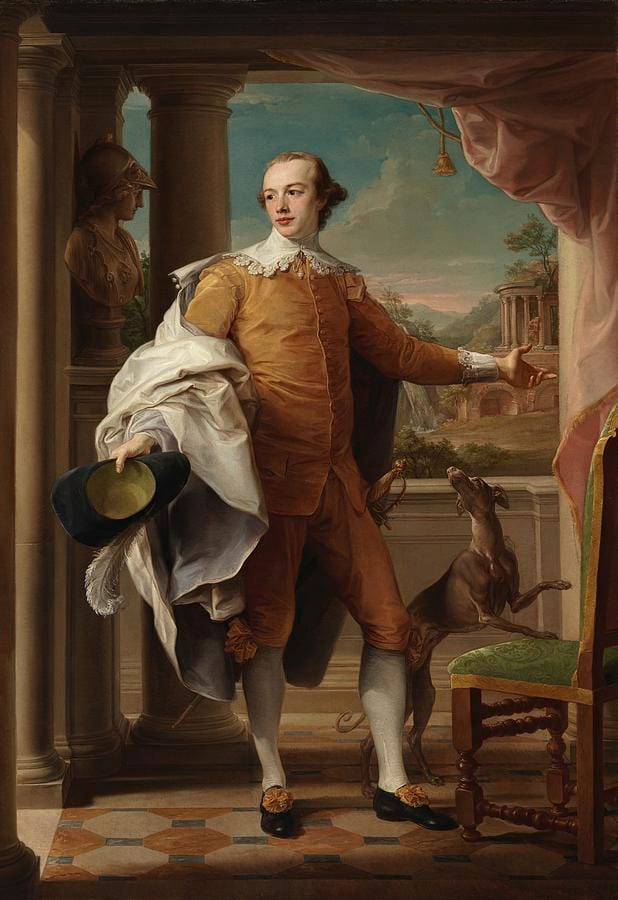
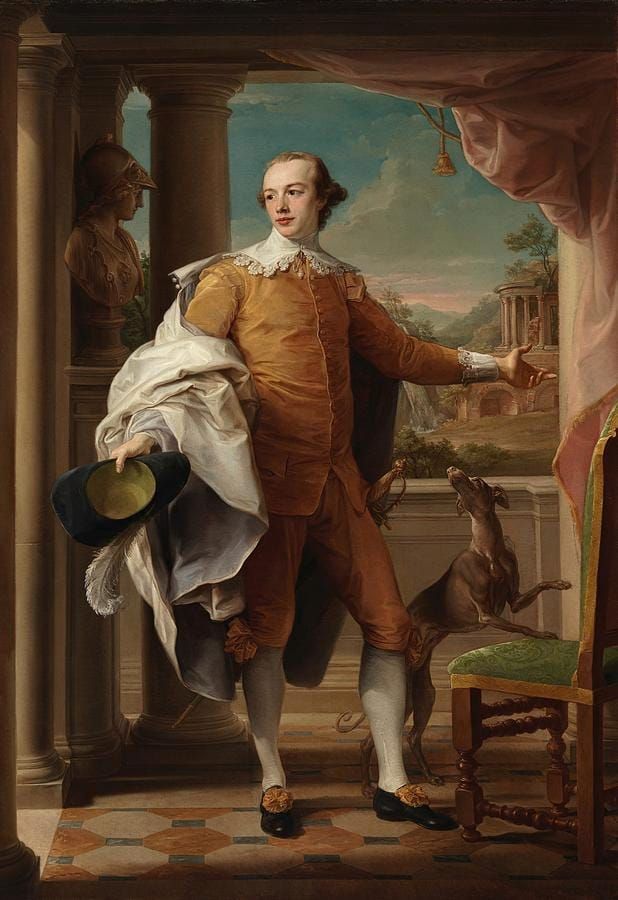
Painted at the end of the 1750s, this is the picture that fixed the formula. Sir Wyndham Knatchbull-Wyndham, a young Kentish baronet in Rome, stands full length in a golden-brown suit with a plumed hat and a cloak over one arm, gesturing out toward a landscape of Roman ruins as though inviting the viewer to admire the view with him. A helmeted antique bust watches from a plinth behind his shoulder and a greyhound presses against his leg. The pose is relaxed, the tailoring immaculate, the classical credentials unmistakable. Batoni had found a way to flatter a sitter and certify his education in a single image, and for the next thirty years half the young men of Britain would ask for something very like it.
Diana and Cupid
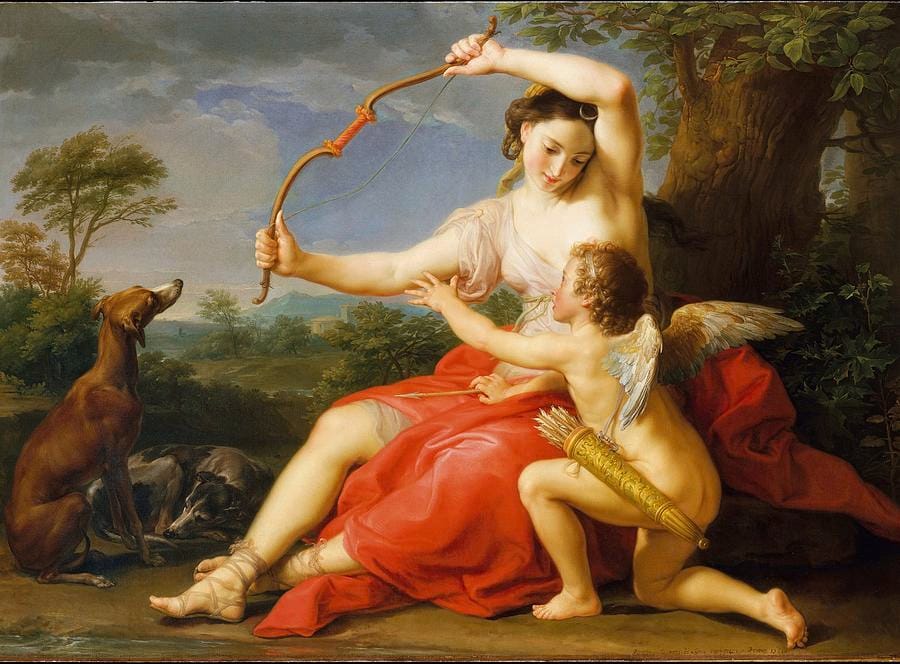
Batoni’s mythologies are as fine as his portraits, and this one from 1761 is the best loved. Diana, goddess of the hunt and of chastity, has caught Cupid trying to make off with her arrows; she holds his bow out of reach with one raised hand while he strains across her lap to grab it, wings still spread. Two hounds watch from the shadows behind. The whole thing is a joke about desire and self-control, told with beautifully drawn limbs, cool silvery flesh and a red drapery that anchors the composition. It belongs to the Metropolitan Museum of Art in New York.
Portrait of John Talbot, Later 1st Earl Talbot
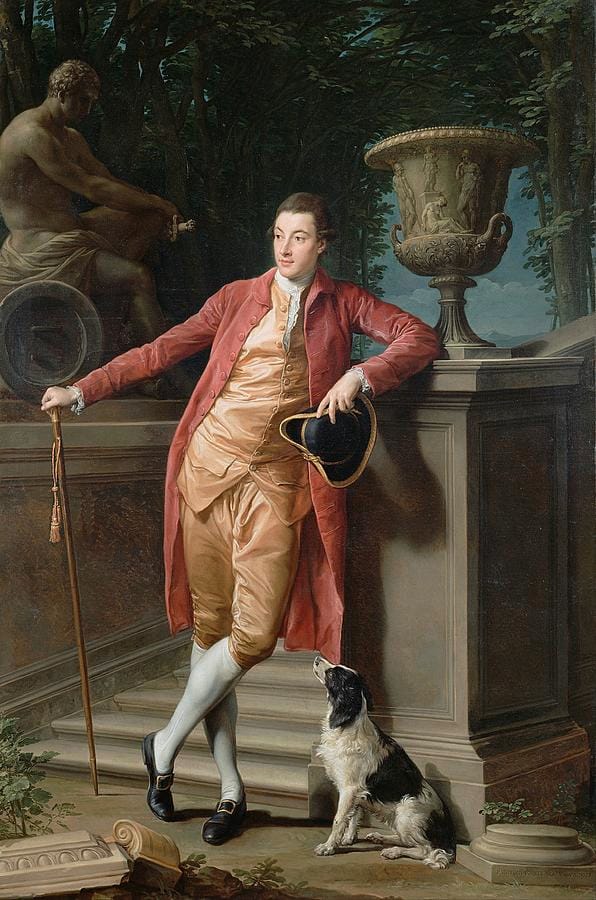
One of the grandest of all Grand Tour portraits, painted in 1773. Talbot stands on a flight of steps in a rose-pink suit, hat in hand, leaning on a cane beside a colossal antique marble vase, with a spaniel looking up at him from the ground. The rhyme between the fluted vase and the sitter’s own upright elegance is entirely deliberate — the man and the antiquity are presented as equals. Batoni’s handling of the silk, the embroidery and the dog’s coat is at its most virtuosic here. The painting is now in the J. Paul Getty Museum in Los Angeles.
Sir Sampson Gideon and an Unidentified Companion
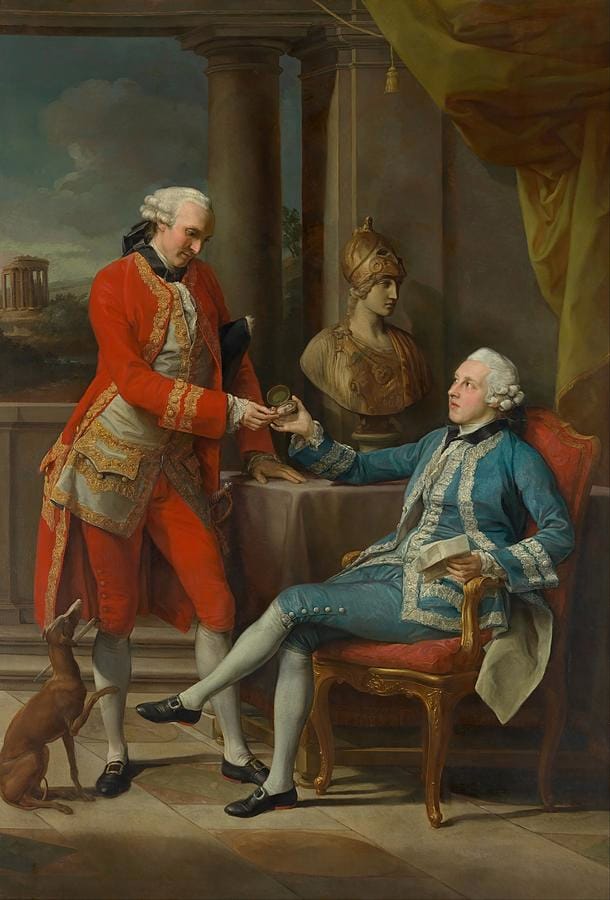
This double portrait of 1767 is Batoni at his most sociable. A young Sir Sampson Gideon, in a scarlet coat, stands and turns to speak to a seated companion in blue who looks back over his shoulder; between and behind them a marble portrait bust presides over the conversation. Nobody has securely identified the second man, which only adds to the picture’s air of two friends caught mid-sentence. Batoni rarely let two full-length sitters share a canvas, and the ease of the exchange here — one standing, one seated, both entirely comfortable — is what makes it memorable.
Portrait of Abbondio Rezzonico
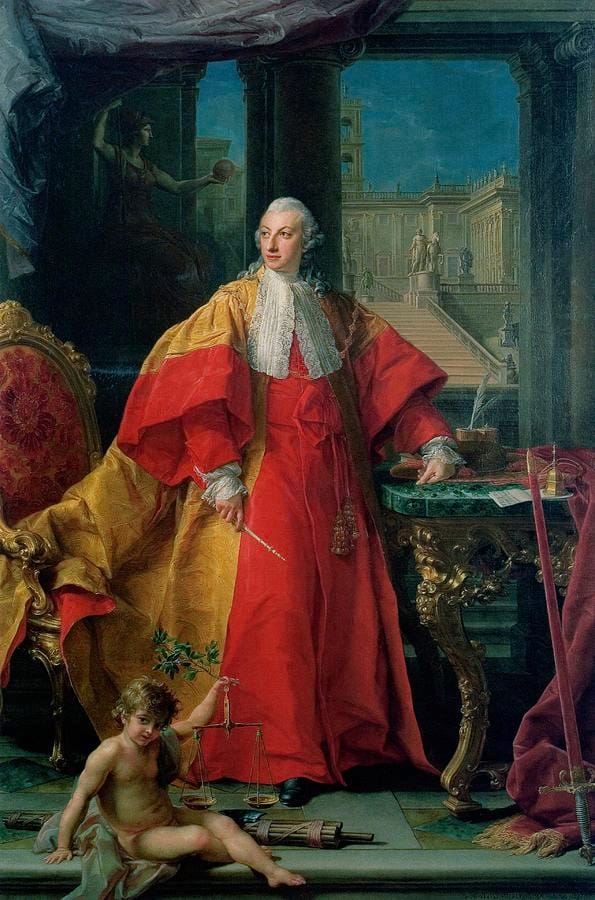
Not every Batoni sitter was a visiting Briton. Abbondio Rezzonico, a nephew of Pope Clement XIII, was appointed Senator of Rome — the city’s highest civic office — while still in his twenties, and Batoni painted him in the 1760s in the full scarlet and gold of that office, standing in a marble hall with a sweep of red drapery behind him and a view opening beyond. It is the most theatrical picture in this list, and a useful reminder that Batoni was first and foremost a Roman painter serving the papal court, whatever the Grand Tourists thought.
Edward Weld
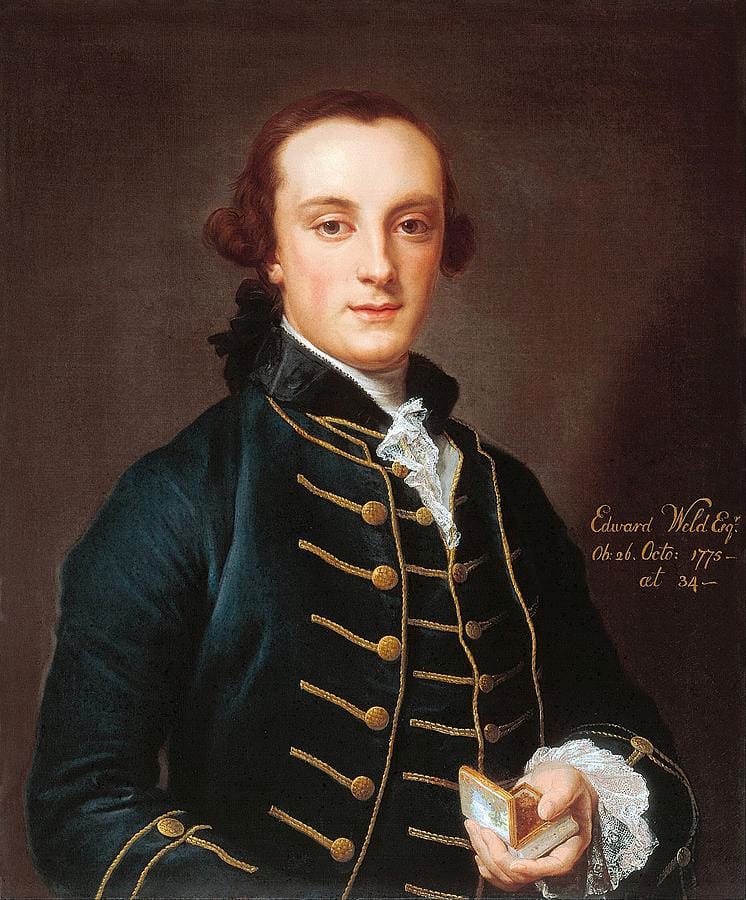
A quieter, half-length portrait of a young Englishman in a dark blue coat with gold buttons and a fall of lace at his wrist, painted in Rome while Weld was on his tour. The inscription in the background was added afterward and turns the picture into a memorial: it records his death on October 26, 1775, at the age of thirty-four. Weld had married only months earlier; his widow, Maria Anne, later became famous as Maria Fitzherbert, who went through a secret marriage with the future George IV. Of all Batoni’s sitters, few had stranger afterlives.
William Weddell
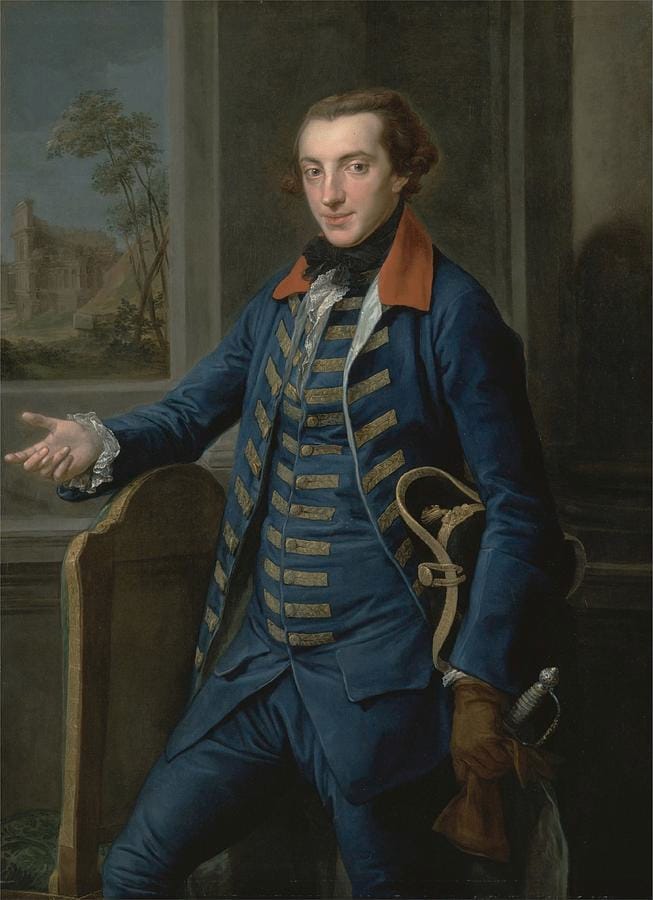
Weddell was a Yorkshire landowner who came to Italy in the mid-1760s and went home with one of the great private collections of Roman sculpture, bought largely through the dealer-restorers of Rome. Batoni shows him in a blue coat with a red collar, one arm extended in a courteous open gesture, a sword at his side. The portrait and the marbles ended up in the same house, Newby Hall, where Weddell built a domed gallery to display them — so the picture and the collection it commemorates can still be seen a few rooms apart.
Portrait of a Lady as Diana the Huntress
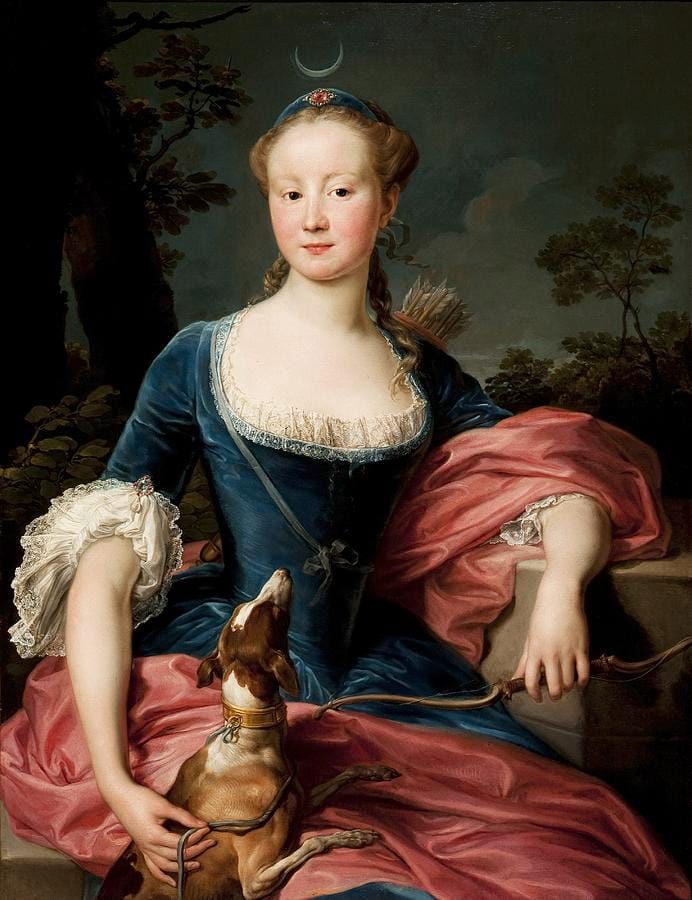
Women sat to Batoni too, and often chose to appear in the costume of a goddess. Here a young woman in a deep blue gown and a great sweep of rose-pink drapery is presented as Diana: a thin crescent moon hangs in the sky above her head, a quiver of arrows shows at her shoulder, a hunting bow rests across her lap, and a collared hound looks up adoringly from her knees. The device let a sitter be painted in something more timeless than the fashions of the season, and it flattered her as chaste, spirited and out of doors all at once. Her identity is no longer certain, but the picture is one of Batoni’s most charming female portraits.
The Return of the Prodigal Son
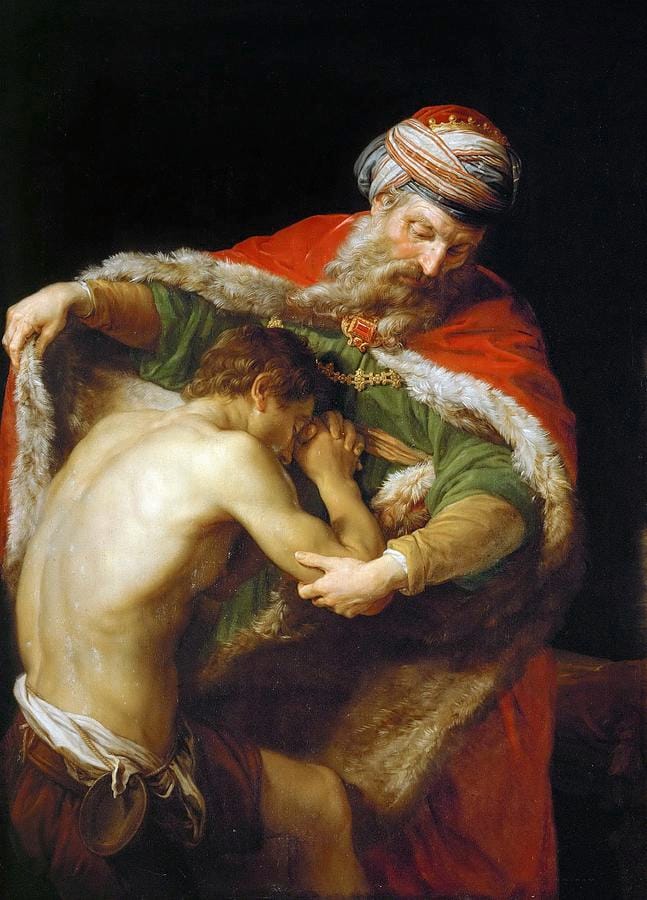
Batoni reduced Christ’s parable to two figures and nothing else. The son, stripped to the waist and sunburnt, sinks against his father’s chest with his face hidden; the father, in a turban and a fur-lined red robe, gathers him in with both arms and closes his eyes. There is no crowd, no fatted calf, no architecture — only the embrace, lit against a dark ground. Painted in 1773, it is the most moving religious picture of his late career, and the contrast of the son’s bare, weathered back against the father’s heavy embroidered sleeve does almost all the emotional work. It hangs in the Kunsthistorisches Museum in Vienna.
The Triumph of Venice
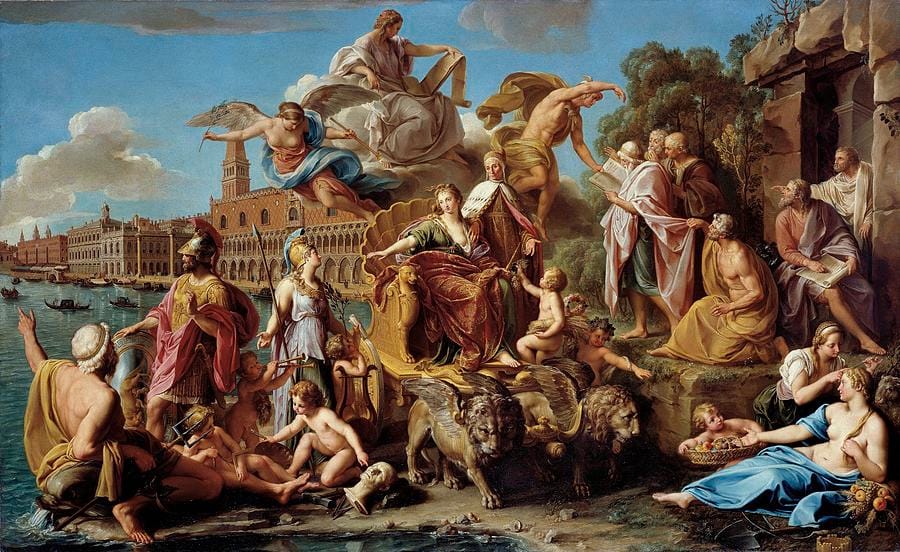
This crowded allegory from 1737 comes from the very start of Batoni’s career, when he was still in his twenties and making his name. Venice appears enthroned in the middle of a tumult of gods, tritons, nereids and putti, with the domes and campanile of the city itself set along the horizon behind. It is bright, busy and openly indebted to Veronese, and it shows how much ambition the young painter had for grand decorative work before portraiture claimed most of his time. Anyone who knows Batoni only from his cool, contained Grand Tour sitters will find it a surprise. The picture is in the North Carolina Museum of Art.
Batoni is the great chronicler of a moment when educated Europe went to Rome to finish its education, and his pictures still carry that atmosphere: warm light on marble, good tailoring, unhurried confidence. A Batoni portrait brings real presence to a dining room or a study, and his mythologies are among the most graceful pictures of their century.
Shop Pompeo Batoni prints here, and explore the rest of our famous paintings collection for more of the world’s most beloved masterpieces.