Pierre Bonnard’s Ten Most Famous Paintings
Lamplit rooms, laid tables, and the blazing light of the south: ten paintings by the great colorist of ordinary life.

Pierre Bonnard (1867–1947) was studying law when he sold a champagne poster and decided to become a painter instead. He joined the Nabis — a small band of young artists who took their name from the Hebrew word for “prophets” and believed a painting was first of all a flat surface covered with color. Bonnard loved Japanese prints so much that his friends nicknamed him “the very Japanese Nabi,” and the flattened space, high viewpoints, and decorative pattern of those prints never left his work.
What did leave was the muted palette of his early years. Bonnard rarely painted in front of his subject; he made quick notes in a pocket diary and then built the picture in the studio from memory, tacking unstretched canvas straight to the wall and working on several at once. The result is a body of work about ordinary life — a table laid for breakfast, a woman drying herself, a window open onto the sea — rendered in color of extraordinary intensity. Here are ten of his best-known paintings.
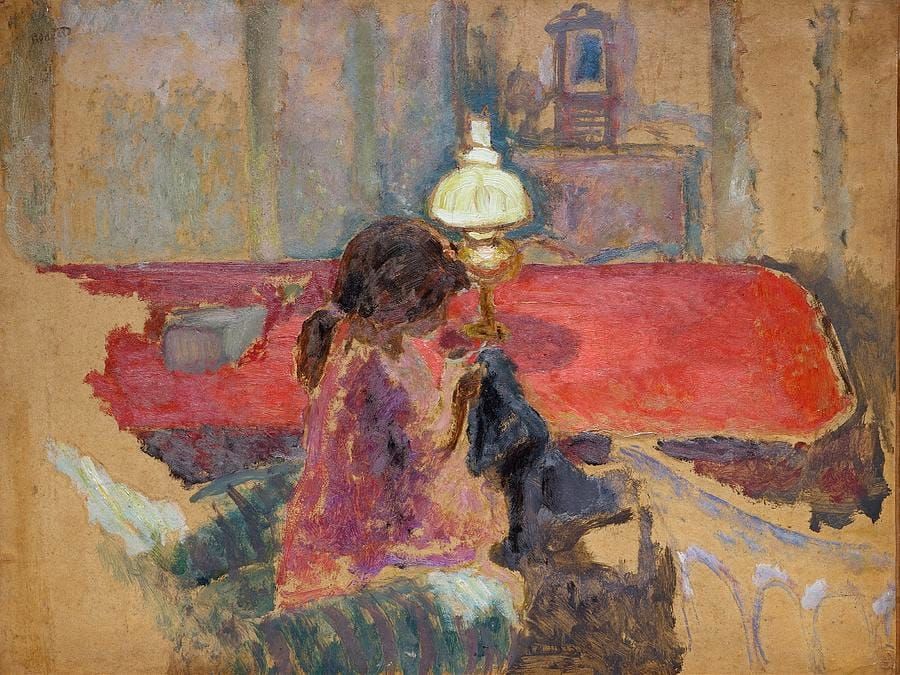
Woman with a Lamp
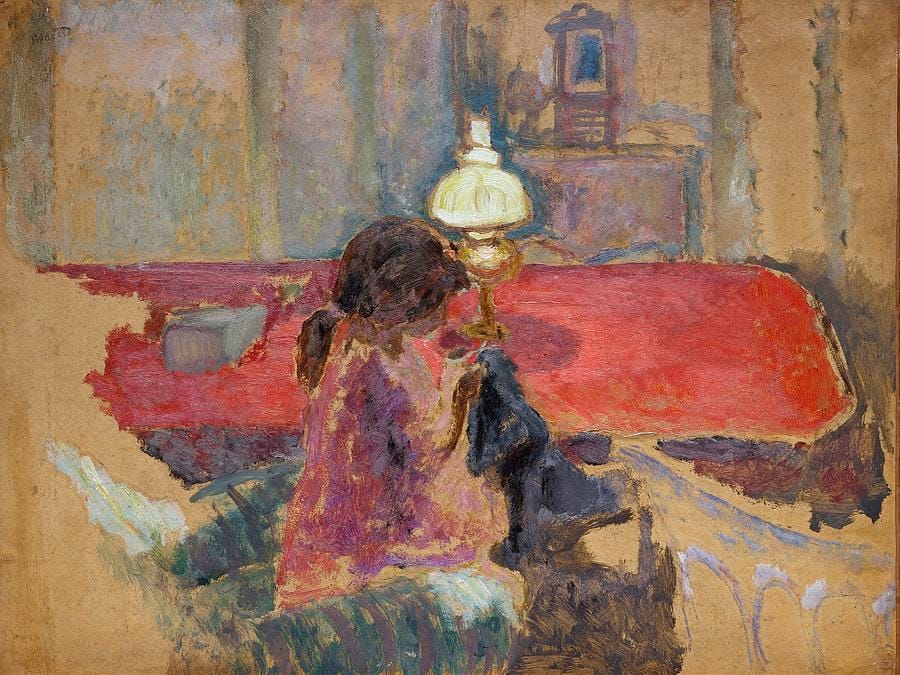
A young woman in a rose-colored wrap leans across a table toward the glass globe of an oil lamp, the whole room organized around that one small pool of light. Behind her a crimson coverlet fills half the canvas and the furniture dissolves into shadow. Bonnard painted dozens of these lamplit rooms in the 1890s, and they gave the Nabis their nickname of “intimists” — painters of the closed, upholstered, faintly conspiratorial spaces of private life. Nothing happens in the picture. The subject is the light itself, and the way a lamp turns a familiar room into somewhere slightly strange.
Le Corsage Rayé (The Striped Blouse)
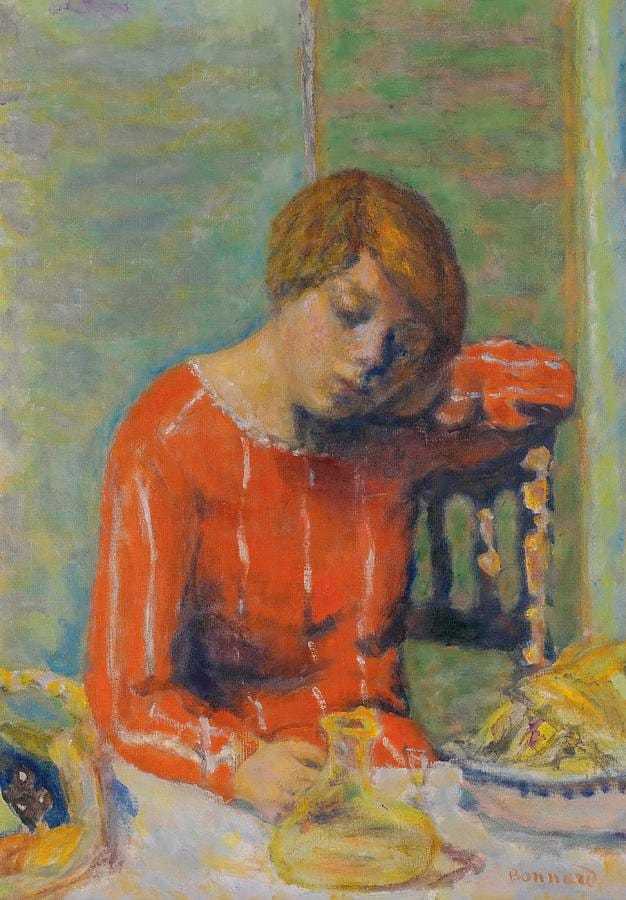
A young woman in a red-and-white striped blouse bends over a table, her hair falling forward, a yellow jug and a shallow bowl of fruit in front of her. She is not posing and she is not looking at us — she is doing something ordinary and absorbing, which is where Bonnard always preferred to catch people. The picture belongs to his later, high-color years, when the wall behind a figure could be green and lilac at once and the light seemed to come from inside the paint. The striped blouse, repeated in dry strokes across the figure, does most of the drawing on its own.
Woman and Dog at Table
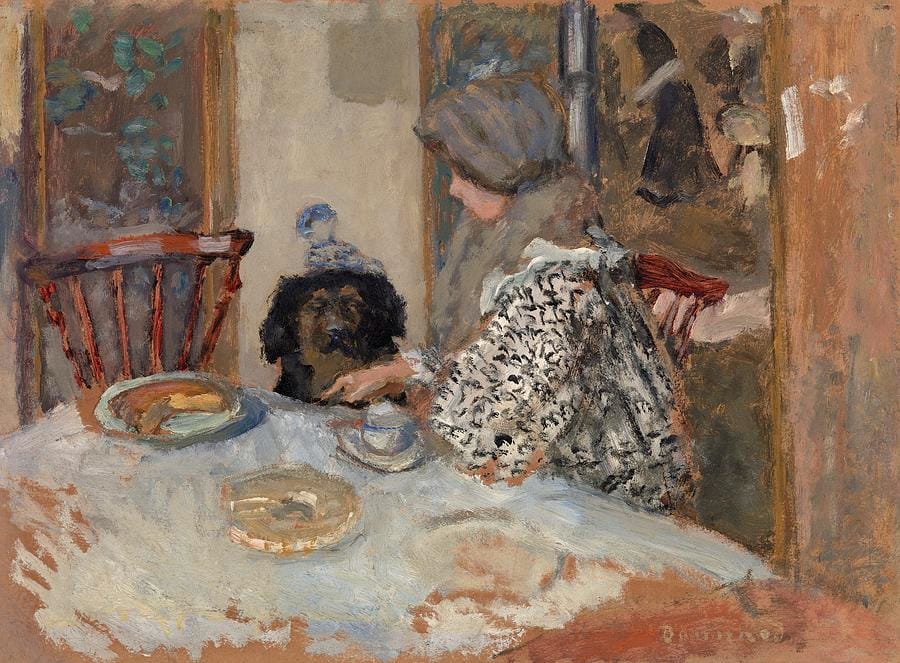
A small black dog sits bolt upright at the table, front paws on the cloth, level with the woman leaning in beside him. The tablecloth swells across the bottom of the canvas in broad strokes of white, cream, and pink, tipped up so steeply that the plates seem about to slide into the viewer’s lap. Bonnard kept dachshunds and basset hounds all his life and painted them constantly, always as full members of the household. The joke of the picture — that the dog has the better seat and the more attentive expression — is entirely deliberate, and entirely characteristic.
Femme Sortant du Bain (Woman Getting Out of the Bath)
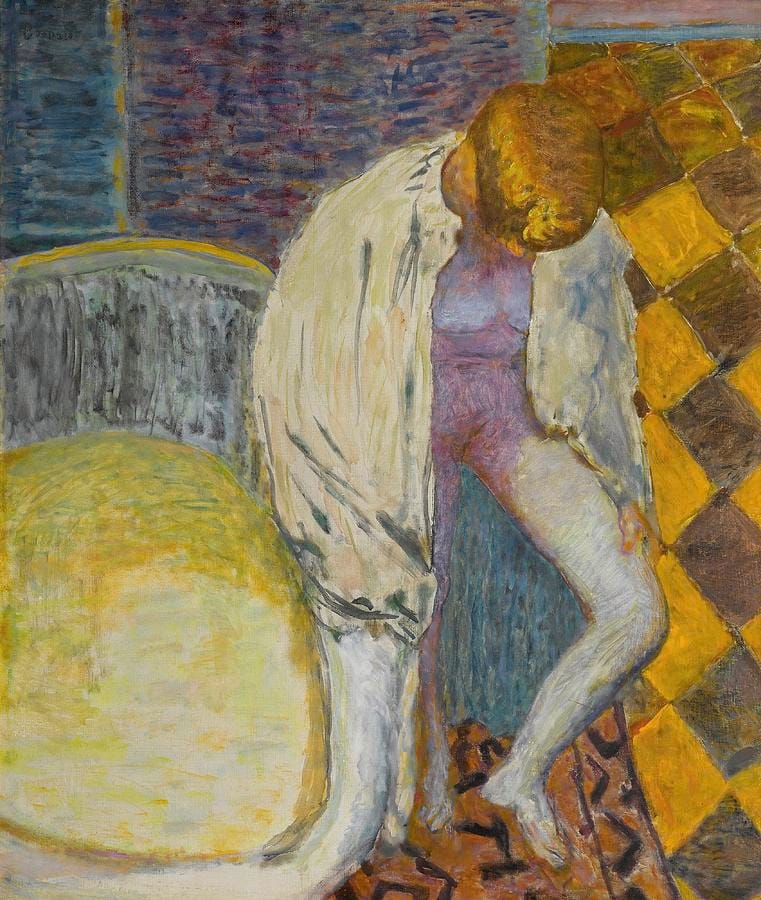
Bonnard met Marthe de Méligny in 1893, lived with her for nearly half a century, married her in 1925, and painted her hundreds of times, very often washing. Here she rises from a yellow tub with a great cream towel thrown over her head and shoulders, one leg reaching down toward a patterned rug, the wall behind her a bold checkerboard of yellow and olive tiles. The bathroom gave Bonnard everything he wanted: enclosed space, tiled color, water, and a figure too busy to pose. These bathing pictures are now considered the summit of his work, and the least sentimental nudes painted by anyone of his generation.
Nature Morte, Trois Grappes de Raisin (Still Life with Three Bunches of Grapes)
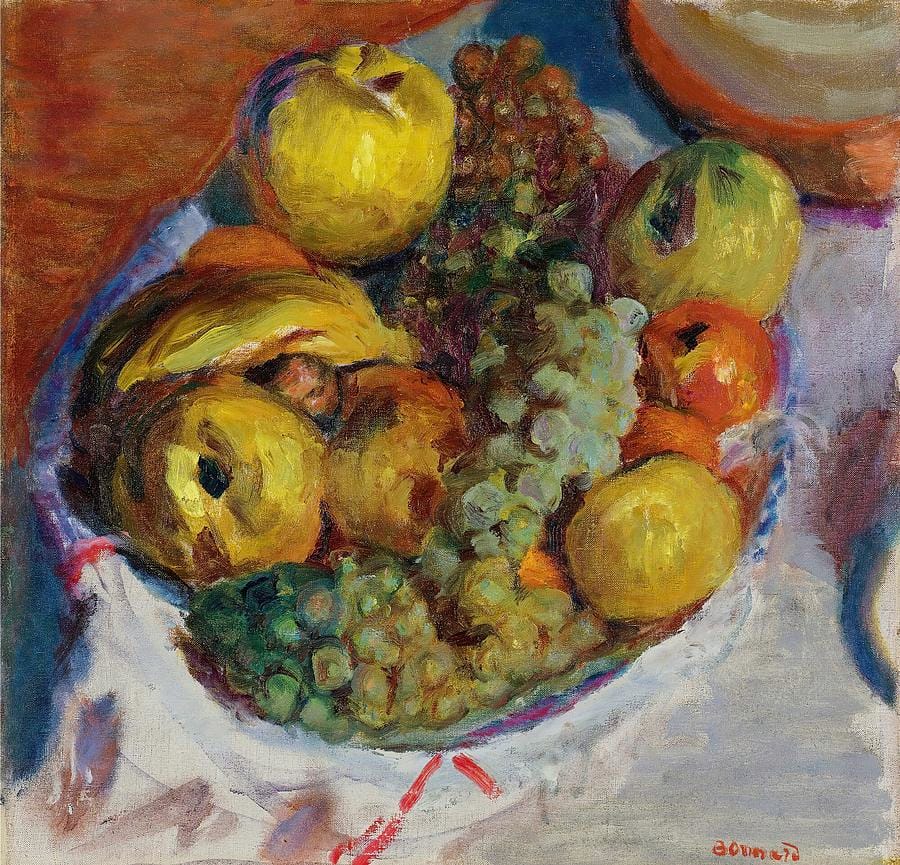
Quinces, apples, and three heavy bunches of grapes are heaped on a white cloth, seen from so high an angle that the fruit fills the picture almost edge to edge. There is barely any room, barely any shadow, and only a glimpse of the dish behind — just the crowded, glowing mass of it. Bonnard’s late still lifes work this way: he takes the most conventional subject in painting and pushes the viewpoint until the ordinary becomes disorienting. Look for a moment and the white cloth turns lilac and green; the fruit is painted in dabs of orange, yellow, and red that never quite settle into solid objects.
Bord de Mer, sous les Pins (Seashore, Under the Pines)
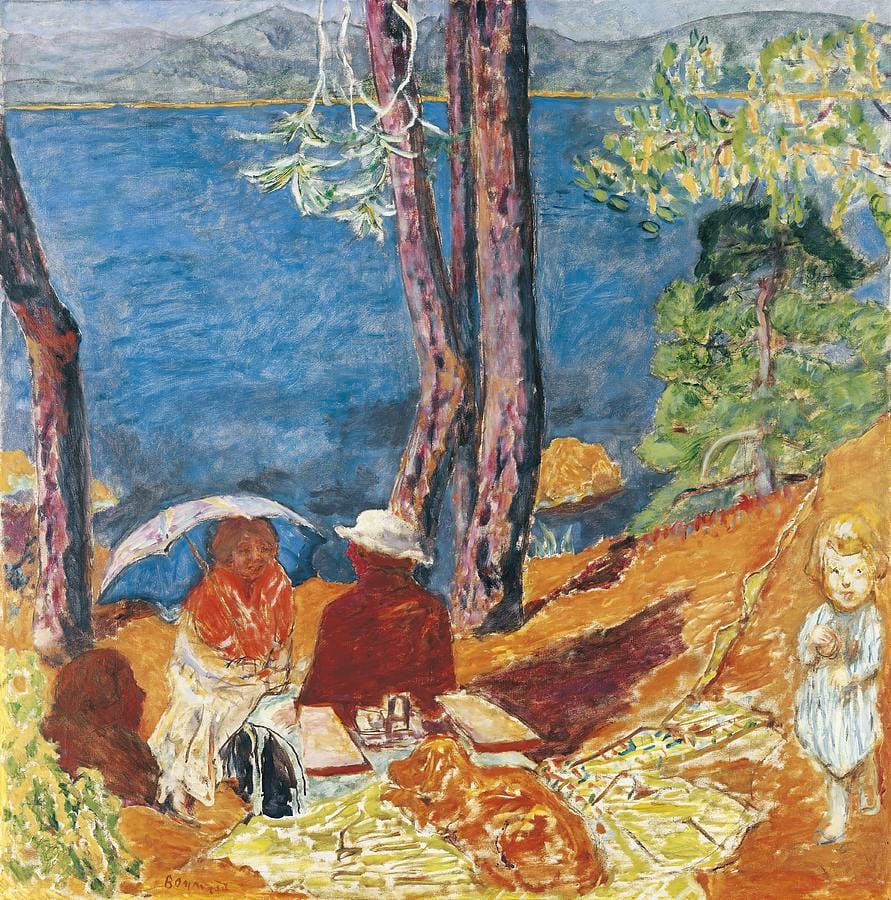
From 1926 Bonnard owned a small villa called Le Bosquet at Le Cannet, in the hills above Cannes, and the Mediterranean transformed his palette for good. This picture looks down through the trunks of umbrella pines to a bay of flat blue water, with figures picnicking on an orange terrace in the foreground. The trunks slice the canvas into vertical bands, a device straight out of Japanese printmaking. Bonnard used the south the way Matisse did — not as a place to record but as a permission to paint hot orange and cool blue side by side and let them fight.
Soleil Couchant (Sunset)
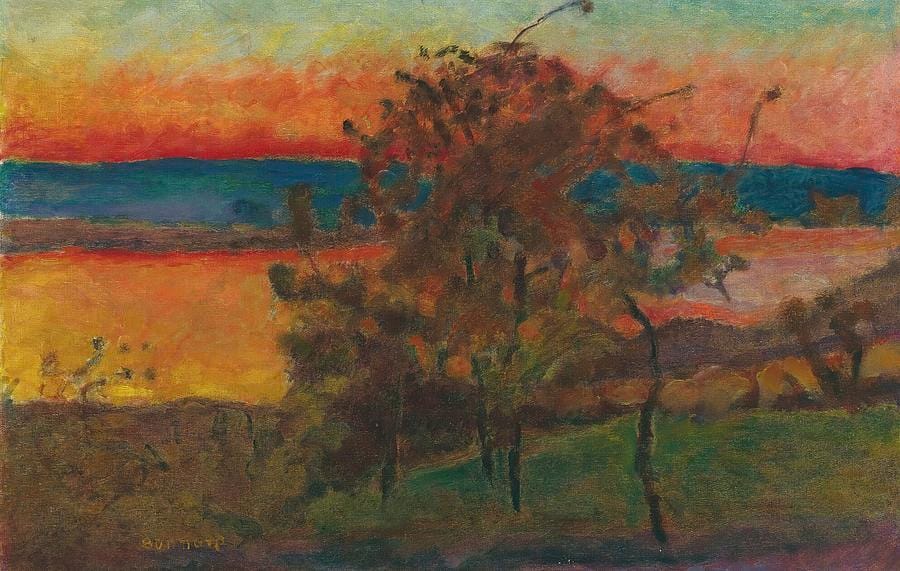
A band of scarlet and orange burns along the horizon above a strip of dark blue-green sea, and a single tree stands in the middle of an empty field, catching the last of the light. It is one of Bonnard’s simplest compositions and one of his boldest colorings — the sky is not the color of any real sunset, but it is exactly the sensation of one. He worked from memory rather than from the motif, which is precisely why: what he set down was the impression a landscape had left behind, days later, rather than the thing in front of him.
Place Pigalle at Night
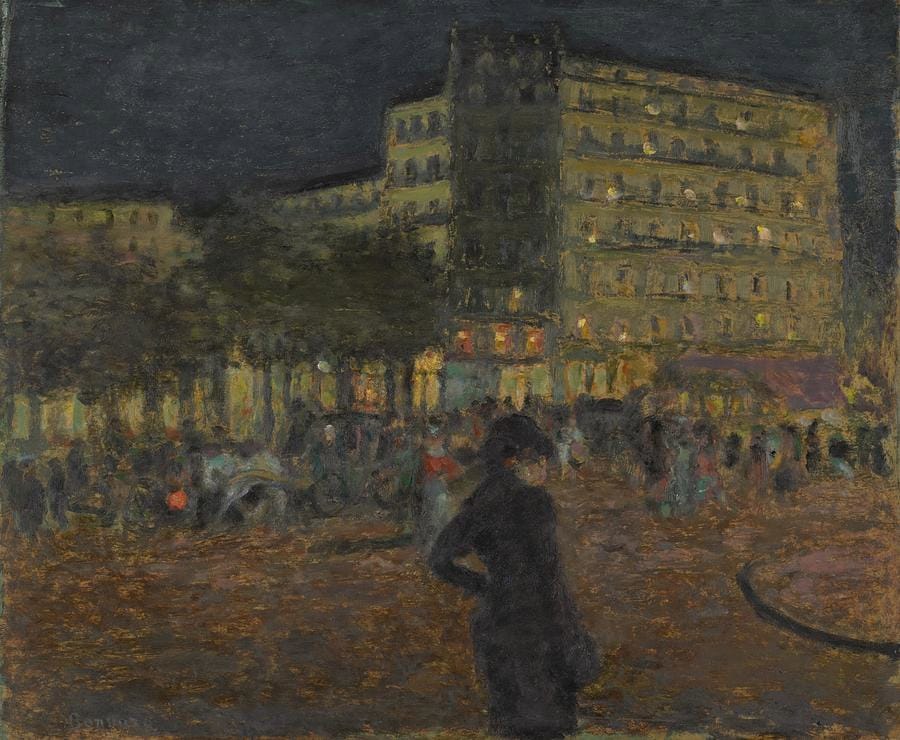
Bonnard kept a studio in Montmartre in his early years, and the streets around Place Pigalle and Place Clichy gave him some of his best city pictures. This one is nearly black. A pale apartment block rises across the square, its windows lit in irregular flecks; below, the awnings of a café glow yellow over a scatter of tiny figures; and in the foreground a lone woman in a long dark coat crosses the empty road, painted as a single silhouette. It is a picture about the specific loneliness of a bright café seen from outside it.
Conversation à Arcachon (Conversation at Arcachon)
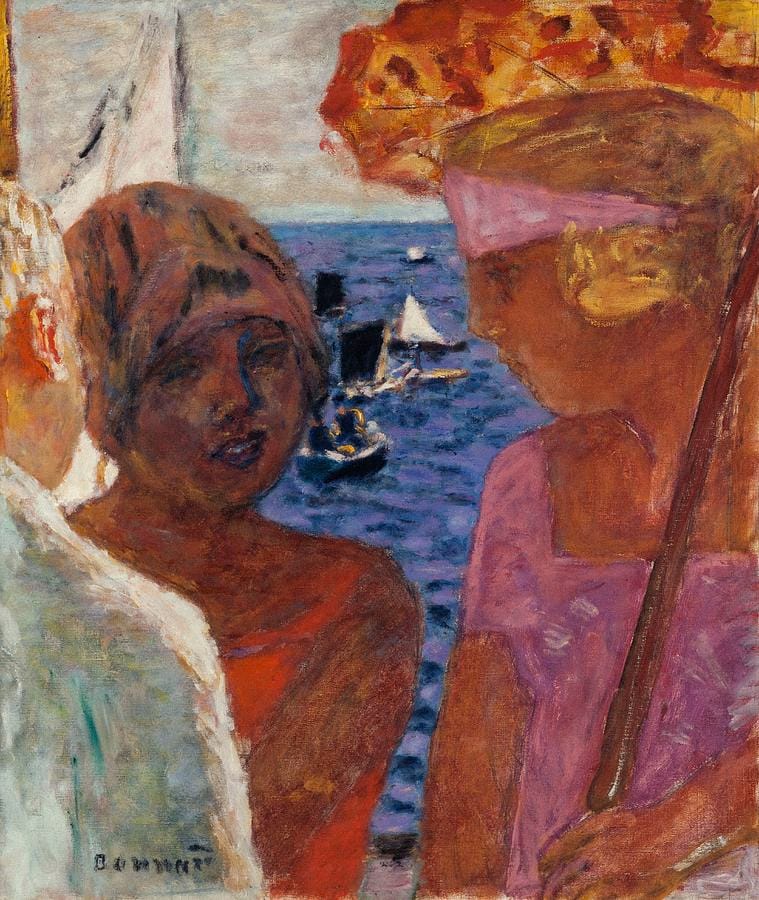
Two women in hats sit under a striped orange awning above the water at Arcachon, on France’s Atlantic coast. One turns toward us in a red headscarf; the other is a broad pink shape seen from behind, blocking half the view. Between them the bay is a slab of deep blue with dark sailing boats stitched across it. The composition is startlingly modern — heads cropped, foreground figures treated as flat color, the sea reduced to a single band — and the picture shows how far Bonnard had traveled from his gentle 1890s interiors without ever changing his subject: people at ease, not doing much.
Portrait de Femme au Grand Chapeau (Woman in a Large Hat)
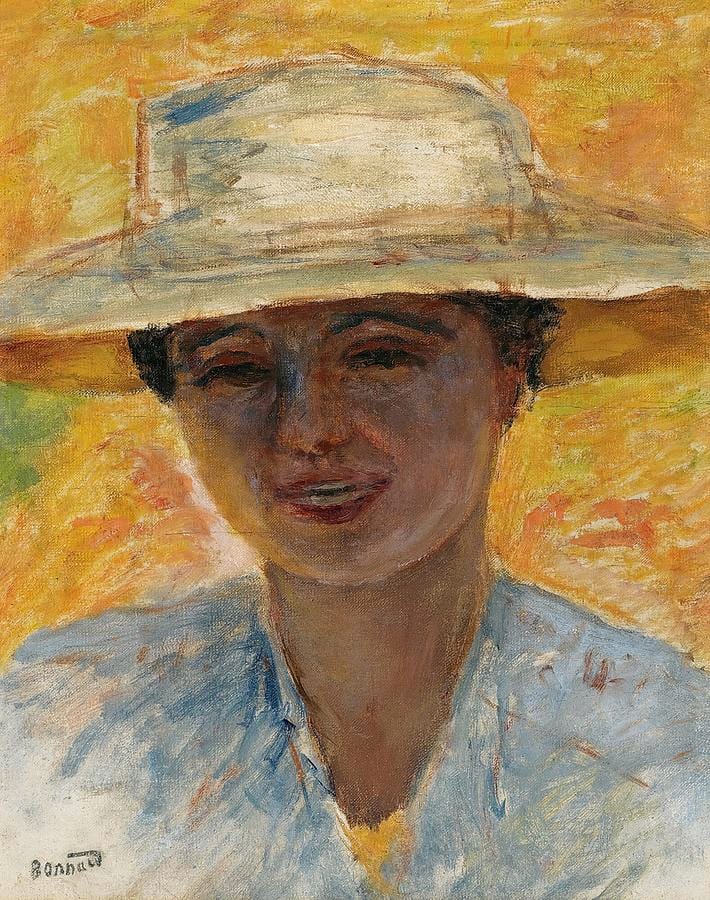
A woman in a wide-brimmed white sun hat and a pale blue shirt looks slightly downward, half-smiling, against a background of pure orange and yellow. Bonnard was not a portraitist by trade and painted relatively few commissioned likenesses, but he was a superb painter of faces caught in passing. The whole picture is built from two temperatures — the cool white and blue of the sitter, the heat of the ground behind her — and the hat brim casts a shadow that Bonnard renders in green and violet rather than gray. It is a small lesson in why other painters revered his eye for color.
Bonnard spent sixty years insisting that a bathroom, a fruit bowl, or a dog at the table was subject enough for a serious painting, and he was right. His pictures carry warmth into a room without demanding anything from it — which is why they hang so easily in the places people actually live.
Shop Pierre Bonnard prints here, and explore the rest of our famous paintings collection for more of the world’s most beloved masterpieces.