Paul Cézanne’s Ten Most Famous Paintings
Apples, bathers, and one Provençal mountain painted over and over: the ten works that made Cézanne the father of modern art.

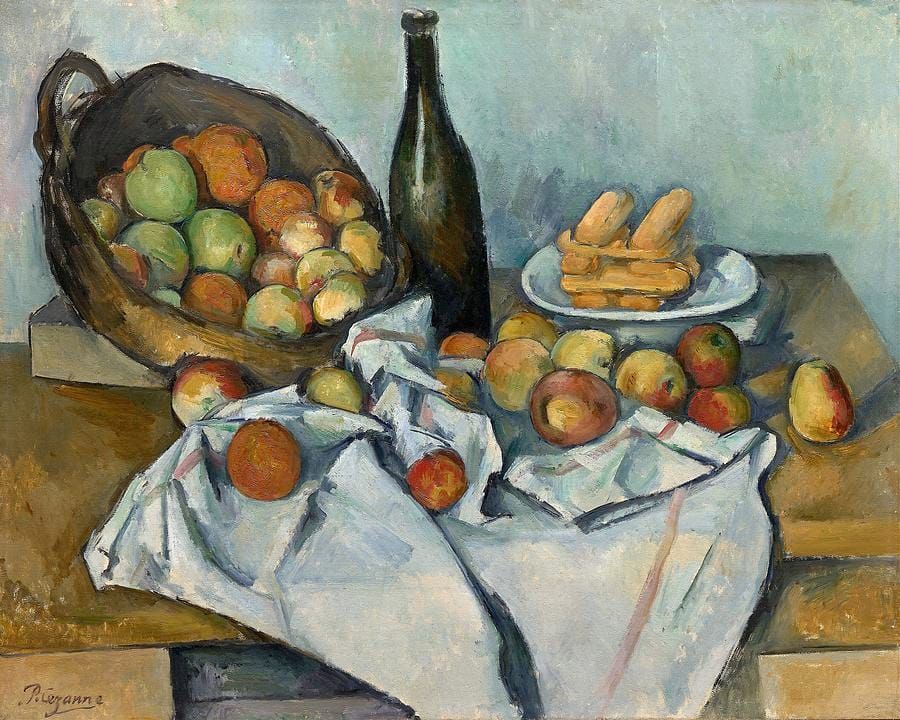
Paul Cézanne (1839–1906) was the son of a prosperous banker in Aix-en-Provence, a schoolfriend of the novelist Émile Zola, and for most of his working life a painter almost nobody wanted. Critics savaged the pictures he showed with the Impressionists in the 1870s. He withdrew to the south of France and spent decades painting the same handful of things — a bowl of fruit, his wife, a bathing party, a limestone mountain outside his window — until he had worked out how to build a painting the way a mason builds a wall.
What he arrived at changed everything that came after. Cézanne broke the world into planes and patches of color, let his tabletops tilt and his outlines double, and cared more about the structure holding a picture together than about copying appearances. Picasso and Matisse both called him the father of modern art, and Cubism is unimaginable without him. Here are ten of his most famous paintings.
The Basket of Apples
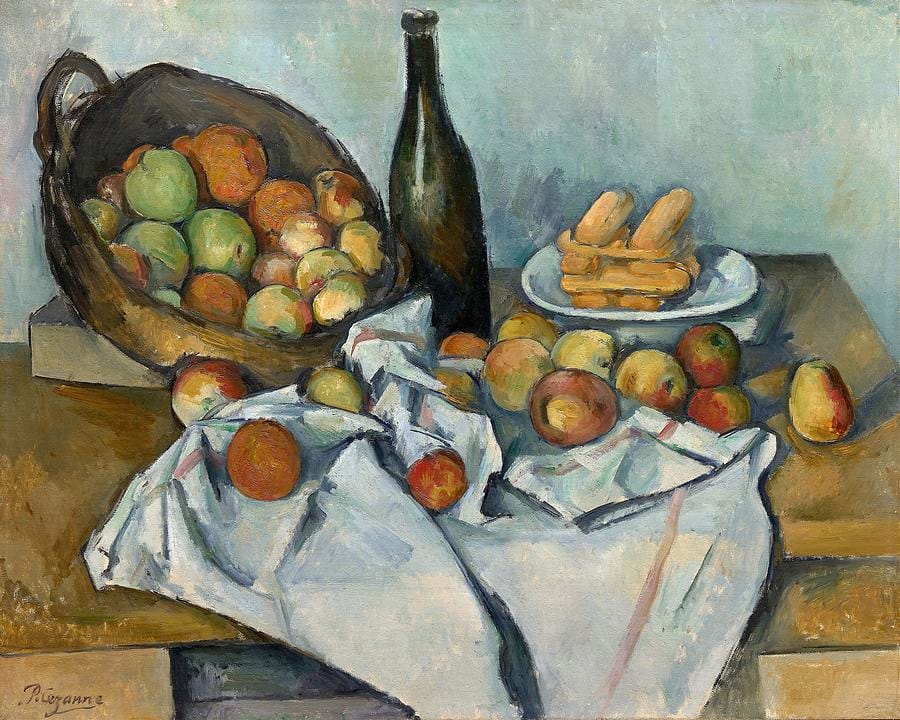
Nothing in this still life of around 1893 lines up. The basket tips forward at an angle no real basket would hold, the bottle leans, and the two edges of the table meet the white cloth at heights that cannot both be true. Cézanne is not being careless — he is showing each object from the angle that suits it best and letting the picture reconcile them. He once said he wanted to astonish Paris with an apple, and this is the painting that did it. Generations of critics have used it to explain how a still life stopped being a window and became a constructed thing.
Mont Sainte-Victoire and the Viaduct of the Arc River Valley
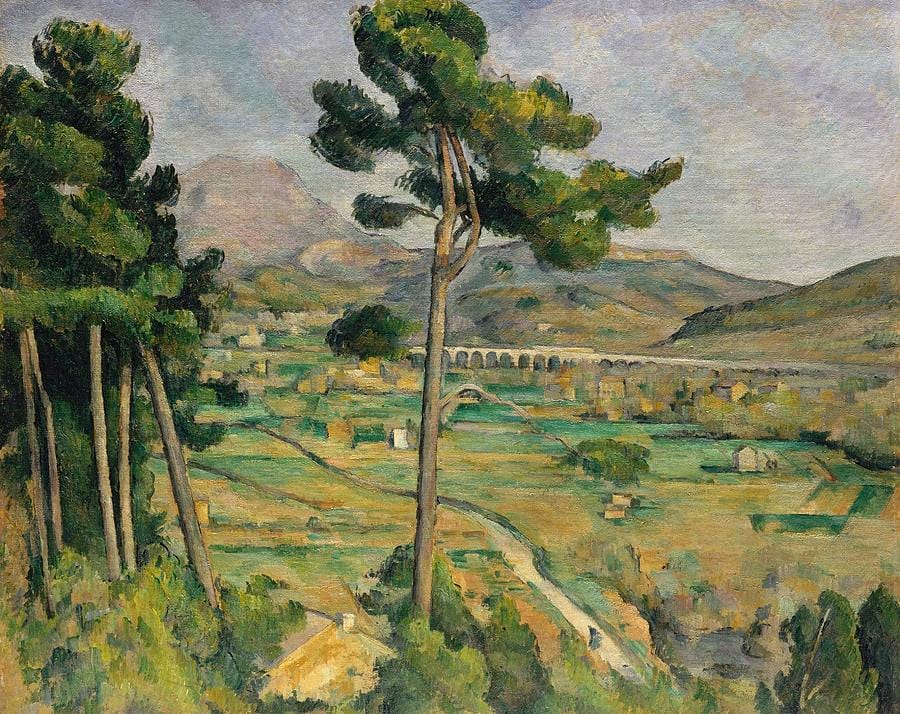
The limestone ridge of Mont Sainte-Victoire rises east of Aix, and Cézanne painted it dozens of times across the last thirty years of his life — in oil, in watercolor, from near and from far. In this version from the 1880s, a pine at the left throws its branches across the sky like a frame, the valley floor is quilted into small fields, and a railway viaduct marches through the middle distance. The mountain became his laboratory: the same subject repeated until color alone could carry weight, distance, and structure without any help from conventional perspective.
The Large Bathers
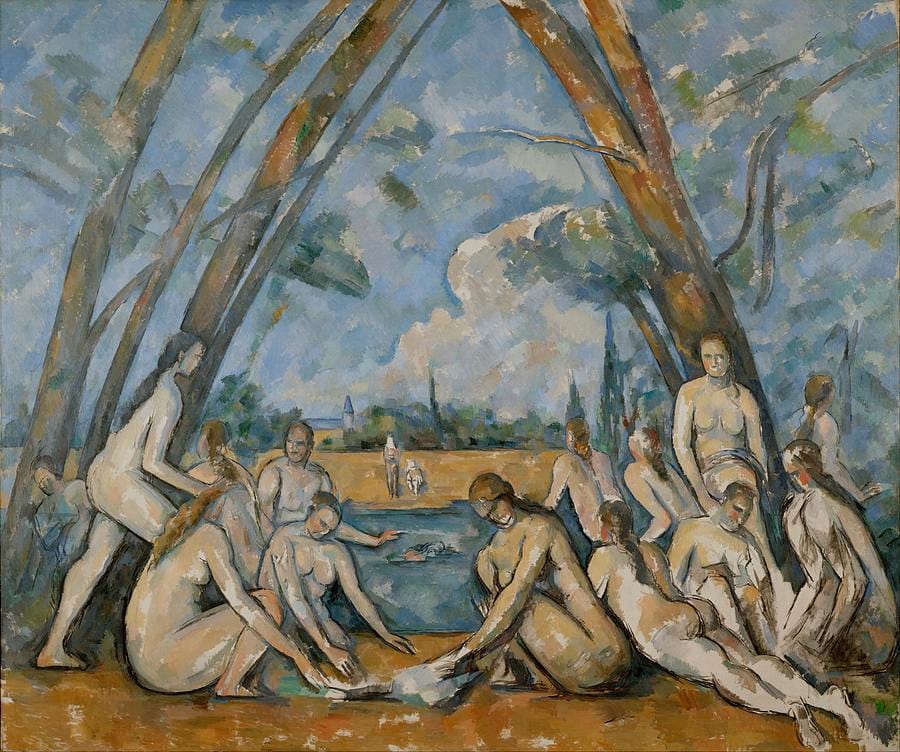
Cézanne spent the last years of his life on a group of very large canvases of nude bathers in a landscape, and this is one of them. The trees lean inward to form a great triangular arch, the figures are massed along the banks like architecture, and no one has a face worth reading — they are volumes, not people. He worked from drawings, memory, and Old Master poses rather than models. Unfinished patches of bare canvas glow through the blue. When Matisse bought a smaller Cézanne bather picture he kept it for decades and called it a source of strength; this is the monumental version of that idea.
The Card Player
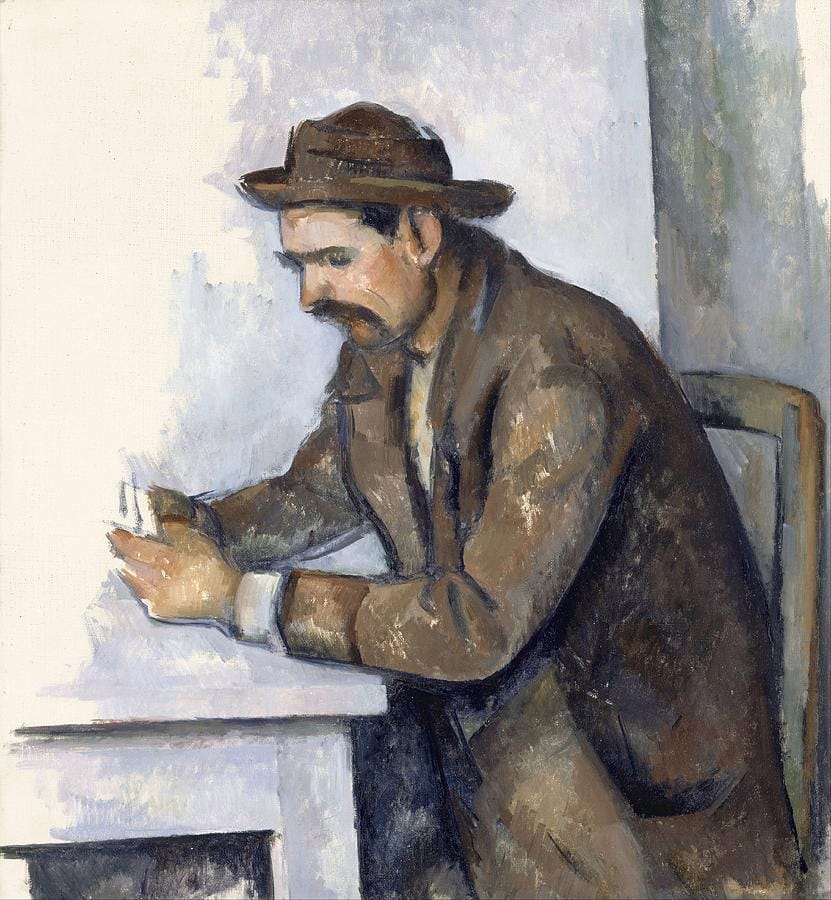
In the early 1890s Cézanne made a series of paintings of men playing cards, using farm workers from his family’s estate outside Aix as models. Here a single player in a broad hat leans in over a table in his working jacket, absorbed in the hand he is holding. There is no anecdote and no comedy — none of the drunkenness or cheating that older painters loved in card-table scenes. Cézanne gives the man the gravity of a monument, all weight and angle and quiet. The card-player pictures are among the most admired paintings of his maturity, and one of the group set a world auction record when it changed hands in 2011.
Boy in a Red Waistcoat
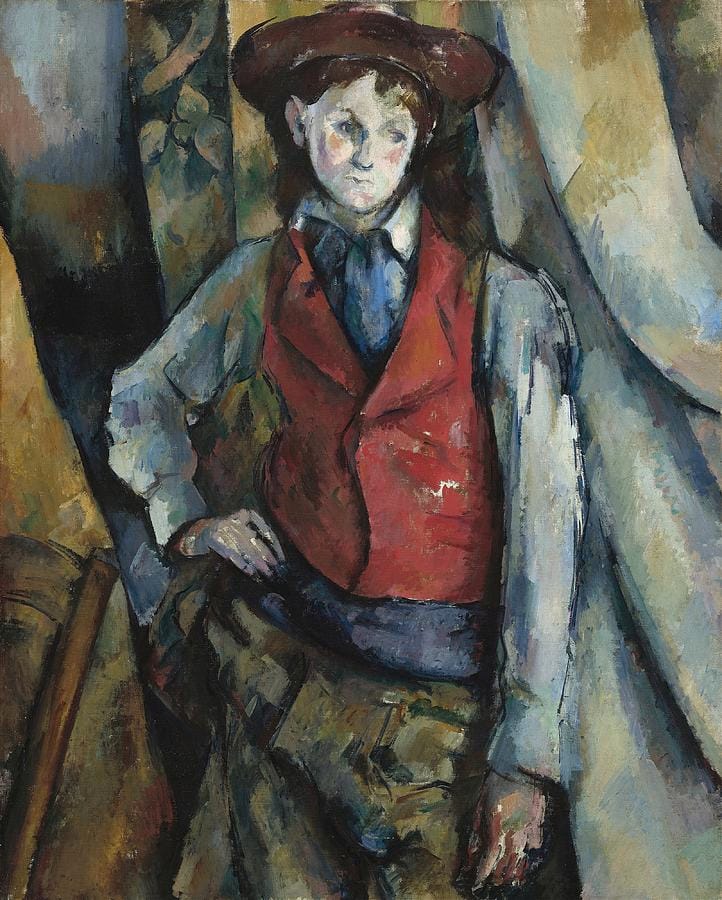
A young Italian model stands against a swagged blue-gray curtain, one hand on his hip, the red waistcoat blazing at the center of the canvas. Cézanne painted him four times around 1890, and this is the best known of the group. Look at the boy’s lowered arm and you will notice it is far too long — an old complaint about the picture, and beside the point. Cézanne stretched it because the composition needed a long descending line at that spot. The painting is a lesson in how far he would push anatomy to keep a design in balance.
Madame Cézanne in a Red Armchair
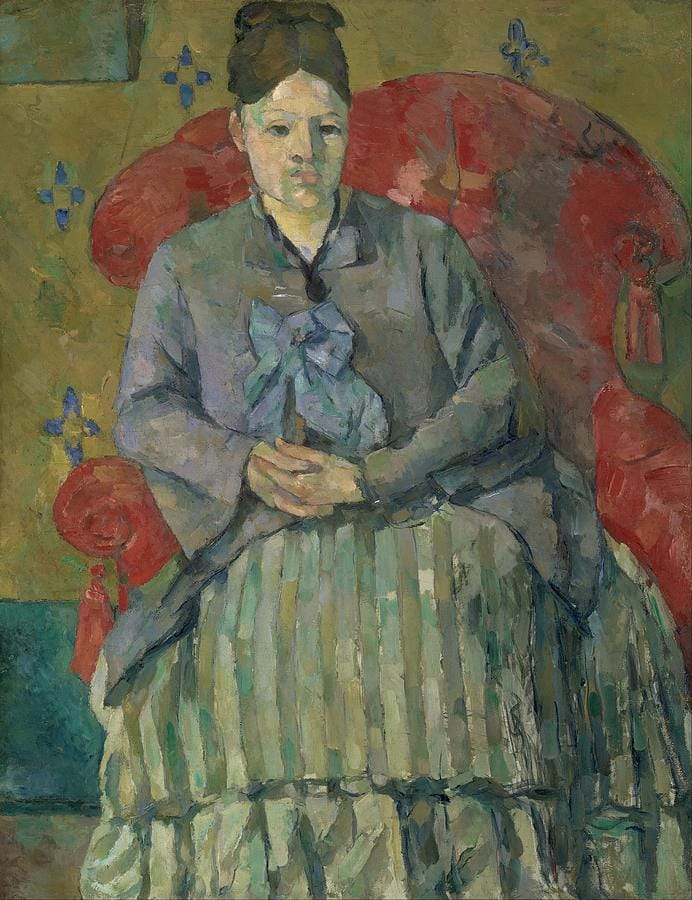
Hortense Fiquet met Cézanne as an artist’s model, lived with him for years before they married, and sat for him more often than anyone else — nearly thirty portraits survive. She is rarely smiling and never flattered. Here she sits upright in a red armchair in a boldly striped skirt and a soft blue-gray jacket, hands folded, patient as furniture. Cézanne reportedly told a sitter to hold still like an apple, and the remark has clung to these portraits ever since. What looks cold is really concentration: the red of the chair, the cool blues and greens of her clothes, and the patterned wall behind are locked together with enormous care.
A Modern Olympia
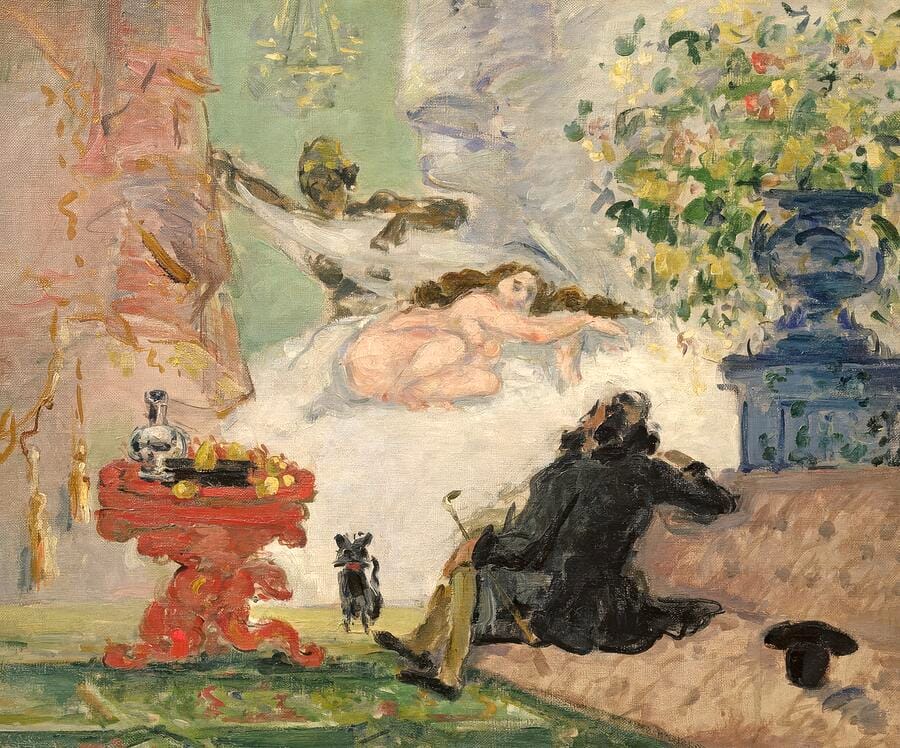
Cézanne showed this small, wild canvas at the first Impressionist exhibition in 1874, where it drew some of the harshest reviews of the whole show. It answers Manet’s scandalous Olympia of a decade earlier, but as a fever dream rather than a challenge: a servant whips a sheet off a pale nude curled on a divan, a little dog watches, and a bald man in dark clothes sits with his back to us in the corner — widely read as the painter himself, looking at his own fantasy. The paint is slashed on. It marks the end of his violent early manner, just before Pissarro taught him patience.
The Gulf of Marseilles Seen from L’Estaque
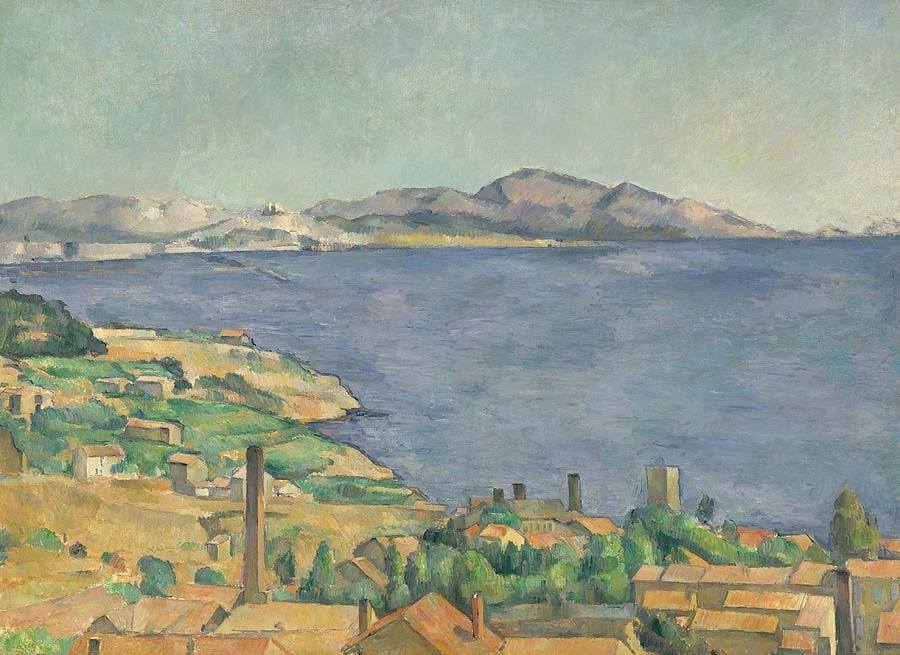
L’Estaque was a fishing village and factory town on the bay west of Marseille, and Cézanne worked there on and off for twenty years. The view is stacked in flat bands: orange rooftops and a chimney in the foreground, then a slab of intense blue water, then the dry hills of the far shore and a strip of sky. He wrote to Pissarro that the local motifs looked like playing cards — roofs red, sea blue — and the painting takes him at his word. It is one of the pictures the young Braque and Picasso studied hardest when they were inventing Cubism a generation later.
Self-Portrait with a Hat
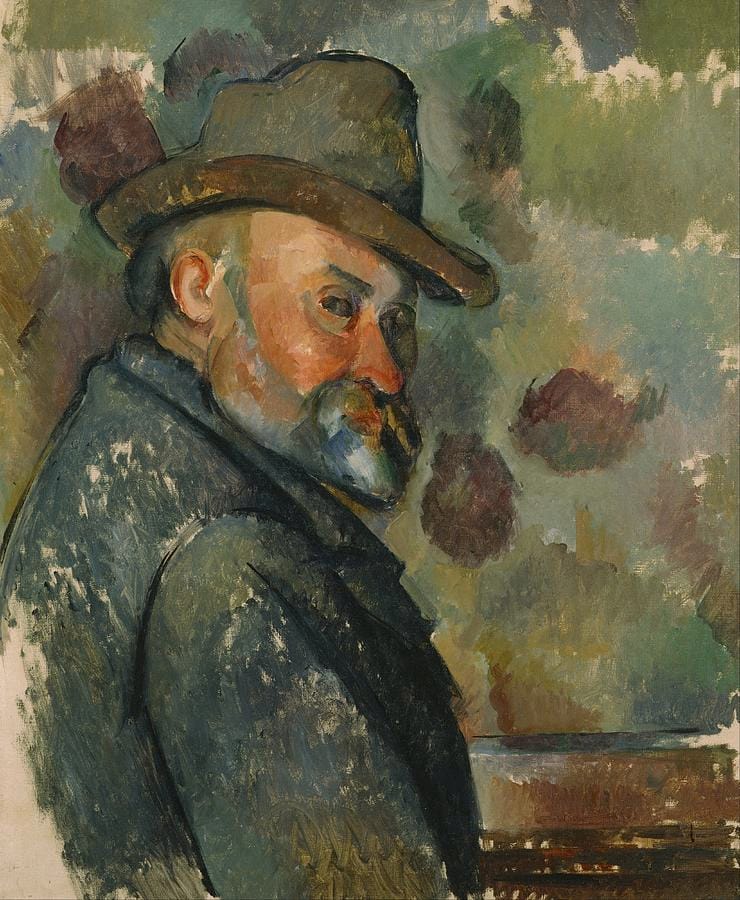
Cézanne painted himself more than two dozen times, and he was never kind about it. In this canvas from around 1890 he turns in three-quarter view under a soft hat, balding, gray-bearded, his eyes sliding away from the viewer. The mottled background is built from the same short diagonal strokes as the coat and the face, so the man and the room behind him are made of one continuous fabric of paint. He was a difficult, solitary character who broke with old friends easily — Zola among them — and the self-portraits record that guardedness without ever asking for sympathy.
Woman with a Coffeepot
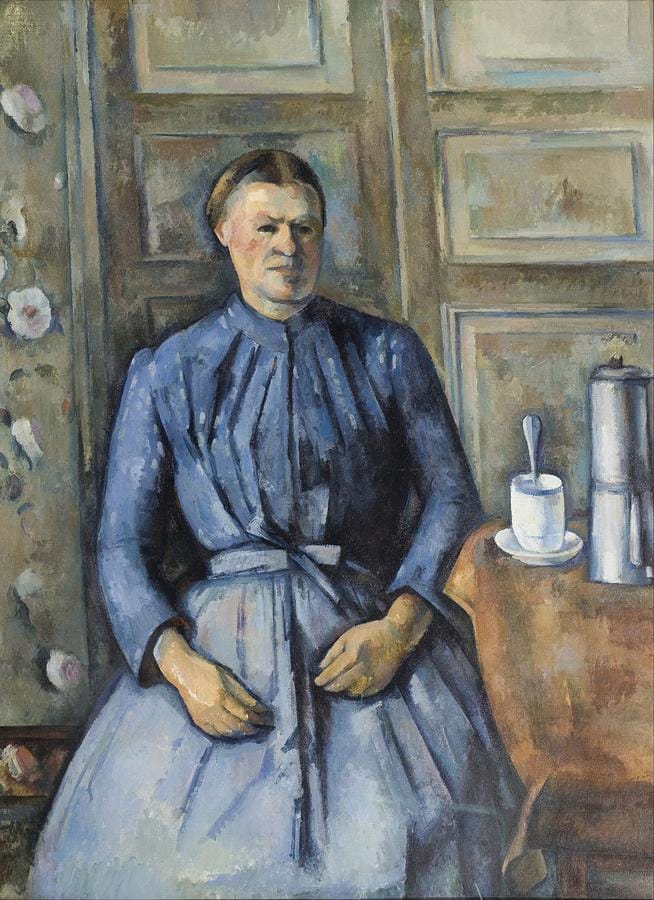
A servant in a blue dress sits square to us behind a table holding a tall tin coffeepot and a cup on a saucer, the paneled door behind her ruled into rectangles. Painted in the mid-1890s, it is the most architectural of all Cézanne’s figure paintings: the woman’s folded arms echo the door panels, her body has the taper of a column, and the spoon in the cup stands perfectly upright. Cézanne famously advised treating nature in terms of the cylinder, the sphere, and the cone. This painting is the clearest demonstration he ever gave of what he meant by it.
Cézanne is the rare painter who is both difficult and easy to live with. The pictures reward long looking — you can spend years noticing how a tabletop refuses to line up — but their color is simply beautiful on a wall: Provençal ochres, pine greens, and that unmistakable blue. A single still life or mountain view brings warmth and quiet order to a room without demanding anything of the people in it.
Shop Paul Cézanne prints here, and explore the rest of our famous paintings collection for more of the world’s most beloved masterpieces.