The Most Beautiful Botanical Art Ever Made
Redouté’s roses, Merian’s Surinam pineapple, Thornton’s midnight cactus — eight high points from three centuries of botanical art.

The most celebrated botanical art ever made is Pierre-Joseph Redouté’s Les Roses, published in Paris between 1817 and 1824 with 169 color-printed plates drawn largely from Empress Josephine’s garden at Malmaison. The other high points are Maria Sibylla Merian’s Surinam plates, Georg Ehret’s flowers, and Robert Thornton’s Temple of Flora.
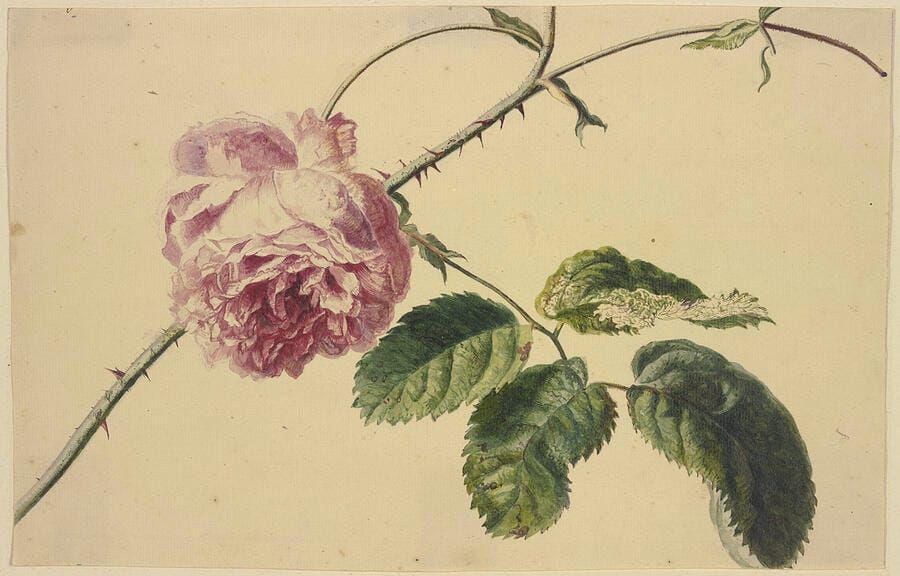
Rosa centifolia foliacea — Pierre-Joseph Redouté
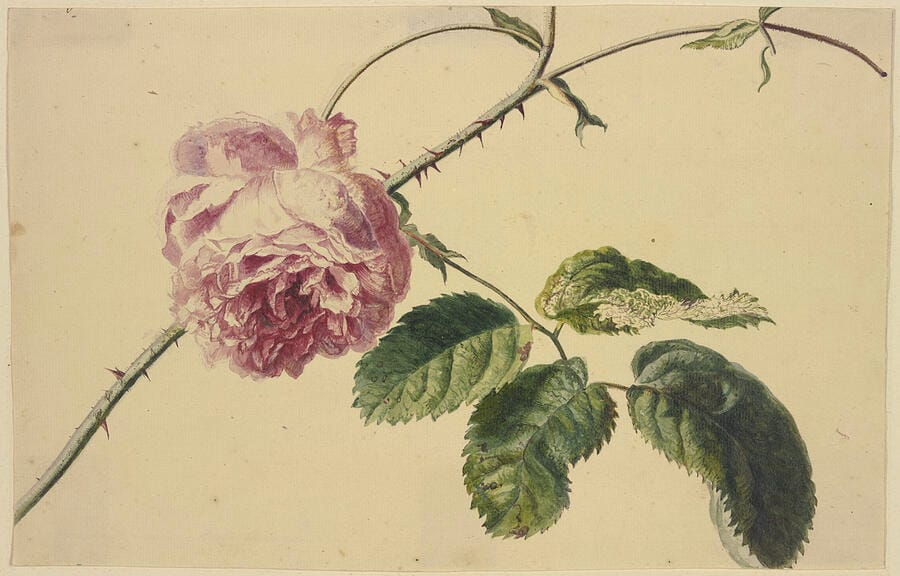
One cabbage rose on a long thorned stem, a scatter of leaves, a bud breaking at the tip, and nothing else. Redouté’s roses are the most reproduced botanical images in the world, and their softness is a printing achievement as much as a drawing one: Les Roses, published in Paris between 1817 and 1824, was printed by stipple engraving, with a single plate inked in several colors at once and each impression finished by hand, so the petals shade without any visible line.
Redouté (1759–1840) had an extraordinary run of luck, drawing for Marie Antoinette, surviving the Revolution, and becoming official painter to Empress Josephine. The roses came largely from her garden at Malmaison — though she died three years before the first volume appeared.
Still Life with Rose Branch, Beetle and Bee — Rachel Ruysch
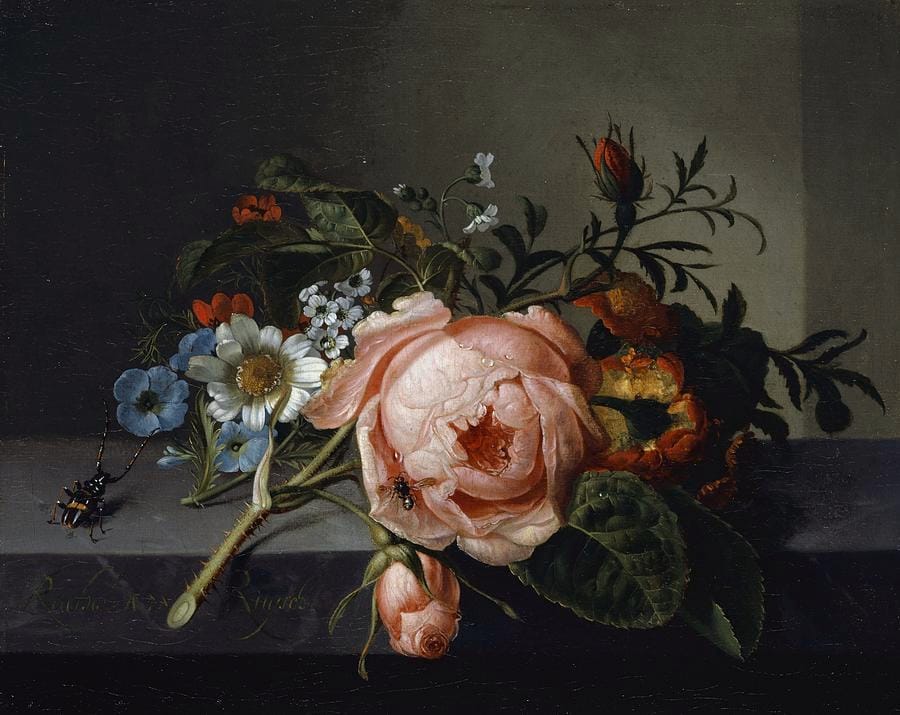
Dutch flower painting is the other tradition feeding into botanical art, and Rachel Ruysch (1664–1750) was its greatest practitioner. Against a plain dark ground she lays a cut rose branch across a stone ledge — one full pink bloom, tight red buds, forget-me-nots, a white daisy — with a beetle on the stone below and a bee at the rose, both placed with a naturalist’s precision.
That precision was inherited: her father Frederik Ruysch was a celebrated anatomist and botanist, and she grew up drawing his specimens. She painted into her eighties, served as court painter in Düsseldorf, raised ten children, and was celebrated across Europe in her own lifetime.
Ananas (Pineapple) — Maria Sibylla Merian, 1705
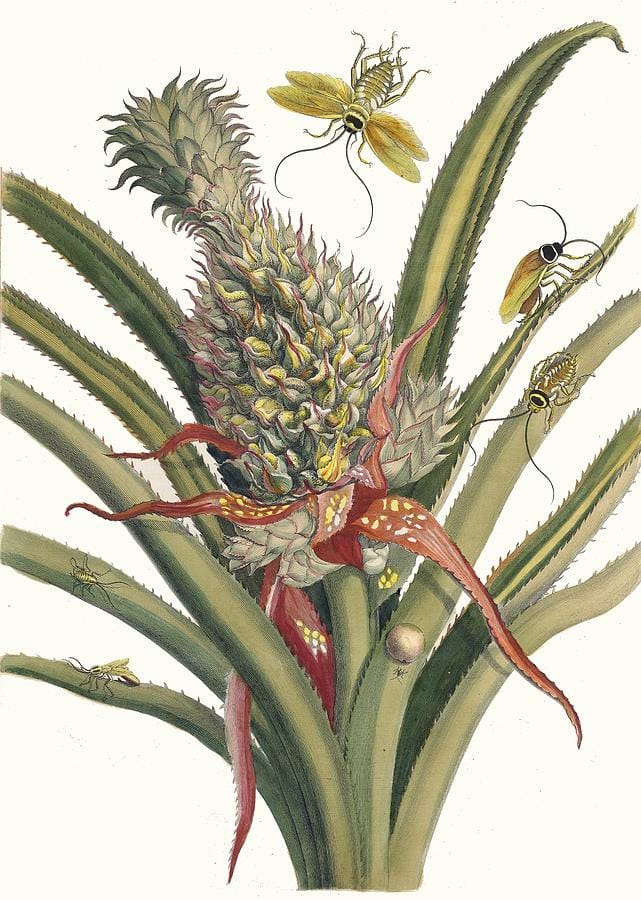
A pineapple with a cockroach on its crown, another running down a leaf, and a beetle below. The pineapple opens Metamorphosis Insectorum Surinamensium, and it announces the book’s argument: insects belong with the plants they feed on, shown at every stage of their life cycle, on one sheet.
Merian (1647–1717) sold her own possessions to fund a voyage to Dutch Surinam in 1699, aged fifty-two, traveling with her daughter and staying two years until malaria drove her home. No European naturalist had done fieldwork quite like it, and nobody had drawn tropical plants and their insects together in this way before.
Magnolia — Georg Dionysius Ehret, from Plantae Selectae
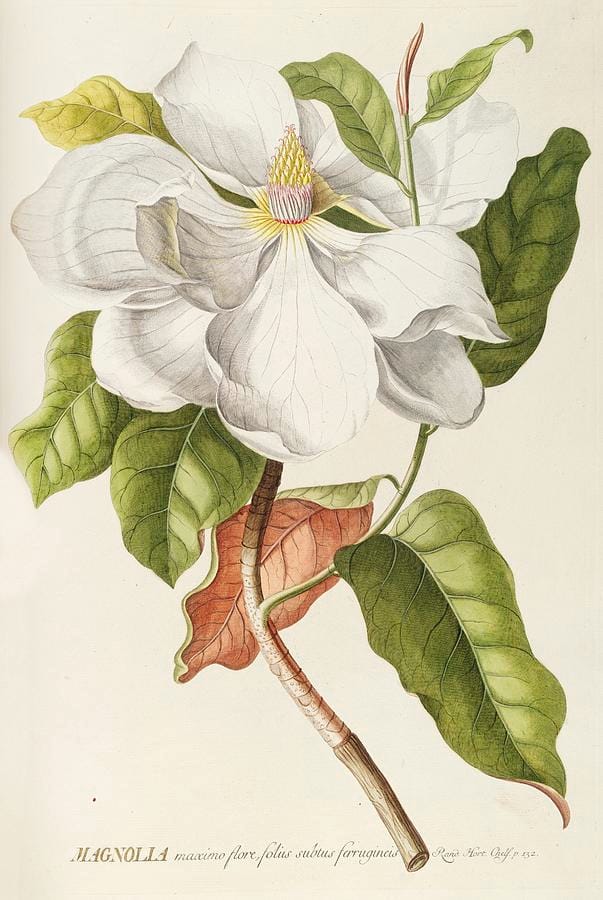
A single open magnolia flower, thick creamy petals turning outward, with the rust-felted underside of a leaf laid deliberately in view. Ehret (1708–1770) draws like a man who has grown the plant himself, which he had: he trained as a gardener before he ever trained as an artist.
He is the pivotal figure in botanical illustration because he worked alongside Linnaeus and drew the plate that explained the new sexual system of classification to Europe. The southern magnolia was a sensation in eighteenth-century European gardens, newly arrived from America and grown by anyone who could afford it.
The Night-Blowing Cereus — Robert John Thornton, from The Temple of Flora, 1799–1807
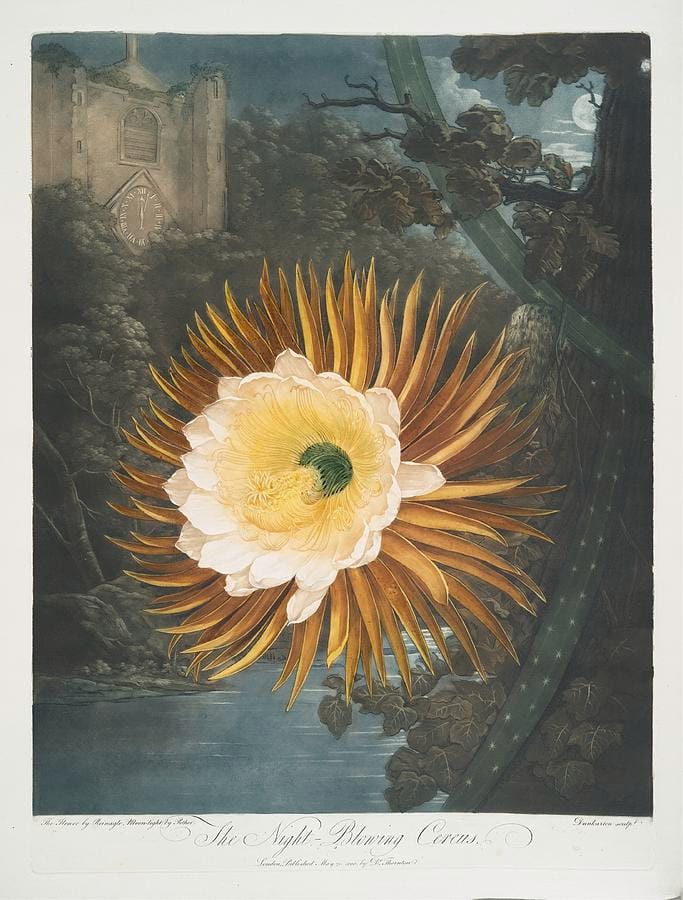
Thornton’s idea was to give every flower a landscape suited to its character, and here it produces the most theatrical plate in botanical art: a night-blooming cactus opening its single white flower in front of a moonlit river, with a church tower behind whose clock stands at midnight — the hour the bloom opens and the night it lasts.
The flower and the moonlight were painted by different specialists, Philip Reinagle and Abraham Pether, whose specialty was moonlight and who was known in the trade as “Moonlight Pether.” Thornton inherited a fortune and spent all of it on the book. It ruined him, and he ended up disposing of the unsold stock by lottery.
Black-billed Cuckoo on Magnolia grandiflora — John James Audubon
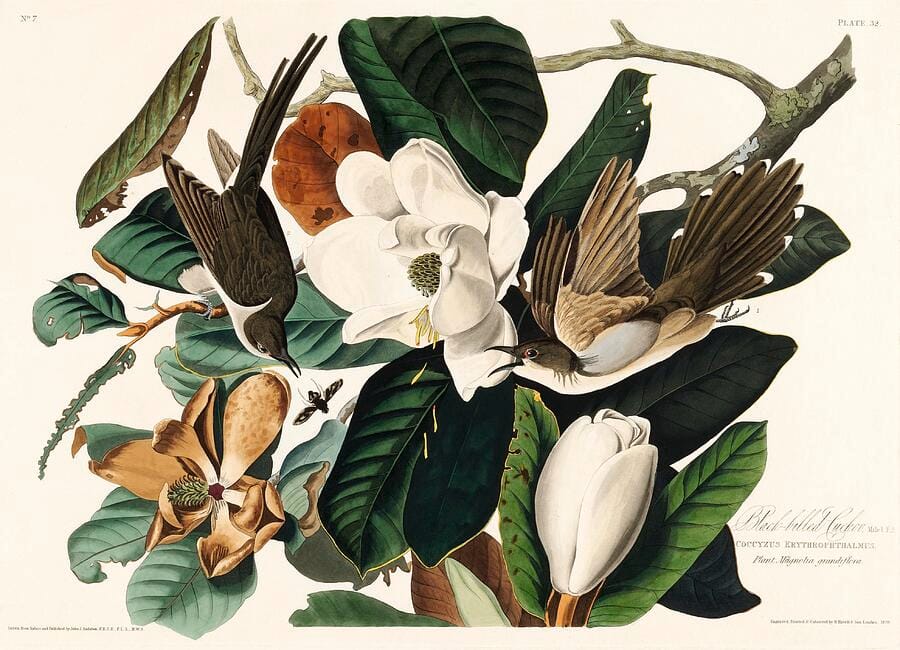
Two black-billed cuckoos work through a southern magnolia on Plate 32, one of them snapping at a moth in mid-air, with a flower fully open, a bud still furled and a spent bloom gone papery brown — and the plate names the plant as carefully as it names the bird. The plants in Audubon’s early plates were frequently painted by assistants, notably Joseph Mason, a Cincinnati teenager who traveled with him in the 1820s and was never credited on the sheets.
The Birds of America was printed at double-elephant folio size, about 39 by 26 inches, and engraved and hand-colored in London by Robert Havell and his son. Roughly 120 complete sets survive.
Odontoglossum grande — James Bateman, from The Orchidaceae of Mexico and Guatemala, 1837–43
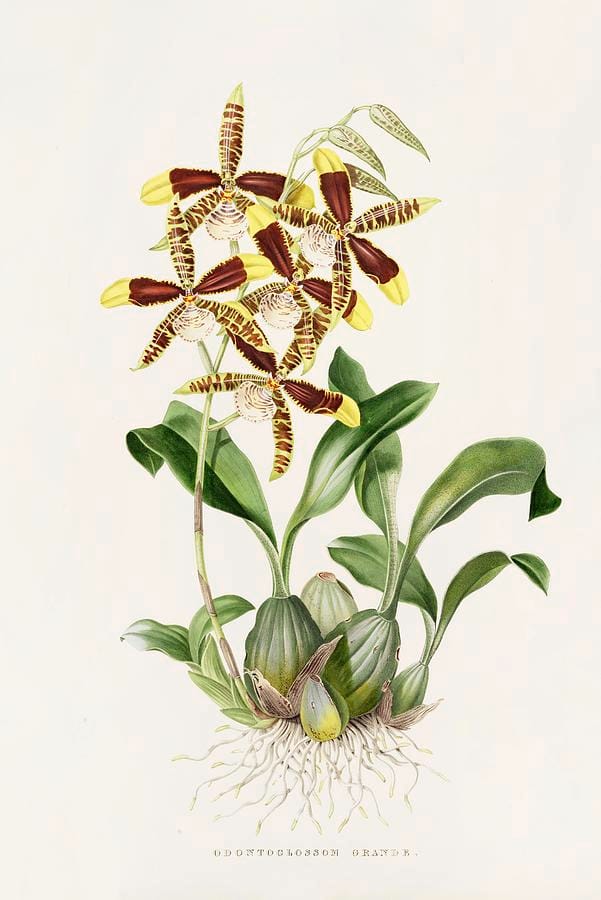
The tiger orchid, its yellow petals barred with chestnut, drawn at full size on a sheet from the largest botanical book ever published. Bateman’s Orchidaceae ran to forty plates on paper so vast that George Cruikshank contributed a joke vignette about the difficulty of shelving it. Around 125 copies were made.
Bateman (1811–1897) never went to Mexico or Guatemala. He was a wealthy Staffordshire plantsman who paid collectors to ship him specimens for his hothouses and drew them there. The book belongs to the height of orchidomania, when a single new species could fetch a fortune.
Showy Ladyslipper — Mary Vaux Walcott, from North American Wild Flowers, 1925
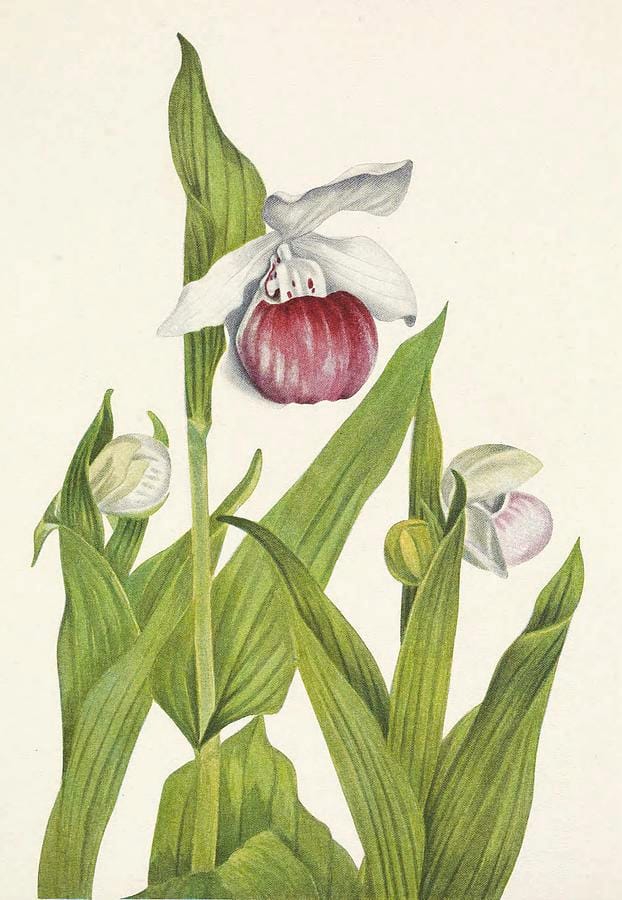
A native orchid in transparent watercolor on white paper: no background, no shadow, no vase — the modern botanical convention, and Walcott’s handling of the pink pouch and the wrapped green leaves is as good as watercolor gets.
Mary Vaux Walcott (1860–1940) was a Philadelphia Quaker who spent her summers in the Canadian Rockies as a mountaineer and glacier photographer, painting wildflowers in the field, often the same day she found them. The Smithsonian published four hundred of her plates in five volumes from 1925, and she is still called the Audubon of American wildflowers.
Frequently asked questions
What is botanical art?
Art that depicts plants accurately enough that a botanist could identify the species from the image. It usually shows the plant against a plain ground with diagnostic details — flower, bud, leaf, seed, sometimes a dissection — rather than in a setting. That requirement is what separates it from flower painting, where the plant is a compositional element rather than a record.
Who is the most famous botanical artist?
Pierre-Joseph Redouté (1759–1840), the Belgian-born painter known as the Raphael of flowers. He drew for Marie Antoinette, survived the Revolution and became official painter to Empress Josephine, whose rose garden at Malmaison supplied most of the 169 plates of Les Roses, published between 1817 and 1824 and still the most reproduced botanical work in existence.
What is the difference between botanical illustration and a flower painting?
Purpose. A botanical illustration is scientific evidence: it isolates the plant, shows the parts needed to identify it, and is accurate to the specimen. A flower painting — a Dutch still life, say — arranges blooms for beauty and meaning, often combining species that could never have flowered in the same week. Rachel Ruysch shows how close the two traditions could come.
Who was Maria Sibylla Merian?
A German-born naturalist and artist (1647–1717) who sailed to Dutch Surinam in 1699 at the age of fifty-two, funding the voyage by selling her possessions. Her book Metamorphosis Insectorum Surinamensium, published in 1705, showed insects together with the plants they fed on and at every stage of their life cycle — a way of drawing nature that nobody had attempted before.
What is the most beautiful botanical book ever made?
Two candidates. Robert John Thornton’s The Temple of Flora (1799–1807) is the most theatrical, setting each flower in a landscape suited to its character; it bankrupted him. James Bateman’s The Orchidaceae of Mexico and Guatemala (1837–43) is the most physically imposing — the largest botanical book ever published, in an edition of roughly 125 copies.
Where can I see original botanical art?
The Shirley Sherwood Gallery of Botanical Art at Kew is devoted entirely to the subject and rotates its displays. The Hunt Institute for Botanical Documentation in Pittsburgh holds one of the largest collections in the world, and the Natural History Museum in London, the Smithsonian and the Rijksmuseum all hold major holdings and publish high-resolution scans online.
Botanical plates were designed for the page, which is why they hang so well in series — three or four of the same size and palette read as one piece. Everything above is available as a framed print, canvas or art, and you can browse the wider botanical collection or the rest of our famous paintings.