Monet vs Manet: What’s the Difference?
Two different painters, eight years apart, who knew each other and were confused with each other from the day they met — here is how to tell them apart.

They are two different men. Édouard Manet (1832–1883) was the older Parisian realist who painted people — bars, boulevards, picnics and scandals — and never once exhibited with the Impressionists. Claude Monet (1840–1926) was the younger landscape painter who chased light across haystacks, cathedrals and water lilies.
One letter apart, and confused since 1865
The mix-up is not a modern failure of education. It started in the artists’ own lifetimes, in the spring of 1865, when the twenty-four-year-old Monet showed two seascapes at the Paris Salon and signed them Monet. Visitors congratulated Manet — already notorious, already thirty-three — on his fine marine paintings. Manet, who had spent two years being abused by the press for Le Déjeuner sur l’herbe and was about to be abused again for Olympia, was not amused to be praised for someone else’s work.
They were introduced not long afterward, and the joke turned into a real friendship. In the summer of 1874 Manet painted alongside Monet and Renoir at Argenteuil on the Seine, and produced Monet Painting in His Studio Boat — one painter portraying the other at work. Manet lent Monet money more than once. After Manet’s death in 1883, it was Monet who organized the public subscription that bought Olympia for the French state.
So: not the same person, not rivals, not even really the same generation. Manet was born eight years earlier and died forty-three years sooner. He was dead before Monet had painted a single water lily.
Manet vs Monet at a glance
| Édouard Manet | Claude Monet | |
|---|---|---|
| Dates | 1832–1883, died at 51 | 1840–1926, died at 86 |
| Movement | Realism; the hinge between old painting and modern | Impressionism — he effectively defines it |
| Painted | People: bars, cafés, boulevards, bullfights, picnics | Places: light, weather, water, gardens, stone |
| Where he worked | Mostly indoors, in the studio | Outdoors, in front of the motif |
| Black | Used constantly — deep, Spanish, velvety | Banished it; shadows built from blue and violet |
| Edges | Hard and flat, like cut paper | Broken and dissolved; no outlines at all |
| Impressionist exhibitions | None of the eight | Five of the eight |
| Signature works | Le Déjeuner sur l’herbe, Olympia, A Bar at the Folies-Bergère | Impression, Sunrise; the Grainstacks; Rouen Cathedral; the Water Lilies |
| Reception | Scandal — Olympia had to be rehung out of arm’s reach | Ridicule first, then fame and wealth in his own lifetime |
The single most useful row is the third. Manet painted people; Monet painted light. Almost every attribution you will ever need to make falls out of that one distinction.
Édouard Manet: the older one, who painted people
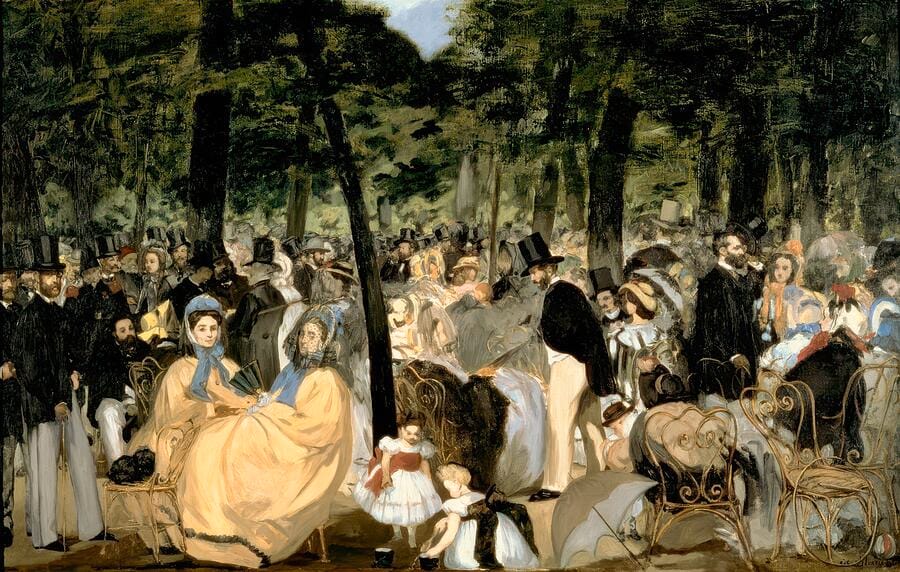
Manet was a Parisian bourgeois who wanted, more than anything, official success at the Salon. He never got it in the way he wanted, and he never stopped submitting. His subject was contemporary life at close range: the crowd in the Tuileries, a barmaid at the Folies-Bergère staring past you into a mirror, a woman at a railing on the Rue de Rome with steam behind her.
What made him modern was not color but flatness. Trained on Velázquez and Frans Hals, he threw away the smooth tonal ladder from light to dark that European painting had used for three centuries and replaced it with abrupt jumps — a lit face, then black. Contemporaries complained his figures looked like playing cards. That is precisely the quality that made the next generation follow him.
Two works to anchor him. Le Déjeuner sur l’herbe (1863), rejected by the Salon and shown at the Salon des Refusés, in which a naked woman picnics with two fully dressed men and looks the viewer in the eye. And Olympia (1863, exhibited 1865), a courtesan on a bed, so unbearable to the Salon crowd that it was hung high on the wall to keep it out of reach. Browse Manet prints to see how consistent the black is across his whole career.
Claude Monet: the younger one, who painted light
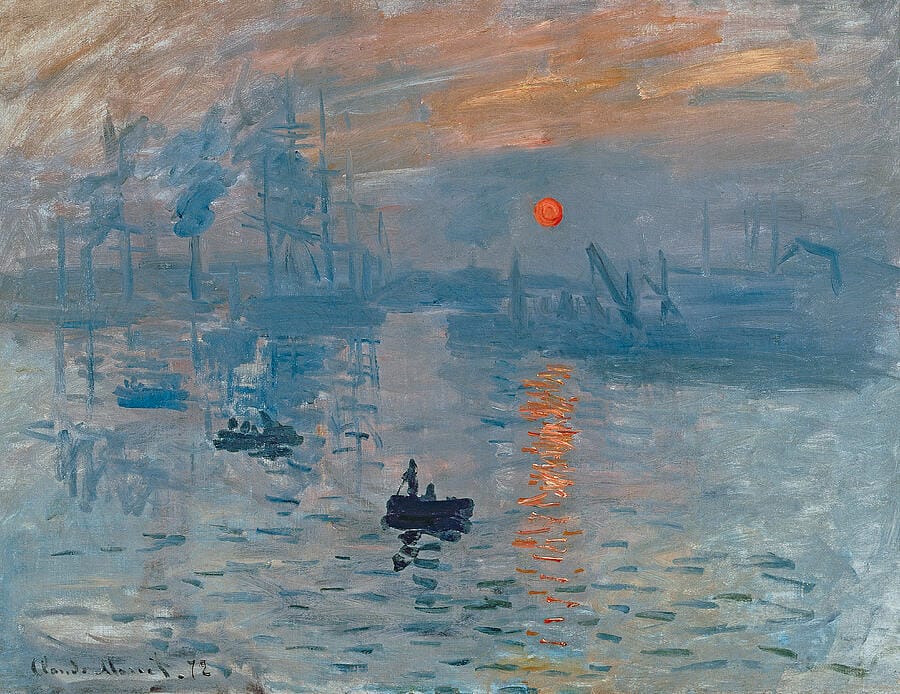
Monet grew up in Le Havre, learned to paint outdoors from Eugène Boudin, and spent sixty years reducing painting to a single question: what color is this, right now? Not what color the object is — what color the light makes it, in this weather, at this hour.
That question produced the series, which is his real invention. Around twenty-five Grainstacks in 1890–91. Around thirty canvases of the west front of Rouen Cathedral in 1892–94, the same stone painted from the same window at different times of day. Then thirty years and some 250 paintings of the pond at Giverny. Nobody had ever treated a subject as a fixed control and the light as the variable.
The name came from a review. When Impression, Sunrise was shown at the first group exhibition in 1874, the critic Louis Leroy titled his hostile piece in Le Charivari around the word impressionists. The painters adopted the insult. Prints of the water lilies and the rest of Monet’s work remain the most reproduced images in the movement.
How to tell a Manet from a Monet in five seconds
Run the picture through this list in order. You will usually have the answer before the third item.
- Is there real black in it? A black coat, a black hat, a black ribbon at a throat. That is Manet. The Impressionists took black off the palette; Manet never did.
- Are there people, and are they looking at you? Manet’s figures confront the viewer. Monet’s figures, when he includes them, are usually turned away or dissolved into the landscape.
- Is the subject the weather? Fog, snow-light, dawn on water, sun through poplars. Monet.
- Are the edges hard? Manet cuts shapes out. Monet has no edges — objects end where the brushstrokes stop agreeing with each other.
- Does the same view exist several times over? A cathedral façade, a haystack, a bridge, painted again and again at different hours. Only Monet did that.
- Is it indoors, in Paris, at night? A café, a bar, a studio, a balcony. Manet.
The one trap worth naming: Manet did paint outdoors in the 1870s, under Monet’s influence, and those Argenteuil boating pictures look genuinely Impressionist. Check for black in the shadows — it is usually still there.
Frequently asked questions
Are Monet and Manet the same person?
No. They were two different French painters with almost the same surname. Édouard Manet lived from 1832 to 1883; Claude Monet lived from 1840 to 1926. They knew each other, were friends from the mid-1860s, and were confused with one another during their own lifetimes — the confusion began at the 1865 Paris Salon.
Who came first, Monet or Manet?
Manet came first. He was born in 1832, eight years before Monet, and was already a notorious figure in Paris by 1863 while Monet was still an unknown student. Manet died in 1883 at the age of 51, forty-three years before Monet, who lived until 1926 and worked almost to the end.
Did Monet and Manet know each other?
Yes, and they were friends. They met in the mid-1860s after the public confused their names at the Salon. Manet lent Monet money, painted alongside him at Argenteuil in 1874, and portrayed him at work in his floating studio. After Manet died, Monet organized the subscription that bought Olympia for the French state.
Who painted Water Lilies, Monet or Manet?
Monet. The Water Lilies are roughly 250 paintings of the pond in his garden at Giverny, made between about 1896 and his death in 1926. Manet died in 1883, before Monet had even created the garden, so he could not have painted them.
Was Manet an Impressionist?
No, though he is often called one. Manet never exhibited in any of the eight Impressionist group shows between 1874 and 1886, holding out for official recognition at the Salon instead. He influenced the Impressionists deeply and briefly absorbed their outdoor light in the 1870s, but he kept black on his palette throughout.
How do you pronounce Monet and Manet?
Both are stressed on the final syllable and both end in the sound “nay”. Manet begins like the English word “man” — ma-NAY. Monet begins closer to “moan” — mo-NAY. In French neither final T is sounded.
If you want the difference on your own wall, the two men reward very different rooms. Manet’s blacks and hard edges hold their own against strong architecture and dark furniture; Monet’s dissolved light works best where there is daylight to answer it. Browse Manet and Monet reproductions as canvas, framed or art prints, printed to order in sizes up to 72 inches.