Leonetto Cappiello’s Ten Most Iconic Posters
A green devil, a red zebra and a woman in a dress of flames: the ten posters that made Cappiello the father of modern advertising.
Leonetto Cappiello (1875–1942) was born in Livorno, taught himself to draw, and arrived in Paris at twenty-three with a knack for caricature. Within a year he was contributing to the humor papers Le Rire and Le Cri de Paris, and by 1900 he had signed with a printer and turned that gift for quick, exaggerated likeness on the advertising poster. Over the next four decades he produced something close to a thousand designs, and in the process he changed what a poster was for.
His predecessors, Jules Chéret and Alphonse Mucha among them, made posters that were lovely to linger over. Cappiello worked for a city that had started to move fast. He reduced each design to one startling figure — a devil, a zebra, an acrobat, a hat — set against a flat, usually black background, so that the image detonated in a passer-by’s eye from a tram window and stuck there. The product barely appears; the character does the remembering for you. Here are ten of his most iconic posters.
Maurin Quina
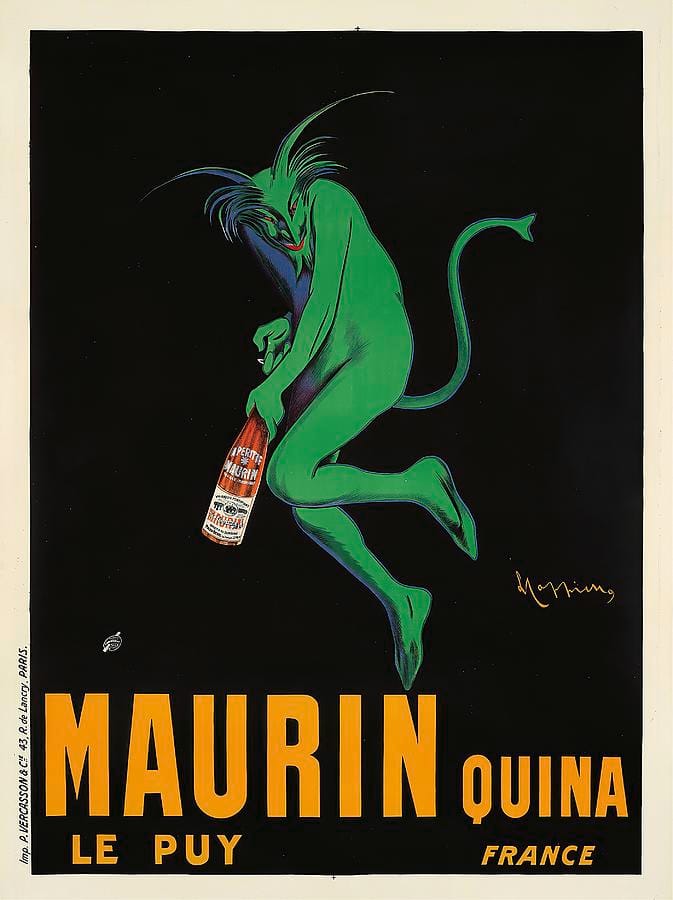
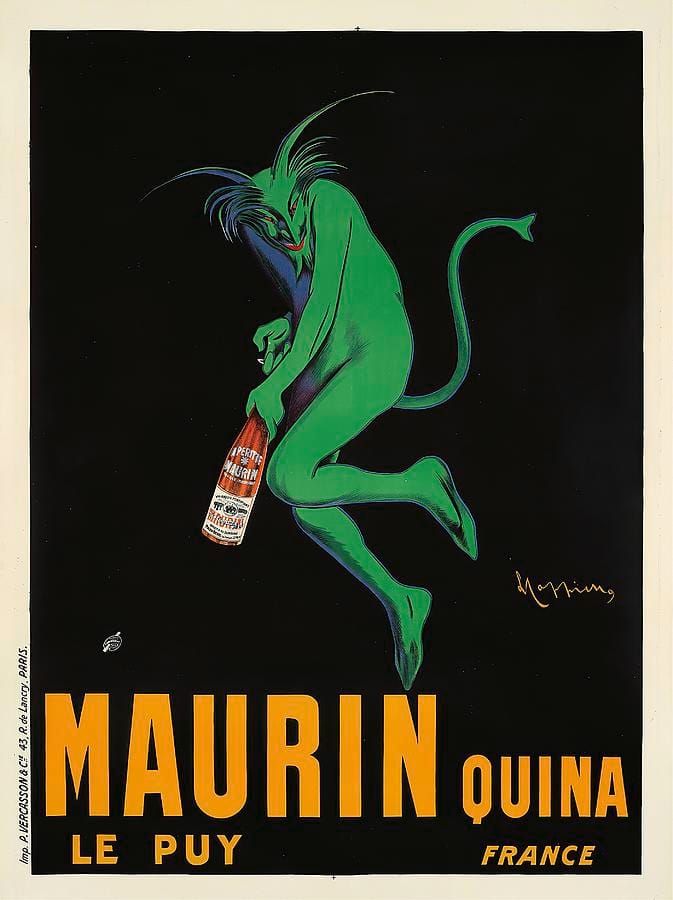
The most famous poster Cappiello ever made, and the clearest statement of his method. A grinning green devil leaps out of pure black, clutching a bottle to his chest with both hands, his body arched into one long elastic curve and his tail flicking out behind him. He advertises a quinquina apéritif from Le Puy, and the design dates from 1906 — remarkably early for something that still looks contemporary. Nothing about a green devil says bitter cherry apéritif, which is exactly the trick: the figure is so odd and so vivid that the brand name attached to it becomes unforgettable. The little devil has outlived most of the drinks Cappiello was hired to sell.
Cachou Lajaunie
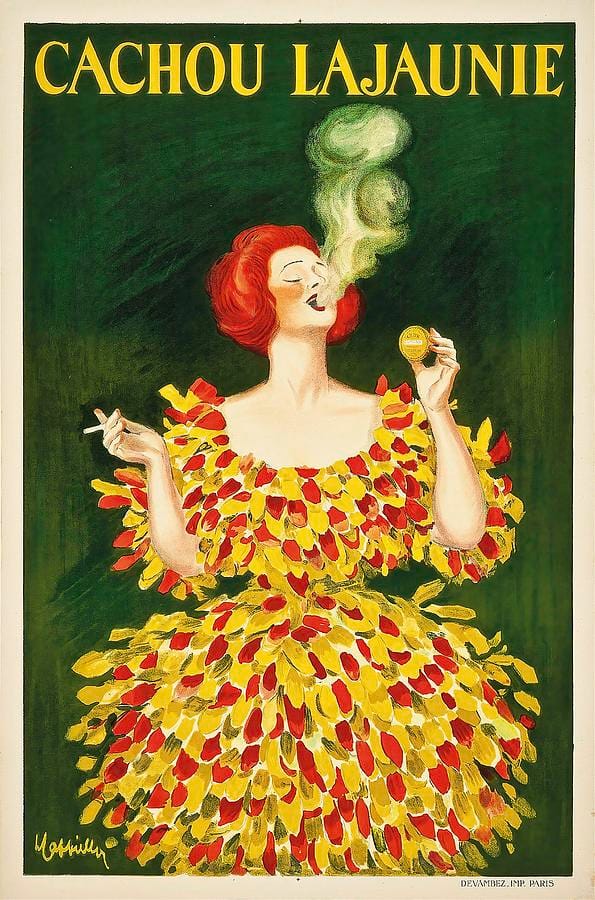
Against a deep green ground, a red-haired woman in a dress made of red and yellow flames throws her head back and breathes out a curl of pale green vapor. She is selling cachous — tiny liquorice breath pastilles sold in a flat tin, made in Toulouse — and the poster dates from around 1920. The whole idea of the product, a small sweet that changes the air you exhale, is compressed into one gesture. It is a masterclass in advertising an invisible benefit, and the flame dress remains one of the best-known costumes in poster history.
Cinzano Vermouth Torino
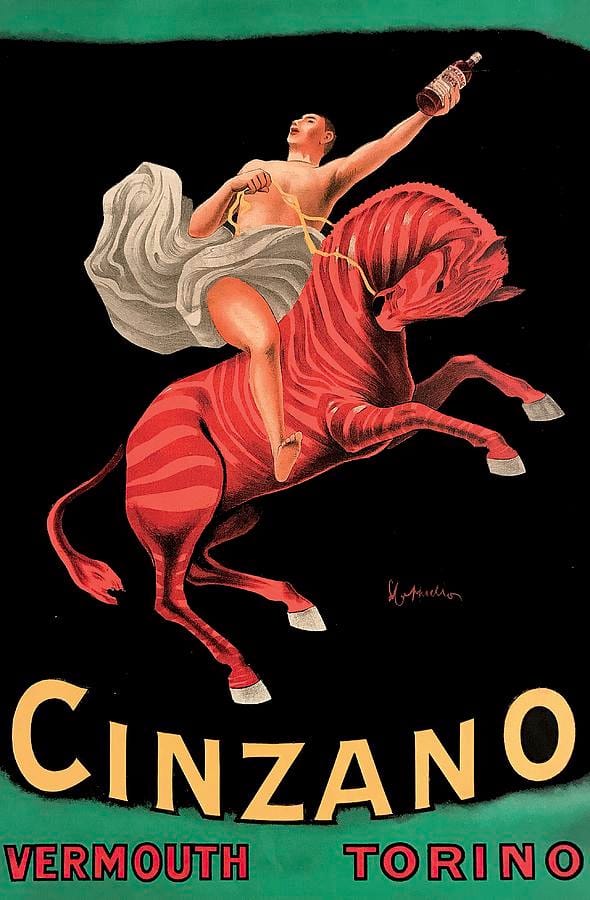
A woman in windblown white rides a rearing red zebra, one arm flung up with the bottle held high, against a flat band of green. Cappiello designed it around 1910 for the Turin vermouth house, and the zebra is doing the work no product shot could: it is impossible, brightly colored, and immediately memorable. He returned to Cinzano and its rivals many times over his career, but this is the design people still recognize. The tilted diagonal of horse and rider gives the poster a lurch of movement that reads instantly, even at speed.
Bouillon Kub
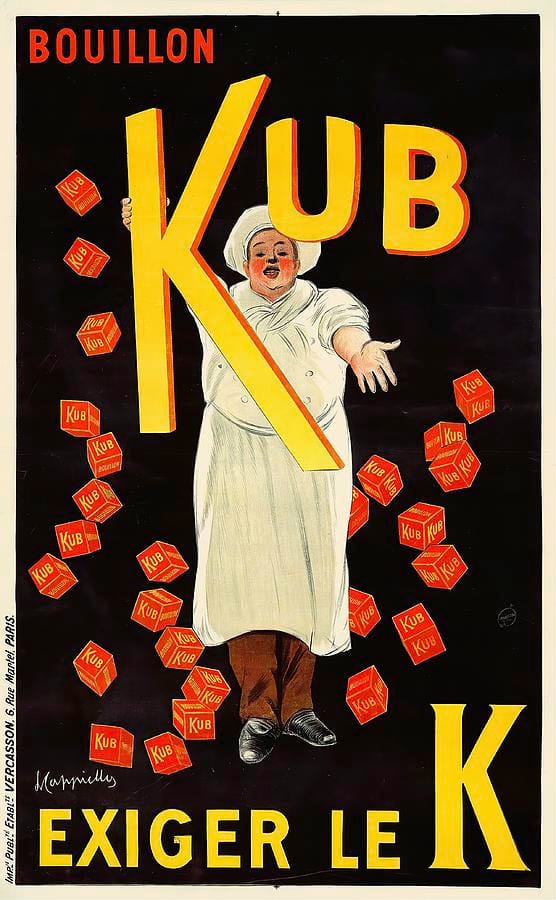
A beaming chef in white stands between an enormous yellow K and B while red stock cubes tumble through the air around him, over the instruction Exiger le K — insist on the K. The poster comes from the early 1930s, and it shows how completely Cappiello could build an image out of typography. The letters are not decoration around the picture; they are the picture, with the figure planted between them like a third character. Bouillon Kub advertising was everywhere in interwar France, and this remains the version people picture when they hear the name.
Mistinguett, Casino de Paris
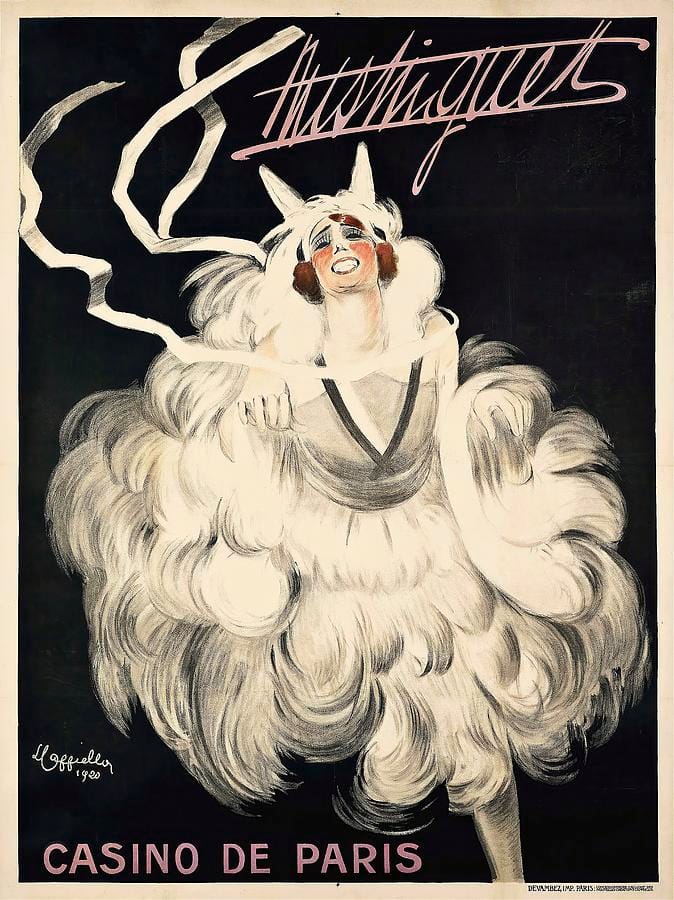
Mistinguett was the reigning star of the Paris music hall, famous for her legs, her nerve and her salary, and Cappiello — who had begun his career as a caricaturist of performers — drew her for the Casino de Paris around 1920. She erupts from a mountain of white ostrich feathers, mouth wide, chin up, her scrawled signature streaming across the top of the sheet like a banner. Almost nothing else is given: no theater, no date, no title. If you were in Paris then, the feathers and the grin were all the information you needed.
Job
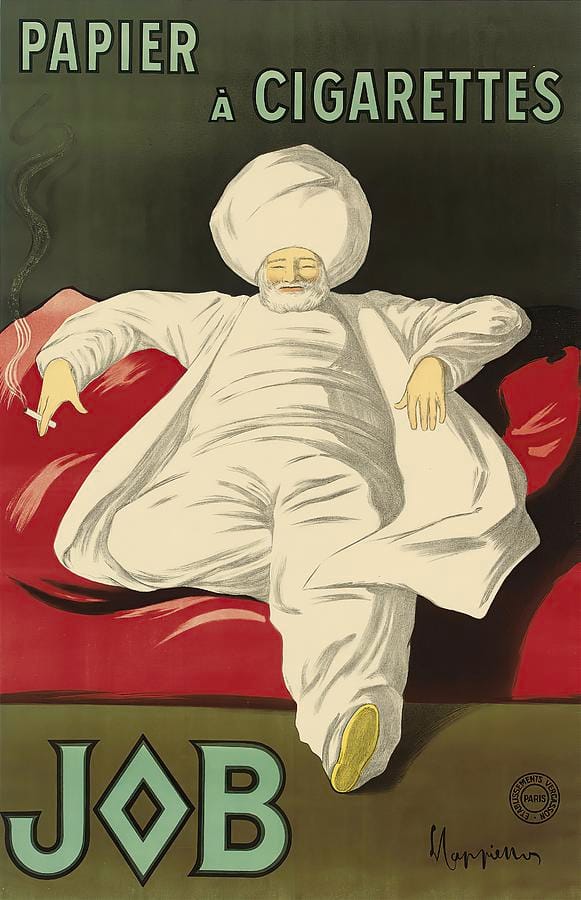
The cigarette-paper company Job commissioned posters from the best designers of the age, and Cappiello’s contribution shows a bearded man in a white turban and loose white robes sprawled back on red cushions, eyes shut in perfect contentment, a lit cigarette held out at arm’s length with the smoke curling up beside him. It dates from the early 1910s. Where Mucha had wrapped the same brand in ornament a decade earlier, Cappiello gives you one blissful body, one plume of smoke and the brand name in green at the foot of the sheet. The white robes against the red divan do all the color work, and the boneless pose sells the idea of ease better than any slogan could.
Contratto
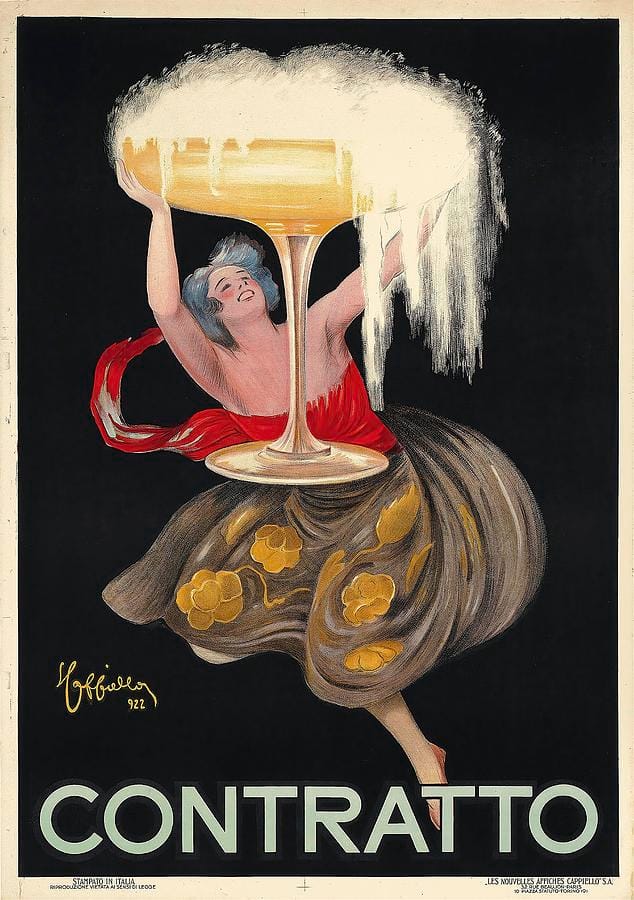
A woman in a red bodice and a swirling gold-flowered skirt dances out of the blackness holding an enormous champagne coupe above her head, and it is overflowing — foam boiling up over the rim and spilling down the far side in a white cascade. Cappiello signed and dated it 1922, for Contratto, the Piedmontese house that helped establish Italian sparkling wine. He understood that fizz is a sensation rather than an object, so he drew the sensation: the lift, the eruption, the spill. Everything is scaled to delight, the glass nearly as wide as the woman is tall, and the brand name simply sits underneath and takes the credit.
Mossant
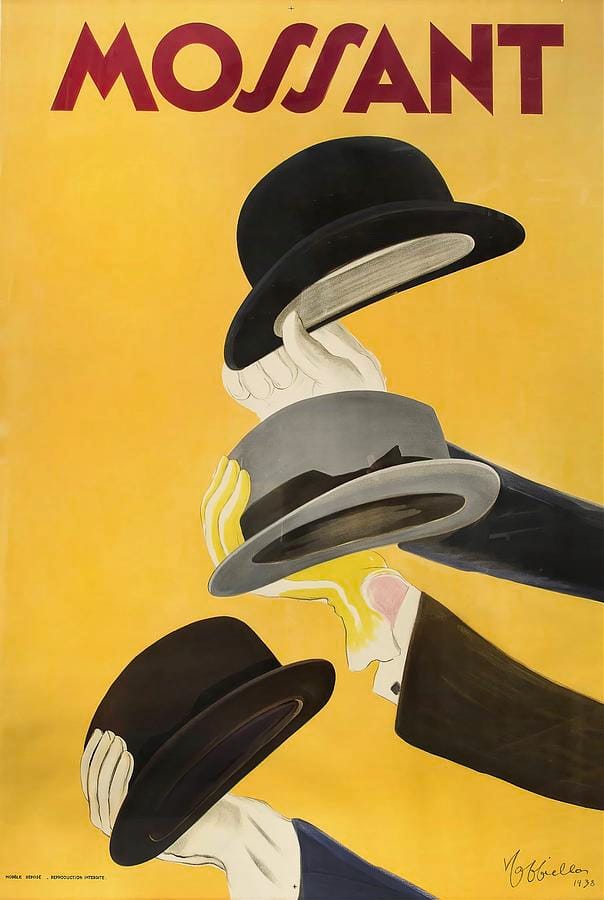
Three gloved hands come in from the edges of a flat mustard-yellow field, each lifting a hat — two black bowlers and a gray one — in the small courteous gesture of raising your hat to someone in the street. The brand name runs across the top in red, and that is the entire poster. Mossant was a French hatter, and Cappiello signed this design in 1938, near the end of his career, when his style had pared down almost to a graphic sign. No face, no shop, no model: just three hands, three hats, and a piece of everyday manners doing the selling.
Nitrolian
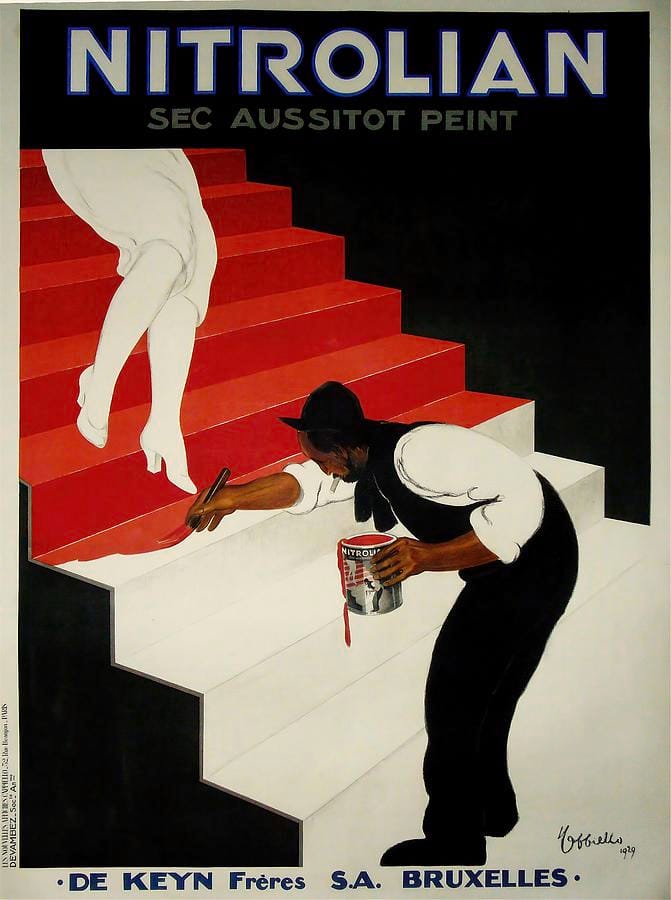
A painter in shirtsleeves and a black hat bends over a white staircase, tin in one hand, drawing his brush across the treads to leave them brilliant scarlet — while a few steps above him a pair of white-trousered legs walks calmly down the paint he has only just laid. The line across the top reads Sec aussitôt peint: dry as soon as it is painted. Signed and dated 1929, made for a Brussels enamel manufacturer, it is Cappiello’s wittiest piece of visual storytelling. The entire product claim is delivered by two figures and a flight of red steps, with nothing to read but the brand name.
Veuve Amiot
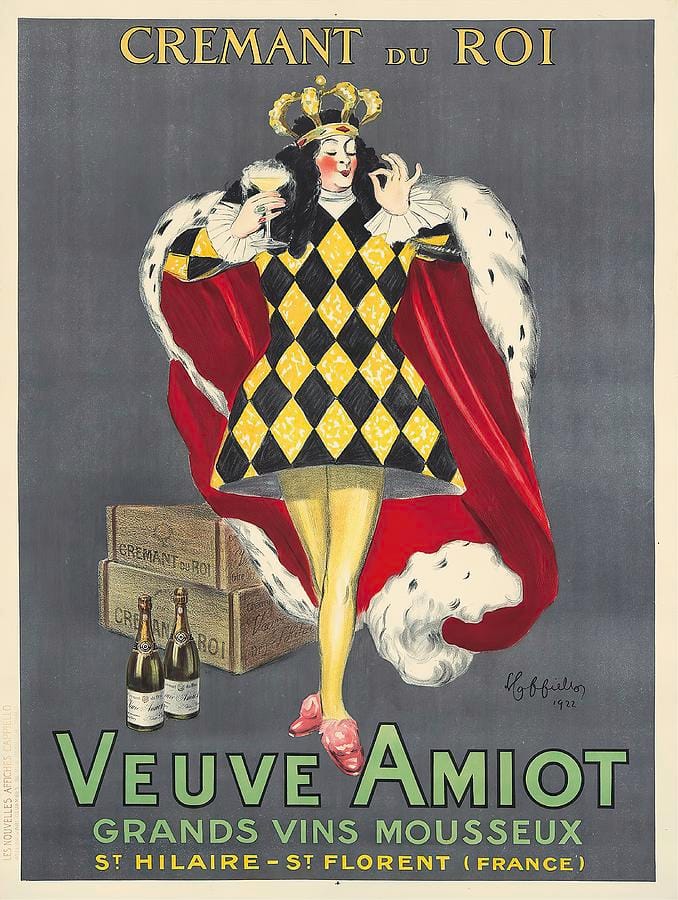
A crowned harlequin in a black-and-gold diamond tunic and an ermine-lined crimson cloak stands beside a stack of wine crates, a brimming coupe in one hand and the other lifted in the pinched-finger gesture that means perfect. Above him runs the line Crémant du Roi — the king’s crémant. Cappiello dated the design 1922; the wine is the sparkling Saumur of Veuve Amiot, on the Loire. He kept a lifelong affection for the costumes of the commedia dell’arte and the circus and used them constantly, because a figure the eye already recognizes, doing something it does not expect, was his shortest route into a stranger’s memory.
Cappiello’s posters were designed to be seen for a second and a half from a moving vehicle, which is exactly why they hold a wall so well today. The color is flat and confident, the drawing is fast, and each one carries a single character you cannot quite forget. Framed in a kitchen, bar or hallway, they bring the wit of Belle Époque and Art Deco Paris into a room without a hint of stuffiness.
Shop Leonetto Cappiello prints here, and explore the rest of our famous paintings collection for more of the world’s most beloved masterpieces.