Leonardo Da Vinci’s Ten Most Famous Paintings
From the Mona Lisa to his anatomical studies, a tour of the ten works that define the Renaissance’s greatest polymath.

Leonardo da Vinci (1452–1519) is the most famous artist who ever lived, and one of the least prolific. Fewer than twenty paintings are securely attributed to him, several are unfinished, and at least one has been lost. What survives instead is thought: some 6,000 pages of notebooks covering anatomy, hydraulics, optics, botany, geology, and flying machines, written backward in mirror script by a man who described himself, with some pride, as an unlettered one.
Painting was only ever part of his practice, but it is where his curiosity produced the greatest results. He pioneered sfumato — the smoky, edgeless blending of light into shadow — dissected human bodies to understand how muscles move beneath skin, and studied weather and distance so that his backgrounds recede into real, breathable air. Here are ten of his most famous works.
The Mona Lisa
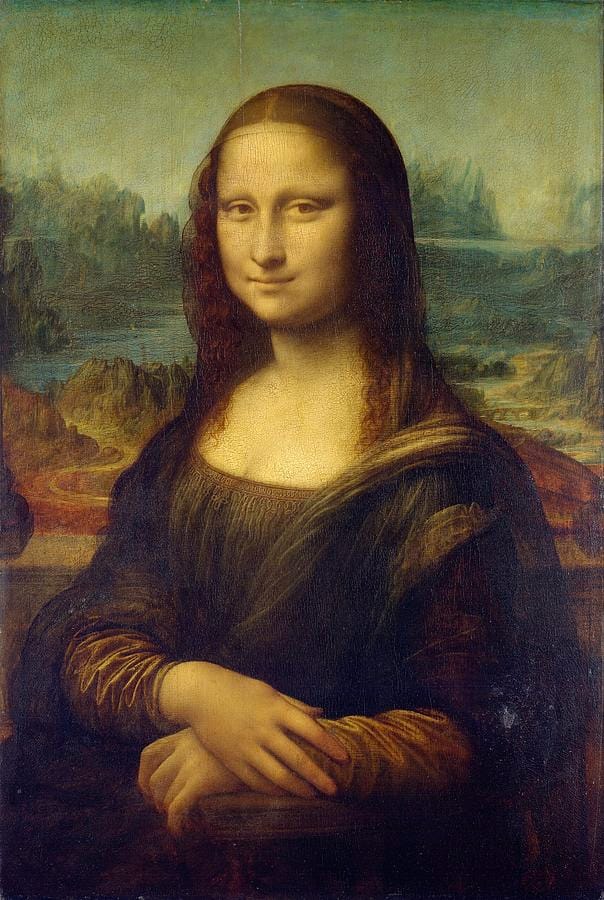
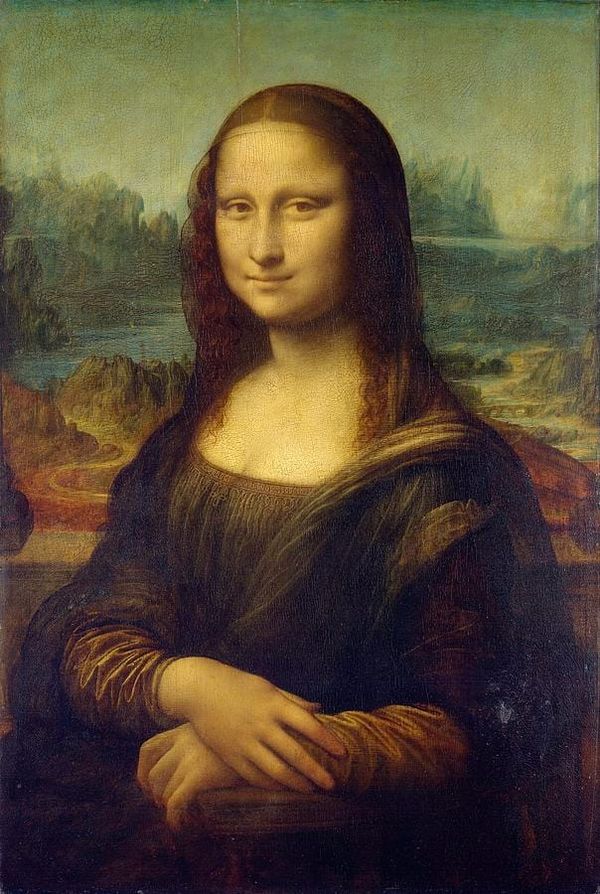
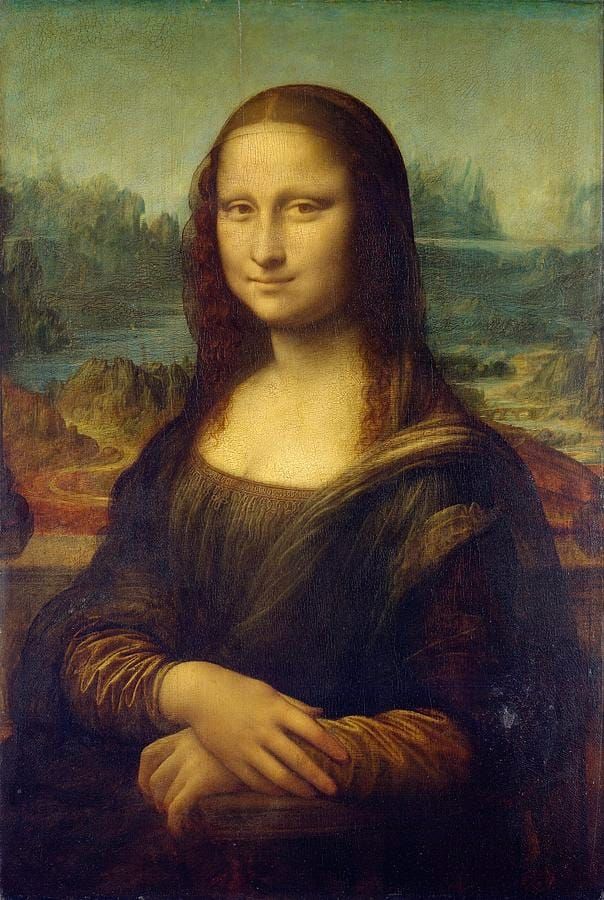
The most visited painting on earth is a modest half-length portrait, probably of Lisa Gherardini, the wife of a Florentine silk merchant. Leonardo began it around 1503 and never handed it over; he carried it with him for the rest of his life, still refining it in France more than fifteen years later. Its power comes from sfumato — the corners of the mouth and eyes dissolve into shadow, so the expression shifts depending on where you look — and from the strange, geological landscape behind her. Its global fame dates largely from 1911, when it was stolen from the Louvre and the theft made headlines worldwide.
Lady with an Ermine
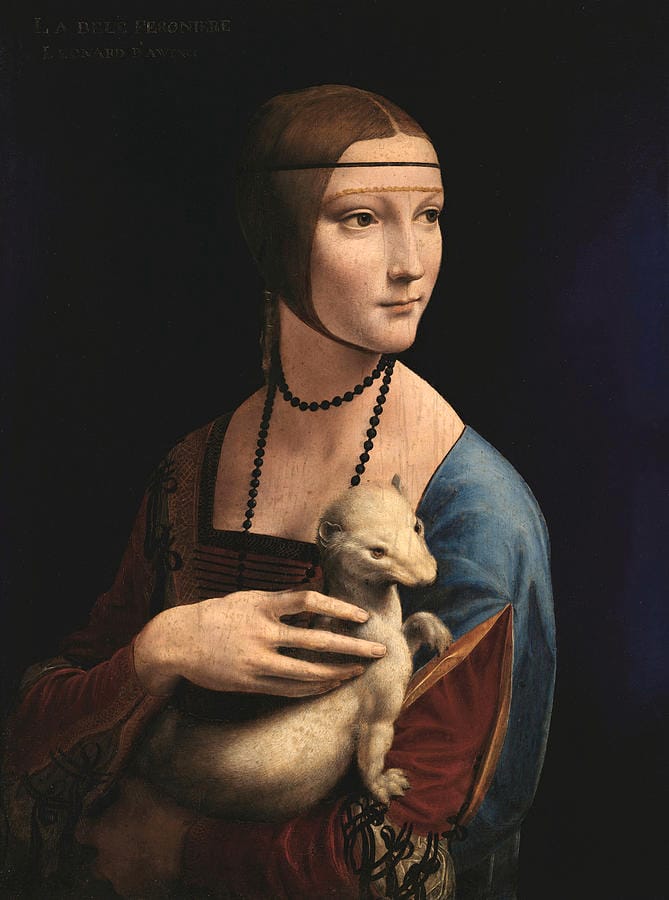
Painted around 1489–91 in Milan, this is a portrait of Cecilia Gallerani, the teenaged mistress of Leonardo’s patron Ludovico Sforza, holding a white ermine that doubles as a pun and a compliment — the animal was a symbol of purity and one of the duke’s own emblems. What makes it revolutionary is the movement: Cecilia’s body turns one way while her head turns another and her gaze goes somewhere else entirely, as though she has just been interrupted. Portraits before this were static profiles. This one has a pulse, and it is arguably the first genuinely psychological portrait in European art.
The Virgin of the Rocks
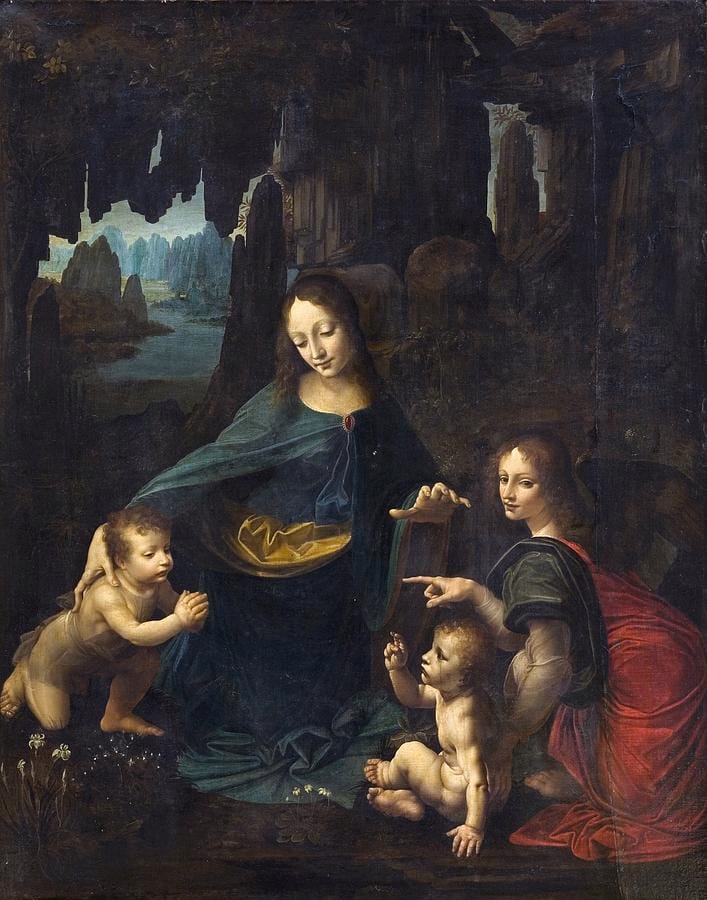
The Virgin Mary, the infant Christ, the infant John the Baptist, and an angel are gathered in a shadowy grotto of weathered rock and precisely observed plants. Leonardo painted two versions of this composition, roughly twenty years apart, following a contractual dispute with the confraternity who commissioned it — one now hangs in Paris, the other in London. Both are showcases for everything he had worked out about light: the figures emerge from deep darkness into a soft, directionless glow, and the grotto opens onto a hazy blue distance that seems genuinely far away rather than merely painted small.
Vitruvian Man (The Proportions of the Human Figure)
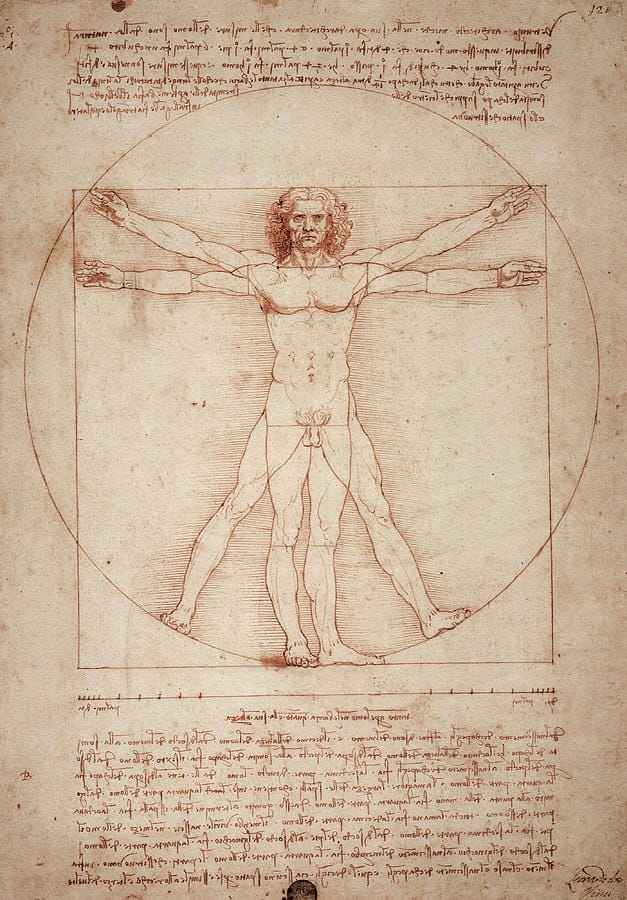
A nude man stands with arms and legs outstretched in two superimposed positions, inscribed simultaneously within a circle and a square. Drawn in pen and ink around 1490, the study takes its title from the Roman architect Vitruvius, who argued that the proportions of the human body should govern the proportions of buildings. Leonardo tested the claim against real measurements, corrected it, and covered the sheet with notes in his mirror writing. It has since become the universal shorthand for the Renaissance itself — printed on coins, textbooks, and hospital signage — largely because it makes an abstract idea about order and the human body instantly legible.
The Virgin and Child with Saint Anne
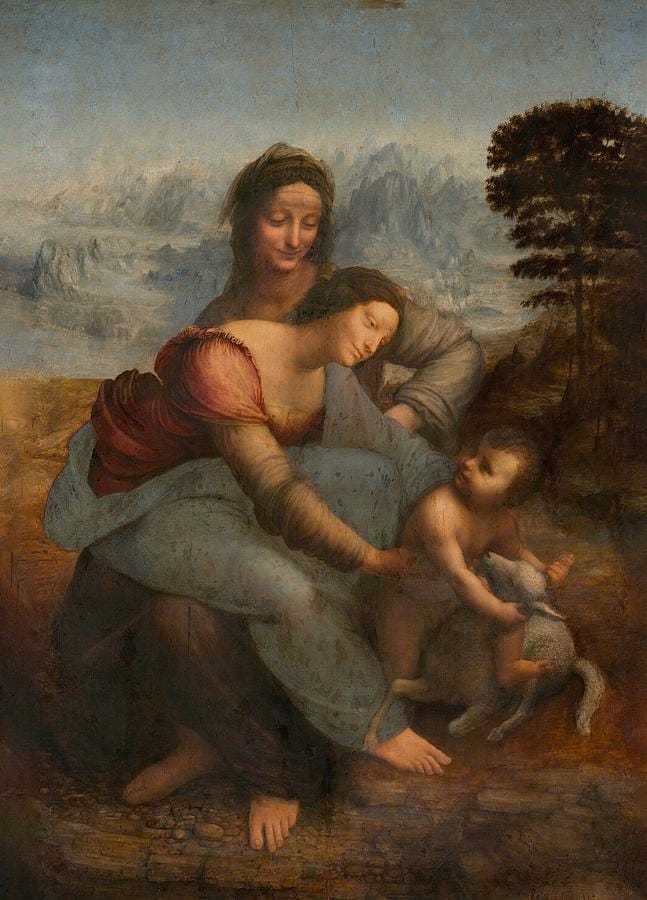
One of Leonardo’s late works and never entirely finished, this painting stacks three generations into a single unstable pyramid: Saint Anne holds her daughter Mary on her lap, and Mary leans forward to catch the infant Christ, who is playing with a lamb. Every figure is in motion and every motion is arrested. Sigmund Freud famously wrote an entire essay about it. Setting the psychoanalysis aside, it is a technical marvel — the interlocking bodies, the misty blue mountains behind, and the smile Anne wears, which is the same unreadable expression Leonardo gave the Mona Lisa.
The Annunciation
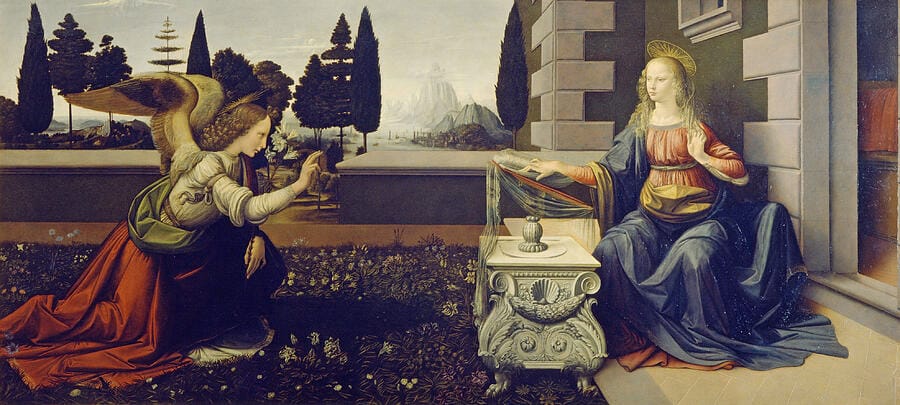
This is early Leonardo, painted around 1472–76 when he was barely into his twenties and still working in Verrocchio’s Florentine workshop. The angel Gabriel kneels on a lawn scattered with meticulously identifiable flowers to tell Mary she will bear the son of God, while behind them a line of cypresses gives way to a hazy harbor and blue mountains. The wings were studied from real birds. The perspective of the marble table has puzzled scholars for a century — it only resolves when viewed from the right — and the whole picture shows a young painter already testing rules rather than following them.
The Heart and the Bronchial Arteries
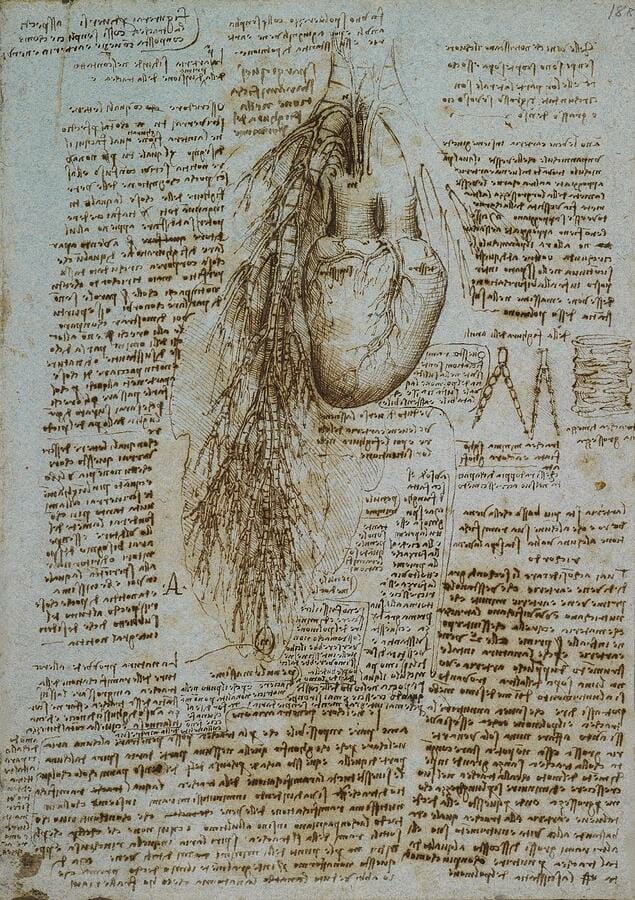
Leonardo dissected some thirty human bodies over his lifetime, working in hospital mortuaries by candlelight, and his anatomical drawings were three centuries ahead of anything else being produced. This study of the heart and its vessels is one of hundreds of such sheets, combining precise observation with a mechanical curiosity about how the thing actually functions — he built a glass model of a heart valve and pumped water through it to watch the eddies. Had these pages been published in his lifetime, medical history might look different. Instead they sat unseen in private collections for hundreds of years.
Salvator Mundi
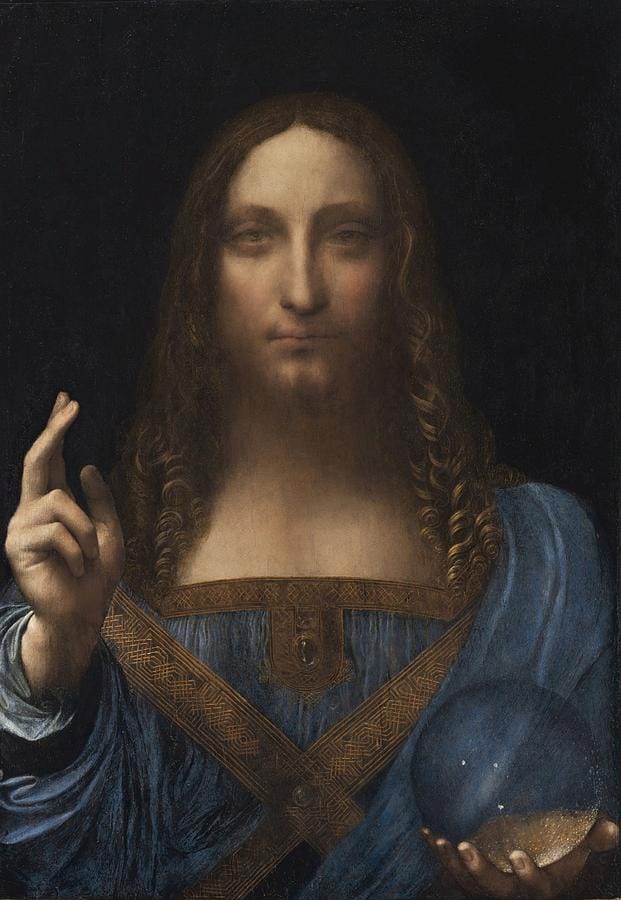
Christ faces the viewer directly, raising his right hand in blessing while his left holds a transparent crystal orb representing the world. Long thought lost and for many years dismissed as a workshop copy, the painting was cleaned and reattributed in the early 2000s, and in 2017 it sold at auction for $450 million — by an enormous margin the highest price ever paid for a work of art. The attribution is still debated by specialists, and the picture’s current whereabouts are not publicly confirmed, which has only added to a story that now rivals the painting itself.
Ginevra de' Benci
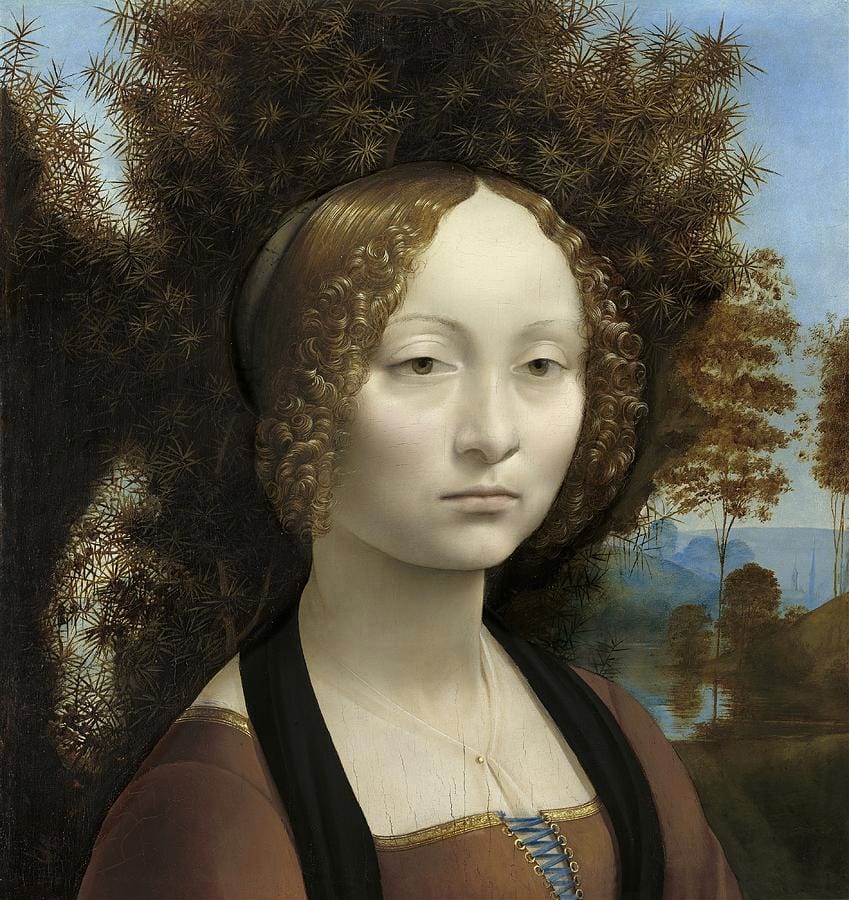
Painted around 1474–78, when Leonardo was in his mid-twenties, this portrait of a young Florentine noblewoman is the only painting by him in the Americas. Ginevra’s pale, faintly severe face is framed by a spiky juniper bush — a visual pun, since juniper is ginepro in Italian — and the reverse of the panel carries a wreath and the motto “beauty adorns virtue.” The bottom of the picture was cut down at some point, so her hands are lost. Even so, the modeling of the skin and the cool, watery landscape behind mark a decisive break from the portraiture of his teachers.
Self-Portrait
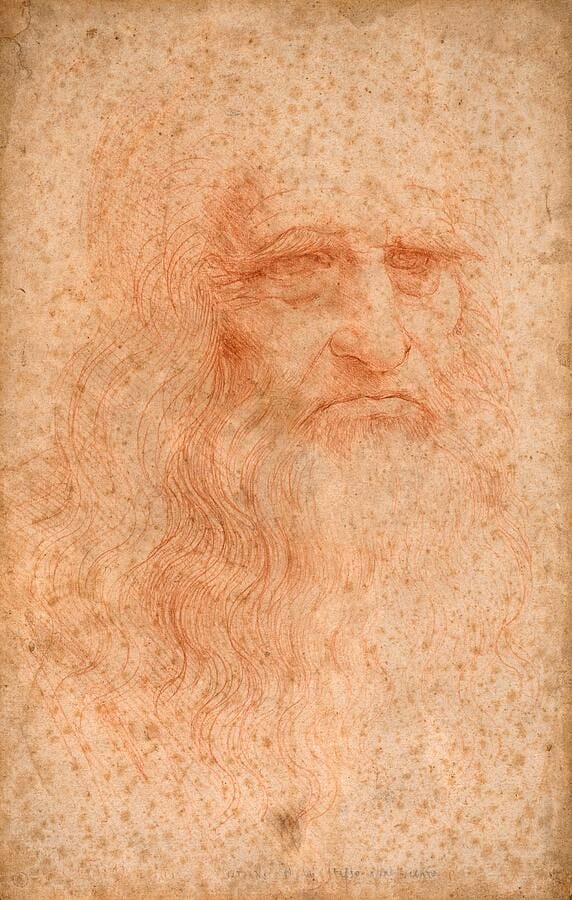
A red chalk drawing of an old man with a long beard, flowing hair, and heavy brows, made around 1512 and traditionally taken to be Leonardo in his sixties. It is the image that fixed his reputation for all time: the sage, the wise old genius, the Renaissance man grown venerable. Some scholars doubt whether it depicts him at all, pointing out that he would have been under sixty and that the drawing may portray a relative or an ideal type. Either way, the draftsmanship is astonishing — every furrow and strand rendered in confident, economical strokes with no correction anywhere.
Leonardo left behind a handful of paintings and a mountain of questions, and five centuries later both still hold. His work rewards living with in a way few images do: the more familiar a Leonardo becomes, the stranger it tends to look, which is exactly the quality you want in something you will pass every day.
Shop Leonardo da Vinci prints here, and explore the rest of our famous paintings collection for more of the world’s most beloved masterpieces.