John Trumbull’s Ten Most Famous Paintings
The soldier who became the painter of the American Revolution — ten works that gave the founding generation its face.

John Trumbull (1756–1843) is the reason most Americans picture the Revolution the way they do. He was the son of a Connecticut governor, a Harvard graduate, and — briefly — a soldier, serving as an aide to George Washington in 1775 before resigning in a dispute over the date of his commission. Blind in one eye from a childhood fall, he made his living instead with a brush, sailing to London in 1780 to study under the American expatriate painter Benjamin West.
It was West who suggested the project that would occupy Trumbull for forty years: a series of paintings recording the great events of the Revolution while the participants were still alive to sit for them. He traveled on both sides of the Atlantic taking likenesses from life, and four of the resulting canvases were enlarged for the Rotunda of the United States Capitol, where they remain. He later gave his collection to Yale, creating the first art museum attached to an American college. Here are ten of his most famous works.
The Declaration of Independence
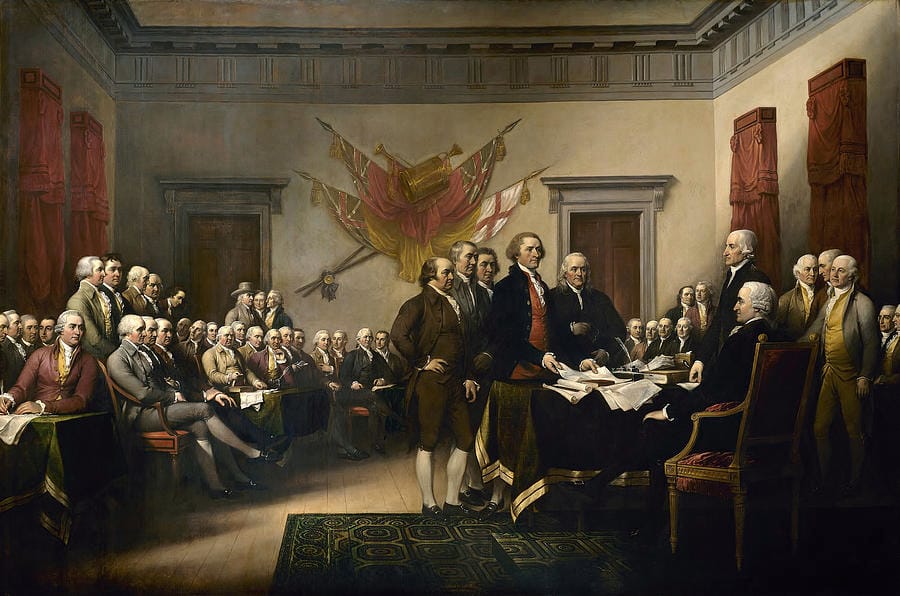
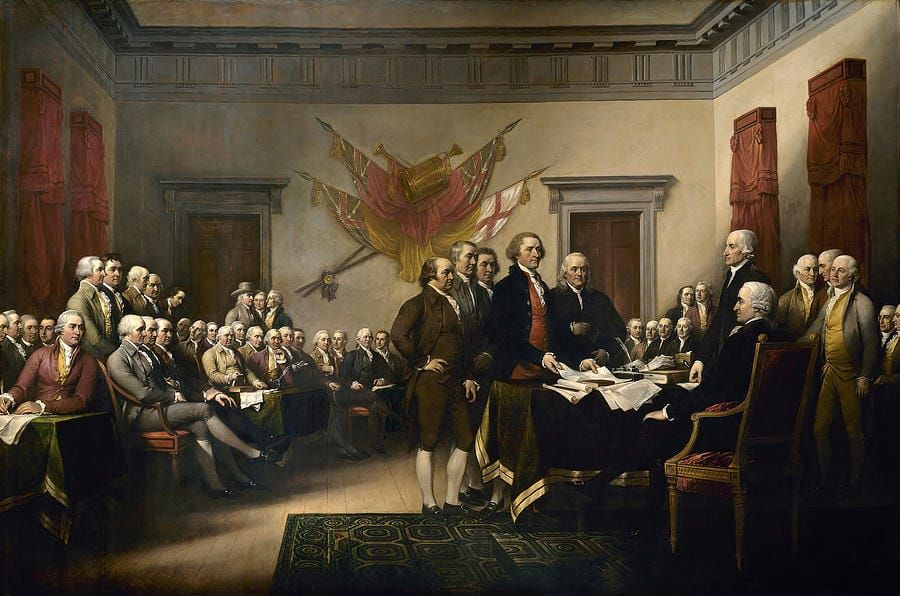
The most reproduced American history painting ever made does not show the signing at all. Trumbull chose the moment in June 1776 when the drafting committee — Jefferson, Adams, Franklin, Sherman, and Livingston — presented their text to John Hancock, who presides at the table on the right. Trumbull included forty-seven men, forty-two of them signers, and spent decades collecting their faces from life or from portraits he trusted, leaving out anyone he could not verify. He began the small version in the 1780s with Jefferson’s help, working from a sketch Jefferson drew of the room. The image is engraved on the back of the two-dollar bill.
The Surrender of General Burgoyne at Saratoga
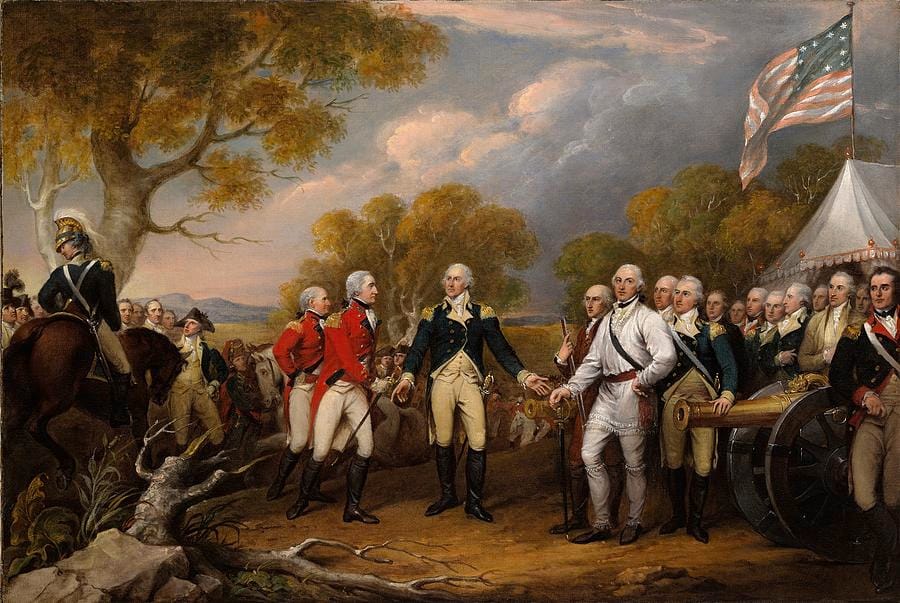
In October 1777 a British army under General John Burgoyne surrendered at Saratoga in upstate New York — the victory that persuaded France to enter the war on the American side. Trumbull shows Burgoyne, in scarlet, offering his sword to General Horatio Gates, who declines it and gestures instead toward his tent, where dinner is waiting. American officers stand in a long line to the right beneath a great tree and an early Stars and Stripes. The courtesy of the moment is the point: Trumbull was painting the Revolution as an honorable contest between gentlemen, and this canvas hangs in the Capitol Rotunda.
The Death of General Mercer at the Battle of Princeton
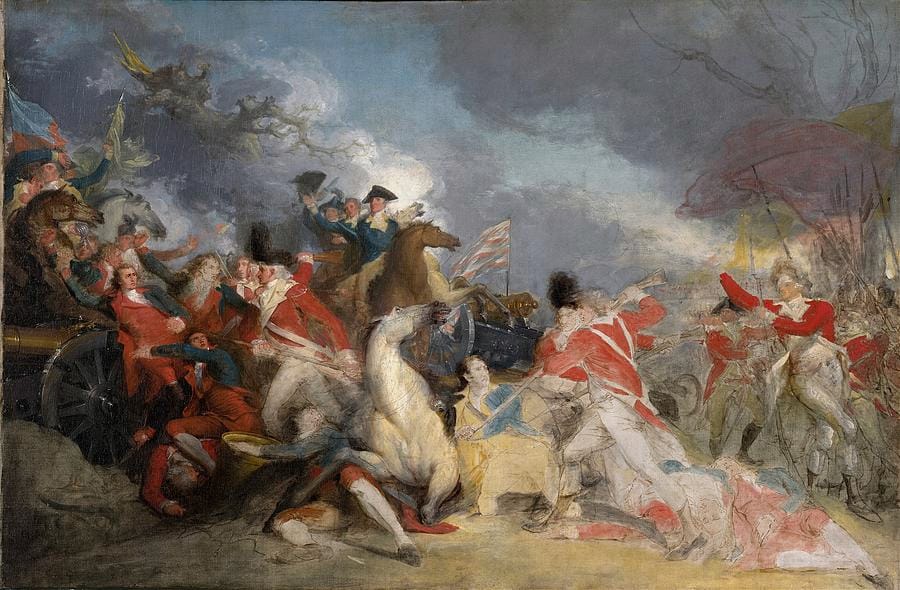
Trumbull’s battle pictures are far wilder than his ceremonial ones. Here, on January 3, 1777, the Virginian general Hugh Mercer lies mortally wounded beneath his fallen gray horse, bayonets closing over him, while Washington rides in from the right through a haze of smoke and a tangle of rearing animals and falling men. The composition is all diagonals and confusion, with none of the orderly ranks of the surrender scenes. Mercer died of his wounds nine days later and became one of the Revolution’s celebrated martyrs. The painting belongs to Yale, and is among the most physically violent works by any American artist of the period.
The Resignation of General Washington
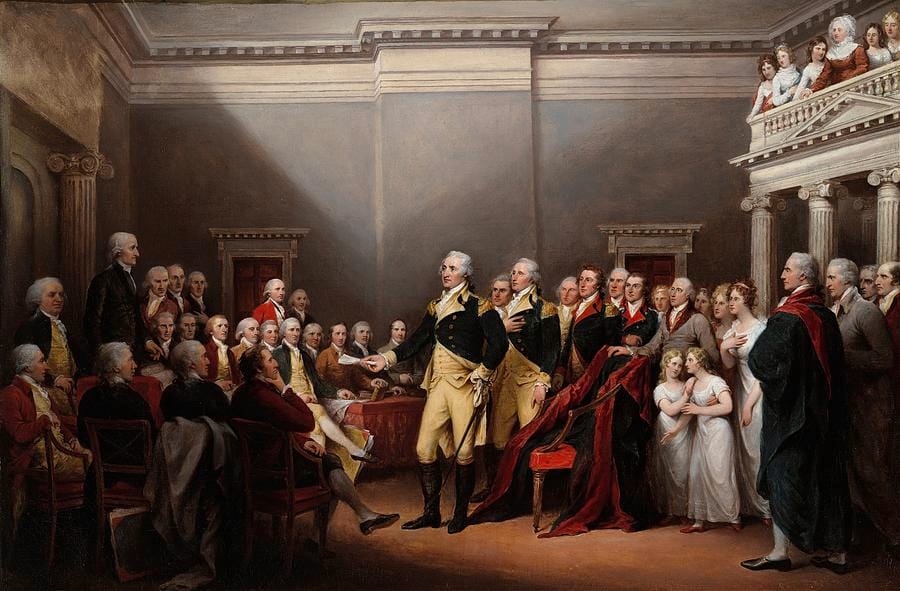
On December 23, 1783, in the Maryland State House at Annapolis, Washington stood before the Continental Congress and gave back his commission as commander in chief. Trumbull thought it the noblest act of the war — a victorious general voluntarily surrendering power — and he stages it plainly: Washington alone on the floor of the chamber, arm extended, delegates seated in a curve before him, spectators crowded into the gallery above. Martha Washington and her grandchildren watch from the balcony, an addition Trumbull made for effect. It is one of the four Trumbull canvases in the Rotunda of the Capitol.
General George Washington at Trenton
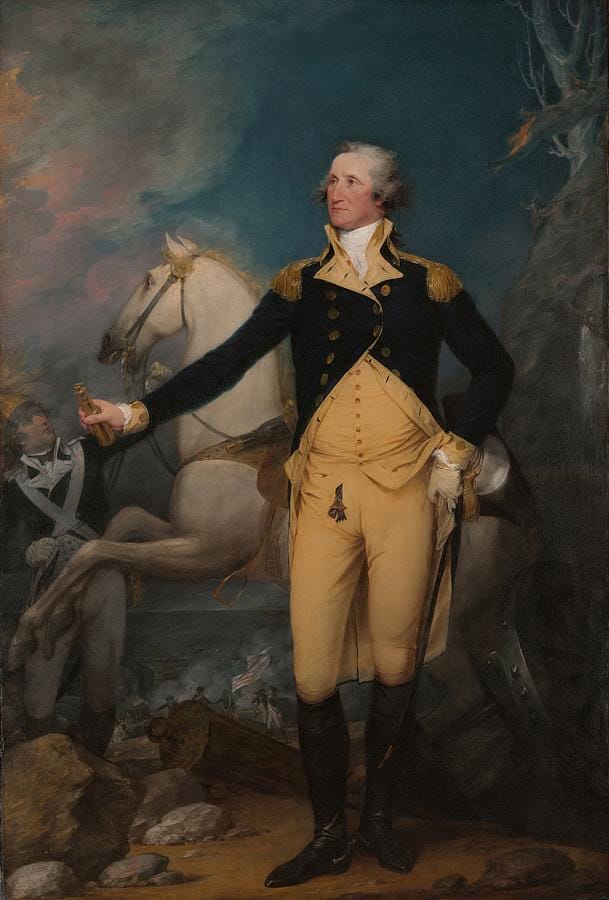
Painted in 1792, this is Trumbull’s grandest single portrait of Washington: the general stands full length on the eve of the Battle of Princeton, a spyglass in his outstretched right hand and his left resting on his hip, a white horse rearing behind him under the grip of an aide, and cannon, colors, and marching men moving through the smoke below. Charleston, South Carolina, had commissioned a portrait and Trumbull gave them this — then found the city wanted something calmer and more civic, and painted a second version to suit. He kept the original, which is now at Yale, and considered it the best of all his portraits of Washington.
George Washington and William Lee
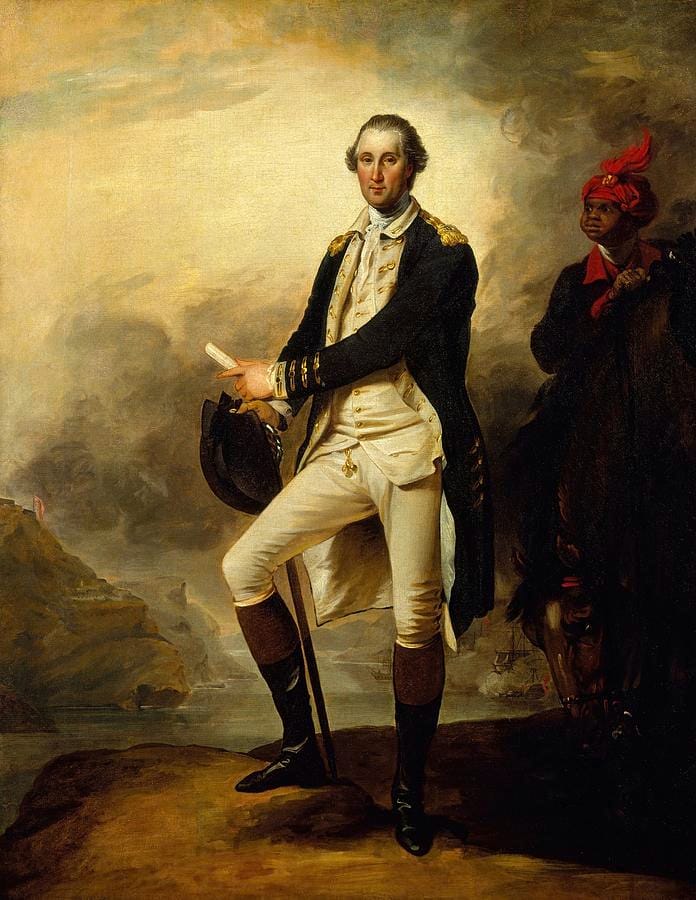
Trumbull painted this in London in 1780, while studying with Benjamin West and working from memory of the man he had briefly served. Washington stands in the blue and buff of the Continental Army against a distant landscape, hat under his arm; behind him waits William Lee, the enslaved manservant who accompanied Washington throughout the war, holding the horse and wearing a plumed turban. Lee appears in several Washington portraits and is one of the few enslaved Americans of the era whose face was recorded at all. The painting is in the Metropolitan Museum of Art in New York.
Alexander Hamilton
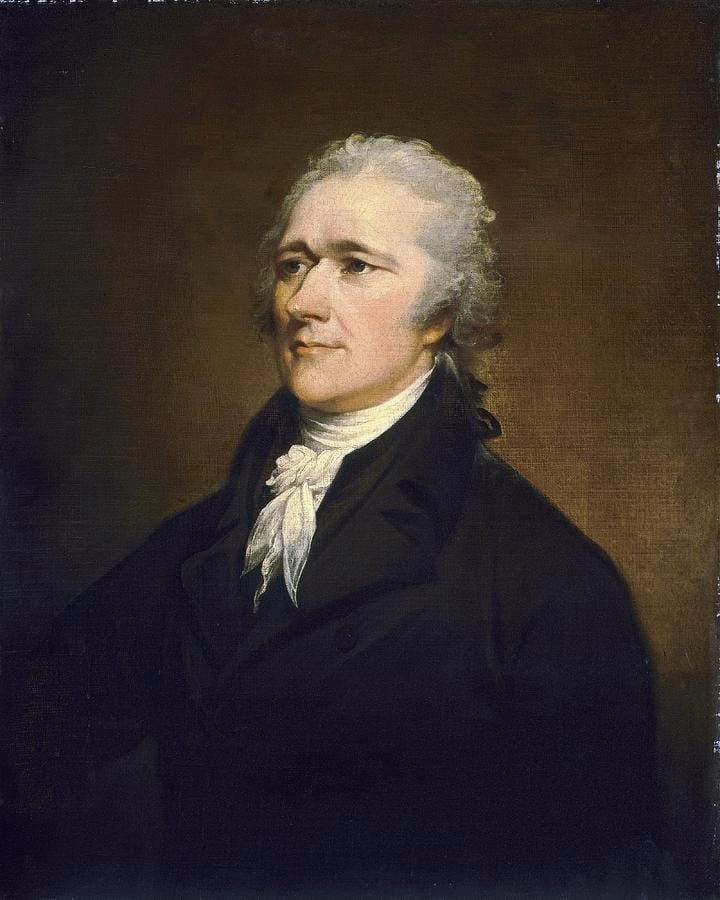
Trumbull knew Hamilton and painted him repeatedly, and this bust-length portrait — the head turned, the expression alert and faintly amused, the dark coat and white stock set against a plain, almost black ground — became the definitive likeness. Hamilton was killed in his duel with Aaron Burr in 1804, and afterward Trumbull’s image did the work that photographs would later do for public men: it was copied, engraved, and reproduced until it simply was Hamilton’s face. A version of it is the source for the portrait on the ten-dollar bill, which is why the first Secretary of the Treasury still looks out at Americans every day.
Thomas Jefferson
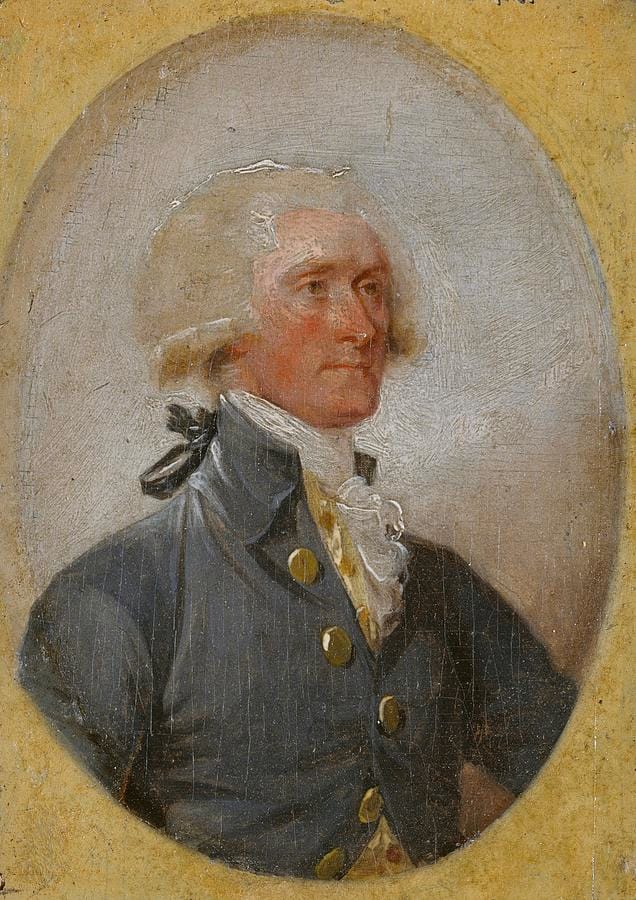
Trumbull met Jefferson in Paris in 1786 and stayed in his house on the Champs-Élysées, and the friendship shaped both men’s careers — Jefferson encouraged the Revolution series and supplied the floor plan for the Declaration picture. This small oval portrait shows Jefferson in his early forties, red-haired and powdered, in a blue coat with a black ribbon at his neck, the head modeled softly against a pale ground. It was painted as a study for the larger history painting and then took on a life of its own, becoming one of the standard images of Jefferson before the presidency.
John Adams
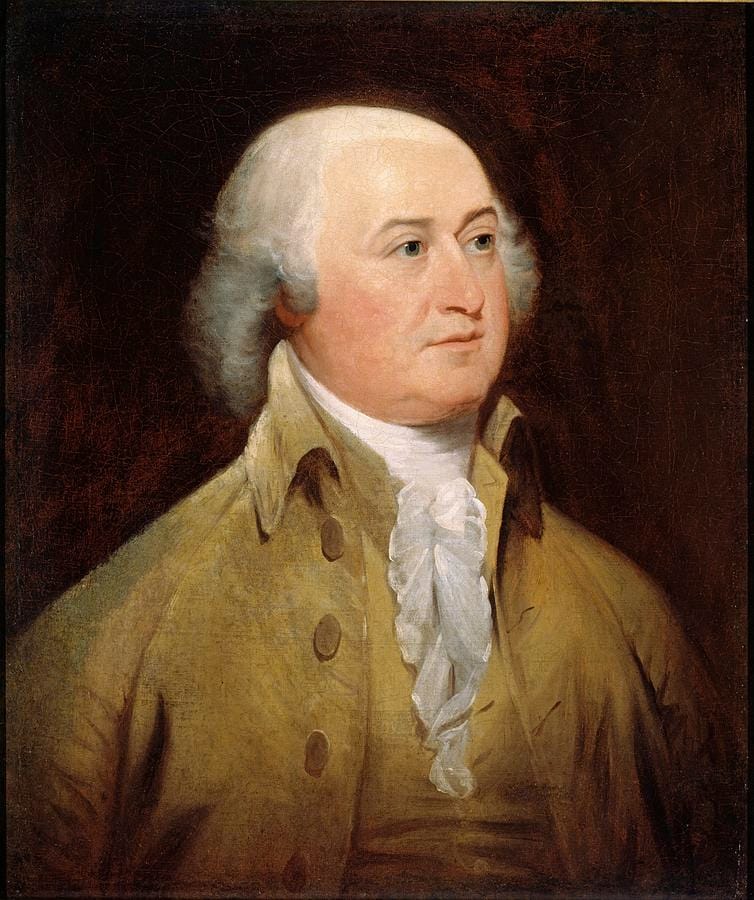
Trumbull painted Adams around 1793, when he was serving as the first vice president of the United States and enjoying it very little. The portrait is unusually direct: a stout, ruddy man in an olive-brown coat with a white stock, hair brushed back, looking out with an expression of blunt intelligence and a hint of impatience. There is no drapery, no column, no allegorical clutter — nothing but the face. Adams sat to Trumbull more than once over the years, but this is the likeness that stuck, and it remains the image most often used to illustrate his presidency.
Self-Portrait
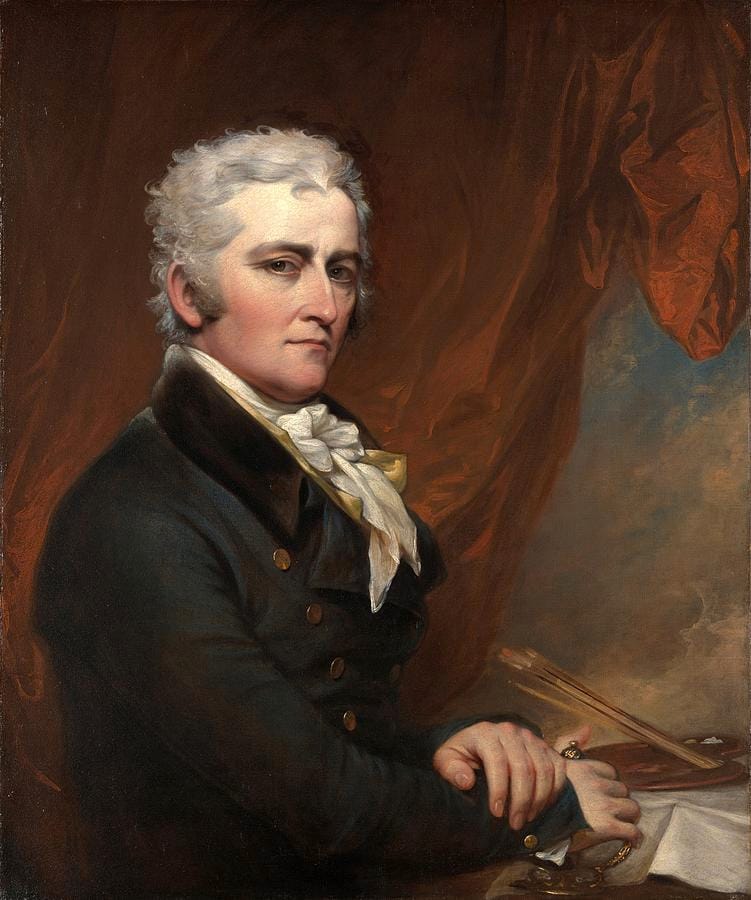
Trumbull painted himself several times; this one shows him in middle age, white-haired, in a dark green coat with a loose white cravat, seated before a swag of red curtain with his palette and brushes just visible at his elbow. The pose is that of a gentleman rather than a tradesman, which was the whole argument of his life — he came from a governor’s family and wanted painting understood as an honorable calling for such a man. Look closely at the eyes and you see the slight asymmetry left by the childhood accident that took his sight on one side.
Trumbull was not the most gifted painter of his generation, but he was the one who understood what was worth recording, and he did it while the witnesses were still living. His pictures hang naturally in a study or a library, and they carry a weight of history that few images can match.
Shop John Trumbull prints here, and explore the rest of our famous paintings collection for more of the world’s most beloved masterpieces.