Joaquín Sorolla’s Ten Most Famous Paintings
Wet sand, white dresses, and the Mediterranean at midday: the ten paintings that made Sorolla the master of Spanish light.

Joaquín Sorolla (1863–1923) was born in Valencia and orphaned at two when a cholera epidemic killed both his parents. He trained locally, won a scholarship to Rome, and made his early reputation on large, sober canvases about Spanish social life — the kind of picture that won medals at international exhibitions. Then he turned to the beach outside his own city, and everything changed.
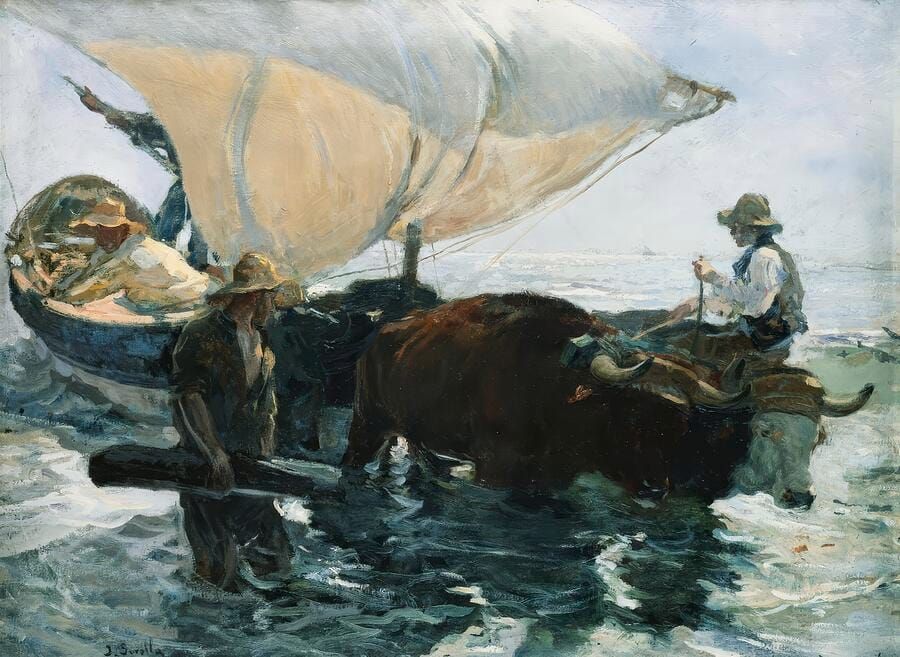
From the mid-1890s Sorolla painted almost entirely out of doors and at speed, working on large canvases in the open air with the sea in front of him: children in the shallows, oxen dragging boats through the surf, women in white walking into the wind. Critics gave the style a name — luminism — but what it really amounts to is a lifelong argument that light is the subject. He was hugely celebrated in his day, particularly in America, where a single New York exhibition in 1909 drew enormous crowds. Here are ten of his most famous paintings.
The Return from Fishing
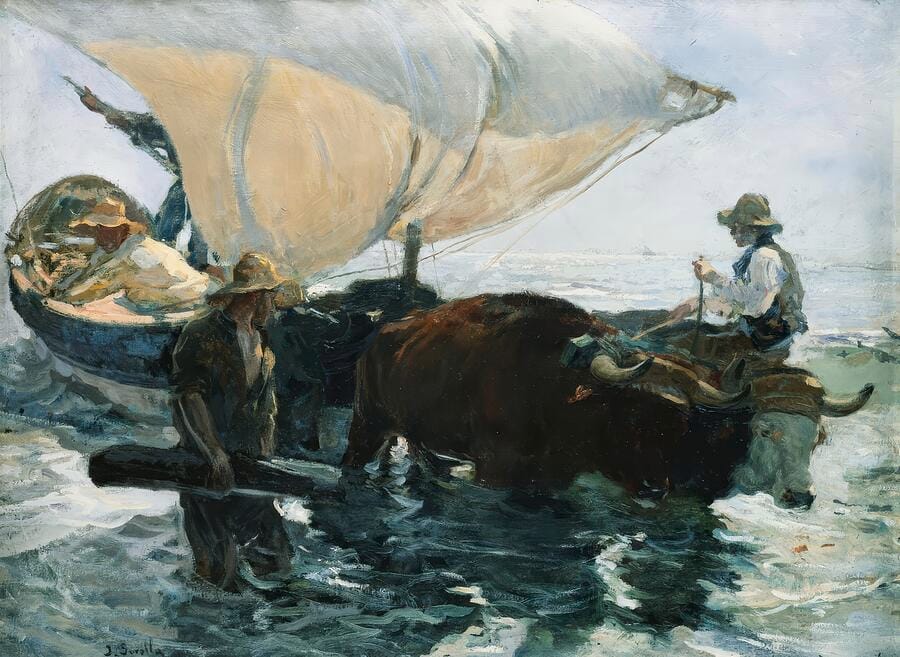
A pair of oxen wade chest-deep through the surf, hauling a fishing boat toward the sand while the great triangular sail still fills above them and a man in a straw hat stands over them at the boat’s side. Painted in 1894, The Return from Fishing was the picture that made Sorolla’s international name: it was shown in Paris and bought by the French state, and it hangs today in the Musée d’Orsay. Everything he would spend the next thirty years perfecting is already here — the wet flanks of the animals, the shadow the sail throws on the water, the sense that the whole scene is moving and the paint only just caught it.
Mending the Sail
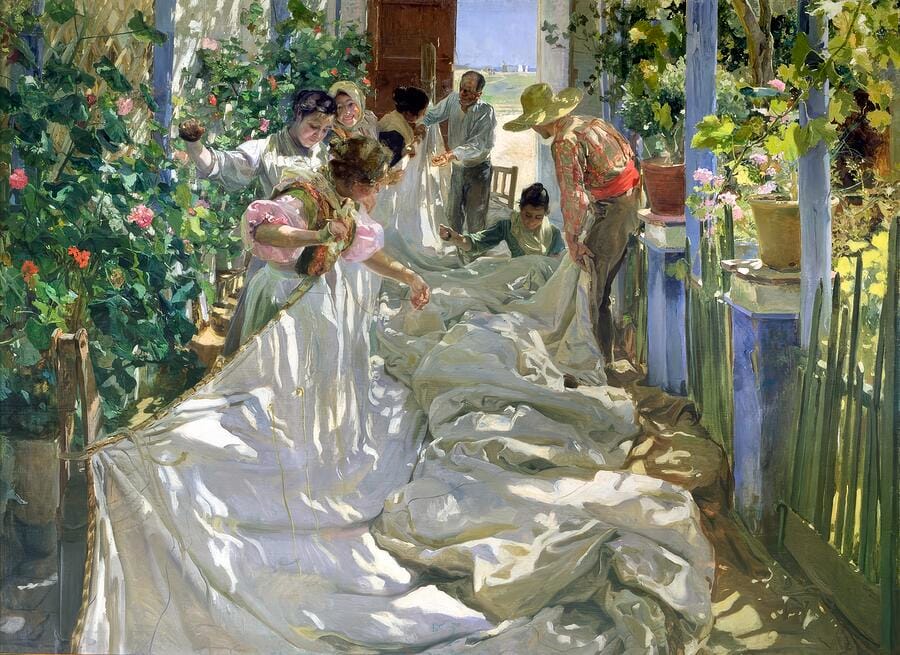
An enormous white sail is spread across a vine-shaded courtyard while a group of Valencian fishing families work along its edges with needles and thread. Painted in 1896, the canvas is really a study of light filtered through leaves and thrown back off acres of sailcloth — dappled, shifting, and worked in strokes of pale violet and green as much as white. It won Sorolla a medal in Munich and was acquired for a museum in Venice, where it remains. The subject is communal labor, but the picture never lectures: the pleasure is in the shade, the flowers along the wall, and the ordinary competence of people doing a familiar job.
Kissing the Relic
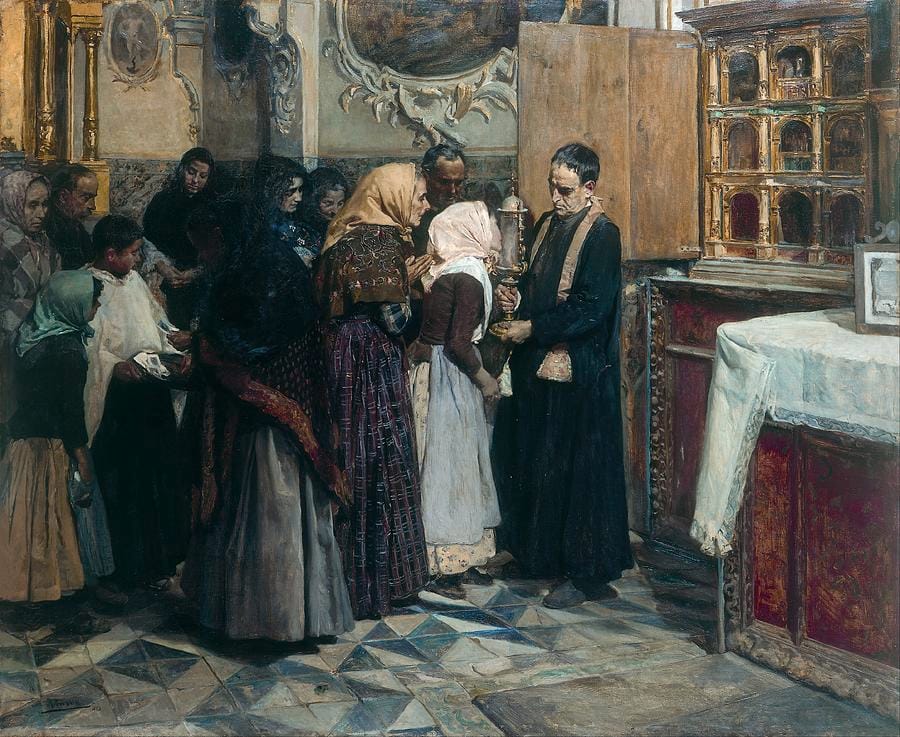
Inside a dim church, a line of women in black shawls shuffles forward to press their lips to a relic held out by a priest at the altar rail. Painted in 1893, this is Sorolla before the sunlight — the palette almost monochrome, the faces of the older women in the line described with unsentimental exactness. Pictures like this belong to the strand of Spanish realism running back through Velázquez and Goya, and they won him his first serious prizes. Seeing it beside his beach paintings is the quickest way to understand how far, and how deliberately, he traveled in the following decade.
Selling Melons
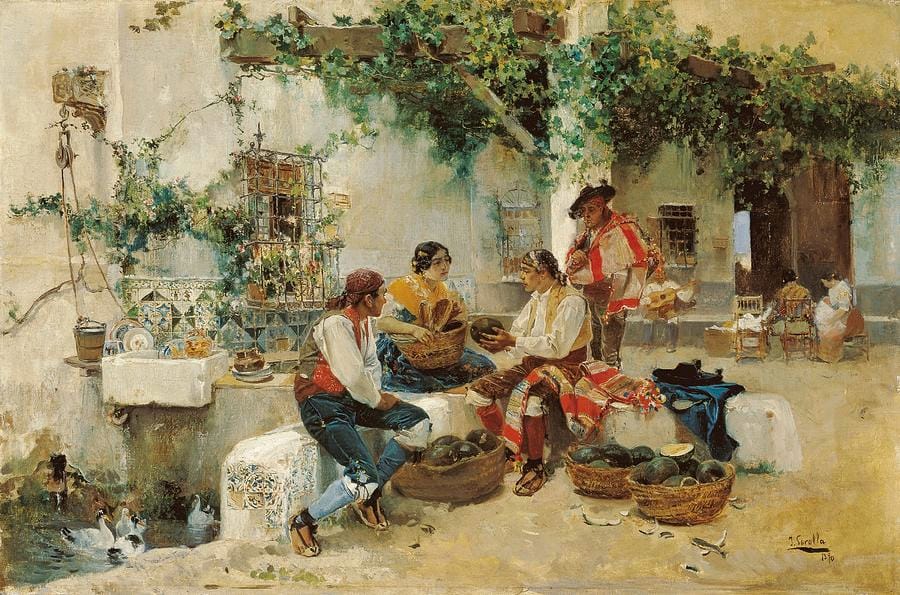
Selling Melons dates from 1890, before Sorolla found the blazing beach light he became famous for, and it shows how good he already was. In a whitewashed Valencian courtyard hung with vines and birdcages, three young people in local dress sit among baskets of dark green melons while a fourth leans against the wall in a striped sash; ducks pick about the paving, a rack of painted plates catches the light, and further back a couple sits out in the sunlit street beyond. The embroidered costumes let Sorolla indulge his love of pattern, but what really holds the picture together is the cool shade of the courtyard set against the glare outside it.
Under the Awning, Zarauz
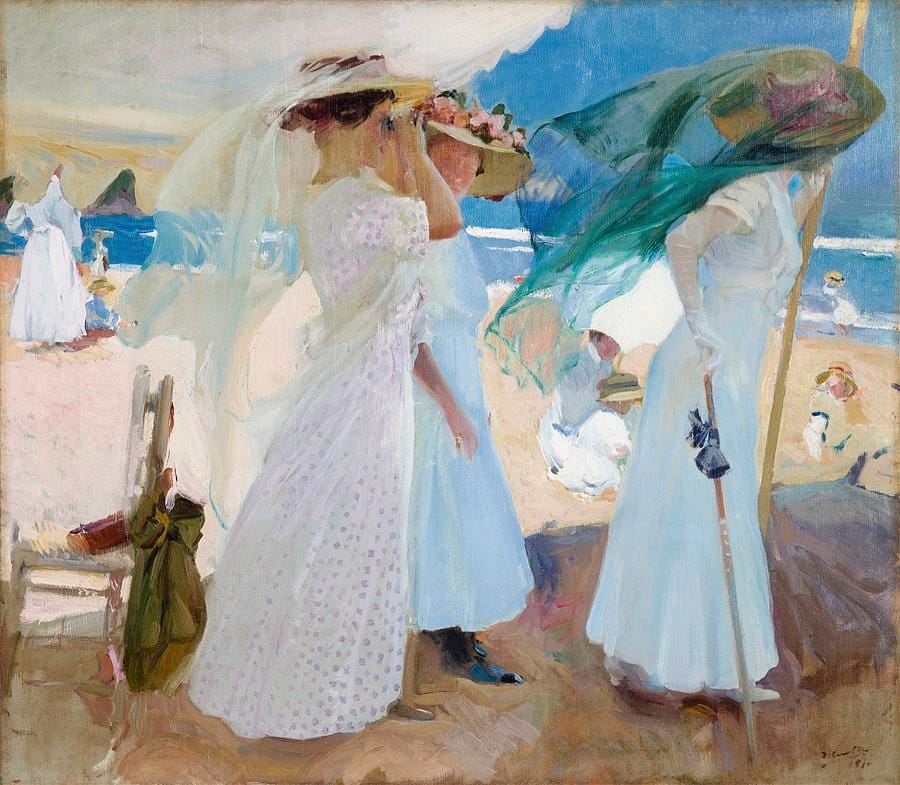
Three women in white summer dresses stand in the shade of a striped beach awning at Zarauz on the Basque coast, holding their hats against the wind, with the bright sand and bathers behind them. Painted in 1910, it is one of Sorolla’s most elegant compositions: the awning cuts a hard diagonal of shadow across the top of the canvas, and everything below it is a study in what white becomes when it is half in shade — gray, blue, lilac, pale green, almost never white. The Basque resorts drew fashionable Madrid society every summer, and Sorolla painted them there for years.
The Siesta
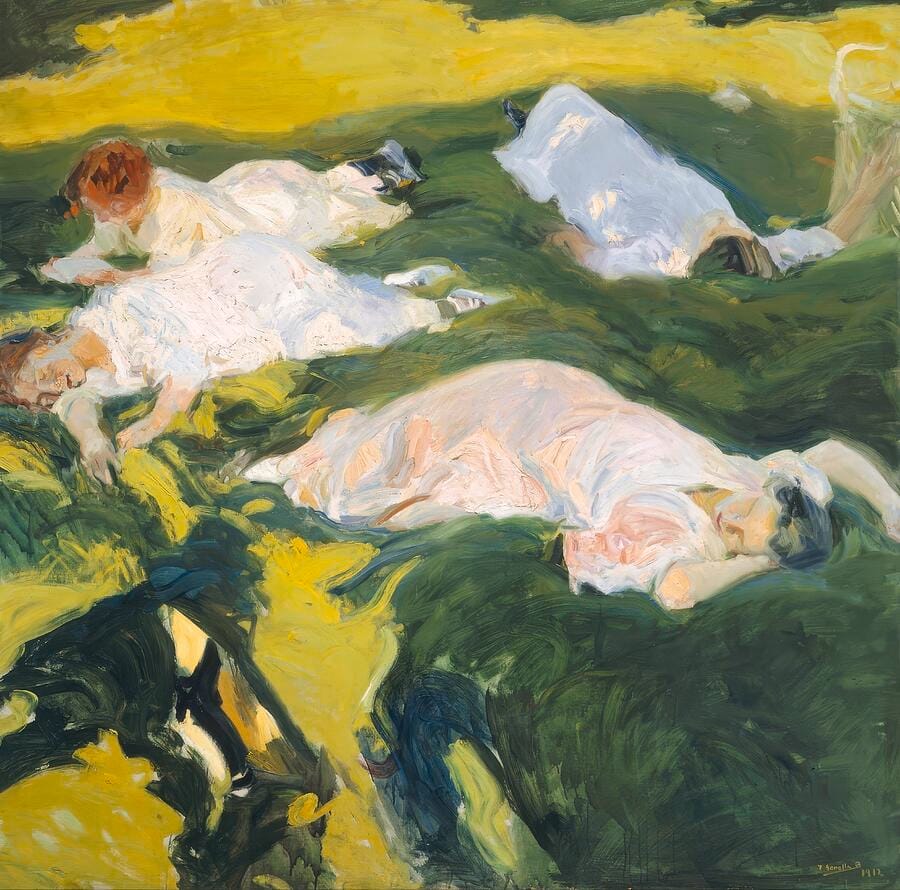
Four women lie asleep on long grass in the shade, seen from directly above, their white dresses spilling around them in loose folds. Painted in 1911, The Siesta is one of the boldest things Sorolla ever composed — no horizon, no sky, nothing to orient the viewer except the pattern of bodies and cloth against green. The grass is laid in with fast strokes of yellow-green and blue, the dresses in cool grays, and the whole picture hovers between description and near-abstraction. It hangs in the Museo Sorolla in Madrid, the house he built for his family and filled with his own work.
The Pink Robe
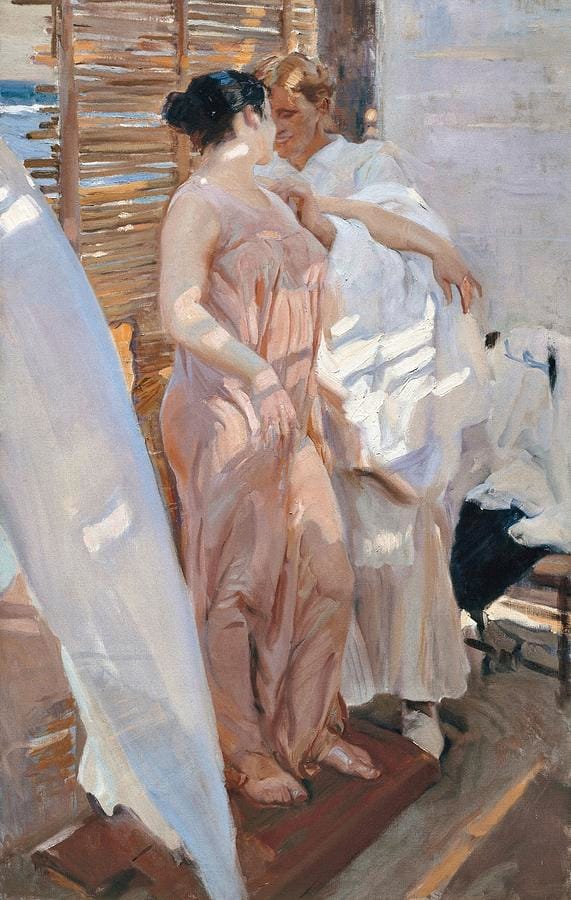
Two women stand at the entrance of a reed-matted bathing hut, one wrapped in a rose-colored robe with her hair still wet, the other holding out a great sheet of white towelling to screen her. Sorolla painted several versions of this moment after the swim, around 1916, and they are among his most sensuous pictures — not because of what is shown, which is very little, but because of the way sunlight comes through cloth and matting and turns pink into orange, white into blue. The subject is barely a subject at all; it is a pretext for the light.
María Looking at the Fishes
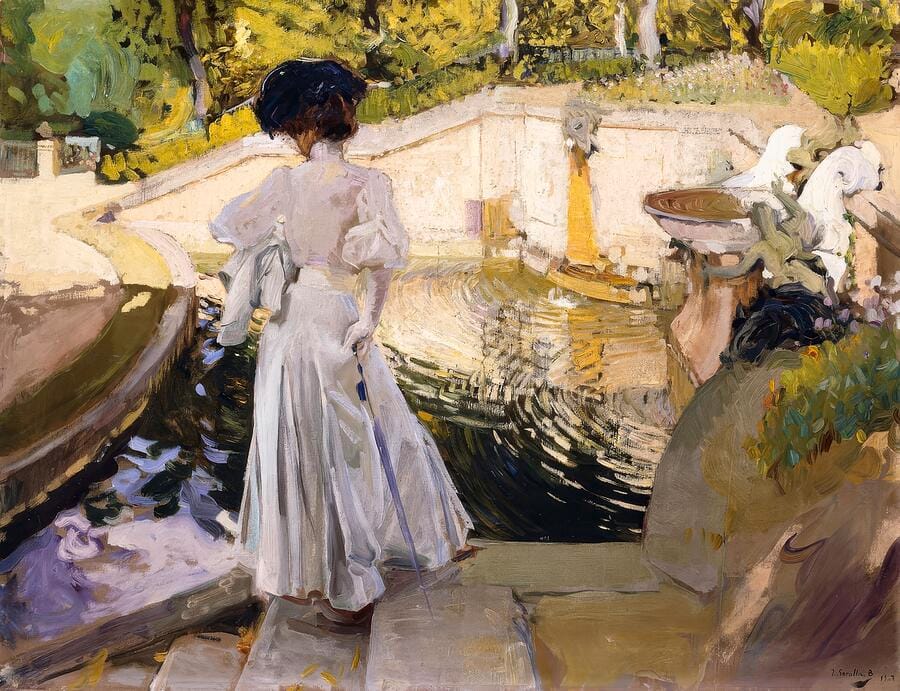
Sorolla’s eldest daughter María stands in a long white dress at the edge of an ornamental pool, seen from behind, bending slightly to look down into the water. Painted in 1907 in the royal gardens of La Granja, near Segovia, it is one of many pictures in which his family provided both models and company on painting trips. María had survived a serious bout of tuberculosis a few years earlier, and the summers spent in the mountains and gardens of Castile were partly for her recovery. The picture is characteristically indirect — a portrait of someone entirely absorbed in something else.
Oleanders, the Courtyard of the Artist’s Home
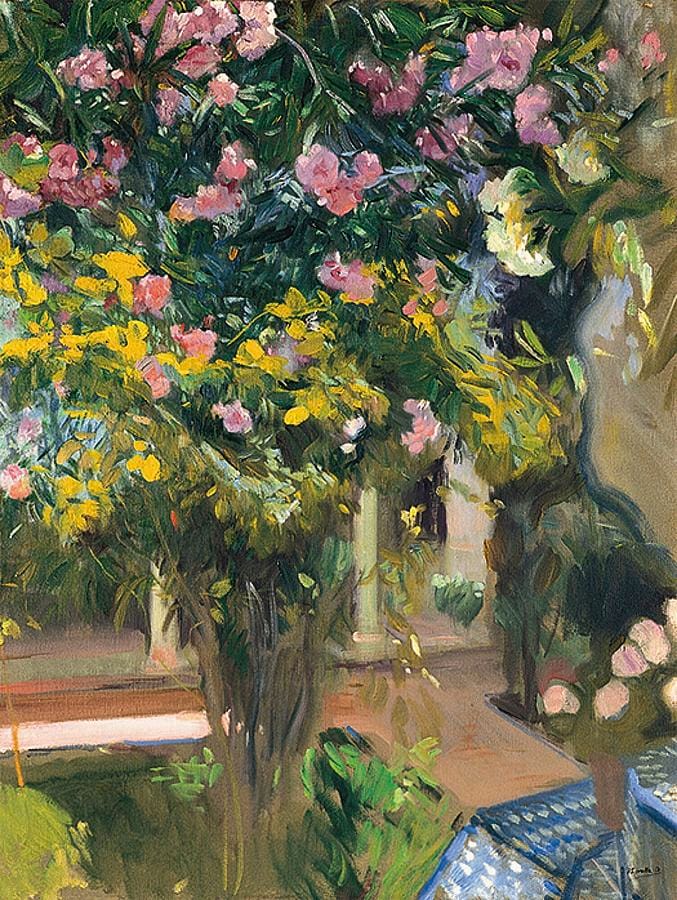
Pink and white oleanders crowd the canvas from edge to edge, with glazed pots and a patch of tiled path glimpsed between the branches. In 1911 Sorolla built a house in Madrid with a walled Andalusian-style garden, laid out with pools, tiles, and terracotta pots to his own design, and in his last working years he painted it constantly. These garden pictures are the most purely decorative things he made — no story, no figures, just flowers and dappled shade handled with the same speed as the sea. The house is now the Museo Sorolla, and the garden is still there to walk through.
Pepilla the Gypsy and Her Daughter
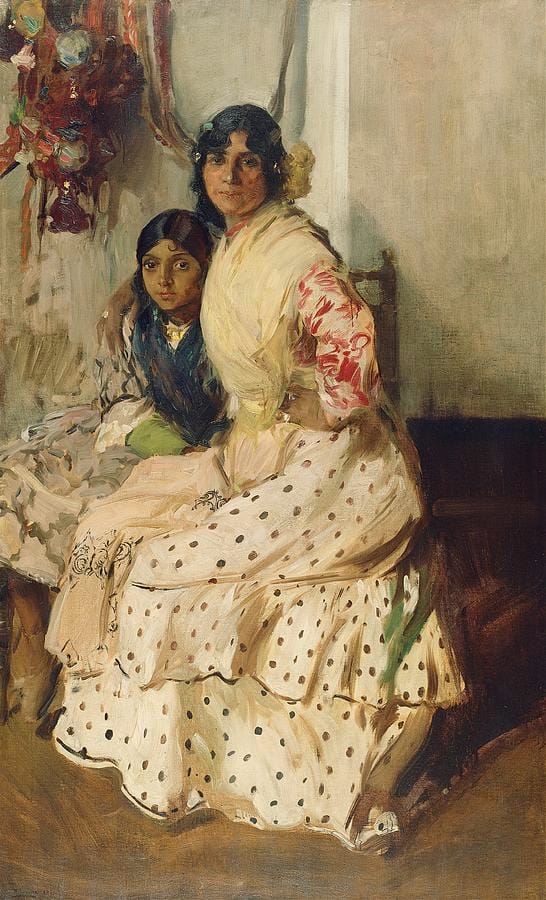
A woman in a cream polka-dot dress sits against a plain wall with her young daughter leaning into her lap, both of them looking steadily out at the painter. Painted in 1910, it is one of the Spanish subjects that entered the collection of the American philanthropist Archer Huntington, whose Hispanic Society of America in New York had given Sorolla his triumphant 1909 exhibition and soon afterward commissioned him to paint the regions of Spain — a project that consumed the last decade of his life. Here the light is soft and even, the paint restrained, and the whole force of the picture is in the two direct, unsmiling gazes.
Sorolla worked at a pace that few painters have matched, and the paintings still feel like the day they were made — the glare off the sand, the wind in a white dress, the shock of cold water. Few artists are better suited to a home: his pictures bring warmth and open air into a room without asking anything of the viewer beyond the pleasure of looking.
Shop Joaquín Sorolla prints here, and explore the rest of our famous paintings collection for more of the world’s most beloved masterpieces.