J.M.W. Turner’s Ten Most Famous Paintings
Fire, shipwreck, moonlight and Venetian haze: the ten pictures that made Turner the greatest painter of weather in Western art.


Joseph Mallord William Turner (1775–1851) was a London barber’s son who entered the Royal Academy schools at fourteen and was elected a full Academician at twenty-six. For the next fifty years he painted the sea, the sky and the weather with an obsessiveness that no artist before him had brought to those subjects, traveling constantly — the Alps, the Rhine, Italy, the coasts of England — and filling sketchbooks wherever he went.
His early work was tightly finished and openly competitive with the Old Masters; his late work dissolved into storms of light that many contemporaries simply could not read. Critics accused him of painting with tinted steam. He kept going anyway, and at his death he left nearly three hundred oil paintings and some thirty thousand works on paper to the British nation. Here are ten of his most famous pictures.
The Burning of the Houses of Lords and Commons
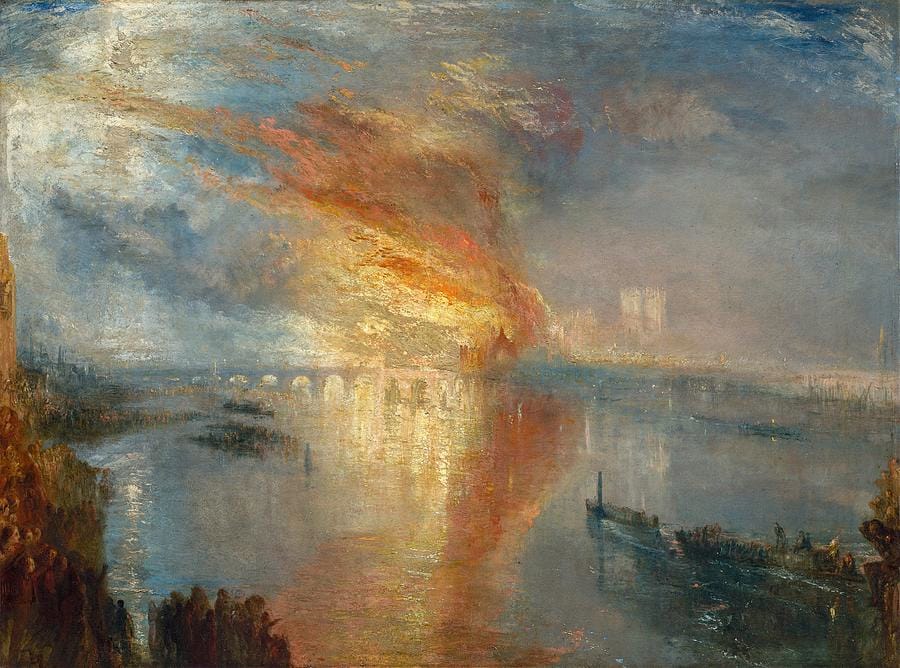
On the night of October 16, 1834 the old Palace of Westminster caught fire and burned to the ground while enormous crowds watched from the banks of the Thames. Turner was among them, sketching from a boat, and he worked the experience up into two large canvases exhibited the following year. This is the more spectacular of the pair: a wall of orange flame throwing its reflection the whole length of the river, Westminster Bridge dissolving in the heat, the spectators reduced to a dark smear along the far bank. Fire and water — the two things Turner painted better than anyone — collide in a single picture.
Dido Building Carthage
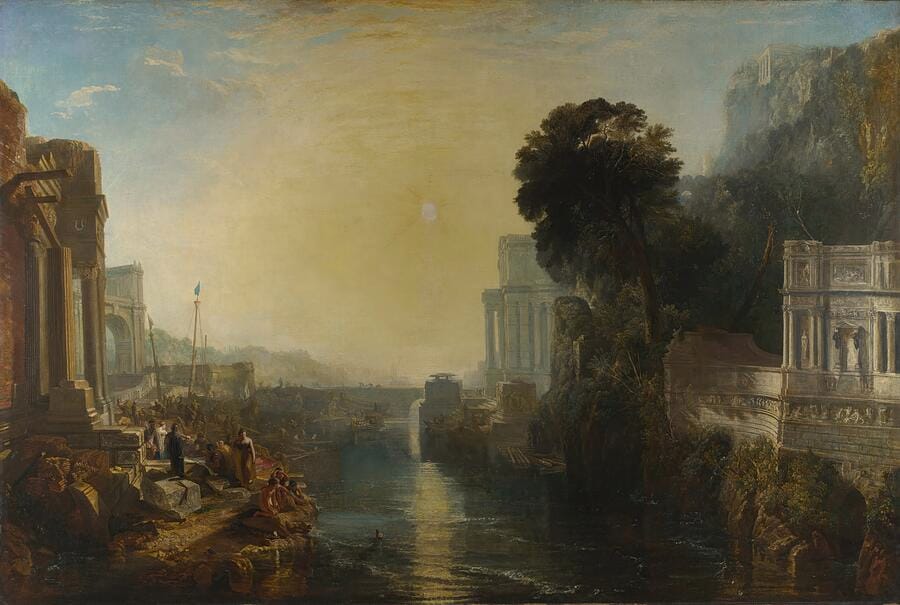
Turner idolised the seventeenth-century French master Claude Lorrain, and this canvas of 1815 was his attempt to beat him at his own game: a golden harbor receding into hazy distance, classical buildings rising along both banks, and the sun sitting almost dead center. Queen Dido stands among her architects as her new city goes up around her. Turner thought it his finest work and left it to the National Gallery on the condition that it hang beside a Claude, so that visitors could judge the two together — which is exactly where it hangs. The picture is less a view than an argument about who owned the light.
Keelmen Heaving in Coals by Moonlight
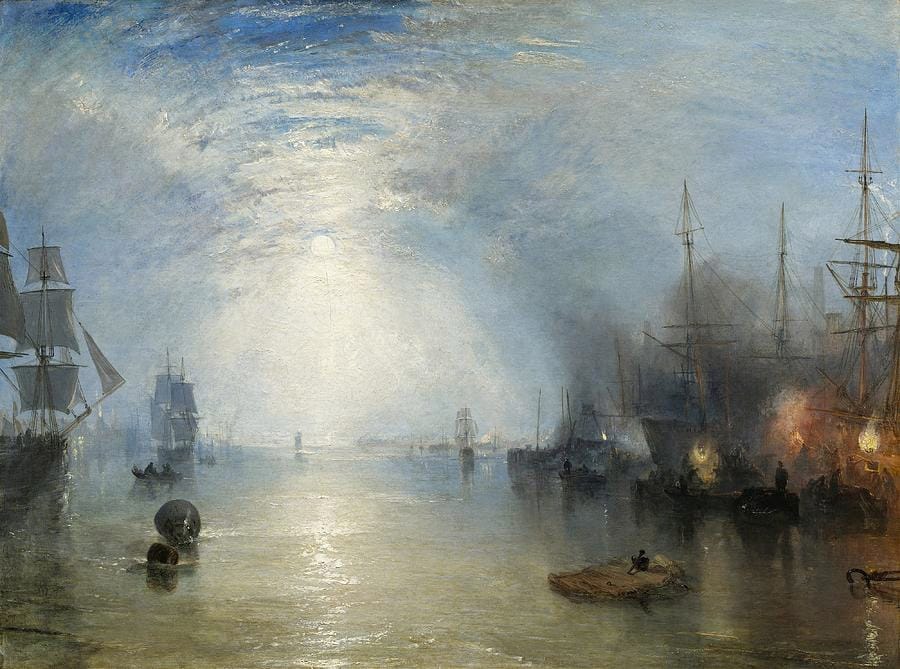
A full moon, a pall of coal smoke, and men working through the night. Exhibited in 1835, this picture shows the Tyne, where flat-bottomed keels ferried coal downriver and gangs transferred it into waiting colliers by torchlight so the ships could sail on the morning tide. The subject is pure industrial fact — the coal trade that heated London — but the treatment is anything but. Moonlight silvers the entire harbor, the torches burn orange against it, and the masts rise into a sky scrubbed to a pale glow. Few paintings have made hard night labor look so much like a vision.
Dort, or Dordrecht: The Dort Packet-Boat from Rotterdam Becalmed
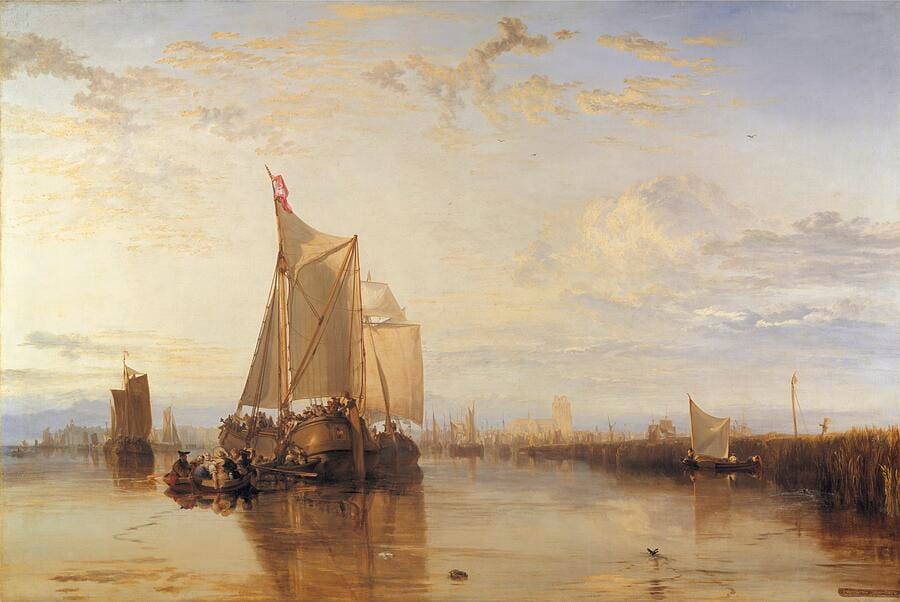
Turner toured the Low Countries in 1817, and the canvas he exhibited the next year is his tribute to the Dutch master Aelbert Cuyp: a broad, glassy river, a packet boat sitting motionless with its sails hanging slack, passengers waiting for a breeze that has not come, and behind them the town of Dordrecht flattened into gold. Almost nothing happens in it. The whole painting is an exercise in warm, even light spread across a very large surface, and his contemporaries recognized at once that he had matched the Dutch seventeenth century on its own ground. It is among the calmest things he ever made.
Wreck of a Transport Ship
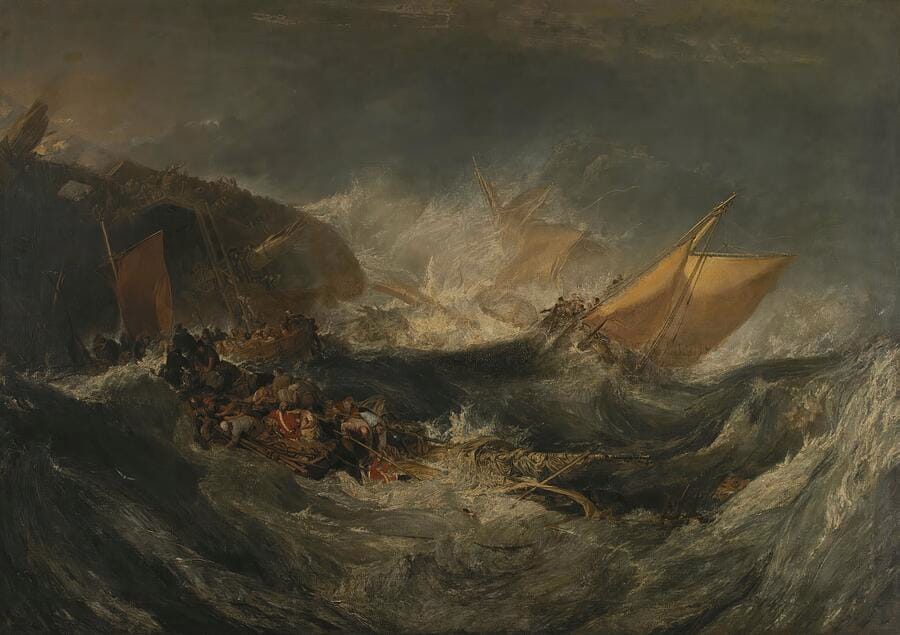
Around 1810 Turner painted a ship coming apart in a heavy sea, its masts already going, boats pitching among the waves while figures cling to anything that will still float. There is no shoreline, no rescue in sight and no comfortable middle distance — only water heaped into green-black hills and a sky of much the same color. Shipwreck was one of the great themes of Romantic art, and Turner returned to it all his life, but this early canvas remains among the most frightening he produced: it puts the viewer down at sea level, close enough to be swamped by the next wave.
The Fifth Plague of Egypt
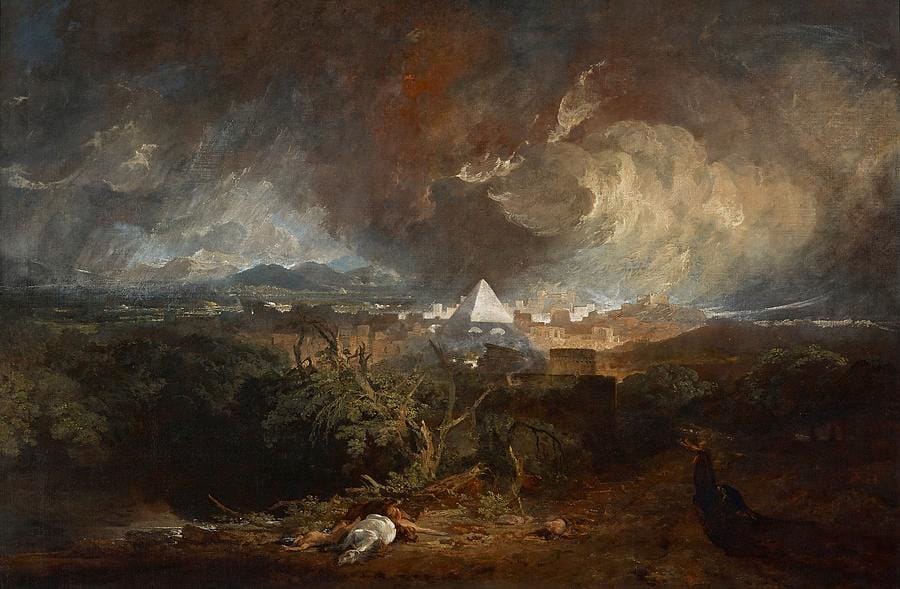
Exhibited in 1800, when Turner was twenty-five, this was one of the paintings that established his reputation as a master of the sublime. A black storm rolls across the Egyptian plain, lightning splits the sky, a pyramid glimmers in the distance, and small stricken figures lie scattered in the foreground. There is a famous oddity about it: what Turner actually depicted — a storm of hail and fire — is the seventh plague of Exodus, not the fifth. The mistake stuck to the title and has never been corrected. The picture matters regardless, because it shows the young Turner already treating weather itself as the true subject of history painting.
Whalers
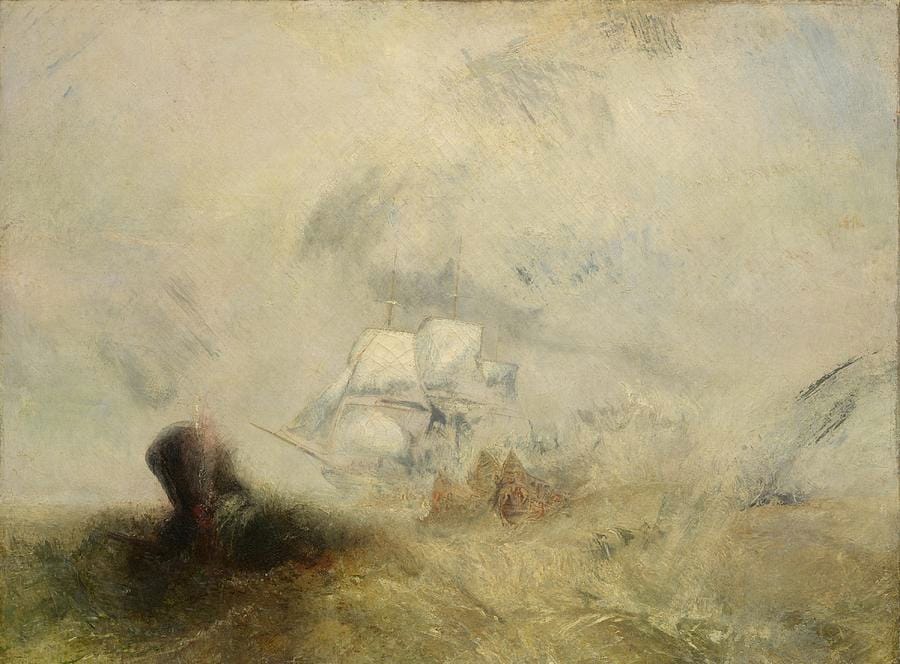
In the mid-1840s Turner painted a group of whaling scenes, drawing partly on a popular book about the sperm whale by the surgeon Thomas Beale. In this one a whaling ship looms out of a pale storm of paint while boats and a thrashing whale can just be made out below; everything else — sea, sky, spray — has been dissolved into a single shimmering veil. Critics grumbled that they could not tell what they were looking at, which is more or less the point. Made when the artist was around seventy, these late canvases are the closest nineteenth-century painting comes to pure atmosphere.
Modern Rome – Campo Vaccino
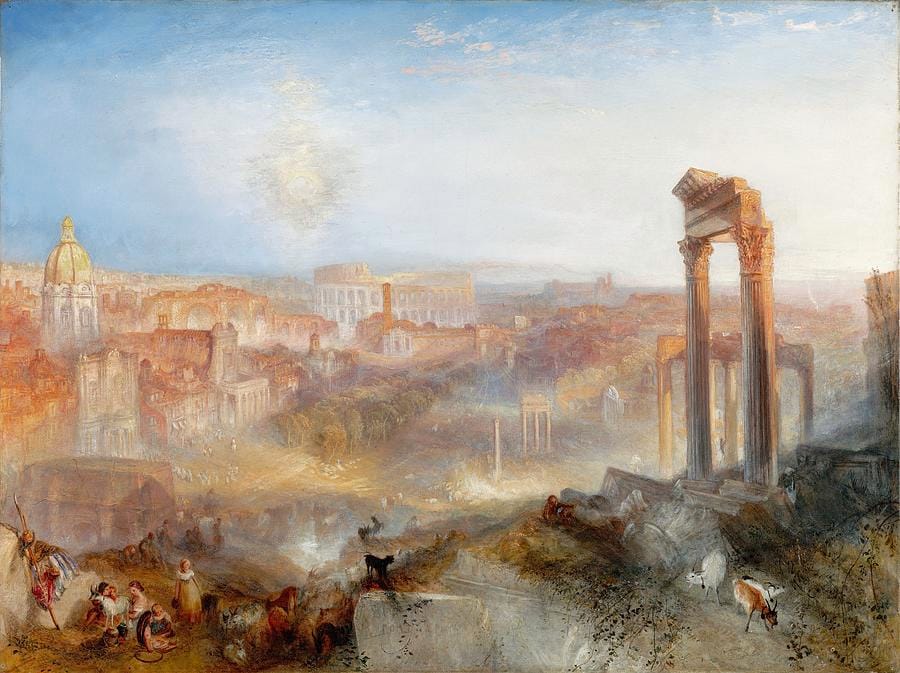
Exhibited in 1839, twenty years after Turner’s first visit to Italy, this canvas looks out across the Roman Forum — then a half-buried field where cattle grazed among the ruins, which is what campo vaccino means: cow pasture. Ancient columns stand against a hazy evening sky with a low moon above them, and herdsmen and their animals occupy the ground where senators once walked. It is a picture about time doing its slow work on empires, painted in dissolving pinks and golds. When it came up at auction in 2010 it set a record price for the artist, and it now belongs to the Getty Museum.
Venice, from the Porch of Madonna della Salute
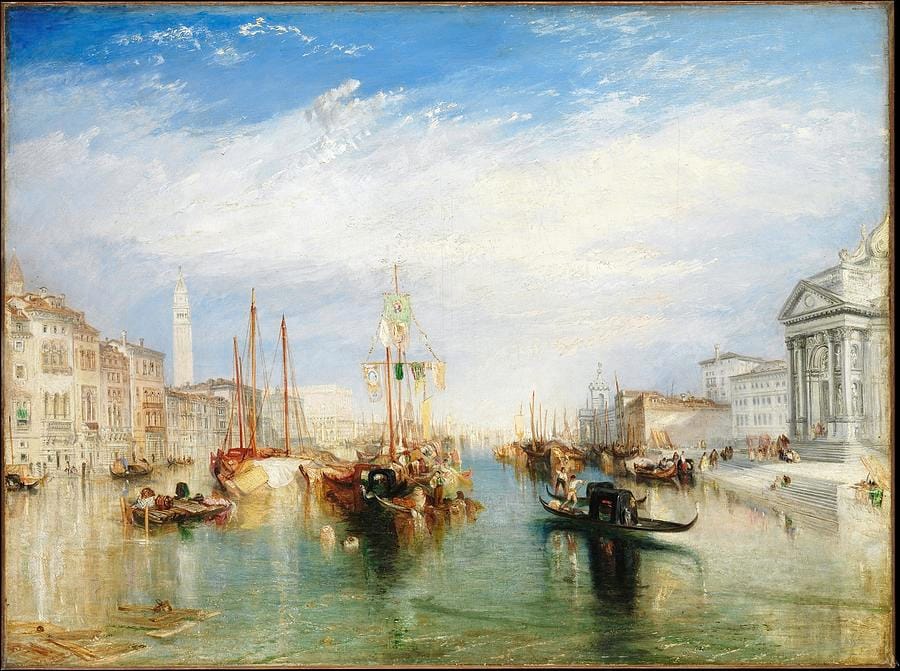
Venice gave Turner his last great subject. He visited three times, and from the 1830s onward produced a run of canvases in which the city seems built out of light rather than stone. This one looks up the Grand Canal from beside the church of Santa Maria della Salute, palaces and bell towers laid out in pale blues, creams and pinks beneath a wide sky, gondolas and working boats clustered in the foreground while the far end of the canal simply evaporates. English collectors loved these Venetian pictures, and they have shaped how visitors expect the city to look ever since.
Valley of Aosta – Snowstorm, Avalanche and Thunderstorm
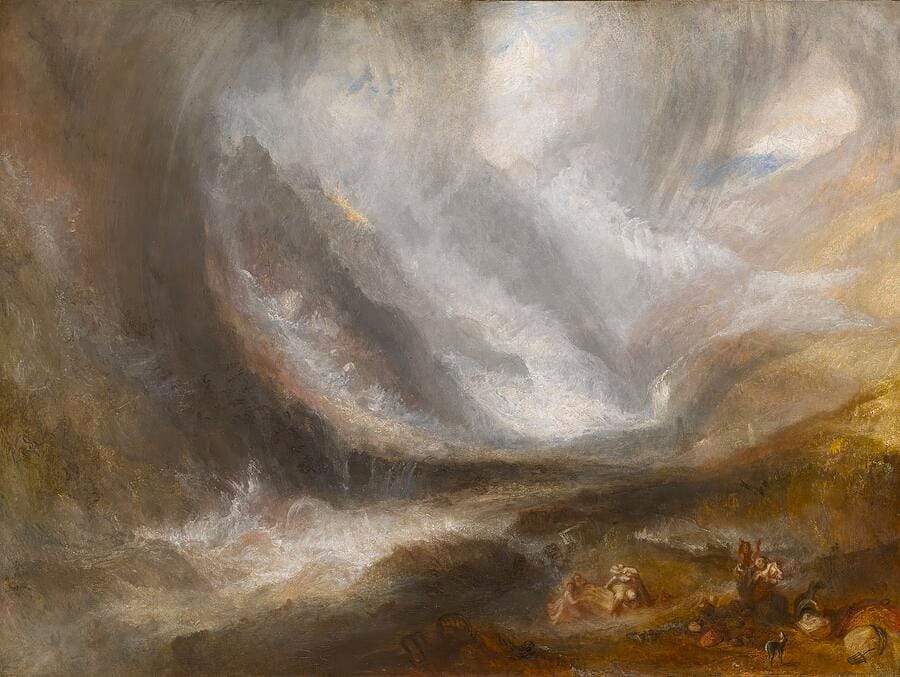
Turner crossed the Alps repeatedly and came away convinced that mountains were mostly weather. In this canvas of the later 1830s a snowstorm, an avalanche and a thunderstorm strike the Val d’Aosta all at once: a white vortex tears through the middle of the picture while the valley below is reduced to brown smudges and a few figures who plainly have no chance. The composition is a spiral, and the human presence is almost an afterthought. Paintings like this one are why the young John Ruskin devoted the first volume of Modern Painters to defending an artist his elders had written off.
Turner is the rare painter whose most extreme experiments have become the most loved part of his work. A Turner sunrise or storm brings light into a room without demanding anything of it — the color does the work from across the space, and the detail rewards you when you come close.
Shop J.M.W. Turner prints here, and explore the rest of our famous paintings collection for more of the world’s most beloved masterpieces.