Jean Béraud’s Ten Most Famous Paintings
Wet boulevards, pastry shops, and the crowds of the Belle Époque: the ten works that made Béraud the portraitist of Paris itself.

Jean Béraud (1849–1935) was born in Saint Petersburg, where his French father was working as a sculptor on Saint Isaac’s Cathedral, and was brought to Paris as a small child after his father’s death. He trained for the law, switched to painting after the Franco-Prussian War, and then spent more than fifty years doing one thing supremely well: recording the daily life of his own city at the exact moment it became the capital of modern pleasure.
He worked from a carriage fitted out as a mobile studio, parking it on the boulevards and painting what went past — cab horses, shop girls, top-hatted clubmen, schoolboys spilling onto the pavement, crowds gathering around an accident. He was not an Impressionist; his handling is tighter and his interest is in people rather than light. But no one has left a fuller picture of Belle Époque Paris, and the photographic accuracy of his street scenes has made them the standard illustrations for the period ever since. Here are ten of his most famous works.
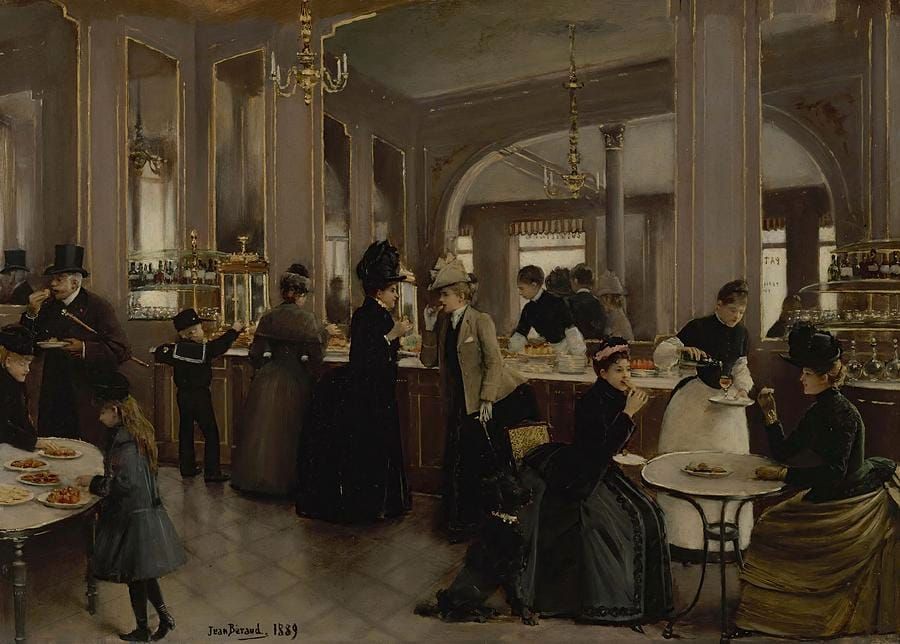
La Pâtisserie Gloppe
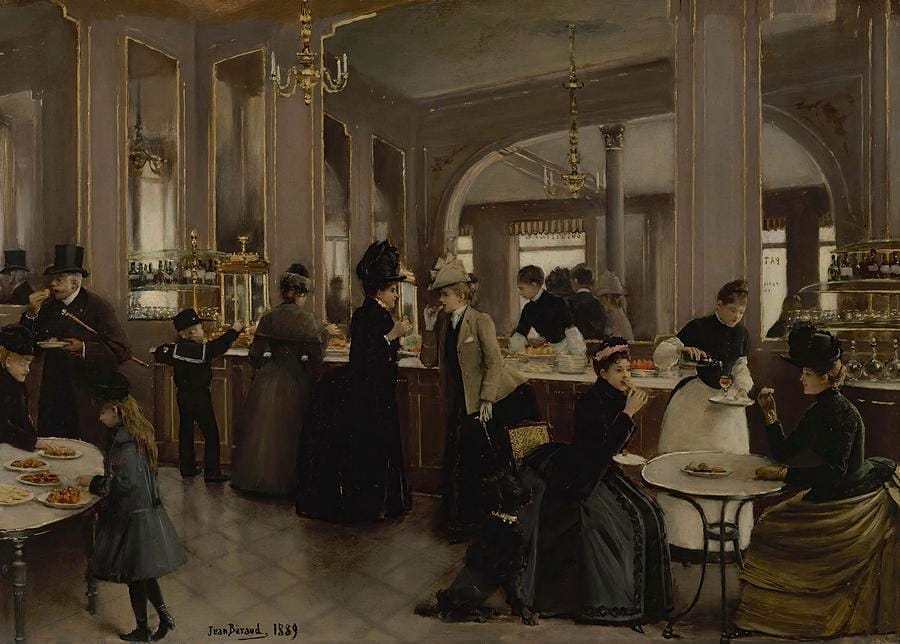
Gloppe’s was the fashionable pastry shop on the Champs-Élysées, and in this 1889 canvas Béraud takes us inside on a winter afternoon. Women in furs and enormous hats sit at small marble tables; a child in a dark coat stands at the counter, transfixed by the cakes; the mirrored back wall doubles the crowd and the gaslight. Every social signal in the room is legible — who has arrived with whom, who is being observed. It is Béraud’s single best-known picture, and a reminder that the Belle Époque’s real theater took place in shops and cafés rather than salons.
Les Funérailles de Victor Hugo, Place de l’Étoile
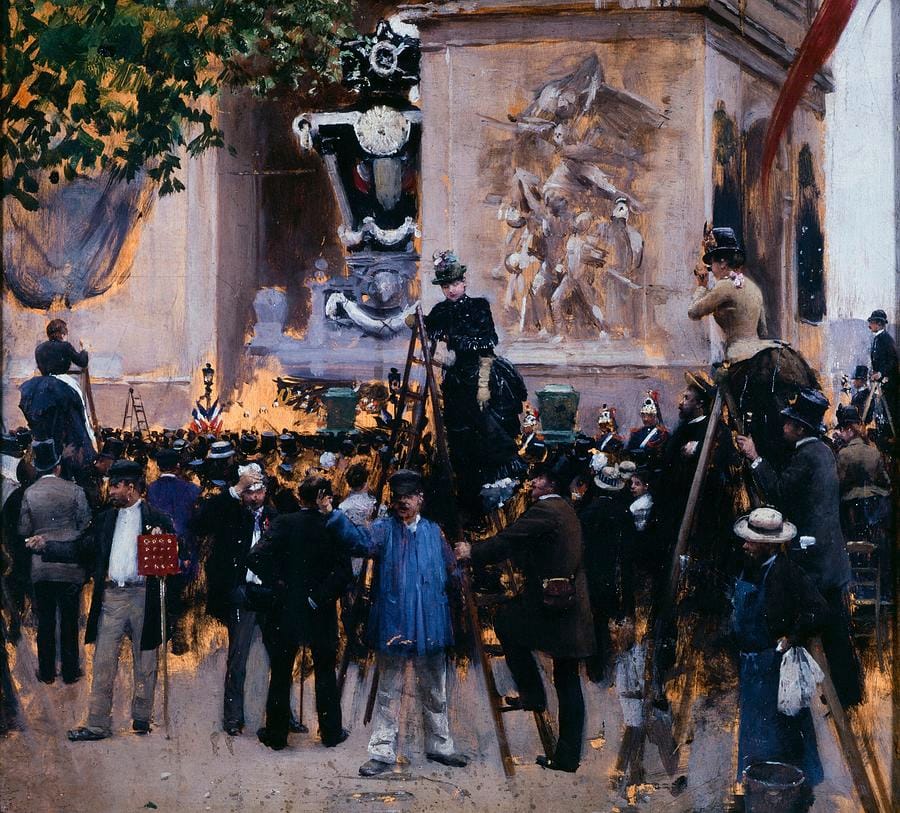
Victor Hugo died in May 1885, and the Republic gave him a funeral on a scale France had not seen for a writer. His coffin lay in state overnight beneath the Arc de Triomphe, which was hung with vast dark drapery and lit by braziers. Béraud painted the scene from within the crowd — photographers on stepladders, top hats, wreaths, a mass of onlookers pressing toward the monument in the dark. Two million people are said to have watched the procession the following day. The picture is a rare instance of Béraud recording history rather than daily life, and it loses none of his eye for the individual face.
La Sortie du Lycée Condorcet
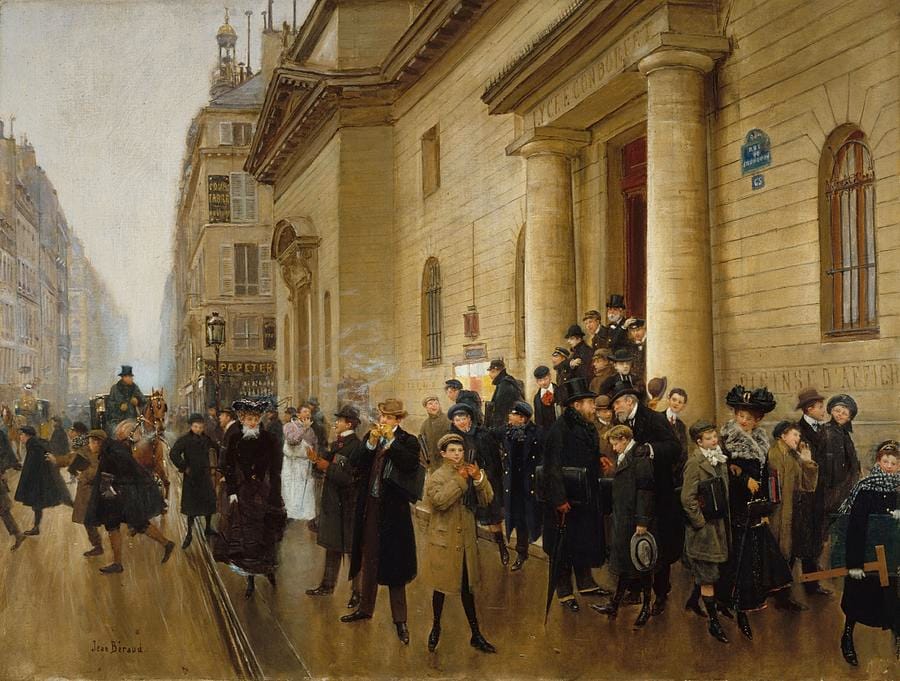
Four o’clock outside one of the great Paris lycées, and the boys are spilling out along the pavement in capes and caps, satchels under their arms, while parents and servants wait beneath the colonnade to collect the younger ones. Béraud loved a moment of controlled chaos, and the Lycée Condorcet — near the Gare Saint-Lazare, a school whose old boys included Marcel Proust — gave him one every weekday. The scene is painted in the pale, damp light of a Paris winter, with the classical façade rising above the crowd like a stage set.
Le Chalet du Cycle au Bois de Boulogne
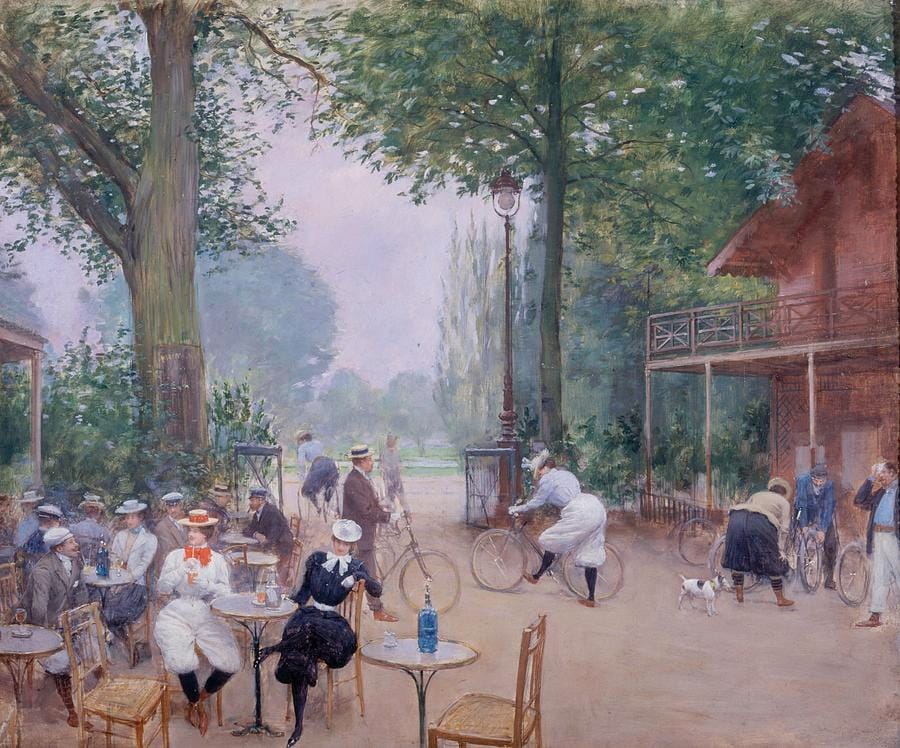
The bicycle craze of the 1890s changed how Parisians dressed, moved, and courted, and the Bois de Boulogne was its parade ground. Béraud shows the refreshment chalet where cyclists stopped: women in white summer dresses at café tables under the trees, a man crouched over a machine adjusting something, others wheeling past on the gravel. Painted around 1900, it captures a genuine social revolution in its most agreeable form — the moment when respectable women could be seen alone, in public, in charge of their own transport.
Le Boulevard Montmartre, la Nuit
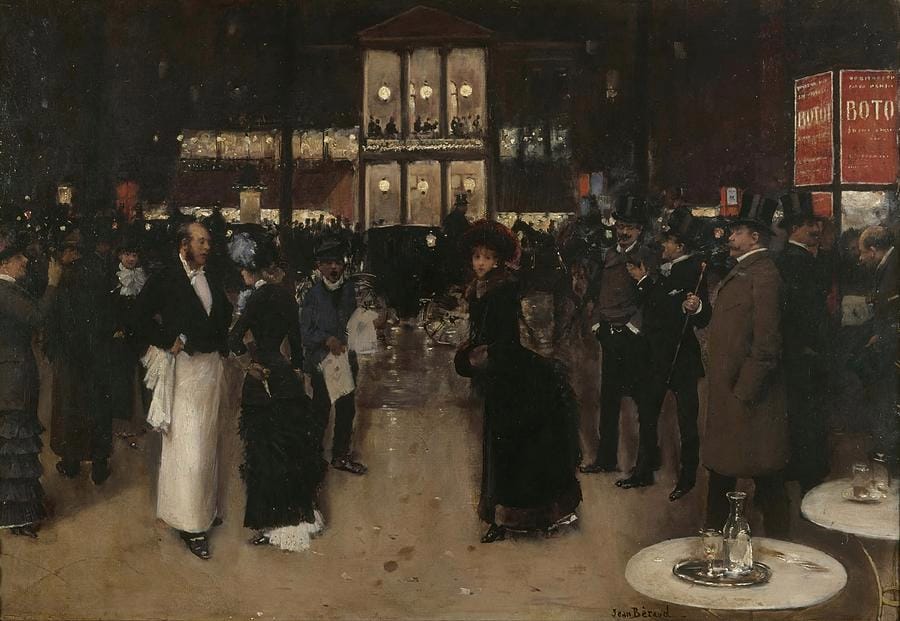
The pavement outside a boulevard theater after dark, with the lit windows of the façade blazing behind a crowd of overcoats and top hats, a waiter in a long white apron among them and a newspaper kiosk glowing at the right. Béraud painted the Grands Boulevards at night repeatedly, and he is one of the few nineteenth-century painters who really understood artificial light — the way gas and early electric lamps flatten faces, throw haloes, and turn a wet pavement into a mirror. The whole picture is built out of black, ochre, and a few sharp points of yellow.
Le Pont des Arts par Grand Vent
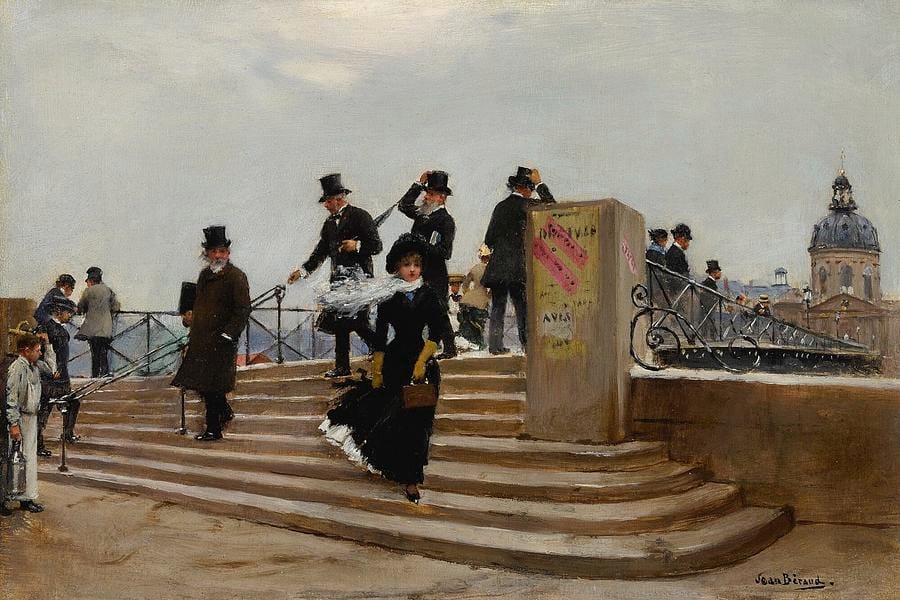
A gust catches a group crossing the Pont des Arts: hats clamped down, coats flying, a woman’s skirts whipping sideways as she comes down the steps, the dome of the Institut de France just visible through the gray air behind. Béraud rarely painted weather for its own sake, but here the wind does all the composing, scattering the figures across the steps in a way no arrangement could. The footbridge, then as now, was the shortest walk between the Louvre and the Left Bank, and the picture catches the particular indignity of crossing it on a bad day.
Sur la Place de la Concorde
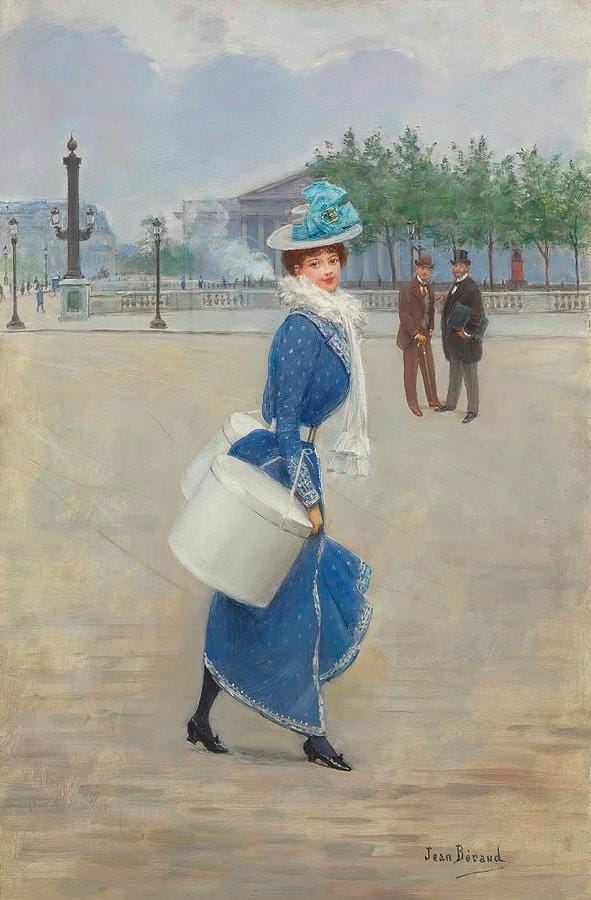
A young woman in a blue dress and a small hat strides across the Place de la Concorde carrying a large lidded basket — a laundress or a milliner’s girl on an errand, painted with as much attention as any society portrait. Behind her the obelisk, a lamp standard, and two idling gentlemen dissolve into pale gray. Béraud made a specialty of these solitary working women crossing the great public spaces of Paris, and the pictures have a quiet point to them: the boulevards belonged to the people who worked on them just as much as to the people who paraded there.
Le Salon de la Comtesse Potocka
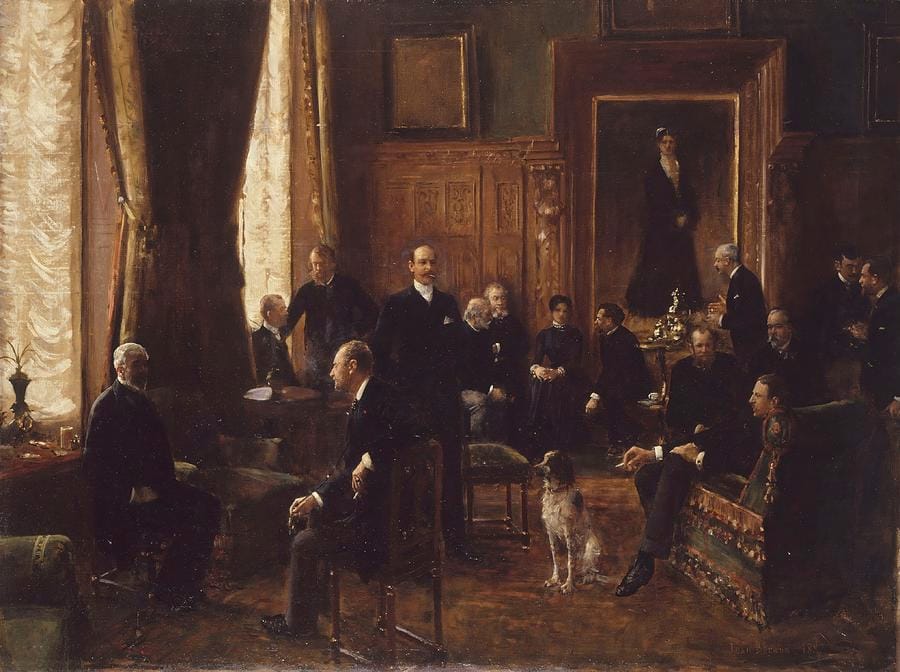
The Countess Emmanuela Potocka presided over one of the most talked-about salons of late nineteenth-century Paris, and her circle of devoted male admirers was famous enough to be gossiped about in print. Béraud paints the room in deep browns and greens: men in evening dress standing and seated in loose groups, a dog on the carpet, tall windows behind. Almost nothing is happening, which is precisely the subject — the salon as a place where conversation and proximity were the entire entertainment. It is one of Béraud’s most atmospheric interiors.
La Colonne Morris
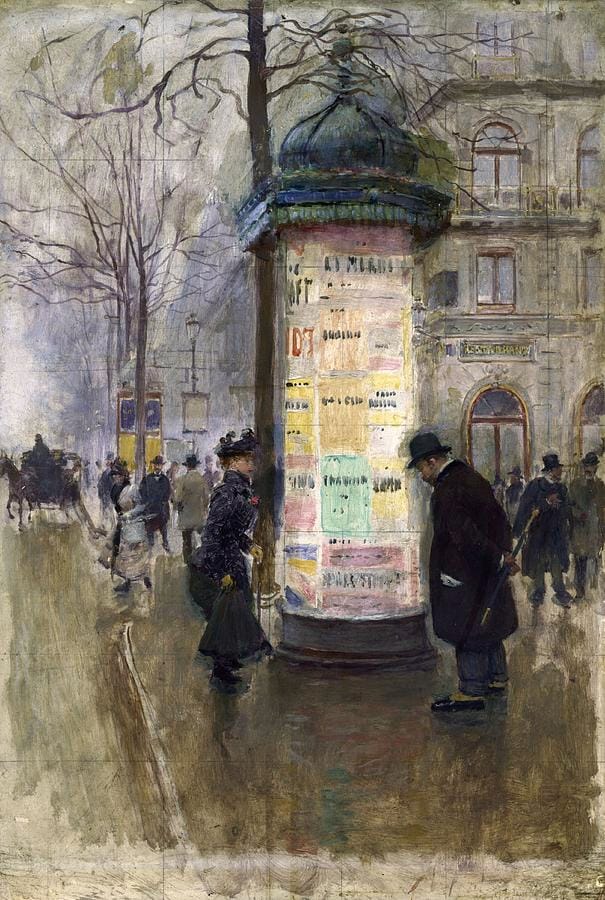
The Morris column — the fat green cast-iron cylinder plastered with theater posters and topped with a little domed roof — appeared on Paris streets from the late 1860s and became one of the city’s signatures. Béraud paints one on a raw gray day, a man in a dark coat and top hat pausing to read the bills while pedestrians blur past and a bare-branched tree stands over the scene. It is a small picture about a large idea: advertising as street furniture, and the boulevard as a place you went to find out what was on.
L’Accident, Porte Saint-Denis
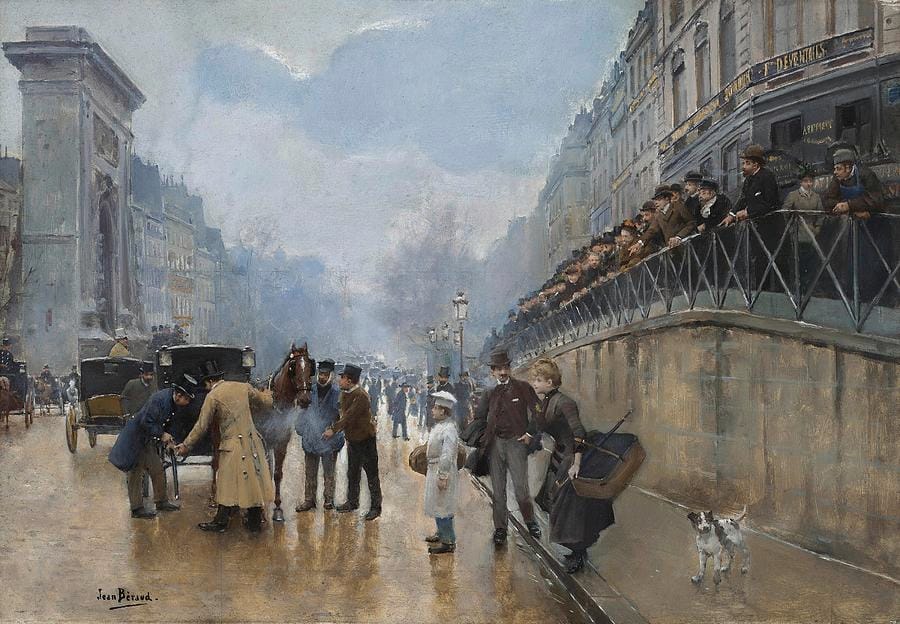
Something has happened at the foot of the Porte Saint-Denis. A crowd has formed around a figure on the ground, a man crouches beside him, others hurry over from the pavement, and the traffic keeps moving in the background as though nothing were wrong. Béraud gives the incident no melodrama at all — the arch rises calmly above it, the light stays flat and gray. What interests him is the shape a crowd makes, and how quickly the modern city closes over an event and carries on.
Béraud outlived his own era by decades, and by the time he died in 1935 the Paris he had painted was already an object of nostalgia. That is much of his appeal now: his pictures are the closest thing we have to standing on the Grands Boulevards in 1890, and they hang beautifully in a hallway or a dining room, full of incident and easy to keep looking at.
Shop Jean Béraud prints here, and explore the rest of our famous paintings collection for more of the world’s most beloved masterpieces.