James Tissot’s Ten Most Famous Paintings
Parisian society, London river parties, and a late life spent illustrating the Bible: the ten works that define James Tissot.

James Tissot (1836–1902) was born Jacques Joseph Tissot in Nantes, the son of a cloth merchant and a milliner — a background that shows in every yard of silk and every trimmed bonnet he ever painted. He trained in Paris alongside Degas and Whistler, anglicized his name in his twenties out of admiration for all things English, and by his early thirties was one of the most sought-after painters of fashionable Parisian life.
The upheaval of the Franco-Prussian War and the Paris Commune sent him across the Channel in 1871, and London made him rich. He painted deck parties, dockside farewells, conservatories, and drawing rooms with a cool, forensic attention to costume and social nuance. Then, after the death of his companion Kathleen Newton in 1882, he returned to France, underwent a religious conversion, and spent his last fifteen years illustrating the Bible. Here are ten of his most famous works.
The Circle of the Rue Royale
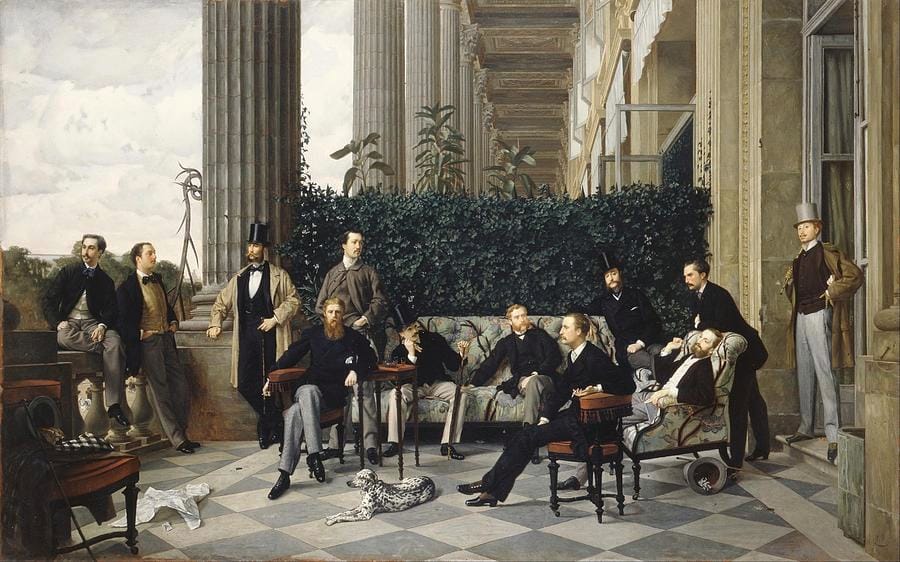
Twelve members of an exclusive Paris gentlemen’s club pose on a balcony above the Place de la Concorde in this 1868 group portrait, now in the Musée d’Orsay. Each sitter contributed a fee toward the commission, and the finished canvas was raffled among them. What lifts it above ordinary club portraiture is the choreography: Tissot spreads the men across the picture in an easy diagonal, lets one sprawl on a sofa while another leans on the balustrade, and gives each face a distinct temperature of boredom, amusement, or self-regard. It is a portrait of a class as much as of twelve individuals.
Portrait of the Marquise de Miramon
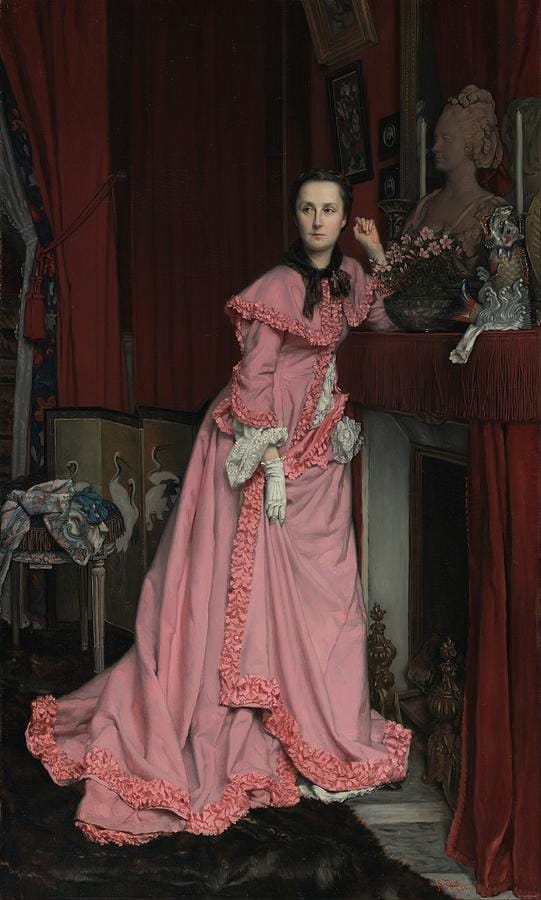
Thérèse Feuillant, the young Marquise de Miramon, stands beside her own fireplace in a rose-pink peignoir, one hand resting lightly on the mantel. Painted in 1866 and now at the Getty Museum in Los Angeles, it is unusual for its date: rather than the formal dress a society portrait normally demanded, Tissot shows his sitter in the informal clothes of a private afternoon at home. The red curtain, the fan, the porcelain, and the flowers are all rendered with a jeweler’s precision, and the pink of the gown does most of the work in a picture that is really about composure.
La Japonaise au Bain
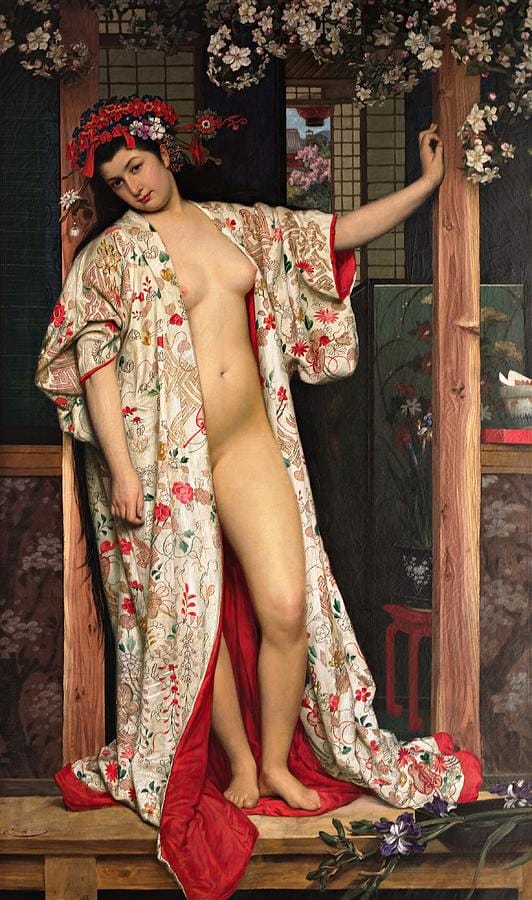
Tissot was among the first Paris painters to be swept up in the craze for Japanese art, and he assembled a serious collection of it. La Japonaise au Bain, painted in 1864 and now in Dijon, shows a young woman stepping through a doorway wrapped in an embroidered kimono she has let fall open, blossom overhead and a screen behind her. It is frankly a European fantasy of Japan rather than anything observed, but its flattened space, high-keyed pattern, and off-center framing show how quickly he absorbed the lessons of Japanese prints — lessons his friend Degas would later push much further.
Chrysanthemums
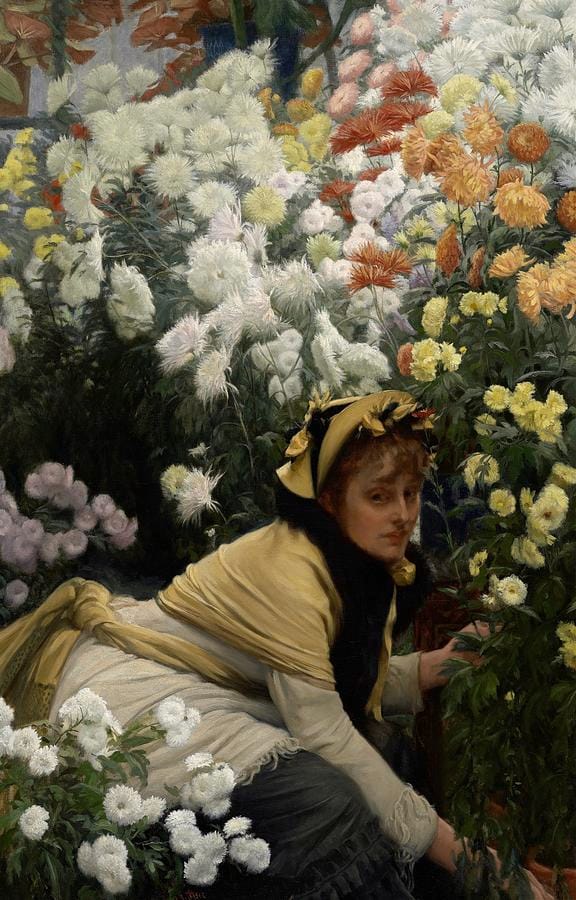
A woman in a yellow-trimmed bonnet moves through a conservatory so densely packed with chrysanthemums that the flowers nearly swallow her. Made around 1875 and now at the Clark Art Institute in Massachusetts, it is one of Tissot’s most purely pleasurable pictures — hundreds of white, russet, and gold blooms painted petal by petal, with the figure pressed to one side and half-hidden. The chrysanthemum was itself a fashionable Japanese import in 1870s London, which makes the picture doubly of its moment: a modern woman among modern flowers, painted with old-master patience.
Seaside (July: Specimen of a Portrait)
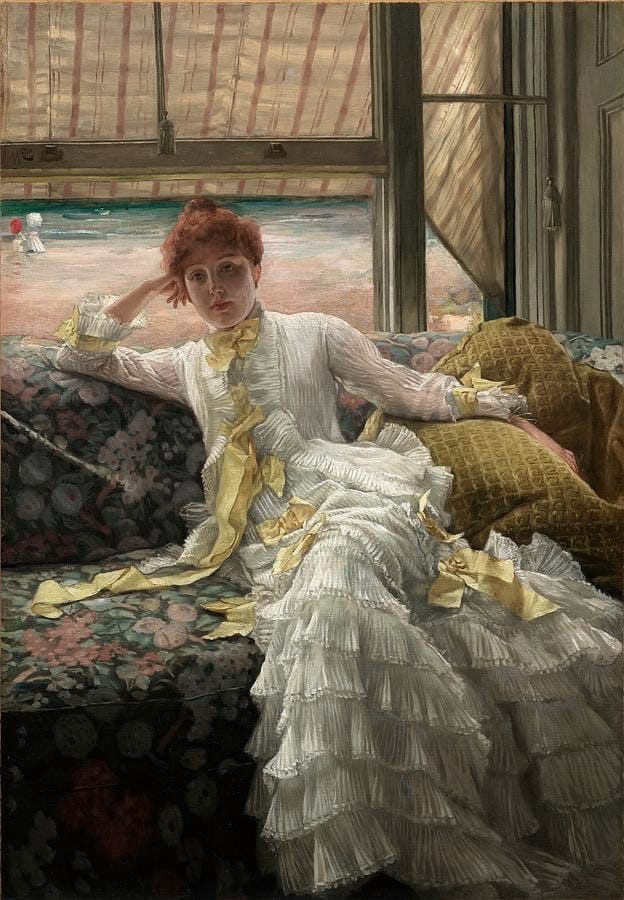
A red-haired young woman reclines on a flowered sofa in a seaside room, her white dress a cascade of pleated flounces tied with lemon-yellow bows, while beyond the open window a striped awning shades a strip of beach and blue-green water. Painted in 1878 and now in the Cleveland Museum of Art, it was exhibited with the sly subtitle “Specimen of a Portrait,” as if to advertise Tissot’s services to prospective clients. The languor is total — heat, holiday, and a faint air of boredom — and the dress is one of the finest passages of painted fabric in Victorian art.
On the Thames
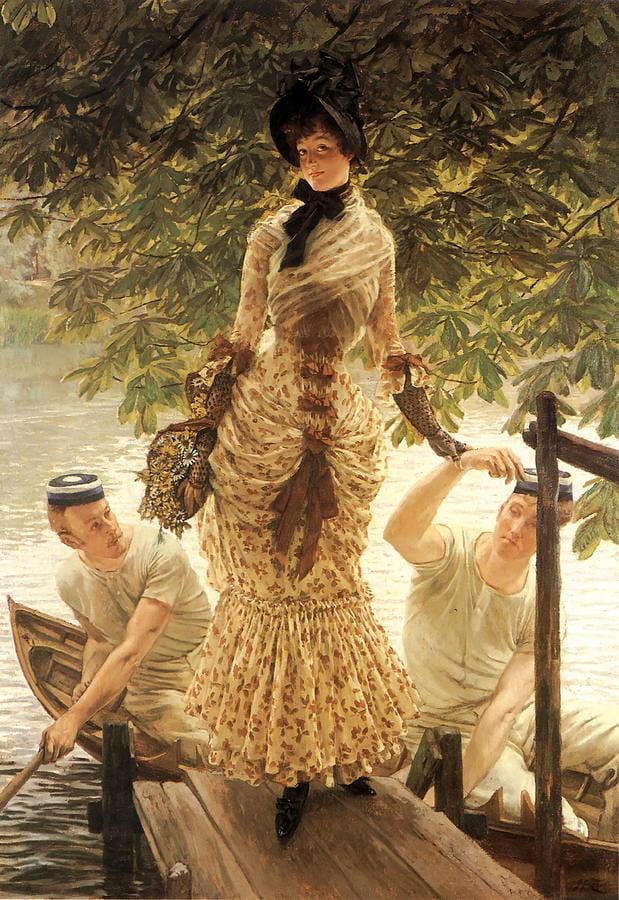
A young woman in a sprigged summer dress and black bonnet stands balanced on the gunwale of a boat, gathering her skirts, while two boatmen in striped caps steady the craft below her. Chestnut leaves hang low over the water. Painted in the early 1880s during Tissot’s London years, it captures the particular English pleasure of a river outing, and the vertiginous viewpoint — we are down in the boat, looking up — is one of his favorite devices. The dress towers over the composition, and the two oarsmen glance up at her with an expression somewhere between deference and appraisal.
The Widower
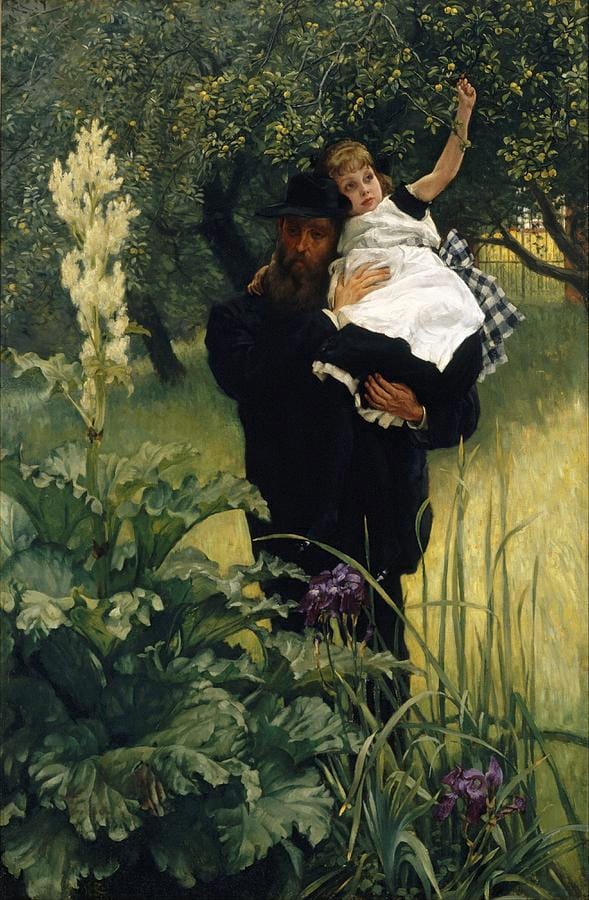
A man in black stands waist-deep in a riot of summer garden growth, lifting a small girl on his arm as she reaches for a flowering spike above her head. Painted in 1876, the picture works by contrast: the lushness of the foliage against the flatness of his mourning clothes, the child’s eagerness against the man’s absent stare. Tissot rarely told stories outright, preferring to leave a situation half-explained and let the viewer supply the rest. Here the title does the explaining, and the garden — overwhelming, indifferent, gorgeous — does everything else.
Goodbye, on the Mersey
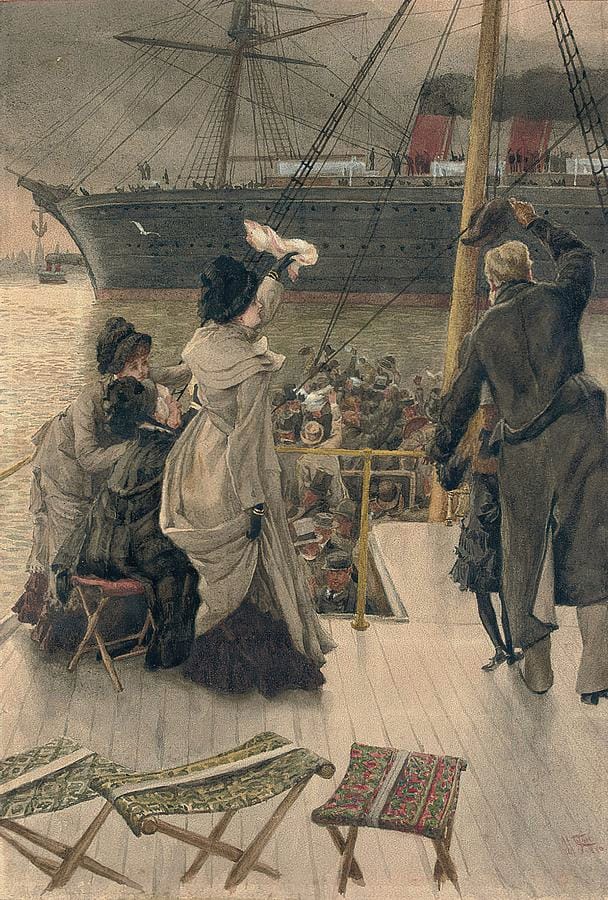
On the deck of a Liverpool tender, women in traveling cloaks wave handkerchiefs at a great steamship pulling away down the Mersey, its emigrant passengers packed shoulder to shoulder along the rail. A man beside them raises his hat. Painted around 1881, it belongs to a group of dockside subjects Tissot made in the years when transatlantic departure was an everyday drama of British port life. The folding camp stools scattered in the foreground are a typically Tissot touch — a small, precise, faintly melancholy detail that tells you the goodbye has already been said.
Women of Paris: The Circus Lover
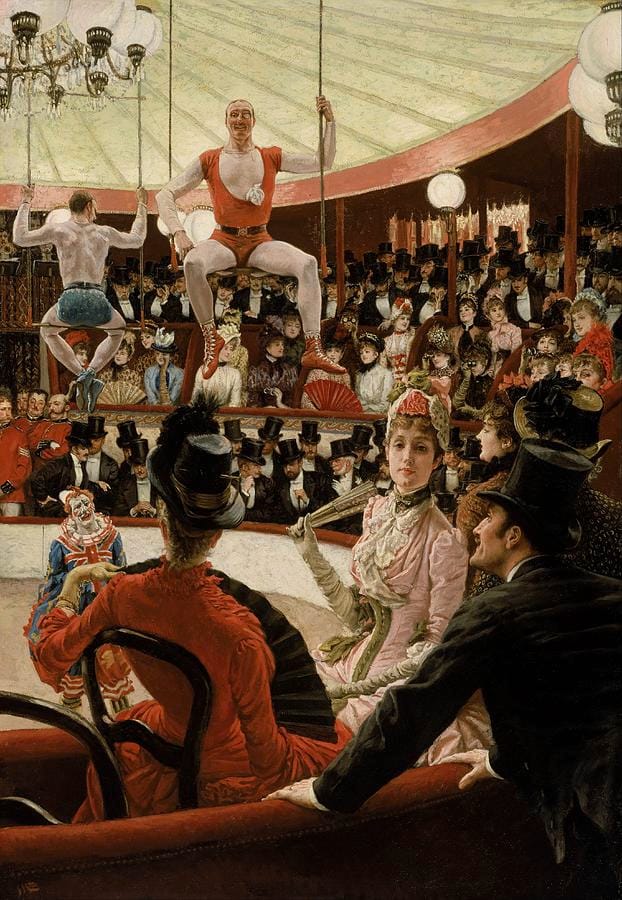
Back in Paris, Tissot embarked on an ambitious series of fifteen large canvases called La Femme à Paris, each showing a different type of modern Parisian woman. The Circus Lover, painted in 1885 and now at the Museum of Fine Arts in Boston, sets a crowded tier of spectators against acrobats swinging above them in the amateur circus at the Cirque Molier. Society women lean over the rail in evening dress, opera glasses raised, while gentlemen amateurs perform in tights. Tissot loved the spectacle, but he also caught the crowd’s appetite for it, which is the sharper subject.
Daniel in the Lions’ Den
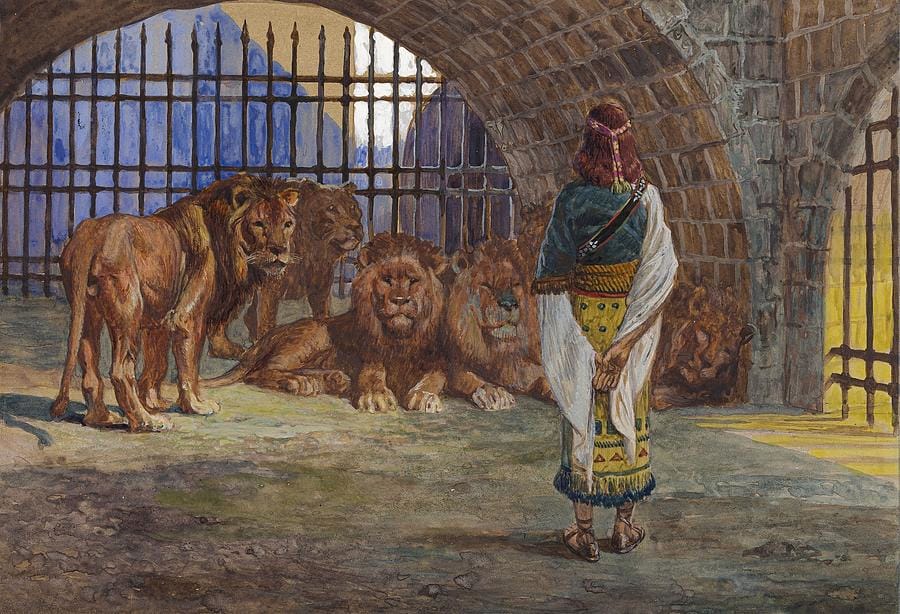
After 1885 Tissot abandoned society painting altogether. He traveled to the Middle East to study landscape, dress, and architecture at first hand, and produced hundreds of small gouaches illustrating first the life of Christ and then the Old Testament. Daniel in the Lions’ Den comes from that late campaign, now held by the Jewish Museum in New York: the prophet stands calmly against the barred wall of a vaulted pit while the lions sprawl and blink around him. Exhibited in Paris, London, and New York, these biblical pictures drew enormous crowds and became the work Tissot was best known for in his lifetime.
Tissot was a painter of surfaces in the best sense — of silk, water, glass, and the small social signals people send without meaning to. His pictures reward long looking, and their warm color and human scale make them unusually easy to live with, whether you hang a Thames outing in a hallway or a conservatory full of chrysanthemums above a mantel.
Shop James Tissot prints here, and explore the rest of our famous paintings collection for more of the world’s most beloved masterpieces.