Jacques-Louis David’s Ten Most Famous Paintings
Oaths, martyrs and emperors: ten paintings by the artist who gave the French Revolution and Napoleon their public face.

Jacques-Louis David (1748–1825) was the most powerful painter in Europe for the better part of thirty years, and the only one whose career reads like a political thriller. Trained in Paris and finally sent to Rome after several failed attempts at the Academy’s top prize, he came home converted: away with the powdered frivolity of the previous generation, and in with the hard clear light, sculpted bodies and shallow stage-like spaces of antiquity. What he added to Neoclassicism was moral urgency. His pictures are not about togas. They are about what a person is willing to sacrifice.
He was also a participant, not an observer. Elected to the National Convention, he voted for the execution of Louis XVI, designed the Revolution’s festivals and funerals, was imprisoned after Robespierre fell, and then became Napoleon’s First Painter, inventing the imagery of the Empire almost single-handedly. When Napoleon fell in turn, David went into exile in Brussels and painted mythologies until he died there. His pupils — Gros, Girodet, Ingres — carried his manner through the whole of the nineteenth century. Here are ten of his most famous paintings.
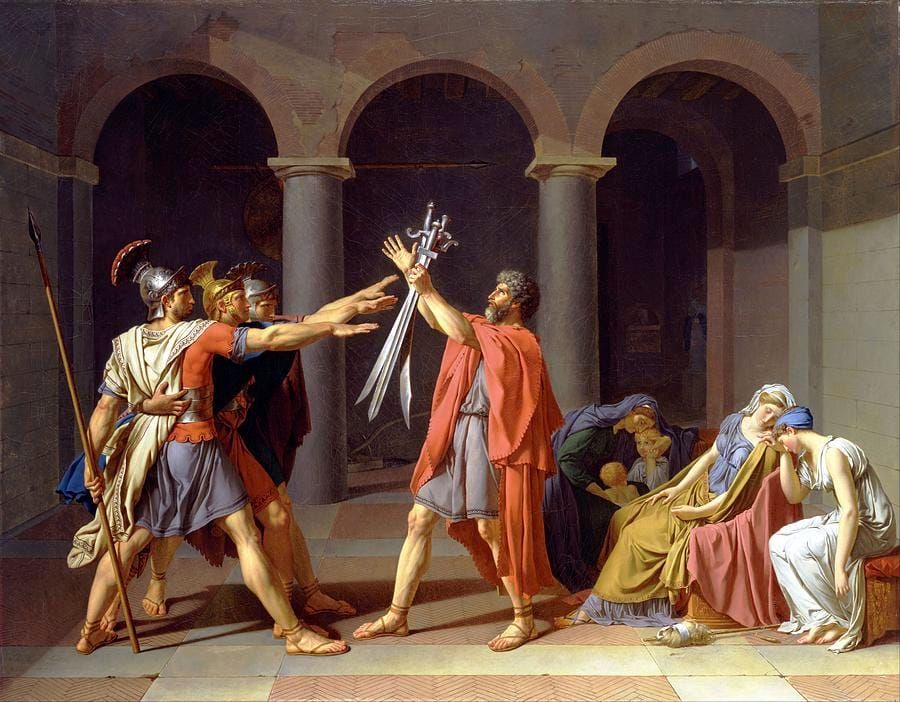
Oath of the Horatii
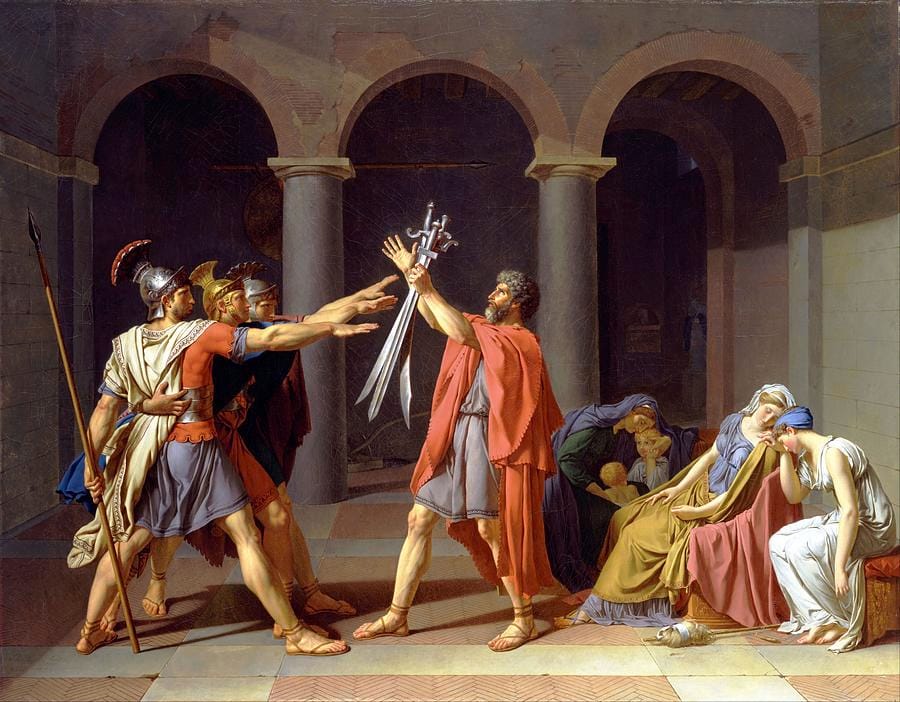
Three brothers stretch their arms toward their father, who holds up their swords; behind them, three arches; to the right, the women of the household collapse into a heap of grief because they already know how the story ends. David painted the Horatii in Rome in 1784 and it made his name at the Paris Salon the following year. The oath scene itself is his invention — no Roman author describes it — and that is exactly why it works. He reduced a complicated legend from Livy to one gesture, split the canvas cleanly between male resolve and female sorrow, and produced the founding image of Neoclassical painting.
The Death of Socrates
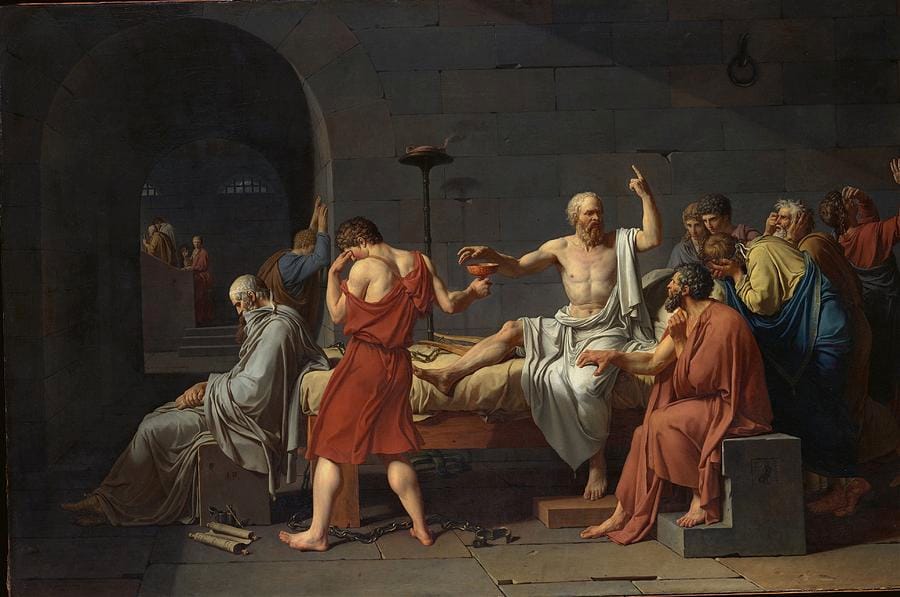
Condemned by Athens, Socrates reaches for the cup of hemlock without looking at it, one finger raised, still mid-argument. His students weep, cover their faces, or turn away; the jailer who handed him the poison cannot bear to watch. David finished the picture in 1787, two years before the Revolution, and it was read at once as a lesson about principle outlasting the state. He took liberties: Plato, shown as an old man slumped at the foot of the bed, was by his own account not present at all. The painting hangs in New York, and remains the clearest statement of David’s belief that a good picture should argue.
The Lictors Returning to Brutus the Bodies of His Sons
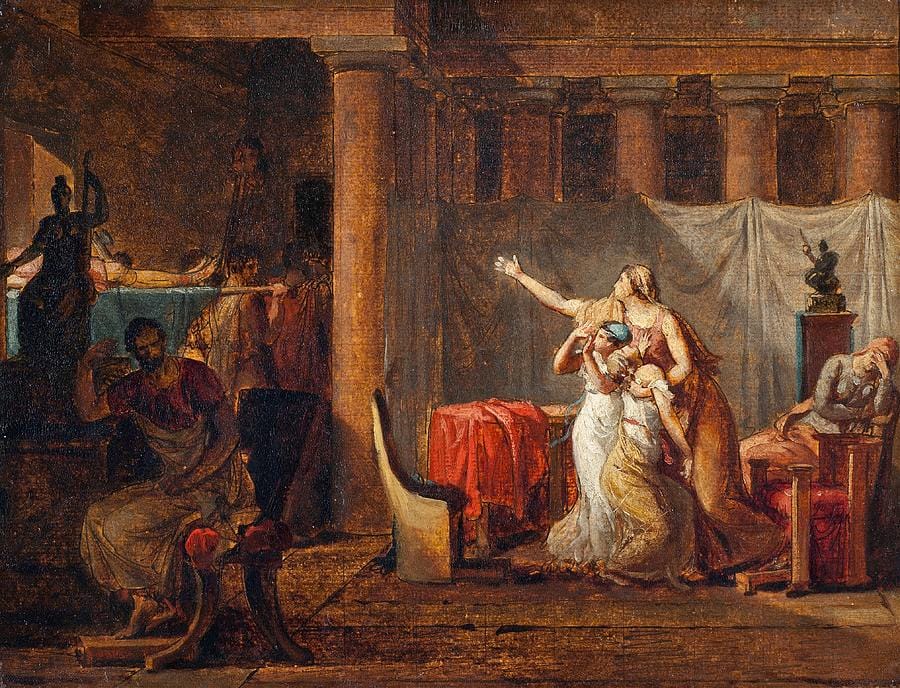
Lucius Junius Brutus, the founder of the Roman Republic, condemned his own sons to death for plotting to restore the monarchy. David shows him sitting in shadow beneath a statue of Roma, jaw set, while behind him the guards carry the bodies in and his wife and daughters recoil in horror. The two halves of the household have nothing to say to each other. Shown at the Salon of 1789 only weeks after the fall of the Bastille, the painting drew crowds who understood it as commentary whether or not David intended it. It is his coldest and most uncomfortable masterpiece.
The Death of Marat
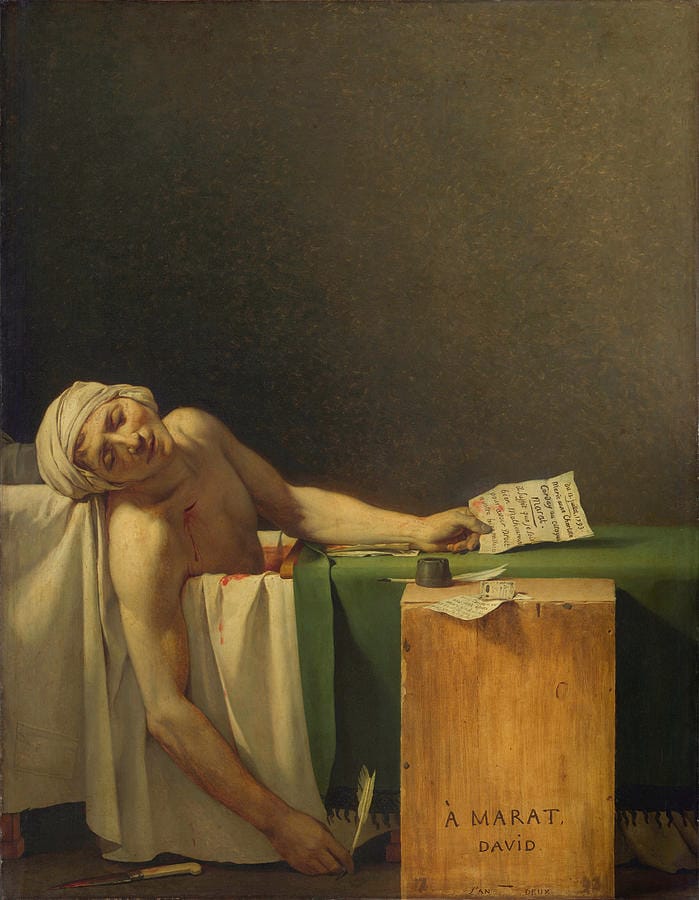
Jean-Paul Marat, the revolutionary journalist, worked in a medicinal bath because of a painful skin disease, and it was there that Charlotte Corday stabbed him in July 1793. David, a friend and political ally who had seen him at work in that bath, painted the scene within months: the wooden packing-crate desk, the quill still in one hand, Corday’s letter of introduction in the other, and above it all an enormous empty green-brown space. He removed the squalor, the crowd and the killer, and left a body lit like a Christian martyr’s. It is propaganda of the highest order, and one of the great political images ever painted.
Antoine-Laurent Lavoisier and His Wife
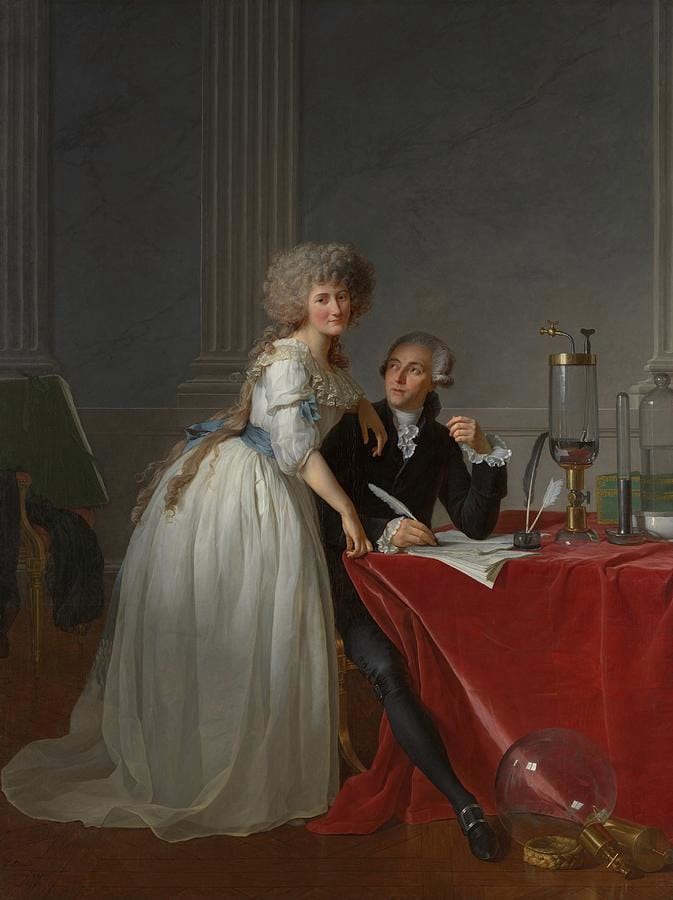
The chemist who named oxygen sits at a red-draped table surrounded by his glass apparatus, looking up at his wife and collaborator, Marie-Anne Paulze Lavoisier, who leans on his shoulder and gazes calmly out at us. She translated scientific texts for him, kept his laboratory notebooks and engraved the plates for his great treatise — she had, in fact, studied drawing with David himself. Painted in 1788, the double portrait is a monument to a marriage of equals and to the confidence of the Enlightenment. Six years later Lavoisier was guillotined, which gives the picture a retrospective poignancy David could not have intended.
The Intervention of the Sabine Women
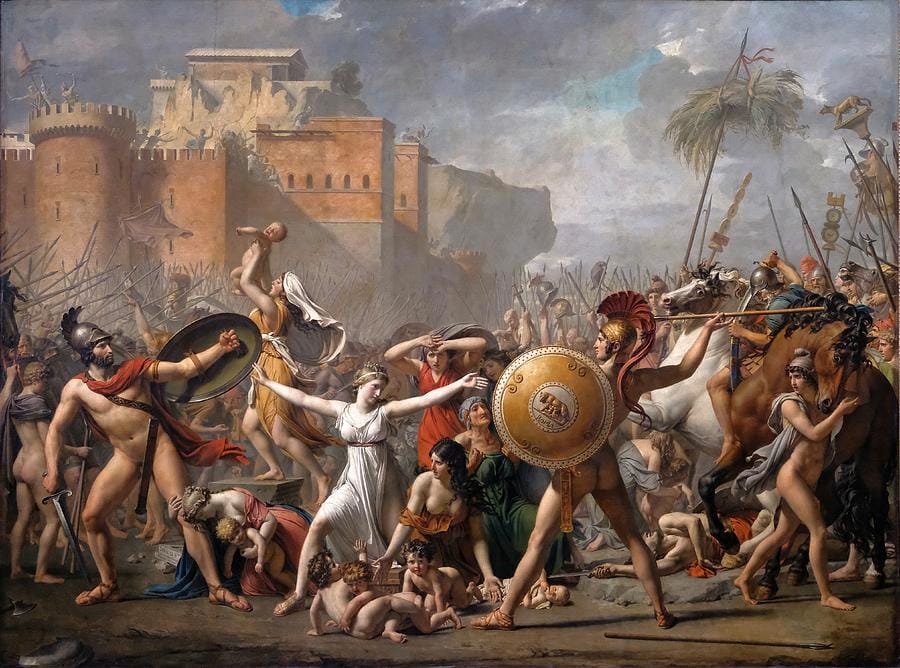
Years after the Romans carried off the Sabine women, the Sabine army came to reclaim them — and the women, now mothers, threw themselves between the two sides. Hersilia stands at the center with her arms flung wide, children tumbling at her feet, while Romulus and Tatius freeze mid-blow. David conceived the picture during his imprisonment after the Terror and finished it in 1799, and its subject is plainly reconciliation after civil bloodshed. He also broke with custom by exhibiting it himself for a paid admission, a scandal at the time and the beginning of a very modern way of showing art.
Napoleon Crossing the Alps
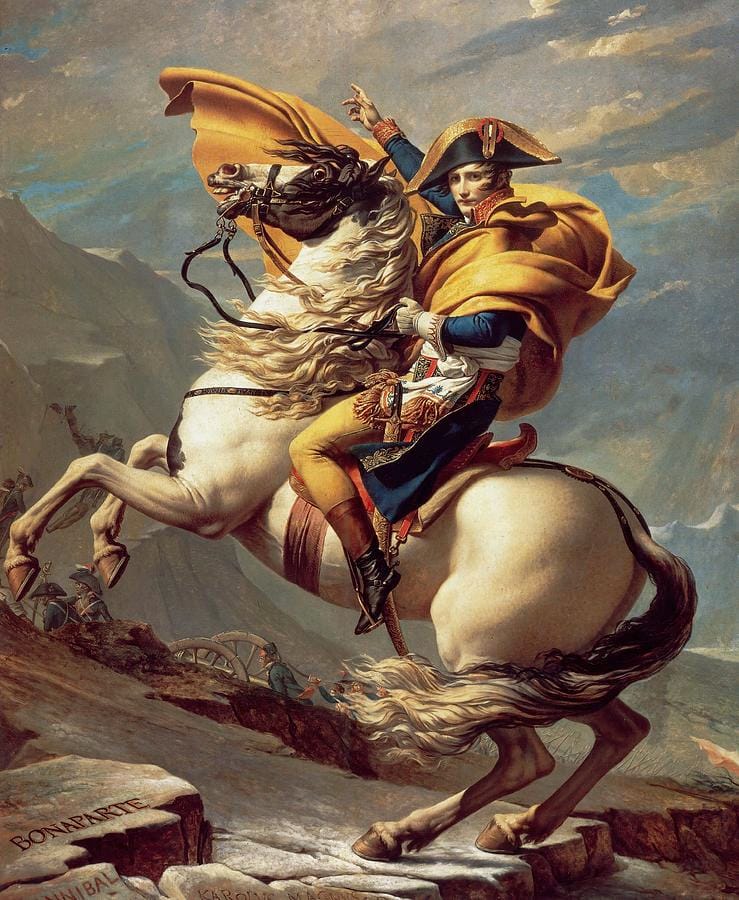
A rearing white horse, a scarlet cloak snapping in the wind, and a young general pointing calmly to the summit while his troops haul cannon through the snow below. Painted from 1801, this is the picture that invented Napoleon as a public image. He had actually made the crossing on a mule led by a guide, and he refused to sit for the portrait, telling David that what mattered was not likeness but character — he wished to be shown serene on a spirited horse. Look at the rocks in the foreground and you will find his name cut into the stone beneath those of Hannibal and Charlemagne.
The Emperor Napoleon in His Study at the Tuileries
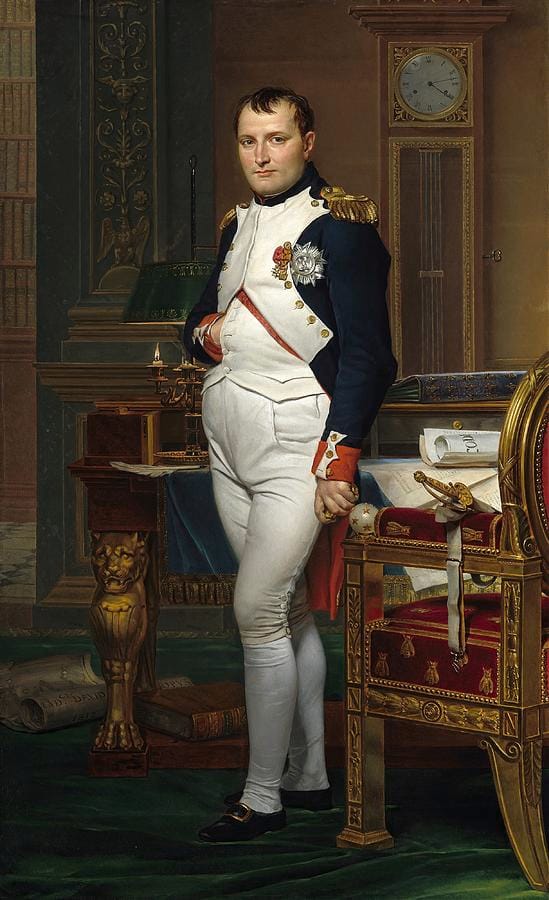
This 1812 portrait is a piece of storytelling disguised as a standing figure. Napoleon rises from his desk in his white breeches and Guards uniform, one hand in his waistcoat, hair slightly disordered; the candles have burned down, the clock on the wall reads a little after four in the morning, and the scroll on the desk is the civil code that carries his name. The message is unmistakable — the Emperor has been up all night working on the laws while France slept. It was commissioned by a Scottish admirer who had never met him, and now hangs in Washington.
Leonidas at Thermopylae
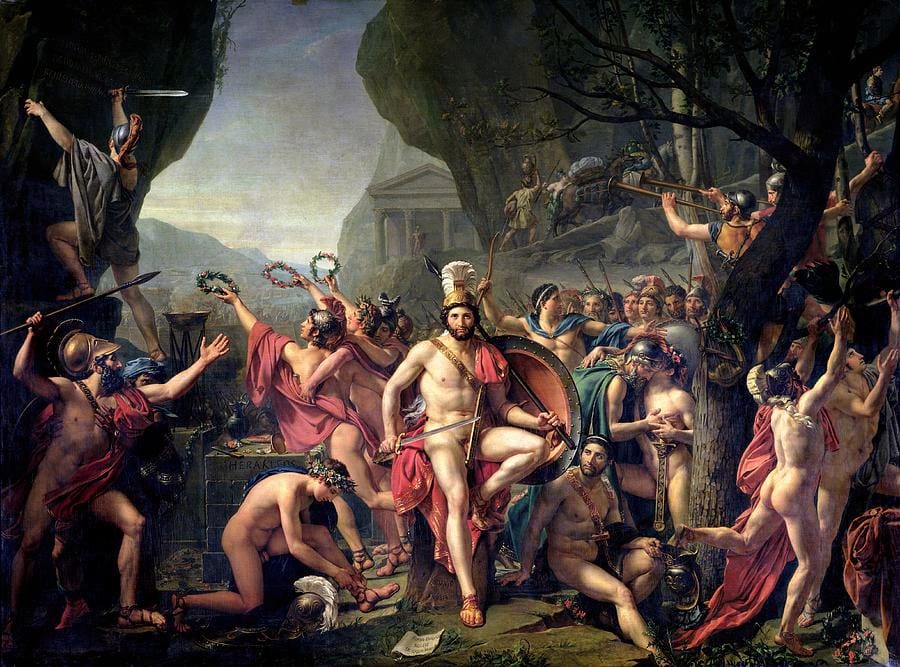
David worked at this vast canvas on and off for more than a decade, finishing it in 1814 as Napoleon’s empire collapsed. Leonidas sits at the center of a swarming rocky pass, sword across his knee, staring outward in complete stillness while around him three hundred Spartans arm themselves, embrace, and climb the cliff to carve their farewell inscription. Nobody is winning anything; they are preparing to die where they stand. Napoleon reportedly had little patience with a picture about a glorious defeat, but David defended it as his most considered work, and it is certainly his strangest and most crowded.
Belisarius Begging for Alms
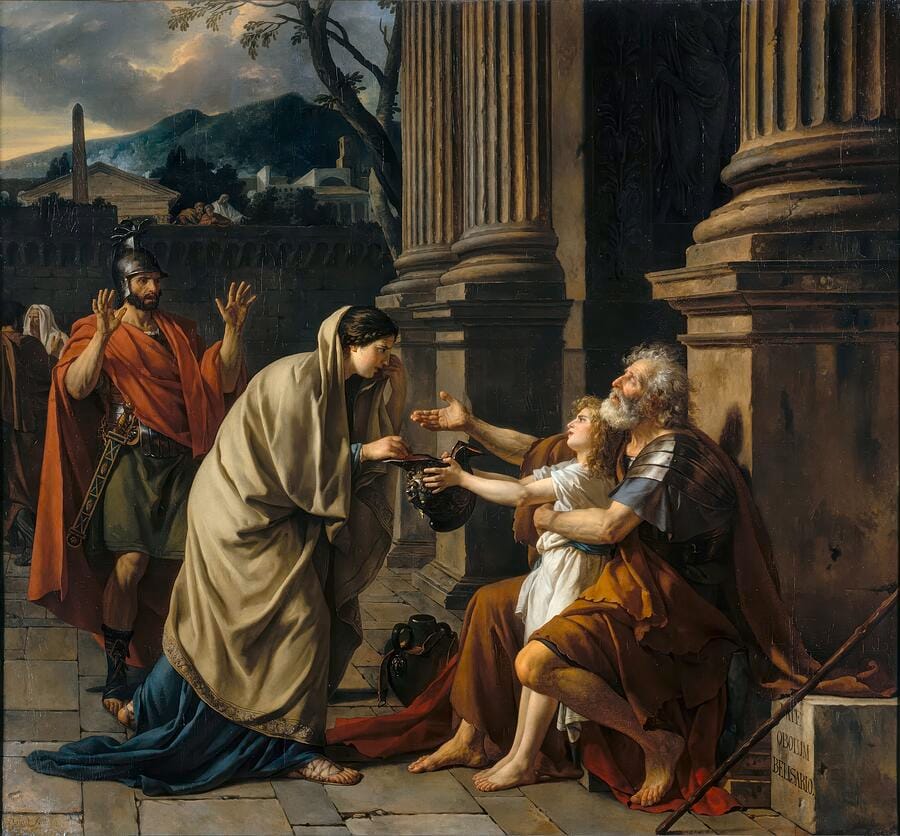
Belisarius was the general who won back half the Roman world for the Emperor Justinian, and legend held that he ended his life blind and destitute on the streets of Constantinople. David painted him in 1781 seated at the foot of a colossal column, one arm around a small boy who holds out an upturned helmet for coins. A woman drops in a piece of money and claps a hand to her mouth; behind her a soldier throws up both arms, having just recognized his old commander in the beggar. The inscription on the stone asks passers-by to give an obol to Belisarius. Exhibited when David was in his early thirties, it made his reputation overnight.
David’s paintings were made to be argued with, and they still are — clear, severe, superbly drawn, and never merely decorative. On a wall at home they bring an unexpected calm, because everything in them is deliberate: the light falls where he wanted it, and not a fold of cloth is wasted.
Shop Jacques-Louis David prints here, and explore the rest of our famous paintings collection for more of the world’s most beloved masterpieces.