Helene Schjerfbeck’s Ten Most Famous Paintings
From a wounded soldier in the snow to the starkest self-portraits in modern art: ten works by Finland’s greatest painter.

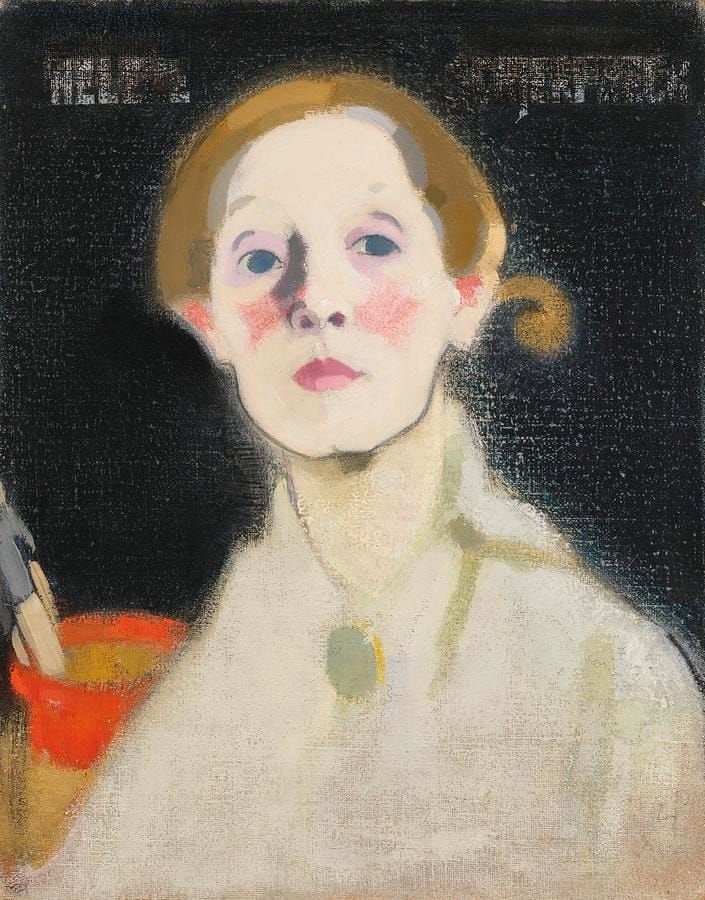
Helene Schjerfbeck (1862–1946) is the painter Finland treasures above all others, and for most of her working life almost nobody outside the country had heard of her. A fall at the age of four left her with a permanently injured hip; unable to attend ordinary school, she was admitted to the Finnish Art Society’s drawing school at eleven, remarkably young even for a school that accepted children. She went on to study in Paris and to paint in Brittany and in St Ives on the Cornish coast, absorbing French realism and, later, the flat decorative shapes of Whistler and the Japanese print.
In 1902 illness and money drove her out of Helsinki to the small town of Hyvinkää, where she lived quietly with her mother and did the work that made her great. Cut off from the art world, she pared her painting down year after year — fewer colors, fewer edges, thinner paint — until her portraits had the bareness of icons. A dealer rediscovered her in the 1910s, and she spent the last thirty years of her life recording her own face with a candor few artists have ever matched. Here are ten of her most famous works.
Self-Portrait, Black Background
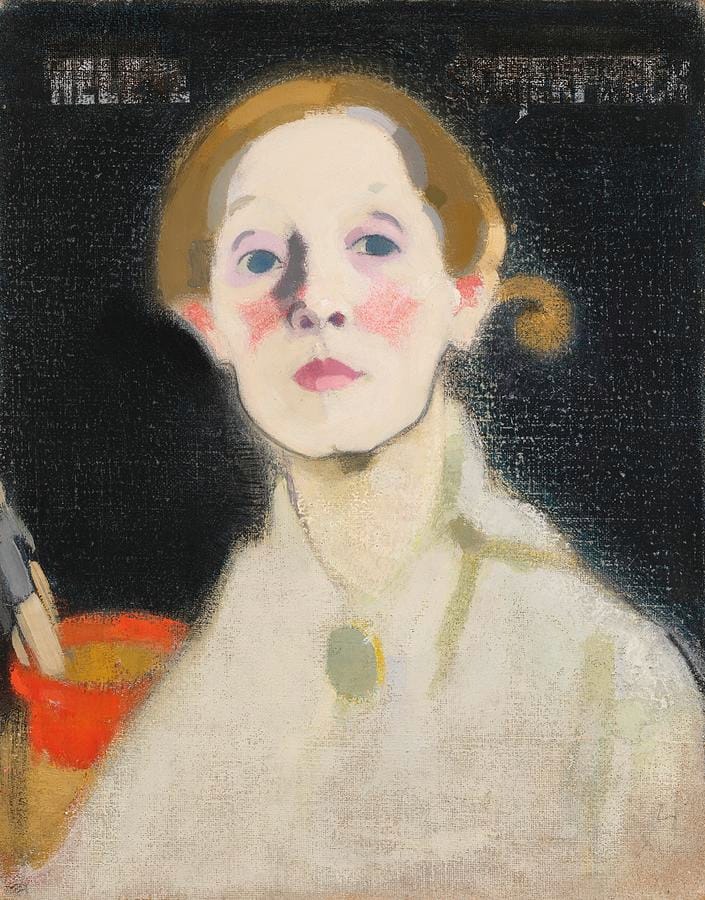
Painted in 1915 when Schjerfbeck was in her early fifties, this is the picture that put her face into the Finnish imagination. She commands the canvas frontally out of a field of pure black, her name lettered across the top like an inscription cut into stone, a pale collar spreading below a face reduced to a few flat planes and two spots of dry rouge. It was made for the Finnish Art Society’s collection of artists’ portraits, which means she painted it knowing it would hang as an official likeness — and she answered the commission with something closer to a confrontation.
Wounded Warrior in the Snow
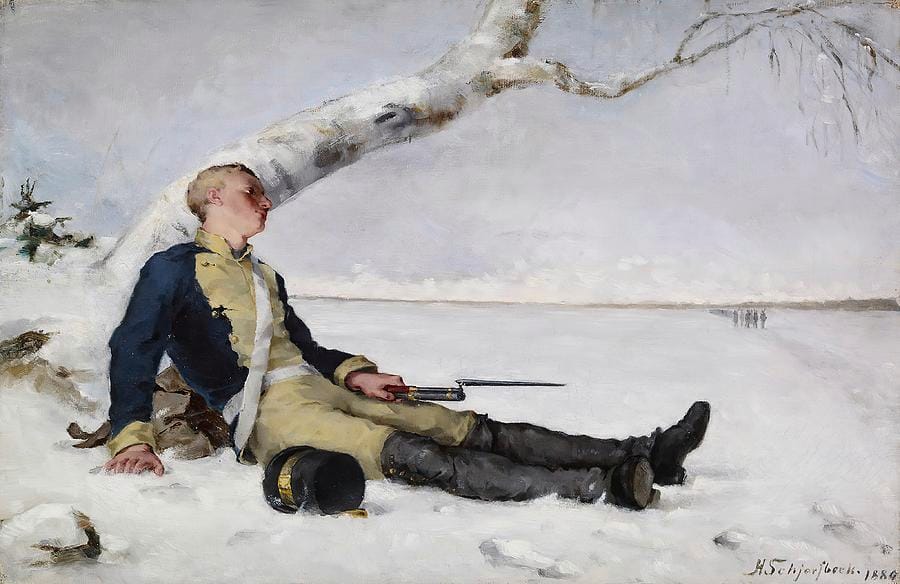
A young soldier in a blue coat with yellow facings lies propped in the snow beneath a snow-laden birch, a sabre across his lap and a dark stain spreading at his hip, the frozen lake behind him running flat to the horizon. Schjerfbeck was eighteen when she painted it in 1880, and the subject comes from the Finnish War of 1808–09, the founding trauma of Finnish national feeling. Nothing about the picture is heroic. His head is tipped back, the snow around him is scuffed and gray, and the emptiness of the landscape does the rest.
The Door
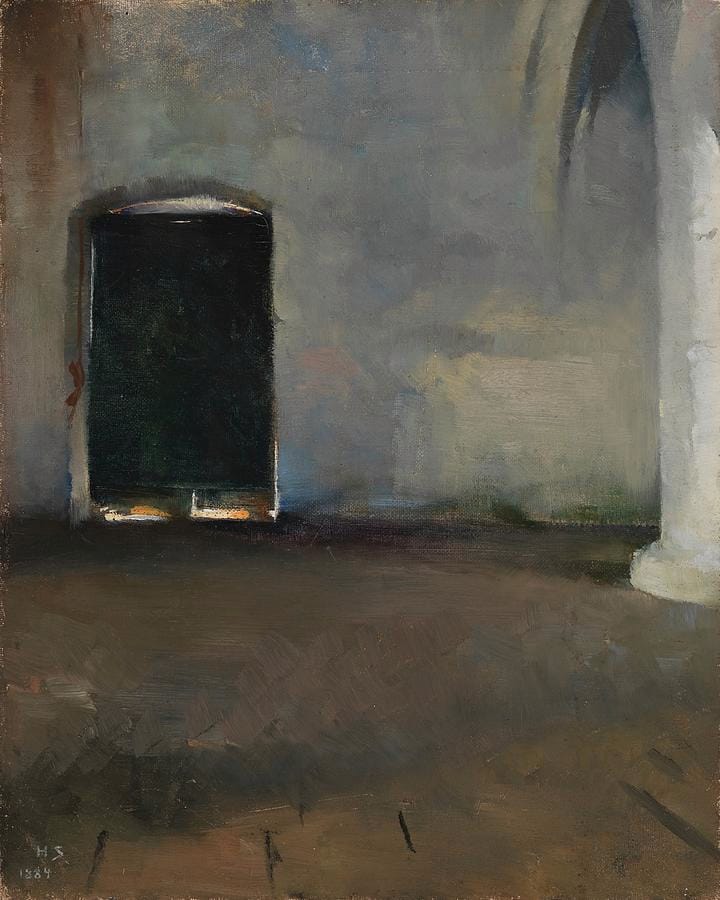
There is no figure in this one at all — just a dark green door set into a pale rendered wall, a step, a corner of stone, and the shadow of a passage falling across the ground. Schjerfbeck painted it in Brittany in the mid-1880s, and it is startlingly ahead of its time: an almost abstract arrangement of rectangles in gray, ochre, and near-black, made when most of her contemporaries were still filling their canvases with anecdote. It is the earliest sign of the instinct that would drive everything she did later — take away, and keep taking away.
The Death of Wilhelm von Schwerin
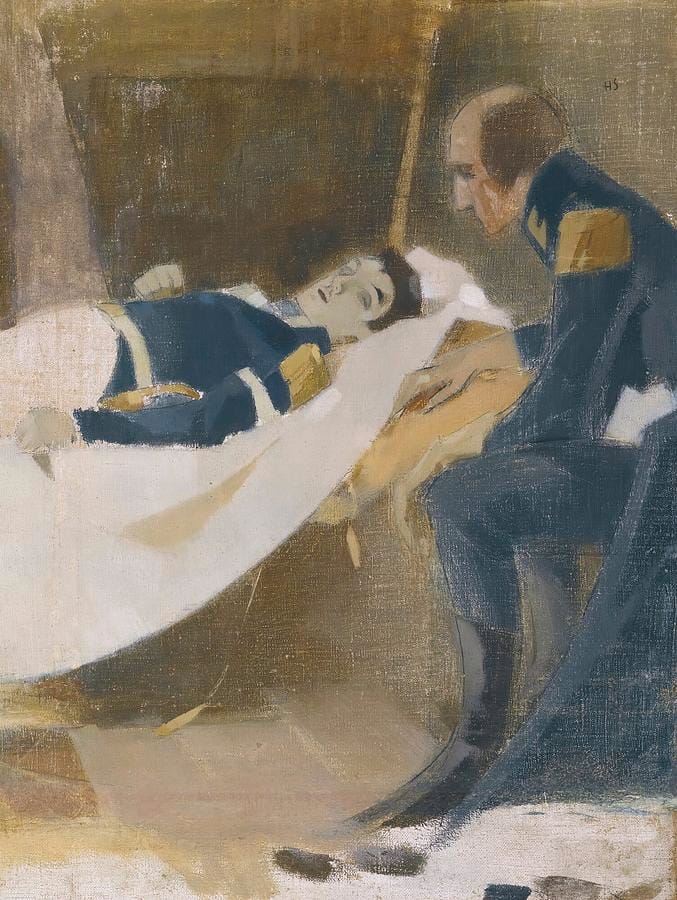
A boy officer lies dying on white bedding while an older man in uniform bends over him, the room around them collapsing into shadow. The subject is drawn from Johan Ludvig Runeberg’s hugely popular verse cycle about the Finnish War, in which the teenage Wilhelm von Schwerin is mortally wounded in battle. Schjerfbeck painted it in 1886, in her twenties, and it was among the works that established her reputation in Helsinki. The white sheet is the brightest thing in the picture and doubles as its subject — a young body laid out like an offering.
The Seamstress
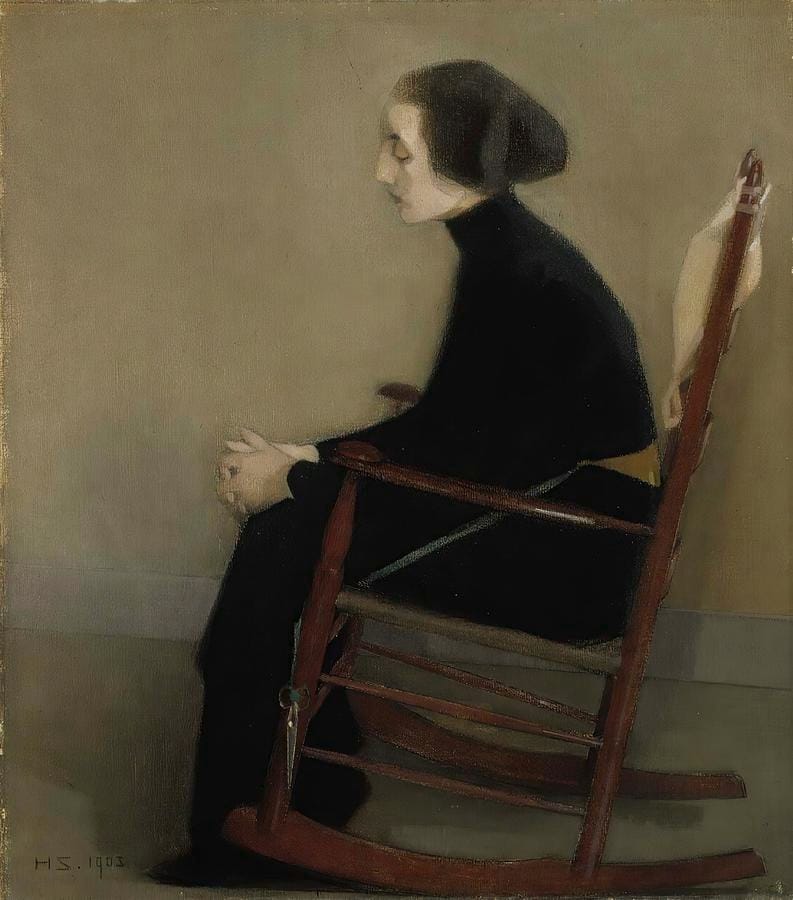
A young dressmaker sits in profile on a red rocking chair, hands folded in her lap, her work put down for a moment; a pair of scissors hangs from the chair back on a ribbon. Painted in 1903, it belongs to the years when Schjerfbeck was turning away from finished realism toward something flatter and quieter. The background is a bare wash of gray-green, the black dress is a single silhouette, and the whole picture rests on the small tilt of the sitter’s head. It is one of the tenderest images of working women in Nordic painting.
Maria
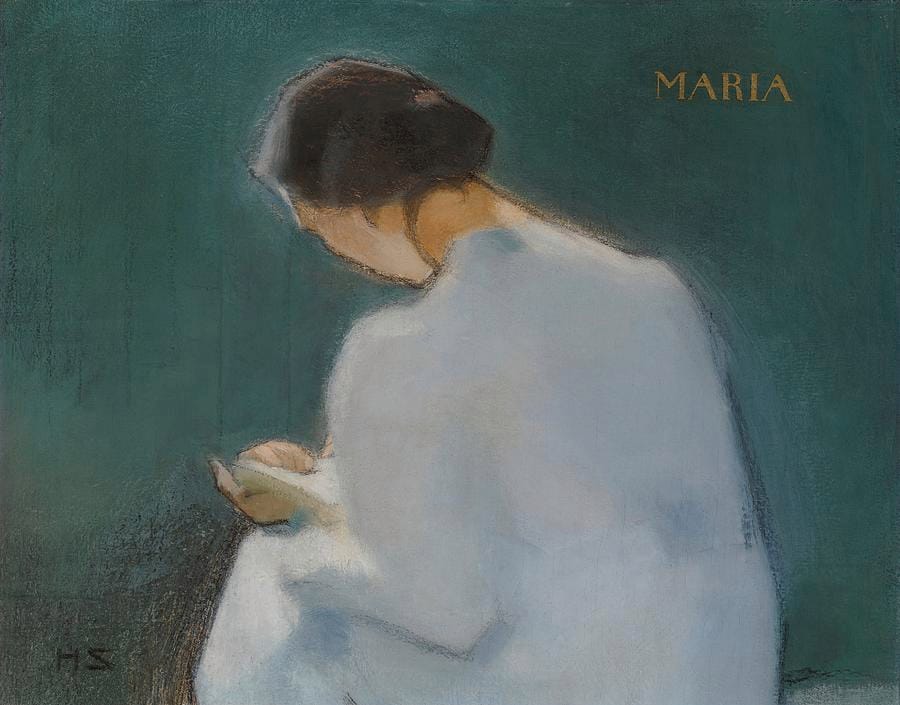
A woman in a pale blue-white blouse is seen from behind and slightly to one side, head bent over something in her hands, set against a deep green ground with the name MARIA lettered faintly in the upper corner. Painted around 1909, it is one of Schjerfbeck’s most purely decorative pictures — the figure is almost a silhouette, the paint is thin enough that the weave of the canvas shows through, and the color is reduced to two notes. The turned-away pose is characteristic: she preferred her sitters caught mid-thought rather than presented.
Circus Girl
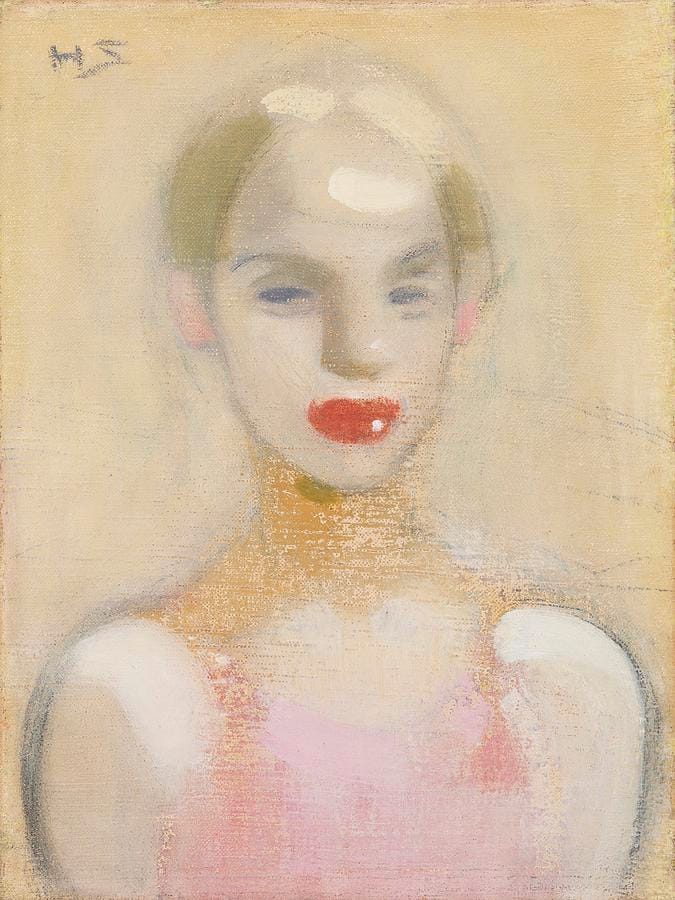
A young performer with cropped fair hair, bare shoulders, and a scarlet mouth stares out of a pale, almost bleached canvas. Painted in 1916, it comes from the period when Schjerfbeck was working from photographs and fashion-magazine cuttings as often as from life, translating whatever she found into her own vocabulary of flat shape and washed color. The face is barely modeled — a smudge of blue for the eyes, a wipe of pink across the cheek — yet the expression is exact, and unsettling: the picture is titled for a spectacle, but the girl looks like someone waiting to go on.
The Girl from California
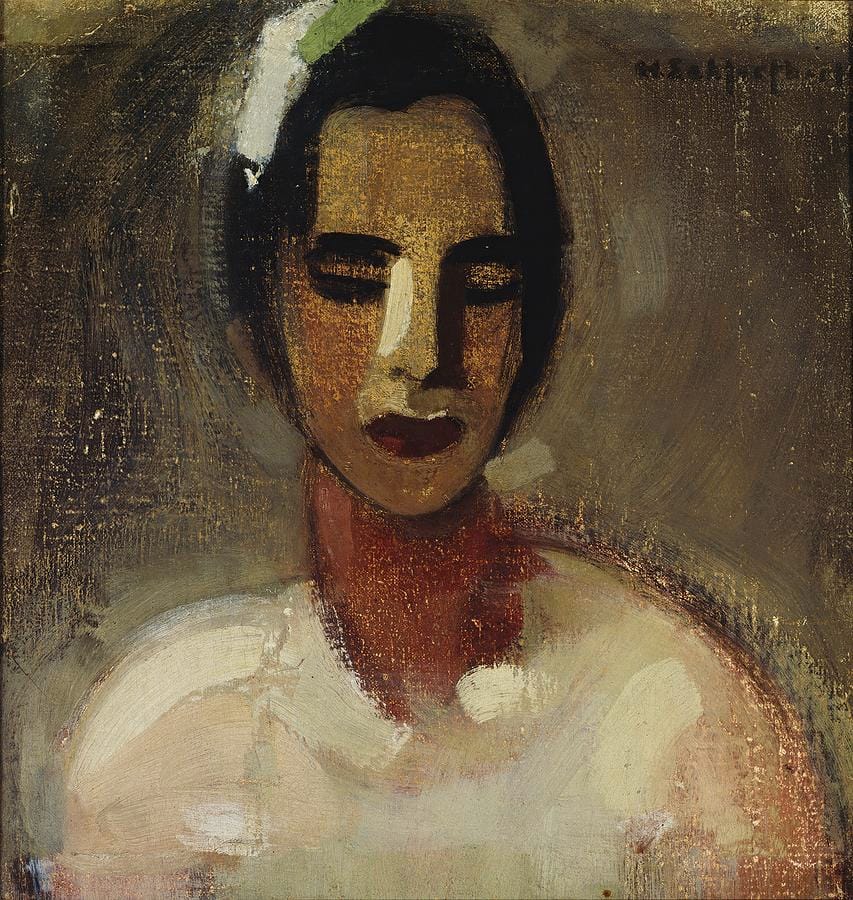
A dark-haired young woman with a white flower set in her hair turns her shadowed face toward the viewer, her shoulders bare, everything behind her dissolved into warm brown. Made in 1919, it belongs to the years when Schjerfbeck often worked from photographs and printed images rather than from sittings, and she returned to this motif more than once. What she does with it is characteristic: the features are pushed almost to the edge of legibility, the skin is built from ochres and greens rather than flesh tones, and the flower — the one crisp, bright thing in the picture — holds the whole design together.
Roses in a Blue-Green Vase
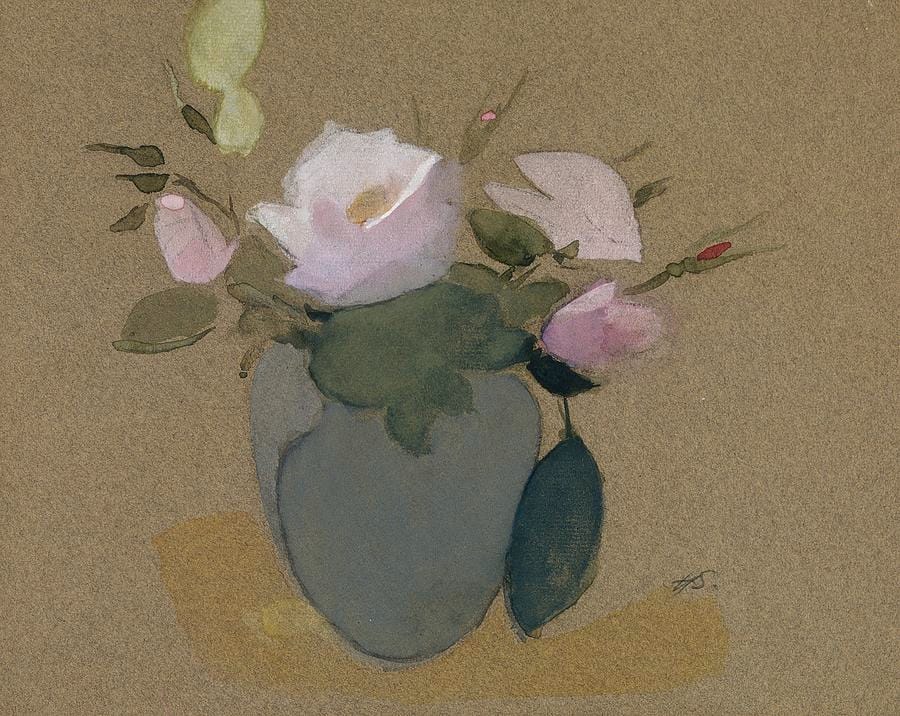
Schjerfbeck painted still lifes throughout her life, usually small, always spare, and this is among the loveliest: a handful of pale roses, some open and some still tight in the bud, in a squat blue-green vase. There is no cloth, no second object, barely a hint of a surface beneath the vase — the flowers simply sit in the middle of a bare warm-gray ground surrounded by nothing. Her still lifes were made in the same spirit as her portraits, an exercise in removing everything that could be removed, and they show her extraordinary sense of where to place a single stem.
Self-Portrait with Red Spot
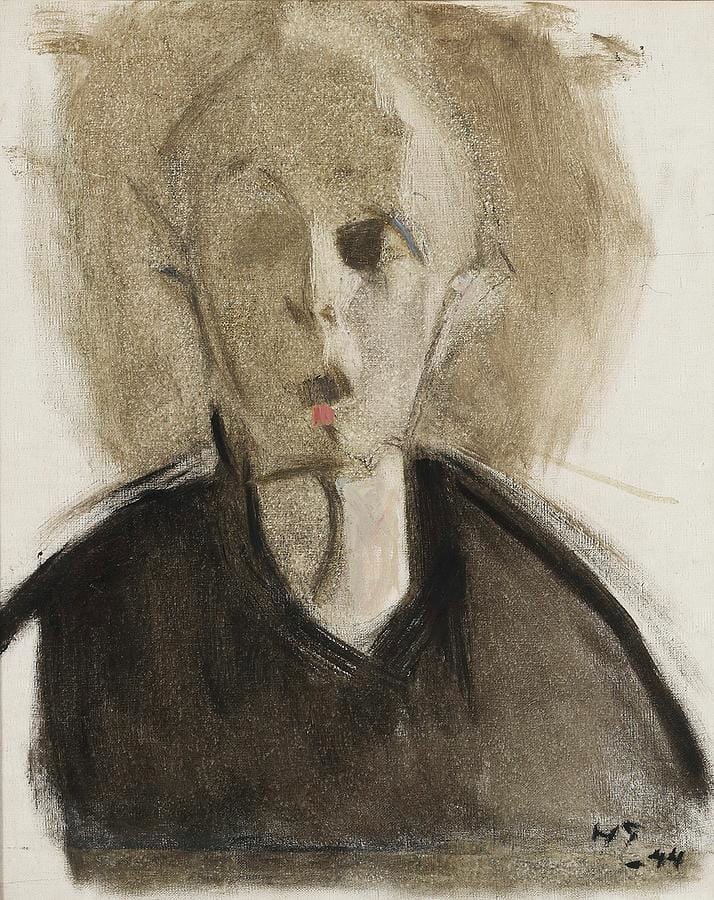
In 1944, at eighty-two and in failing health as the war ground on, Schjerfbeck painted herself as a skull-like head floating over a wedge of black, the features scratched in with a dry brush and a single stroke of red at the mouth. She made close to forty self-portraits across her life, and the last group is among the most unflinching sequences in modern art — an old woman watching her own face come apart and recording it without pity or drama. This is the most famous of them, and one of the great final statements in European painting.
Schjerfbeck spent forty years taking things out of her pictures, and what survives the subtraction is remarkably durable: a color, a contour, a look. Her paintings suit calm, uncluttered rooms — pale walls, plenty of space around the frame — and they reward the kind of attention you only give to something you live with.
Shop Helene Schjerfbeck prints here, and explore the rest of our famous paintings collection for more of the world’s most beloved masterpieces.