Helen Hyde’s Ten Most Beautiful Prints
The American artist who learned Japanese woodblock printing in Tokyo — ten of her most charming and beautifully colored prints.

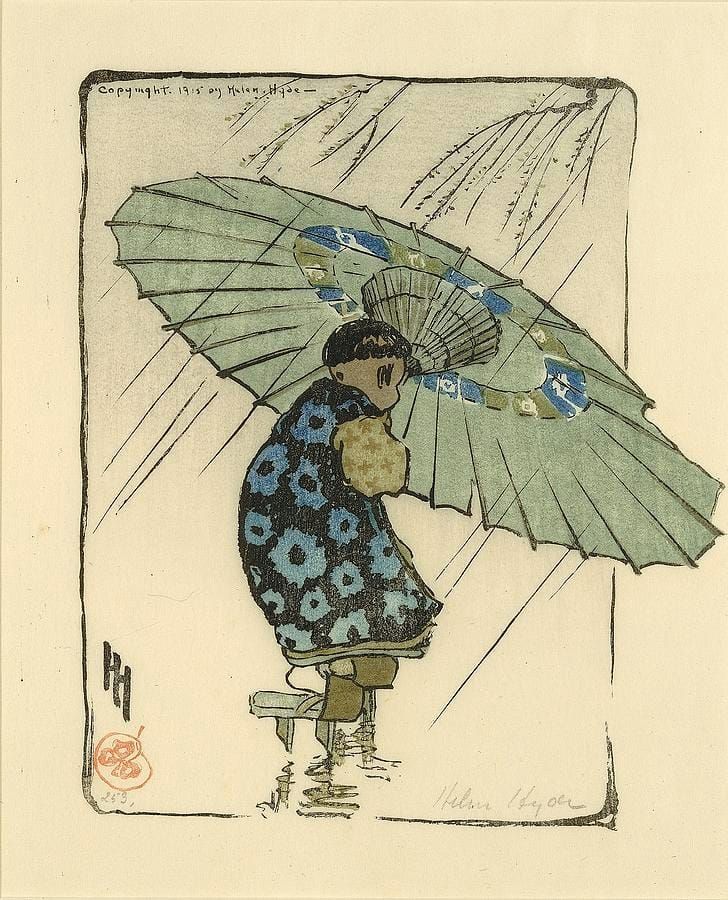
Helen Hyde (1868–1919) was an American artist who found her subject on the other side of the world. Raised in San Francisco and trained in New York, Berlin and Paris, she first began drawing the children of San Francisco’s Chinatown, then sailed for Japan in 1899 and stayed for roughly fifteen years. Rather than sketching Japan as a visiting Westerner, she set out to learn its printmaking from the inside — studying with Japanese teachers and working with the professional carvers and printers of Tokyo, whose hand-cut blocks and water-based inks give her work its soft, glowing color.
The results are hybrid and completely her own: Western drawing and modeling laid over the flat shapes, high viewpoints and delicate registration of the Japanese woodblock tradition. Her great subject was ordinary domestic life — mothers with babies on their backs, small children with round faces and enormous sleeves, umbrellas in the rain, festivals and gardens. Prints like these made her one of the most popular American printmakers of her generation. Here are ten of her most beautiful.
The Family Umbrella
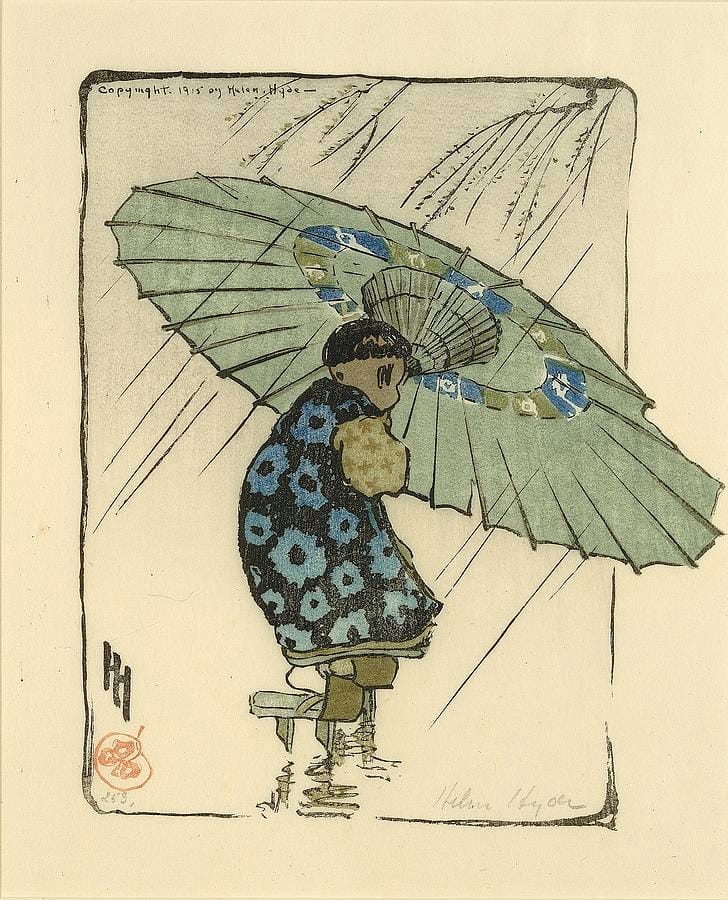
A small child stands almost entirely hidden beneath a huge blue-green paper umbrella, only patterned sleeves, wooden clogs and a pair of legs showing beneath the rim, while pale streaks of rain fall across the whole sheet. It is Hyde at her most economical: two or three flat colors, a bold circle, and a joke everyone recognizes about a child carrying something far too big. The image became one of her signature designs, and it shows how thoroughly she had absorbed the Japanese habit of letting empty paper do half the work.
Moon Bridge at Kameido
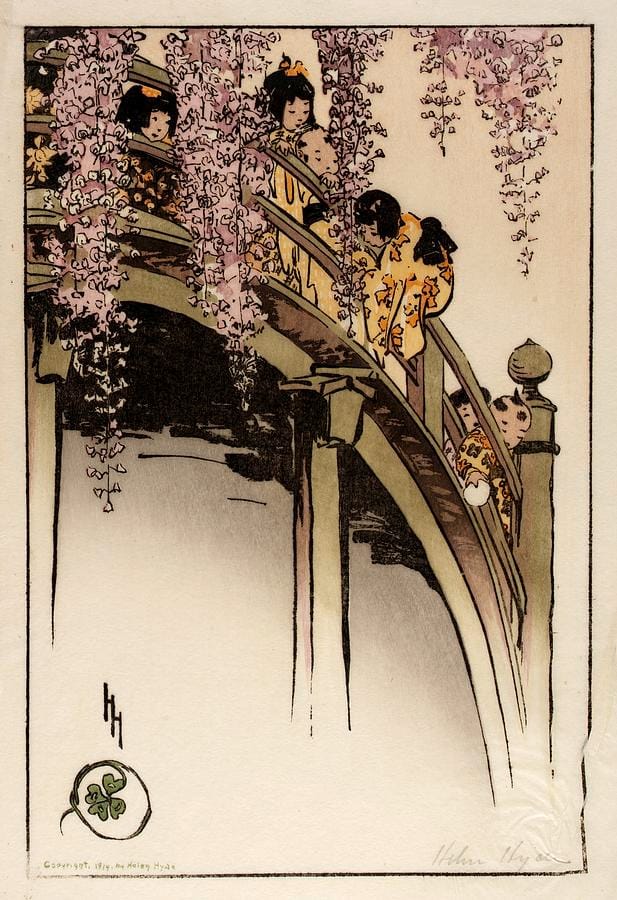
A little group of women and children in kimono leans on the rail of the famous steeply arched drum bridge at the Kameido Tenjin shrine in Tokyo — one of them with a baby strapped to her back — while trailing wisteria hangs in mauve curtains above and around them. The bridge had been a favorite of Japanese printmakers for a century before Hyde arrived, and taking it on was a deliberate act of nerve. Her version keeps the dizzying curve but pushes the figures forward and softens the palette into greens, lilacs and gray. It is probably her single most admired print, and one of the most beautiful things ever made by an American in the medium.
The White Peacock
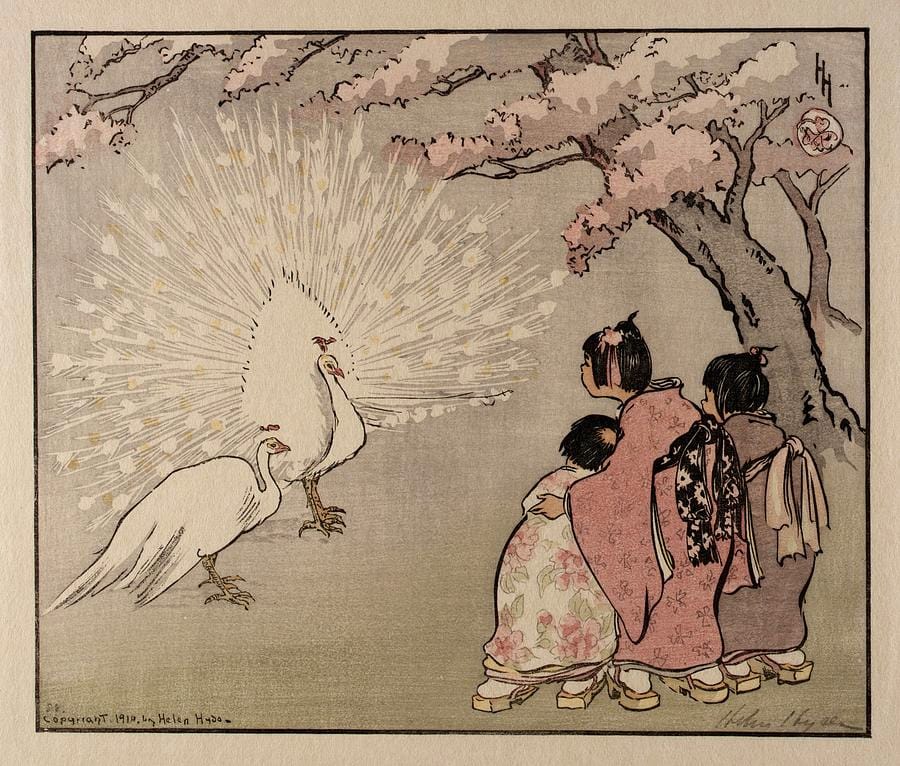
Beneath a canopy of pink cherry blossom, a white peacock opens its tail in a great pale fan while three small figures in patterned kimono stand watching, seen entirely from behind. The bird’s spread feathers fill nearly half the sheet, printed in the barest tints so that the paper itself supplies most of the whiteness — a technique that only works in the hand-printed Japanese method Hyde had trained in. It is one of her most decorative designs and one of her most technically ambitious, and it demonstrates her instinct for balancing a spectacular event against small, quiet human figures.
My Neighbors
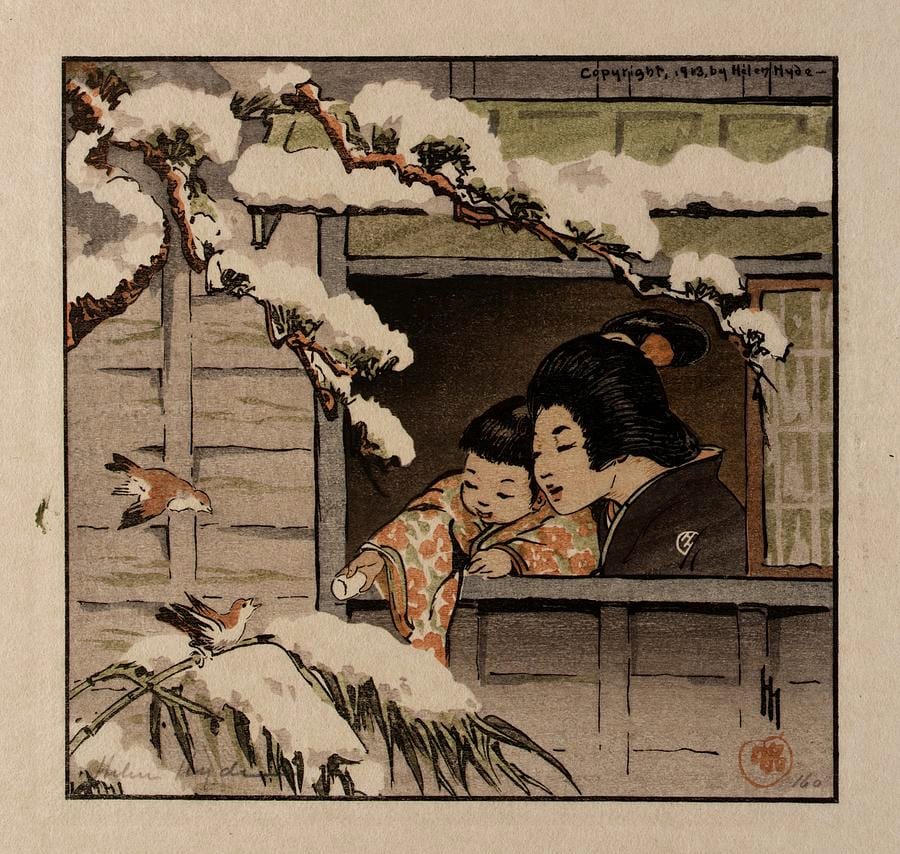
Two women lean out of the open front of a wooden house in deep winter, heads close together in conversation, framed by a snow-laden pine branch and a snow-capped fence, with two sparrows perched on the bough. The composition is essentially a picture within a picture, the dark opening of the house set against dazzling white — an arrangement borrowed straight from Japanese print design. Hyde had a real gift for capturing neighborly gossip without caricature, and this is the warmest example: two friends passing the time in the cold, entirely unaware of being watched.
Goblin Lanterns
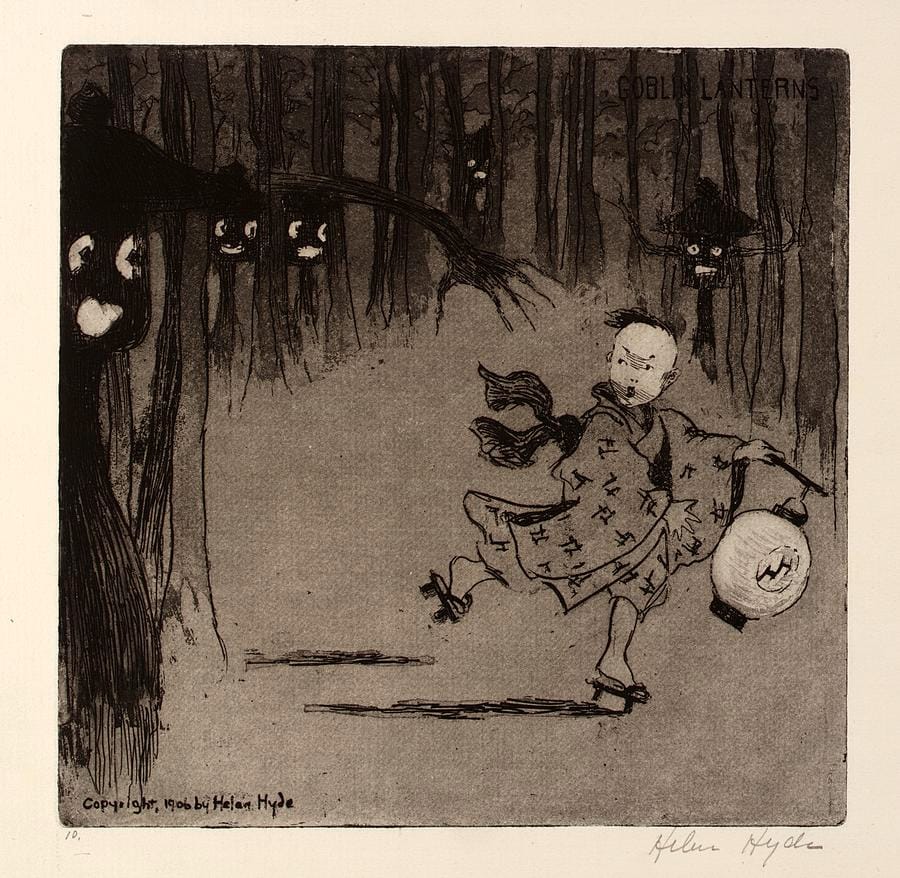
A small boy hurries through a dark grove clutching a paper lantern, and the blackness on either side of him is full of glowing eyes and drifting spirit lights. Printed almost entirely in grays and blacks, it is the most atmospheric thing Hyde made, drawing on the Japanese love of ghost stories told on summer evenings. The child’s expression — determined rather than terrified — is what saves it from becoming merely spooky, and the print stands out sharply among her sunlit gardens and cherry blossoms as proof of her range.
New Year’s Day in Tokyo
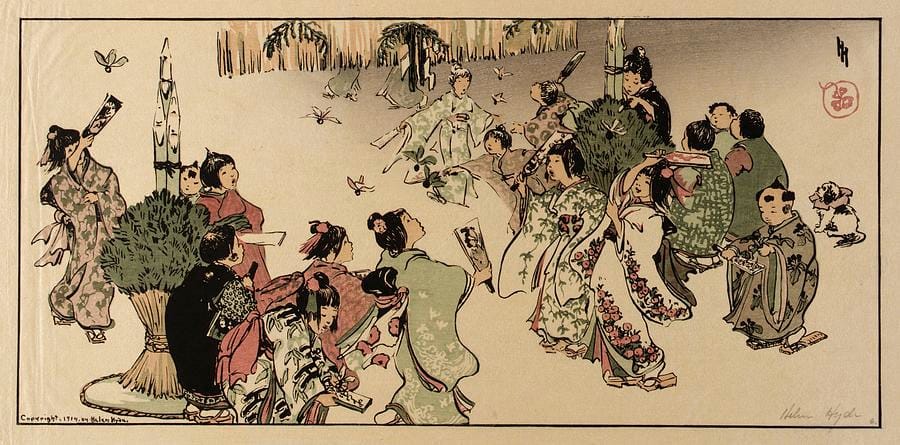
In a long horizontal panorama, a crowd of women and children in their best kimono move across the sheet on New Year’s visits, past tall holiday decorations, greeting one another and steering toddlers by the hand. Hyde used the wide format the way Japanese designers used it, as a scroll to be read from side to side rather than a scene to be taken in at once. The color is festive but never gaudy — soft greens, dusty pinks, black hair — and the whole print gives a vivid sense of what the biggest holiday of the Japanese year actually looked like from street level.
Feeding the Bunnies
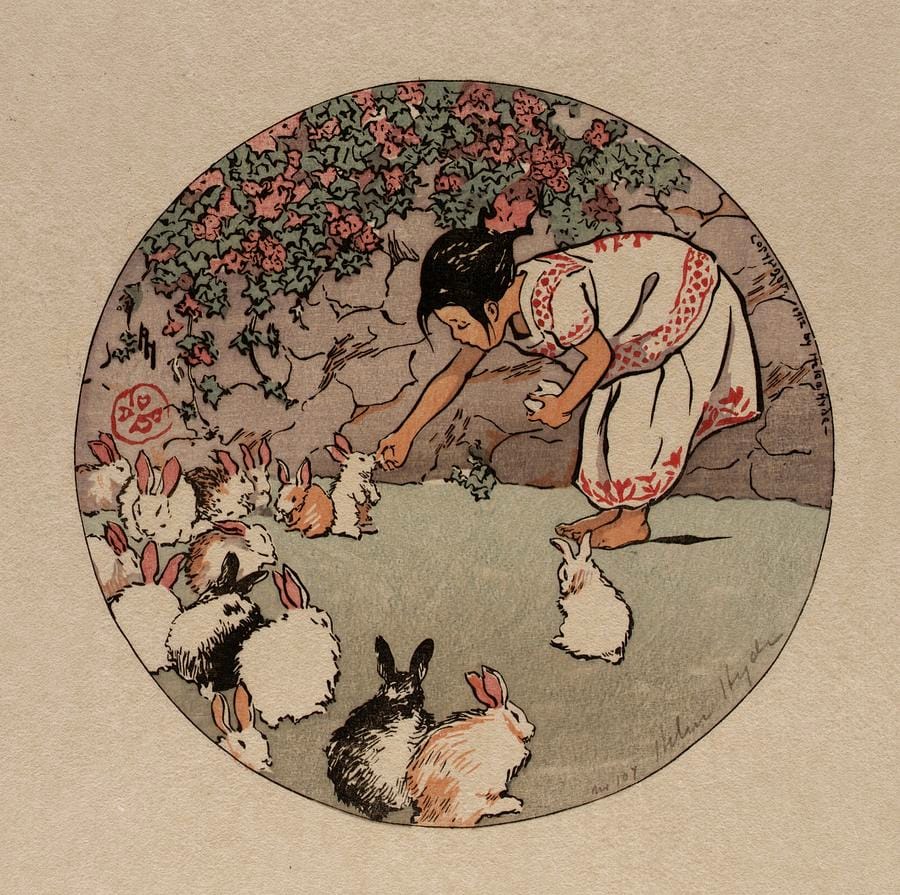
Inside a perfect circle, a small girl bends deep at the waist to offer food to a scatter of rabbits, a bank of flowering azalea behind her and a dozen brown, black and white bunnies nosing about her feet. The round format was one Hyde returned to often, and it suits this subject perfectly: the child’s curved back echoes the border, and the pale rabbits provide bright accents against the gray-green ground. Prints of children with animals were her most commercially successful line, and this remains the most charming of them — affectionate without ever tipping into sentimentality.
Day Dreams
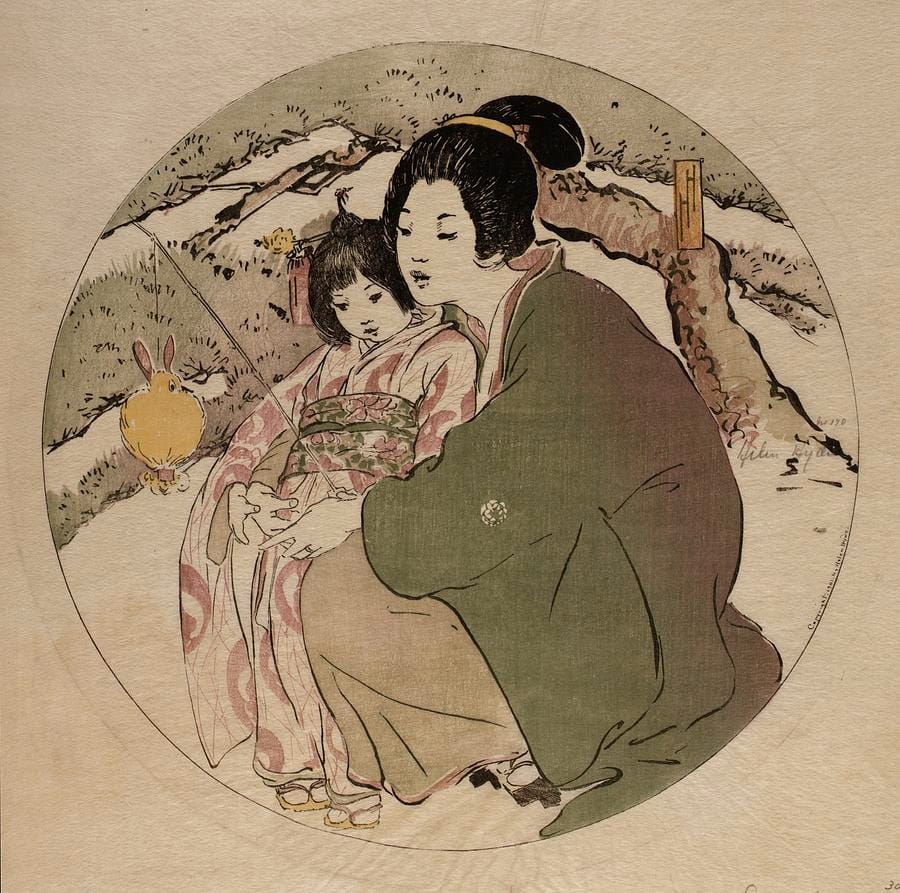
A woman in a green kimono sits under flowering cherry with a little girl leaning against her shoulder, both of them gazing off at something outside the frame, the whole composition again contained in a circle. Hyde’s mothers are never idealized madonnas; they are practical women with children attached to them, caught in a moment of stillness. The delicacy of the printing here is exceptional — the blossom is barely more than a suggestion of pink on cream — and it explains why collectors of her day placed her alongside the finest Japanese printmakers working in the same years.
Moonlight on the Viga Canal
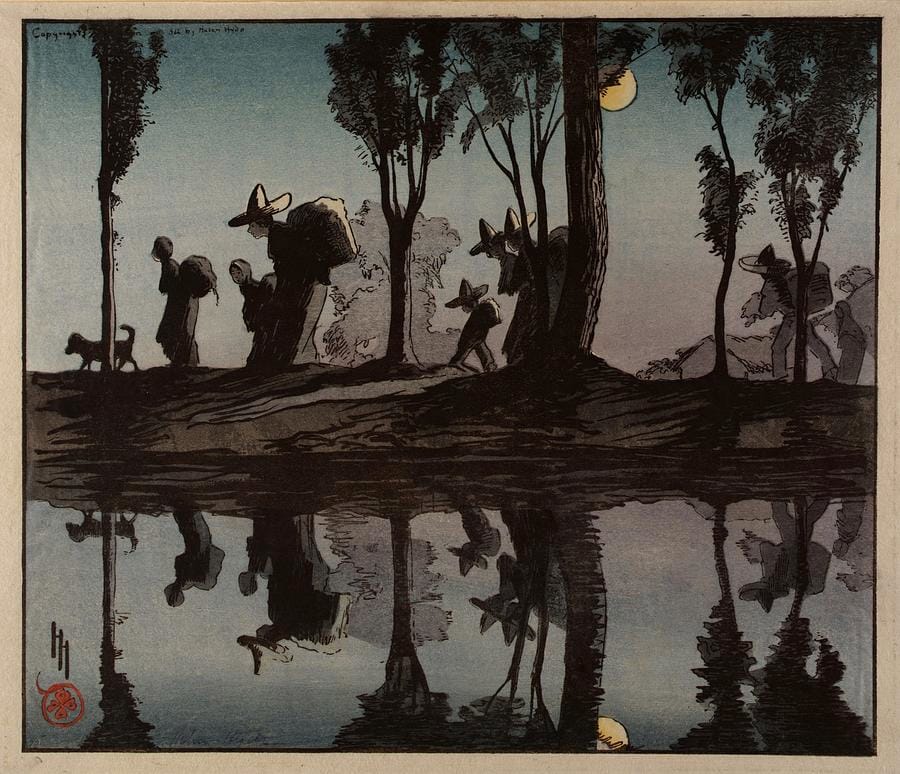
Hyde left Japan for a spell in Mexico, and this print is the finest thing she brought back. On the old Viga Canal outside Mexico City, figures in wide hats pole flat boats through the dark while pale globes of light hang in the trees and everything doubles itself in the still water. The design is pure Japanese night-print construction — silhouettes, reflections, a few points of warm light — applied to a wholly Mexican subject. The result is unlike anything else in her catalog and unlike anything else in American printmaking of the period.
The Good Luck Branch
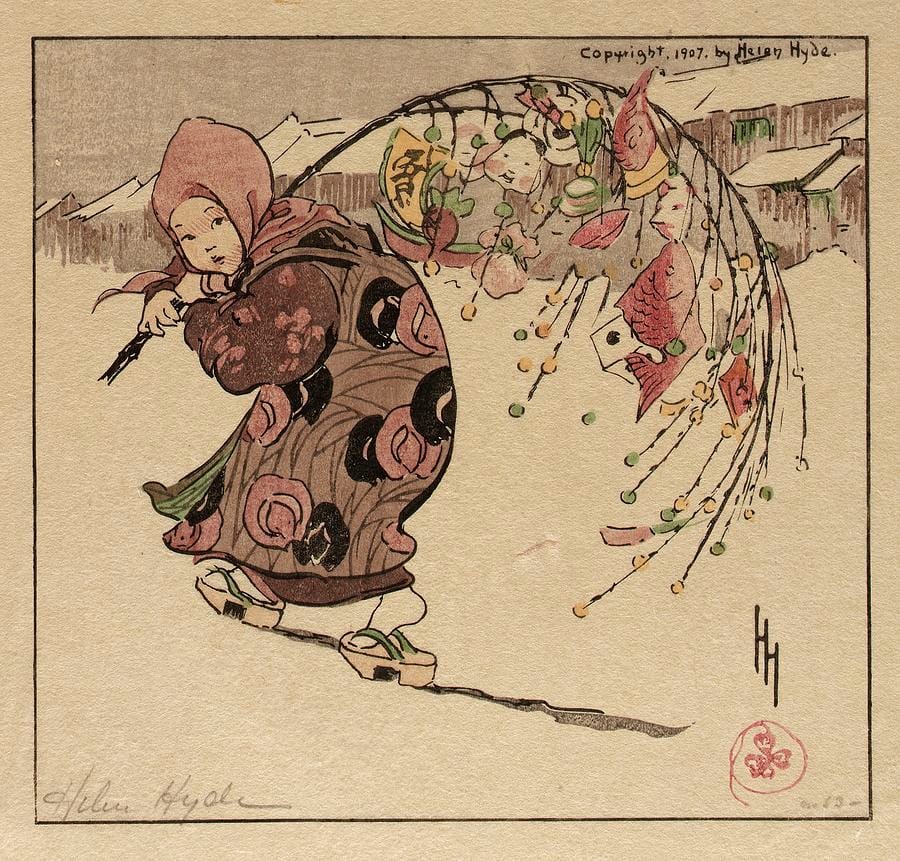
A child in a pink headscarf and a rose-patterned kimono leans forward under the weight of a long branch hung with New Year charms — masks, coins, tiny gilded trinkets — the whole loaded bough curving over her in a great arc that fills the upper half of the sheet. Dated 1907, it is one of Hyde’s most exuberant designs. The swirling diagonal composition, the child braced against the load, and the empty cream paper below her give it a sense of movement rarely found in her quieter domestic scenes, and the branch itself is a New Year’s wish made visible.
Hyde returned to the United States in 1914 and died only a few years later, leaving a body of work that has been quietly gaining admirers ever since. Her prints suit a home beautifully: modest in scale, warm in color, easy to live with, and full of small human observations that reveal themselves slowly on a wall you pass every day.
Shop Helen Hyde prints here, and explore the rest of our famous paintings collection for more of the world’s most beloved masterpieces.