The Great Ocean and Wave Paintings
Hokusai’s Great Wave, Aivazovsky’s Ninth Wave, Turner’s whalers, Homer’s Maine breakers — eight pictures that taught the world how to look at the sea.

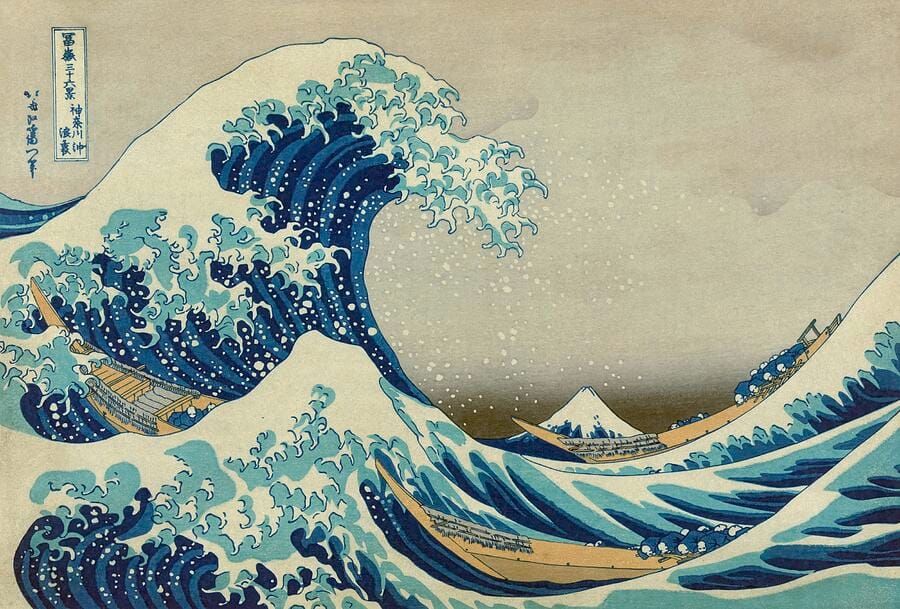
The most famous image of the sea in art is Katsushika Hokusai’s Under the Wave off Kanagawa of about 1831, universally known as The Great Wave — a woodblock print, not a painting. Behind it come Ivan Aivazovsky’s The Ninth Wave, Turner’s late whaling pictures, Courbet’s blunt studies of surf, and Winslow Homer’s Maine breakers.
Under the Wave off Kanagawa (The Great Wave) — Katsushika Hokusai, c. 1831
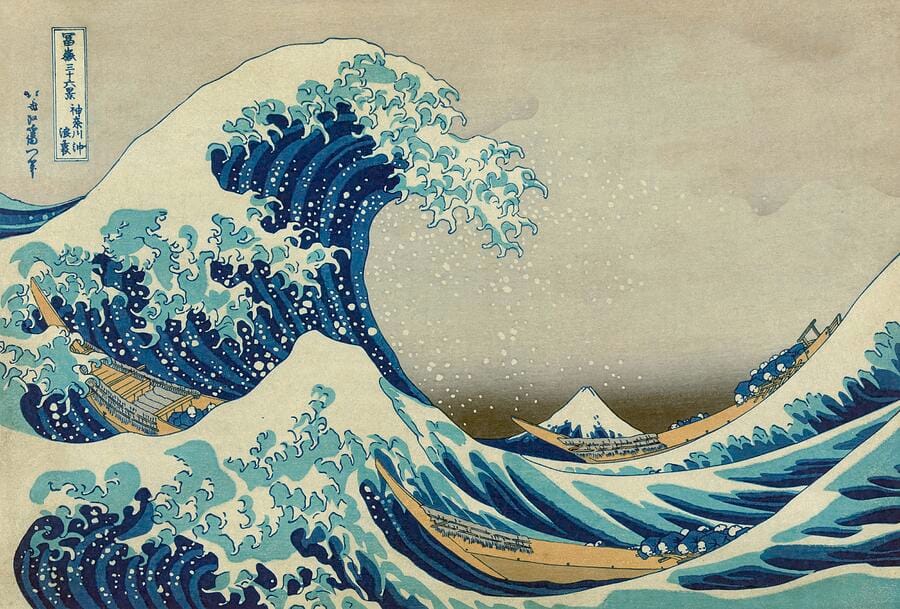
Three fast cargo boats are caught in the trough as a wave claws over them, its foam breaking into fingers. Mount Fuji sits tiny and calm at the center — this is a print from the series Thirty-six Views of Mount Fuji, and the mountain, not the water, is the nominal subject.
Hokusai was around seventy when he designed it. The deep blue that makes it work is Prussian blue, a European pigment that had just become cheap in Japan. Thousands of impressions were pulled from the blocks, which is why surviving copies hang in museums all over the world.
The Ninth Wave — Ivan Aivazovsky, 1850
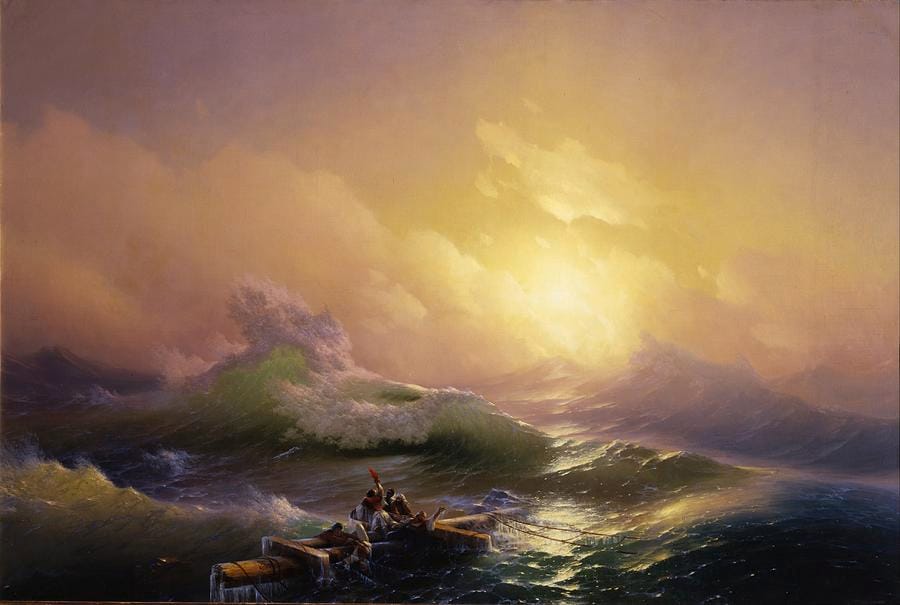
Survivors of a wreck cling to a fragment of mast as the sun comes up through spray the color of amber. The title refers to an old sailors’ belief that waves arrive in sets and the ninth is the killer — so the picture is not showing a storm, it is showing the moment before the worst of it.
Aivazovsky (1817–1900) was born in Crimea and painted the sea almost exclusively, producing some six thousand works. He painted from memory rather than outdoors, which is why the light is theatrical rather than observed. The canvas is in the State Russian Museum.
Whalers — J. M. W. Turner, c. 1845
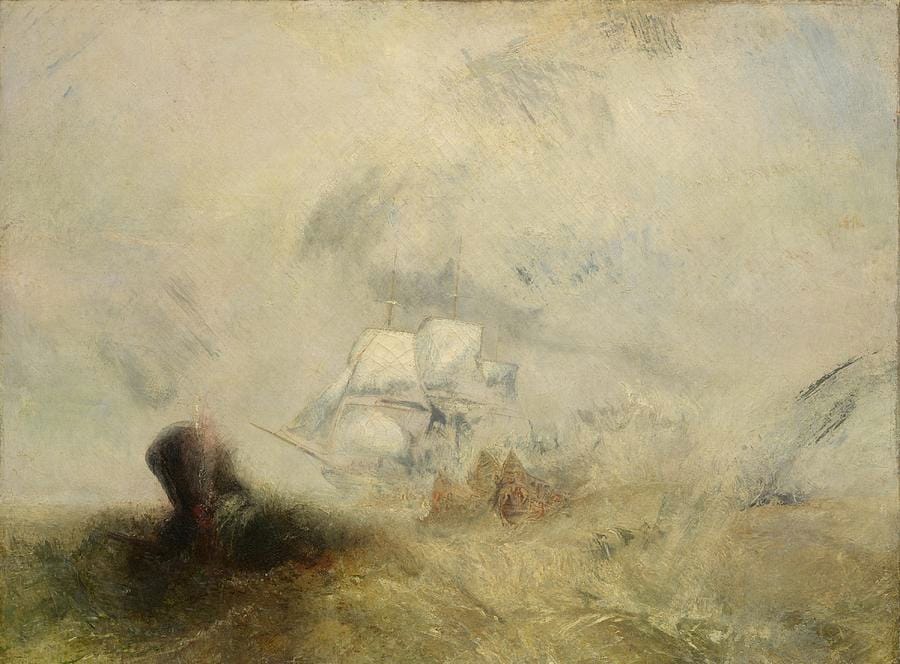
By his seventies Turner had dissolved the sea almost completely. A whaling ship and a rearing whale are just legible in a haze of cream, ochre and gray; everything else — water, air, spray, smoke — has become one continuous atmosphere. Contemporaries complained the pictures looked unfinished. They were not.
This is one of a group of four whaling subjects he exhibited at the Royal Academy in 1845 and 1846, prompted partly by Thomas Beale’s book on the sperm whale. The Metropolitan Museum’s canvas is the one that most clearly points forward to everything Monet would do forty years later.
The Wave (La Vague) — Gustave Courbet, c. 1869
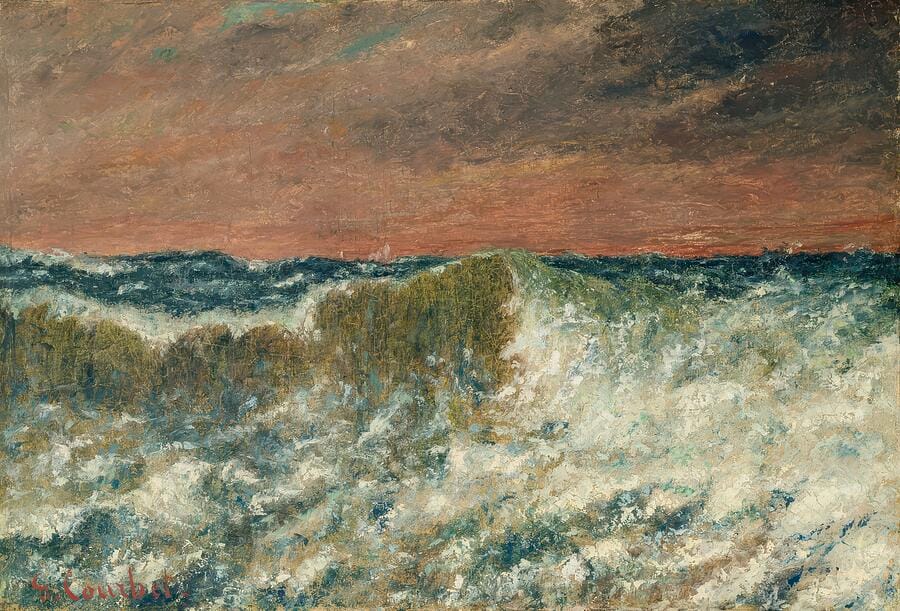
No boat, no shore, no story: a single breaking wave under a bruised sky, filling the canvas edge to edge. Courbet spent the autumn of 1869 at Étretat on the Normandy coast and painted the subject over and over, some two dozen times, laying the water on in thick slabs with a palette knife so the paint has the physical density of the thing it depicts.
They are the most modern seascapes of the century and were recognized as such — Cézanne admired them enormously. Strip away the subject and what is left is an argument about paint that the twentieth century would spend decades having.
Northeaster — Winslow Homer, 1895
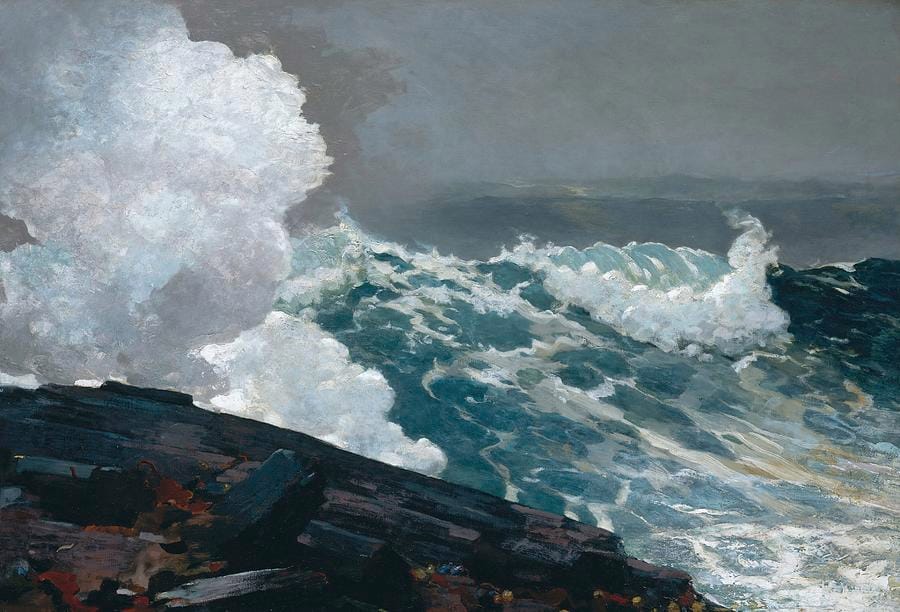
Homer moved to Prout’s Neck on the Maine coast in 1883 and built a studio with a balcony above the rocks, where he watched the Atlantic for the last twenty-seven years of his life. Northeaster is what he made of it: a wall of green water exploding upward off dark ledges, painted from a vantage point close enough to be soaked.
It originally contained two men standing on the rocks. Around 1901 Homer painted them out, leaving nothing human in the picture at all — the change that turns a coastal scene into a portrait of force.
Rocks at Port-Goulphar, Belle-Île — Claude Monet, 1886
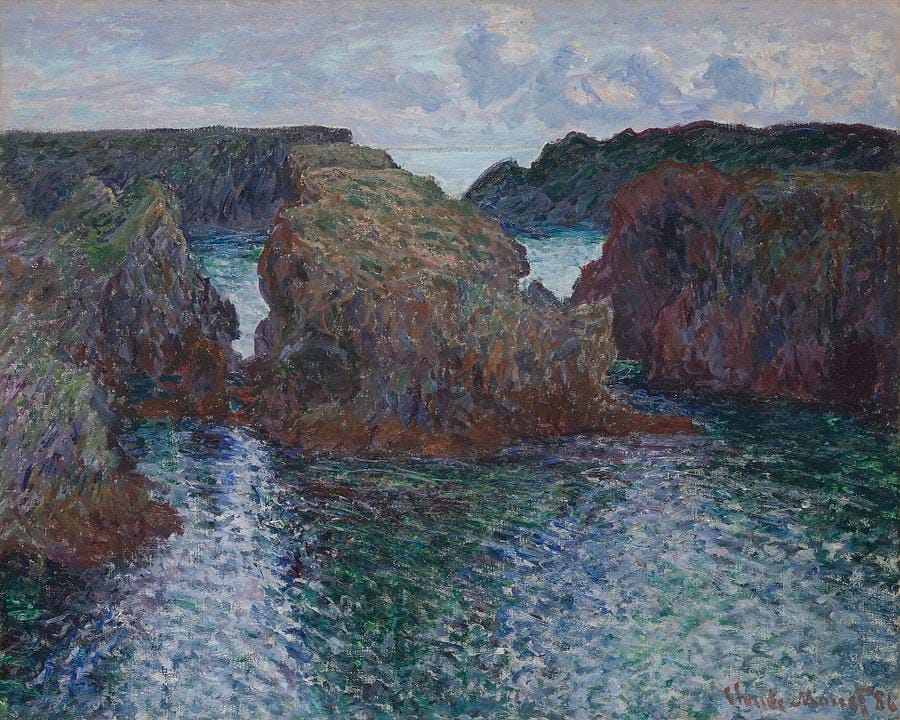
Monet went to Belle-Île off the coast of Brittany in the autumn of 1886 intending to stay ten days and stayed more than two months, producing around forty canvases. The weather was appalling. He had to weight his easel down, and his letters home describe the sea there as terrible and sinister — this is not the Normandy of parasols and regattas.
What he found on the island was the violet-black volcanic rock that keeps recurring in these pictures, set against water broken into short choppy strokes of green and turquoise. It is Impressionism at its least decorative.
The Wounded Foot — Joaquín Sorolla
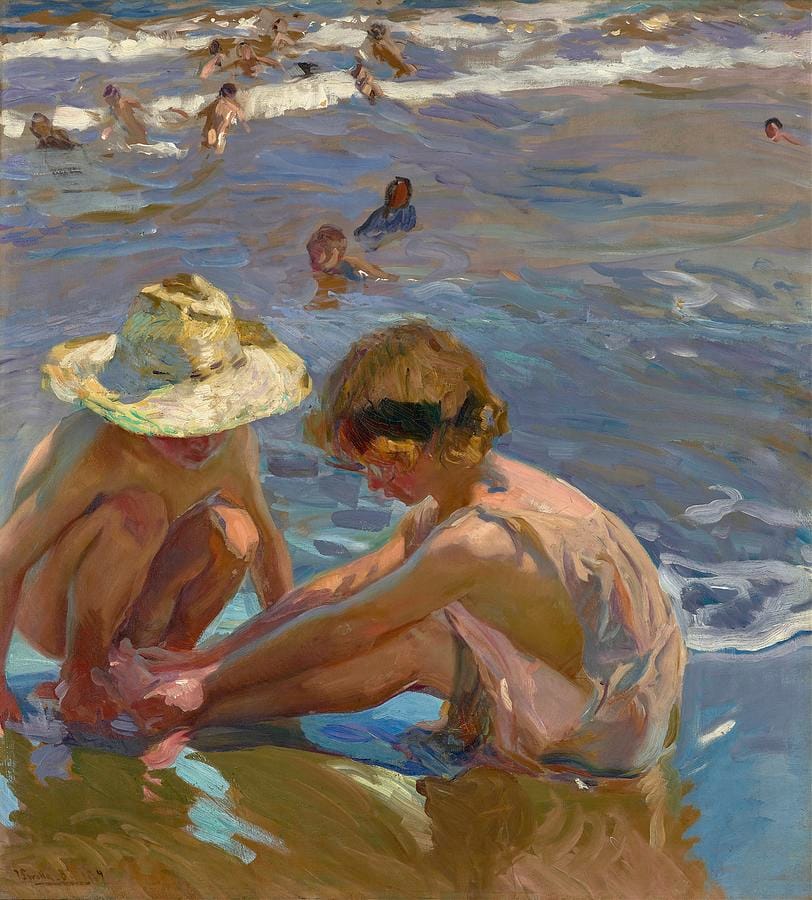
Two children crouch on wet sand at the edge of the shallows, one in a broad straw hat bending over the other’s foot while swimmers bob in the water behind. Sorolla painted dozens of scenes like this on the Mediterranean coast in the first decade of the twentieth century, working outdoors on canvases too big to be comfortable, chasing reflected light off wet sand.
The sea here is not a threat but a surface — pink, lilac and pale green where the sun hits it. His 1909 New York exhibition drew well over a hundred thousand visitors and made him famous in America overnight.
A Mermaid — John William Waterhouse, 1900
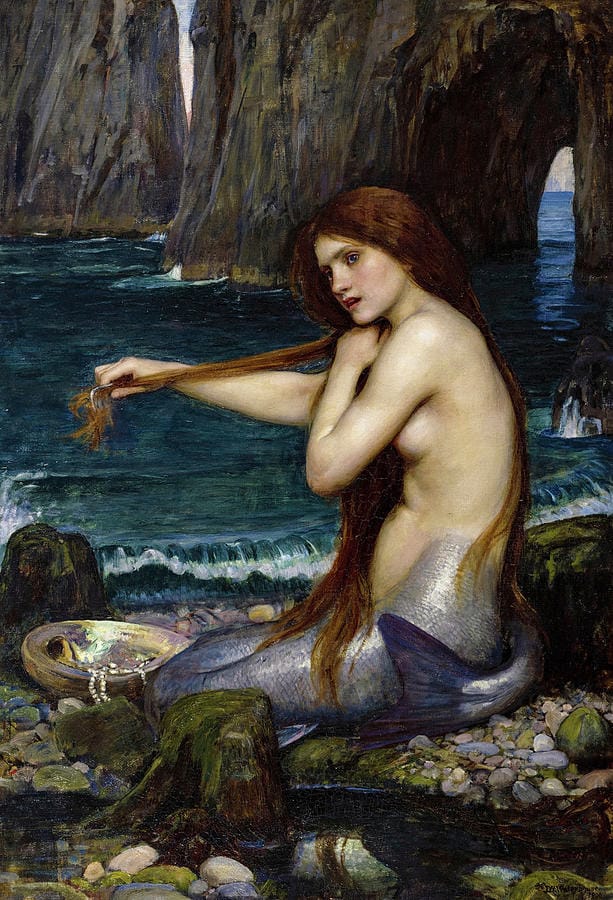
A mermaid sits on the shingle in a cove, combing out her red hair, a shell of pearls beside her and the sea shut off behind by black cliffs. Waterhouse worked at it for years and finally submitted it as his diploma work — the piece a newly elected Royal Academician deposits with the Academy — so it has stayed in the Royal Academy’s collection ever since.
The mood comes from Tennyson, whose mermaid sings alone on a golden throne below the sea. It is probably the best-known painting of a mermaid in Western art, and the reason a great many people picture one exactly this way.
Frequently asked questions
What is the most famous wave painting?
Katsushika Hokusai’s Under the Wave off Kanagawa, made around 1831 and known worldwide as The Great Wave. Strictly it is not a painting but a color woodblock print from the series Thirty-six Views of Mount Fuji. The most famous painted wave is probably Ivan Aivazovsky’s The Ninth Wave of 1850, in the State Russian Museum in St Petersburg.
Is The Great Wave a painting or a print?
A print. Hokusai drew the design, a block-cutter carved it into cherry wood, and a printer pulled impressions in colored inks — the standard division of labor in Japanese ukiyo-e publishing. Thousands of impressions were produced, so there is no single original. Museums including the Metropolitan Museum of Art and the British Museum each hold their own copies.
Who is the greatest painter of the sea?
J. M. W. Turner, on most reckonings: his late marine pictures dissolve ships and water into pure atmosphere and set the terms for everything after. For sheer volume and drama the answer is Ivan Aivazovsky, who painted around six thousand seascapes, and for the sea as a physical force the answer is Winslow Homer at Prout’s Neck.
What is a painting of the sea called?
A seascape, or in older usage a marine. Marine painting emerged as a distinct genre in the seventeenth-century Dutch Republic, where shipping was the basis of national wealth, and was carried to England by Dutch painters. The word “seascape” was coined much later, on the model of “landscape.”
What does The Ninth Wave mean?
The title comes from an old sailors’ superstition that waves travel in sets and the ninth is the largest and most dangerous. Aivazovsky shows survivors of a shipwreck clinging to a mast at sunrise, with the fatal wave still building. The warm dawn light is deliberately ambiguous — it can be read as either rescue or the last thing they will see.
Why did Impressionists paint the coast so often?
Railways had opened the Normandy and Brittany coasts to Paris by the 1860s, and the sea offered exactly what the Impressionists wanted: changing light, weather, reflections and no fixed detail. Monet, Boudin and Courbet all worked on the Channel coast. Monet’s two months on Belle-Île in 1886 produced around forty canvases of the same handful of rocks.
Sea pictures work in a room for the same reason they worked on a Salon wall: they give the eye distance. Every painting here is available as a canvas, framed or art prints — and you can browse the wider seascape collection or the rest of our famous paintings.