Georg Dionysius Ehret’s Ten Most Beautiful Botanical Illustrations
A gardener’s son who became the greatest botanical artist of the eighteenth century: ten of Ehret’s most beautiful plant portraits.

Georg Dionysius Ehret (1708–1770) was born in Heidelberg, the son of a gardener, and was trained to garden himself. He learned plants the way a gardener does — by handling them, season after season — and only later learned to draw them. That order of events explains everything about his work. An Ehret plate is not a pretty arrangement of flowers; it is a plant described by someone who knew how it grew, complete with the dissected parts a botanist needs to identify it, and it happens also to be beautiful.
His career was made by two men. The Nuremberg physician Christoph Jacob Trew became his patron and published his finest plates in the great folio Plantae Selectae; and in Holland in the 1730s Ehret met Carl Linnaeus, whose new system of classification he helped to illustrate. Ehret settled in England, worked for the Chelsea Physic Garden and for wealthy collectors of exotic plants, and in 1757 was elected a Fellow of the Royal Society — an extraordinary honor for a working artist. Here are ten of his most beautiful illustrations.
Ananas (The Pineapple)
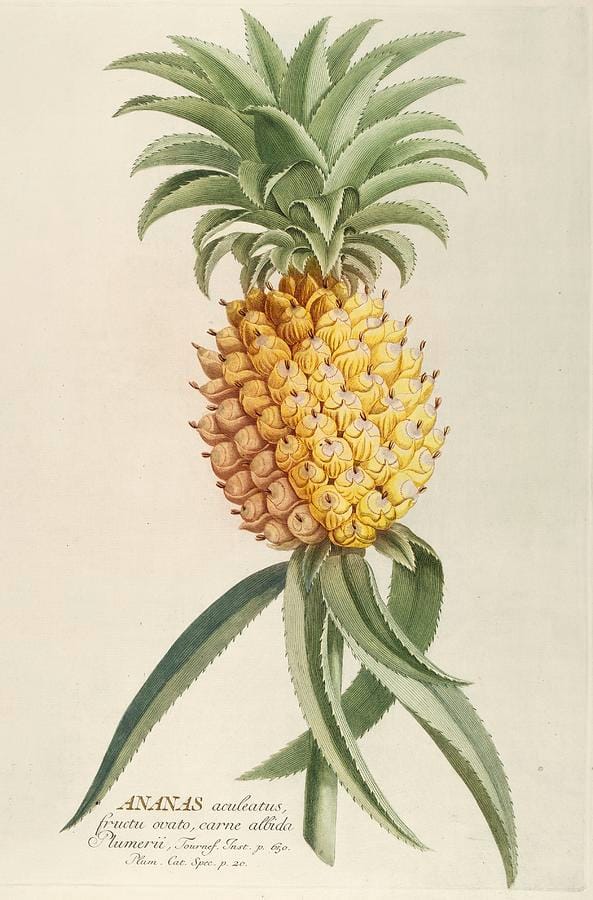
Nothing announced wealth in eighteenth-century Europe quite like a pineapple. Growing one required a heated glasshouse, years of patience, and a gardener who knew what he was doing — which is exactly what Ehret had been. His plate gives the whole plant: the ripe golden fruit with its diamond-patterned skin, the tufted crown of leaves springing from the top, and the long saw-edged foliage curving away below, every spine picked out. The Latin caption beneath identifies it as the variety with white flesh. It is a portrait of the most coveted fruit of the age, made by a man who had almost certainly grown one himself.
Magnolia
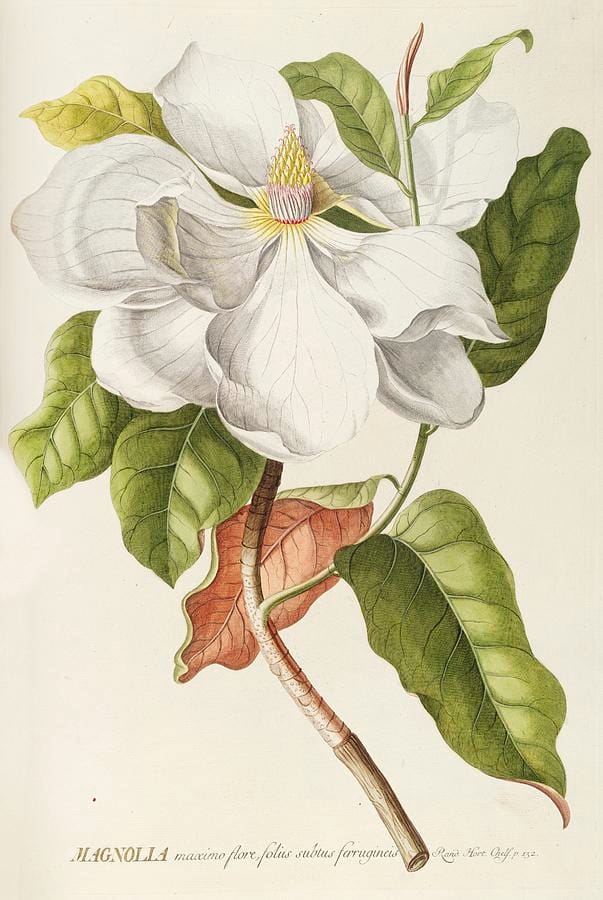
The great white magnolia of the American south reached European gardens in the eighteenth century and caused a sensation, and Ehret drew it more than once. Here a single cupped blossom fills most of the sheet, thick creamy petals curling back from a golden-pink center, set among dark glossy leaves. The detail the caption singles out is the underside of the foliage: one leaf is turned over to show a soft rust-brown surface, and a second, wholly russet, hangs below on the bare branch. Ehret’s magnolias are the most sumptuous flower paintings he ever made.
Cereus (The Night-Blowing Cereus)
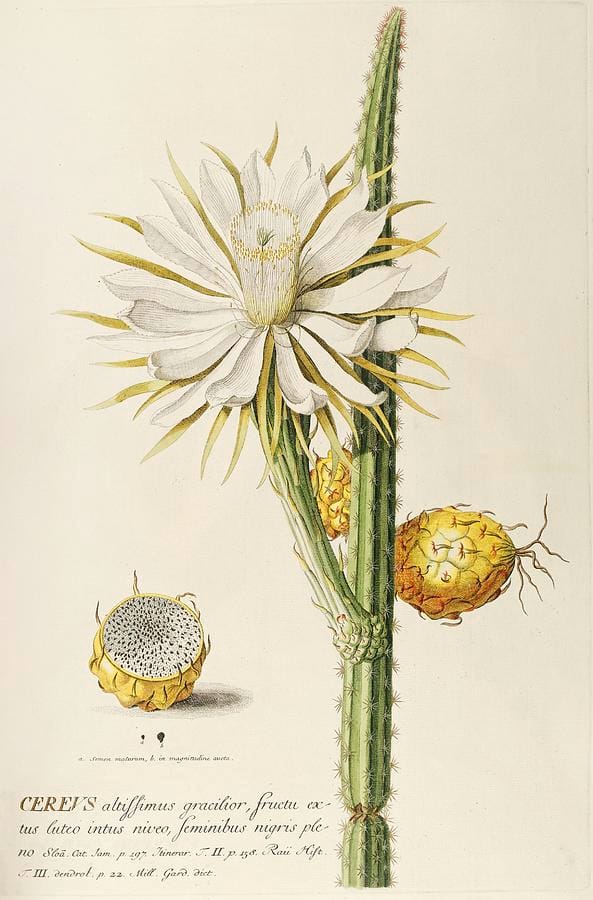
The night-blowing cereus opens for a single night and is finished by morning, which made it an event: collectors sat up to watch, and an artist had one chance to record it. Ehret’s plate gives the flower in full — a great white star of narrow petals ringed by a fringe of golden-green rays, blazing out from a ribbed, spiny stem. He adds the fruit twice over: one hanging whole and yellow beside the stem, another cut open below to show snow-white flesh flecked with black seeds. Botanical record and pure theater, on one sheet.
Haemanthus (The Blood Lily)
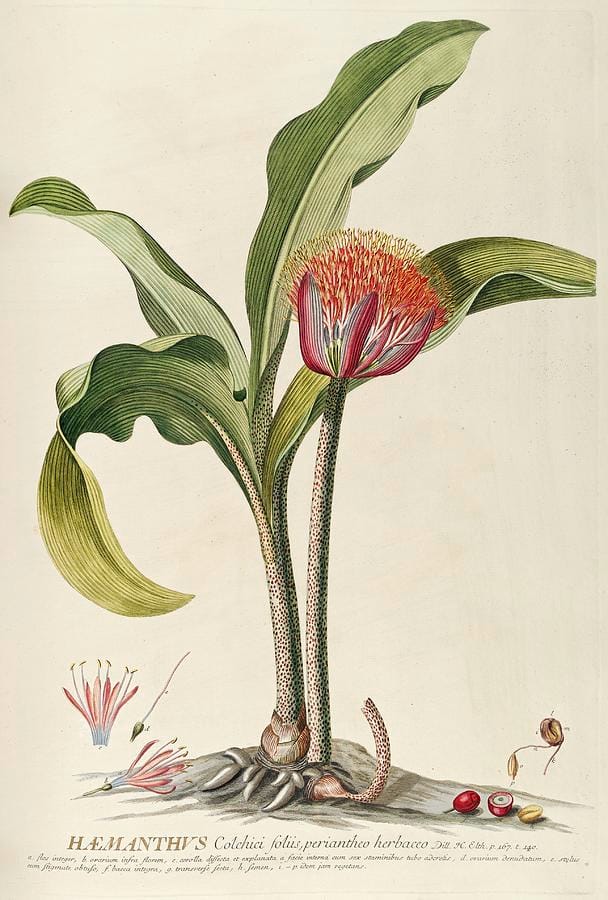
The blood lily comes from southern Africa and was one of the exotic bulbs that thrilled eighteenth-century collectors. Ehret shows it in flower: a shaving-brush of orange-red filaments standing in a deep red cup, raised on a pale stalk mottled with crimson, with two broad strap-shaped leaves curling away to either side. At the base, on a patch of stony ground, he sets the bulb itself, a dissected flower opened out to show its parts, and two scarlet berries. The plant is odd-looking and faintly alarming, and he makes no attempt to soften it.
Plumeria (Frangipani)
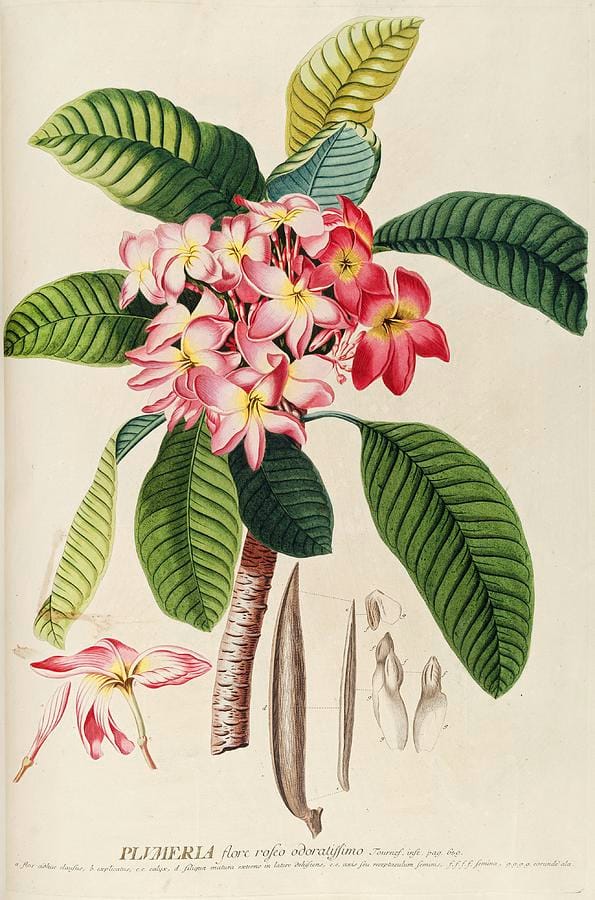
Frangipani was among the tropical American plants flowing into European hothouses through the eighteenth-century trade routes, prized for a scent that carries at night. Ehret’s plate crowds the top of the sheet with clusters of five-petalled pink flowers, each one shading to yellow at the throat, held above whorls of long ribbed leaves on thick pale branches. Along the bottom he lays out the dissections: a single flower opened flat, the tubular calyx, the seed pods split to show their contents. The arrangement is characteristic — beauty above, evidence below, and no sense that the two are in conflict.
Papaya
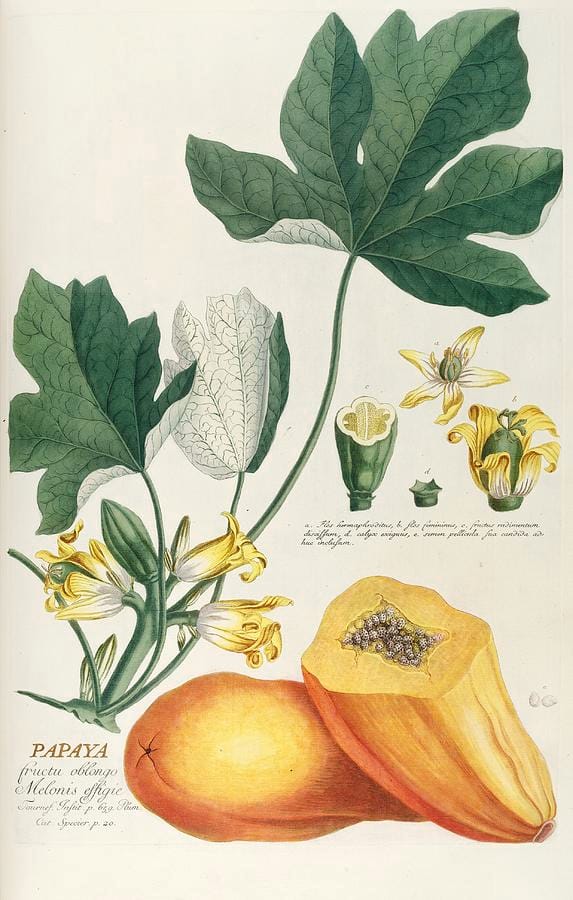
The papaya presented an illustrator with a problem: the fruit and the flowers are borne on separate plants, and a single sheet has to account for both. Ehret solves it by filling the upper half with the huge deeply lobed leaves and sprays of pale yellow blossom, then setting two ripe fruits in the foreground — one whole, one sliced open to show the orange flesh and the dense mass of black seeds in its hollow center. The cut fruit is painted with real relish. Few botanical artists have made scientific completeness look so much like an invitation to eat.
Meadia (The American Shooting Star)
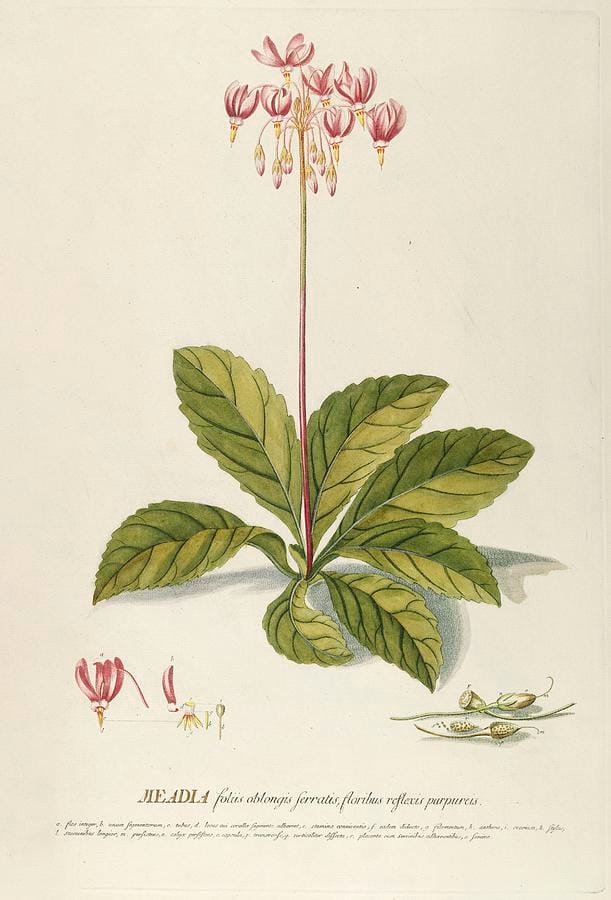
This modest woodland perennial from eastern North America carries one of the better stories in botany. It was named Meadia in honor of Richard Mead, the celebrated London physician and collector who was among Ehret’s patrons; botanists later folded it into the genus Dodecatheon, keeping Mead’s name as the species. Ehret draws a rosette of pale green leaves at the base and a bare reddish stalk rising to a spray of nodding pink flowers, each with its petals swept back from a dark pointed beak — the shape that gives the plant its common name. Dissected florets lie neatly below.
Ehretia
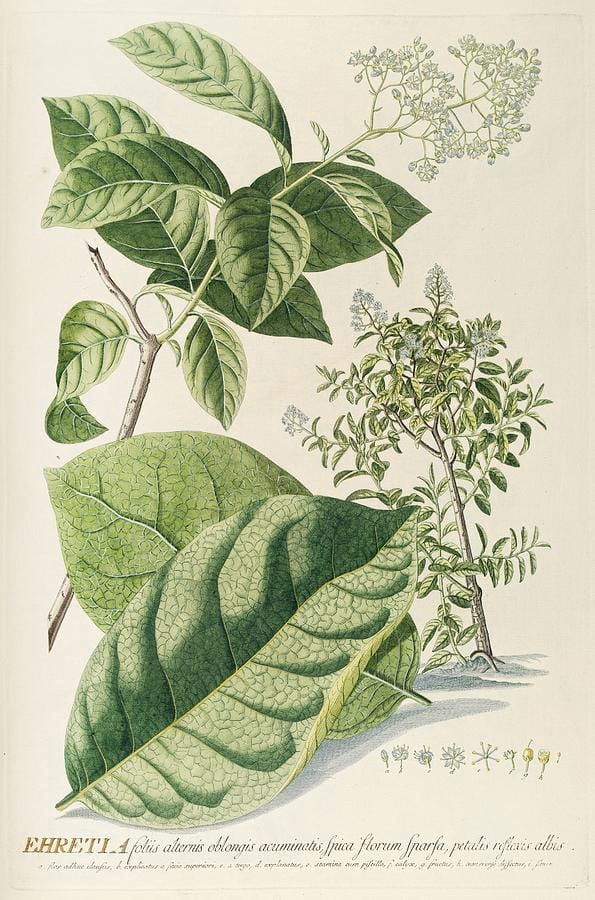
Every botanist of consequence hoped to have a genus named after them; Ehret, who was neither a gentleman nor a scholar by training, got one anyway. Ehretia is a group of tropical and subtropical trees and shrubs, and the honor was a public acknowledgment that his plates had become part of the science itself. Fittingly, he drew the plant that bears his name: large veined leaves spreading across the sheet, an airy spray of tiny pale flowers rising above them, and a careful row of dissected parts along the bottom edge. It is a quiet page, and probably the one that pleased him most.
Bromelia
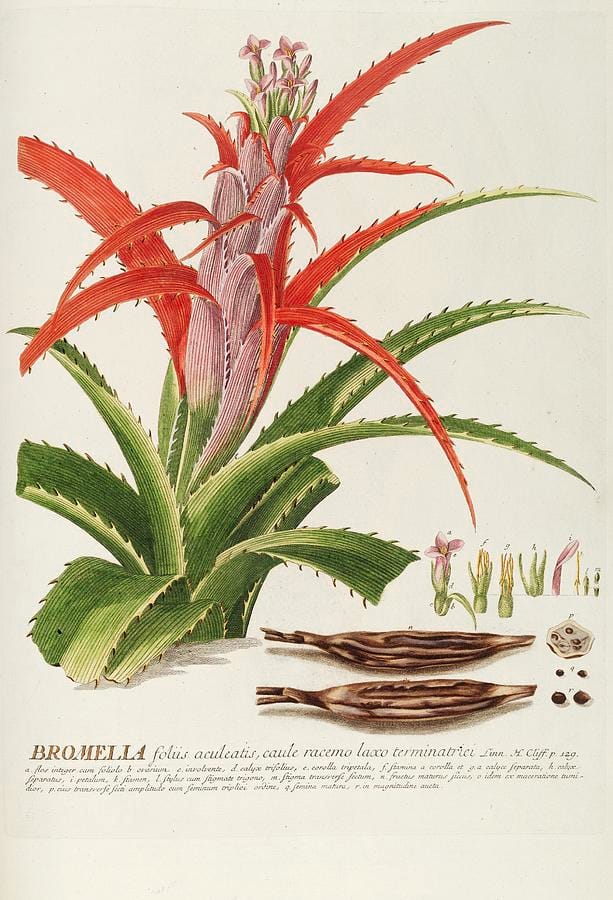
A relative of the pineapple, and just as architectural. Ehret shows the whole rosette head-on: broad green outer leaves, saw-toothed along both edges, spreading low, while the inner ones flare a fierce scarlet around a pink flower spike buried in the center. Below, laid out on the bare page, are two long dried seed pods split to show their contents, a scatter of loose seeds, and a row of dissected florets. Nothing here is arranged for prettiness — the plant is simply presented in its own aggressive symmetry — and the color still leaps off the page.
Monarda (Bee Balm)
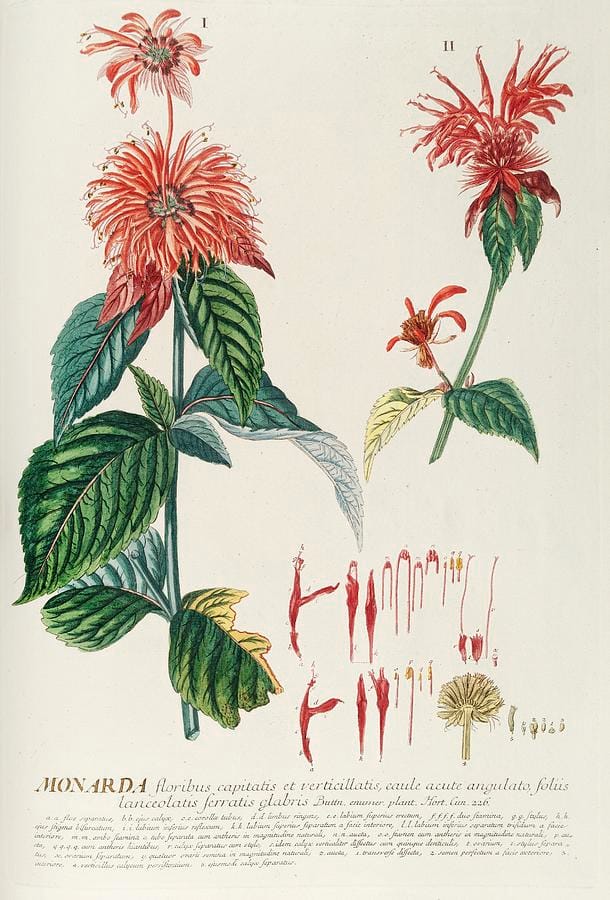
Bee balm is a North American mint, known to colonists as Oswego tea because its leaves were brewed as a drink. Ehret puts two forms side by side on one sheet, a coral-pink plant at the left and a deeper scarlet one at the right, each carrying its ragged crowns of thin curved flowers in whorls up a sharply angled stem. Dark toothed leaves clasp the stem in pairs, one turned to show its pale underside. Along the base runs a rank of separated florets, pinned out like specimens in a case, and the reds are startlingly hot for an eighteenth-century plate.
Ehret’s plates have outlived the botany they were made to serve. They hang beautifully in groups — a run of them along a hallway, or a single large plate over a desk — and they carry the particular charm of images that were meant to be useful and turned out to be art.
Shop Georg Dionysius Ehret prints here, and explore the rest of our famous paintings collection for more of the world’s most beloved masterpieces.