Frederic Remington’s Ten Most Famous Paintings
A Dash for the Timber, A Cold Morning on the Range, On the Southern Plains and more: the ten works by the illustrator who fixed how America pictures its own West.

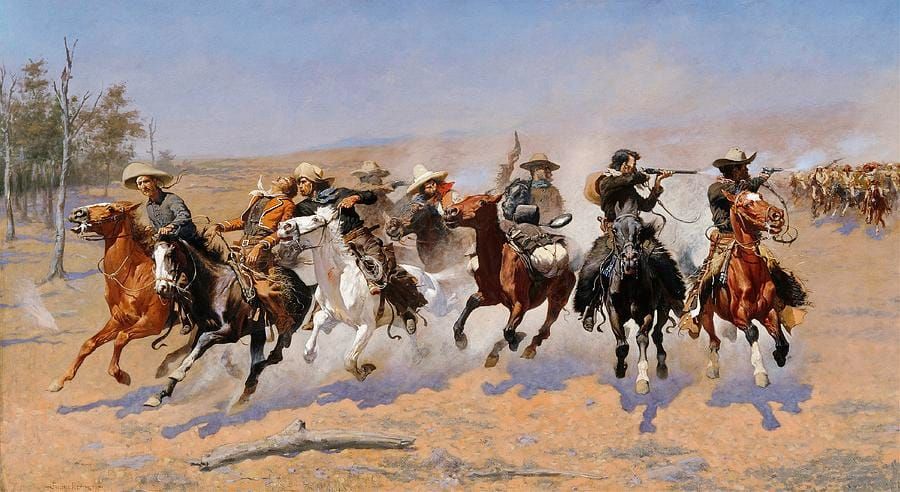
Frederic Remington (1861–1909) was born in upstate New York, went west at nineteen, failed as a sheep rancher and a saloon investor, and came back east with a portfolio of sketches that made him one of the highest-paid illustrators in America. Through the 1880s and 1890s his drawings of cavalry troopers, cowboys, and Plains warriors ran in Harper's Weekly and Century, and for most of the country they were the West — the images arrived faster and more widely than any photograph.
He is best understood as a reporter who became an artist. He traveled with the U.S. Army, covered the Spanish-American War in Cuba, and cared enormously about getting equipment and horses right, but he was also constructing a myth in real time, and his portrayals of Native peoples carry the prejudices of his era plainly. Late in life he burned dozens of canvases and turned toward looser, colder, more atmospheric nocturnes, work that critics now rate above the action scenes that made him famous. Here are ten of his best-known paintings.
A Dash for the Timber
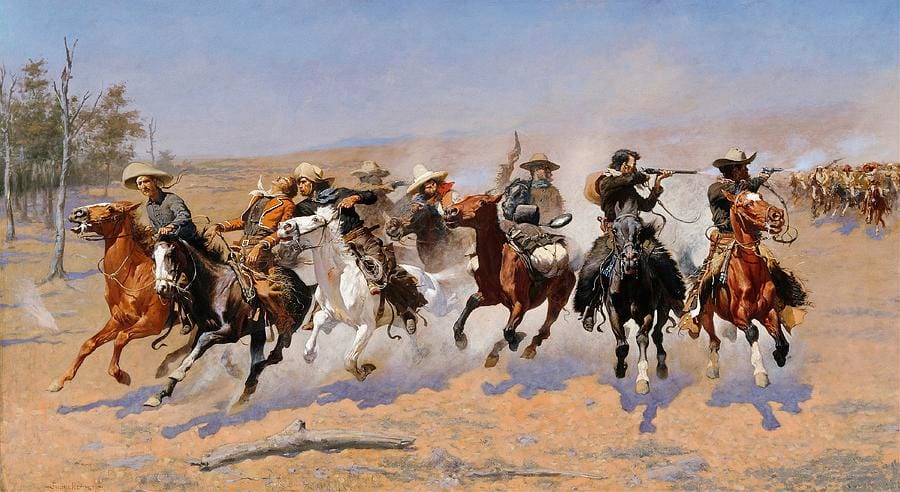
Painted in 1889 and the picture that established Remington as a serious painter rather than a magazine illustrator. Eight riders come straight at the viewer at full gallop, pursued by Apache warriors, one cowboy already slumping in the saddle. Remington borrowed real saddles and gear to get the details right and studied the new stop-motion photographs of horses in order to fix the legs correctly — a detail earlier painters routinely got wrong. Shown at the National Academy of Design that year, it drew crowds and effectively created the market for Western action painting.
A Cold Morning on the Range
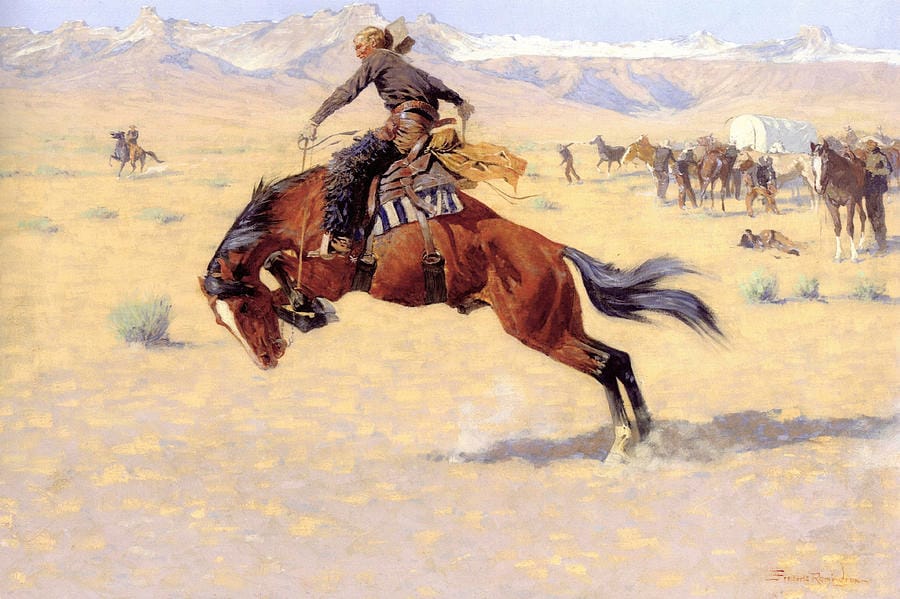
A cowboy tries to mount a horse that has decided otherwise, in the flat light of a freezing morning with the rest of the string standing around watching. There is no violence and no narrative stakes — just the ordinary difficulty of getting a cold horse to accept a rider. Remington was unusually good at this kind of thing, and the painting works because he understood the mechanics: the way the animal has planted itself, the angle of the man's body, the moment of leverage that has not yet been won.
On the Southern Plains
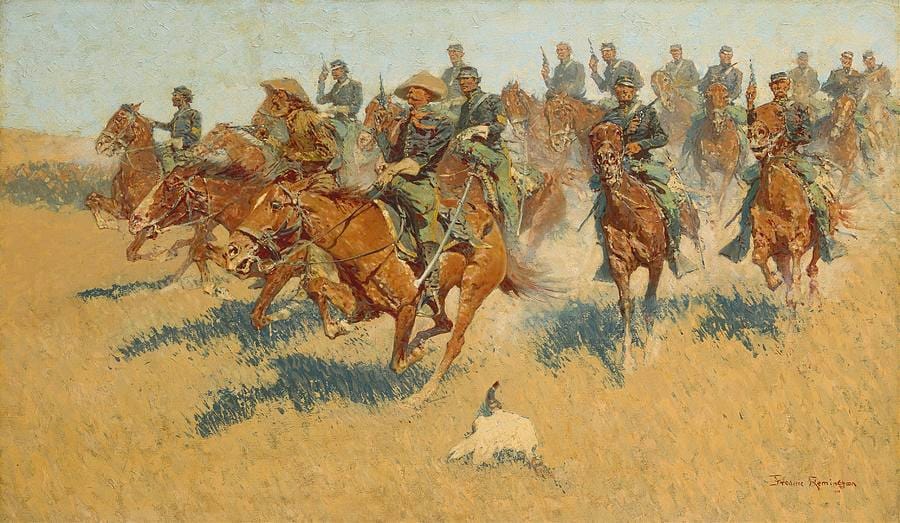
Painted in 1907, near the end of his life, this shows a cavalry detachment charging in line abreast across open grassland, dust boiling up behind them. By this point Remington had substantially loosened his handling: the troopers are painted broadly, the horses are read more through mass and motion than through drawn detail, and the sky occupies most of the canvas. It is a late restatement of the subject that made his name, executed with the freer brush he had developed for his nocturnes.
The Advance Guard
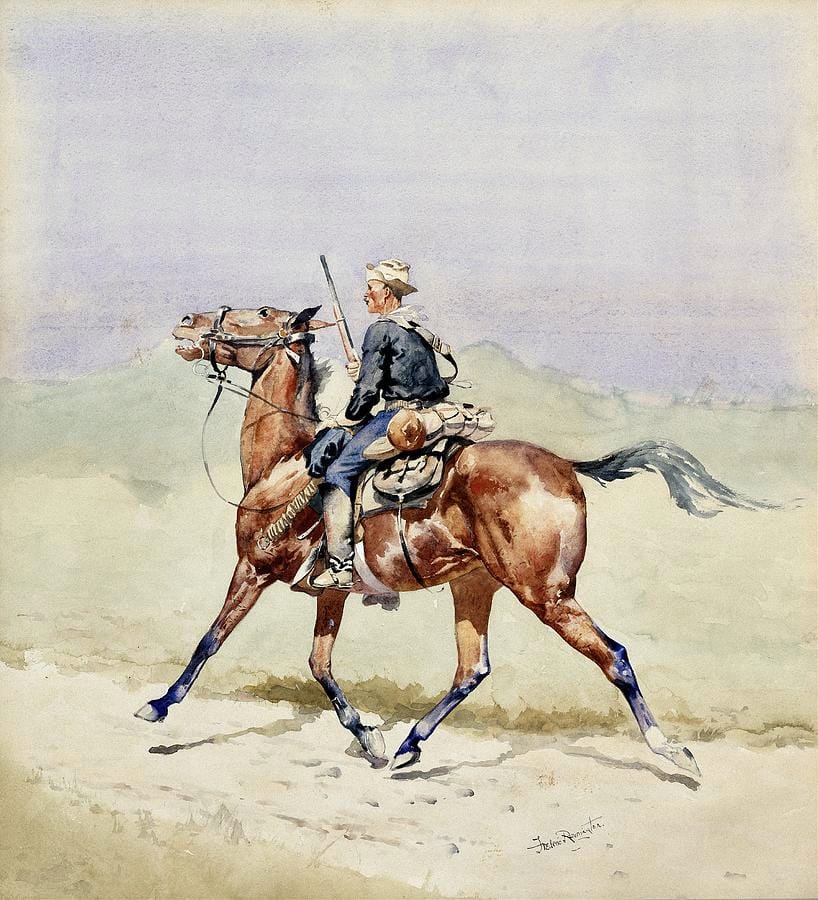
A scouting party moves ahead of a column through broken country, and one man has just been hit. Remington concentrates everything on the instant of alarm — the horses shying, the troopers turning in the saddle toward a threat outside the frame — while the landscape stays wide, empty, and indifferent. He worked from long experience in the field with the Army, and the picture's authority comes from the equipment, the spacing of the riders, and the sense that the danger is somewhere the viewer cannot see.
An Indian Trapper
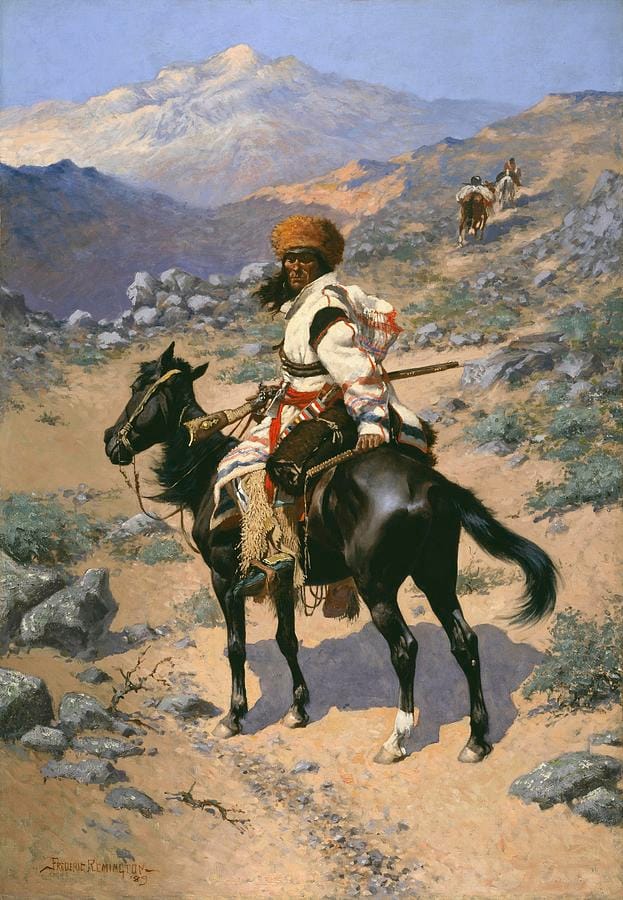
Painted in 1889, a single mounted figure in winter furs against a pale sky, the horse standing still. It is one of Remington's most straightforward portraits of a working man on horseback, with none of the pursuit or gunfire that fills his better-known canvases. The stillness is the point: the picture is about cold, patience, and the weight of the clothing, and it demonstrates that the reputation for pure action was always an incomplete account of him.
Apache Ambush
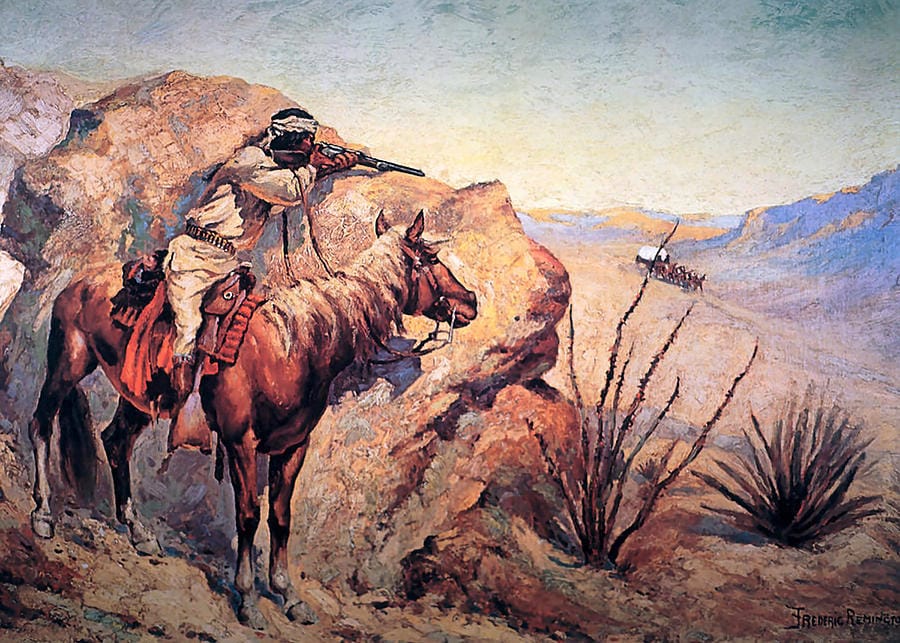
Remington built a number of pictures around the moment before contact — riders in a defile, the threat concealed in the rocks — and the tension is spatial rather than narrative. Nothing has happened yet, and the composition withholds the information the figures need. These paintings are also where the ideological freight of his work is heaviest: they were made for an eastern audience during the final phase of the Indian Wars, and they present the Apache as an unseen menace rather than as people defending their own country.
Friends or Foes
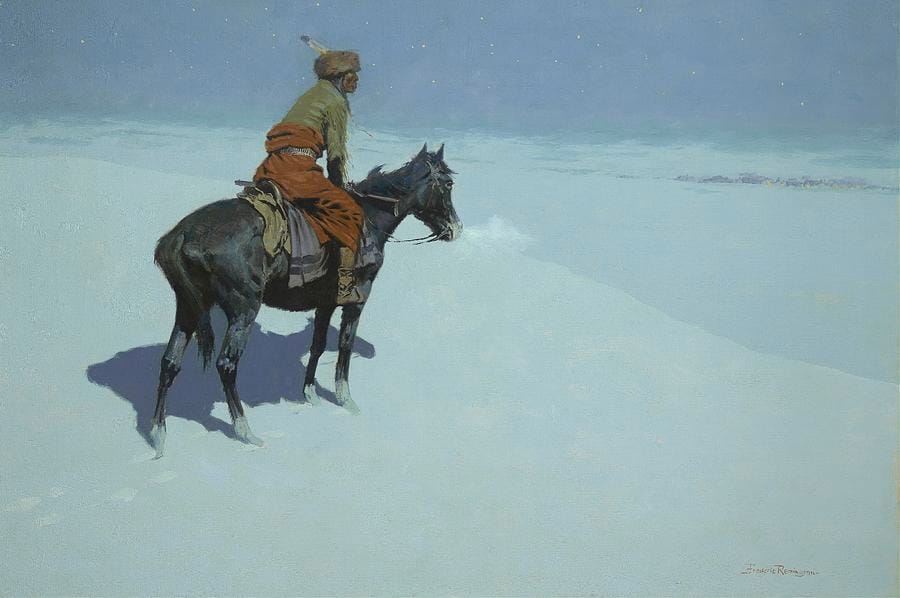
A lone rider halts on a snow-covered ridge, watching distant figures approach across a white plain, unable to tell yet whether they are a danger. The subject is a question, and Remington paints almost nothing but empty snow and sky to ask it. Pictures like this show his growing interest in atmosphere over incident — the near-monochrome palette, the enormous quiet, the single dark shape of horse and rider carrying the whole composition.
The Mexican Major
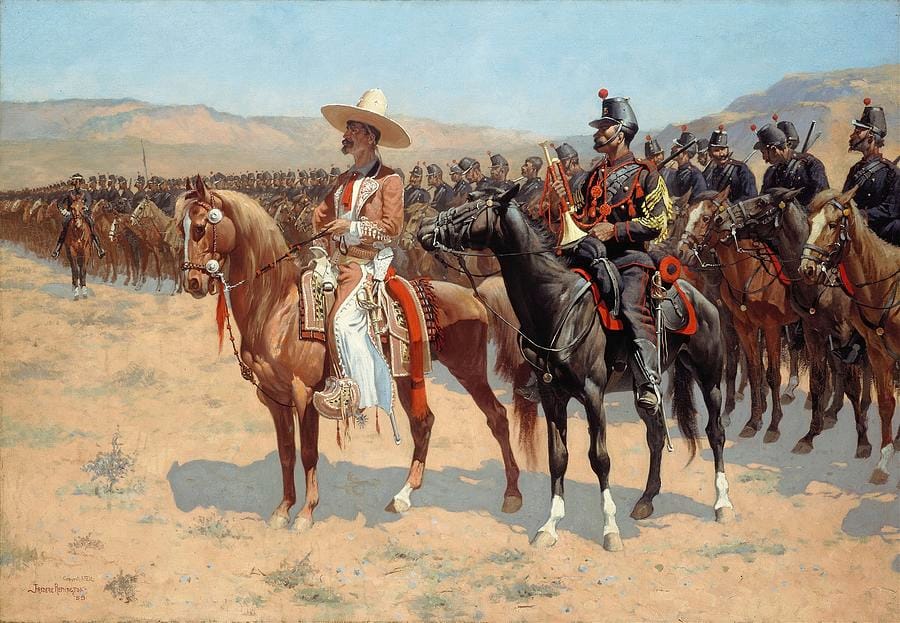
Painted in 1889 after Remington's travels in Mexico, this is a portrait of an officer on horseback in full braided uniform, a subject well outside the cowboy-and-cavalry repertoire he was known for. His Mexican work is a useful corrective to the idea that he only ever painted one country: the light is different, the tack and dress are carefully specific, and the tone is closer to formal portraiture than to reportage.
A Reconnaissance
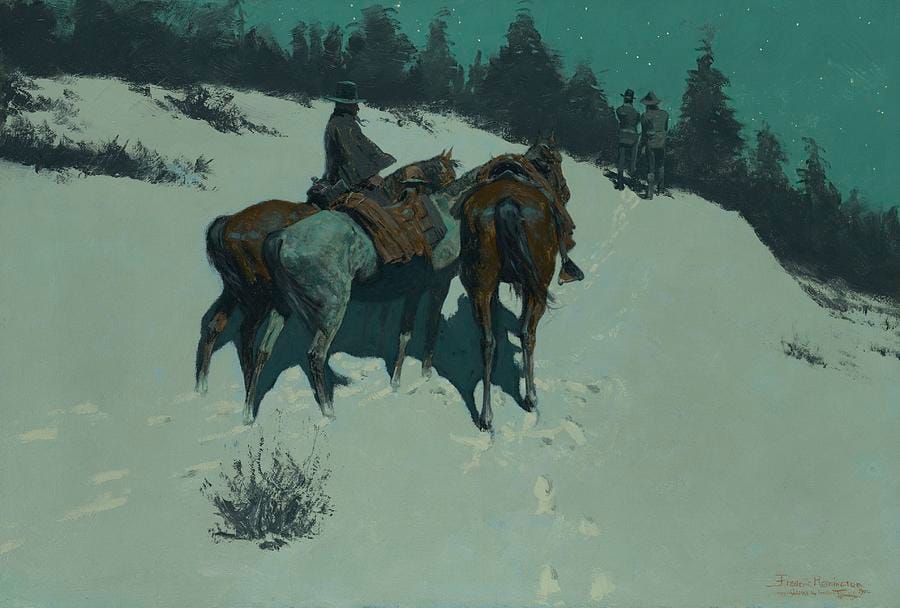
A small party picks its way forward in the dark, and the picture belongs to the group of nocturnes Remington began producing in the 1900s. These are the works his modern reputation rests on. He built them from a narrow range of blues and greens with a single point of warm light, and the figures dissolve into the dark rather than being drawn against it — a method much closer to Whistler than to the crisp illustrations he made his living from.
Roasting the Christmas Beef in a Cavalry Camp
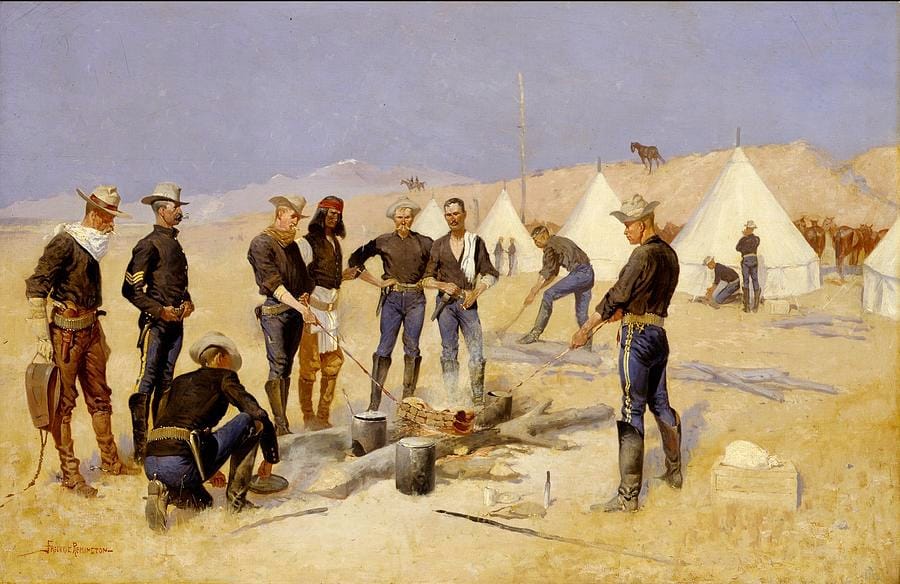
Soldiers gather around a fire in a winter camp turning a carcass on a spit — one of the illustrations Remington produced for the eastern magazines, where holiday numbers wanted scenes of army life on the frontier. The interest here is documentary. Remington spent long stretches in camp with the cavalry, and pictures like this record the unglamorous business of feeding and sheltering a column, which occupied vastly more of a trooper's life than combat ever did.
Remington died in 1909, at forty-eight, after an emergency appendectomy. By then he had produced roughly three thousand pictures and a series of bronzes, and had done more than any other artist to fix the visual language of the American West — a body of work that is both a genuine record of what he saw and a myth he helped build.
Shop Frederic Remington prints here, and explore the rest of our famous paintings collection for more of the world’s most beloved masterpieces.