Frederic Leighton’s Ten Most Famous Paintings
Flaming June, Greek myth and Victorian marble: ten works by the only British painter ever raised to the peerage.

Frederic Leighton (1830–1896) was born in Scarborough and educated almost entirely abroad — Rome, Florence, Frankfurt, Paris — which left him fluent in several languages and, by Victorian standards, unusually cosmopolitan in taste. He settled in London around 1860 and built himself an extraordinary house beside Holland Park, complete with a domed Arab Hall lined with Damascus tiles. Elected President of the Royal Academy in 1878, he became the most powerful figure in British art for the last eighteen years of his life.
His subjects were drawn mostly from Greek myth, the Bible and an imagined Mediterranean antiquity, painted with a smooth, cool finish and a genius for drapery that came from years of drawing after classical sculpture. He was made a baron on his deathbed in January 1896, holding the title for a single day — still the only British artist ever ennobled. His reputation collapsed for most of the twentieth century and has since recovered handsomely. Here are ten of his most famous works.
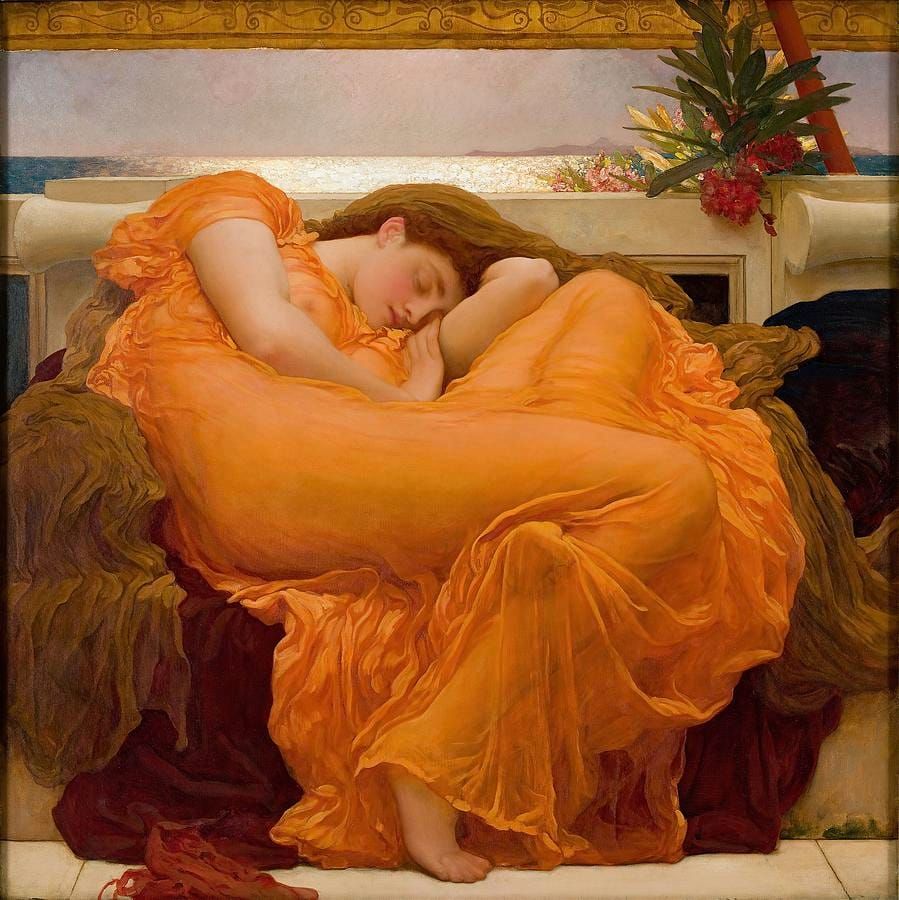
Flaming June
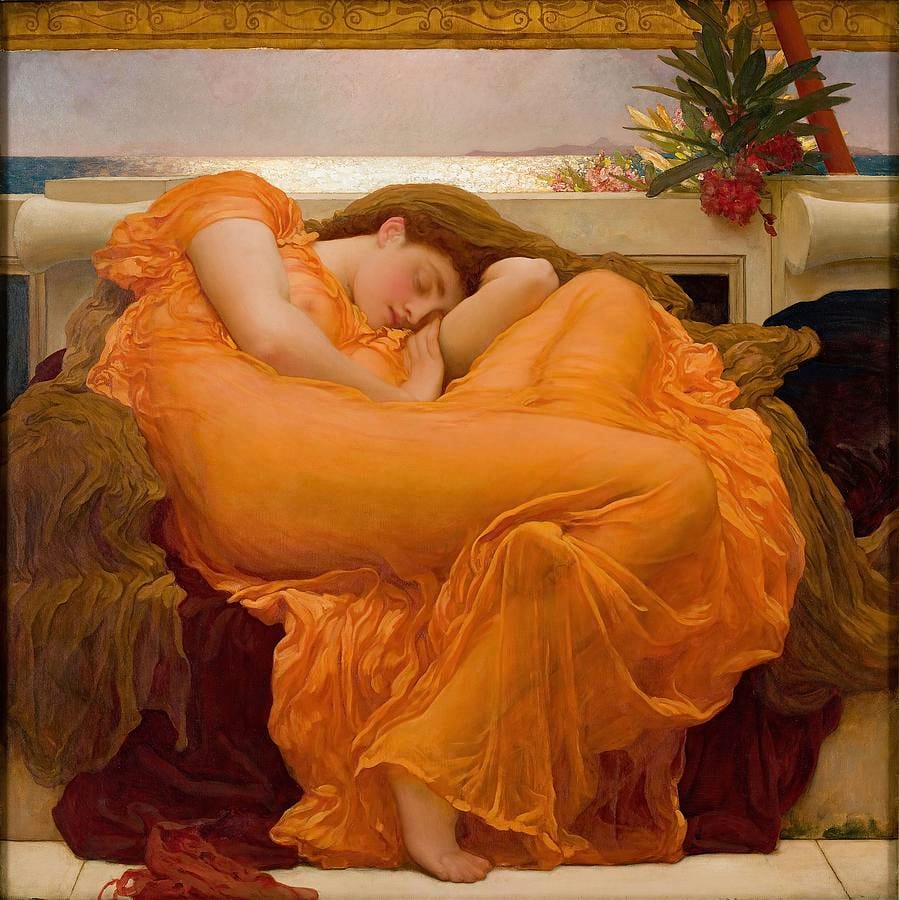
A young woman sleeps curled into a near-perfect circle on a marble bench, wrapped in a gown of blazing translucent orange, with a hazy sea and a sprig of oleander behind her. Painted around 1895, at the very end of Leighton’s life, it is the most famous Victorian painting of them all. It fell so far out of fashion that in the 1960s it could be had for a few pounds in a London shop — the young Andrew Lloyd Webber tried and failed to persuade his grandmother to lend him the money. It was bought instead for the Museo de Arte de Ponce in Puerto Rico, where it still hangs.
Cimabue’s Madonna Carried in Procession
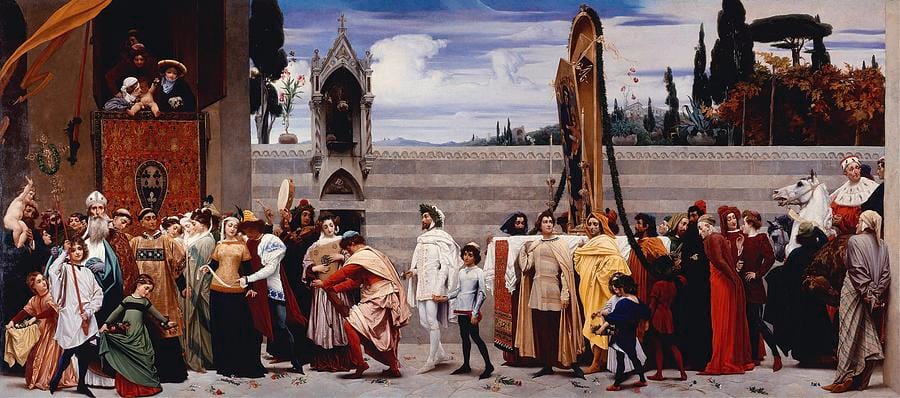
Leighton was twenty-four and living in Rome when he began this enormous canvas, which imagines the medieval Florentine painter Cimabue leading a procession through the streets as his great altarpiece is carried to church, the young Giotto walking at his side. Shown at the Royal Academy in 1855, it was the sensation of the season — and Queen Victoria bought it on the opening day. Few artists have announced themselves so emphatically. The picture is nearly eighteen feet wide, crowded with banners, musicians and children, and painted with a clarity that owes as much to early Italian art as to the Academy. It remains in the Royal Collection.
The Return of Persephone
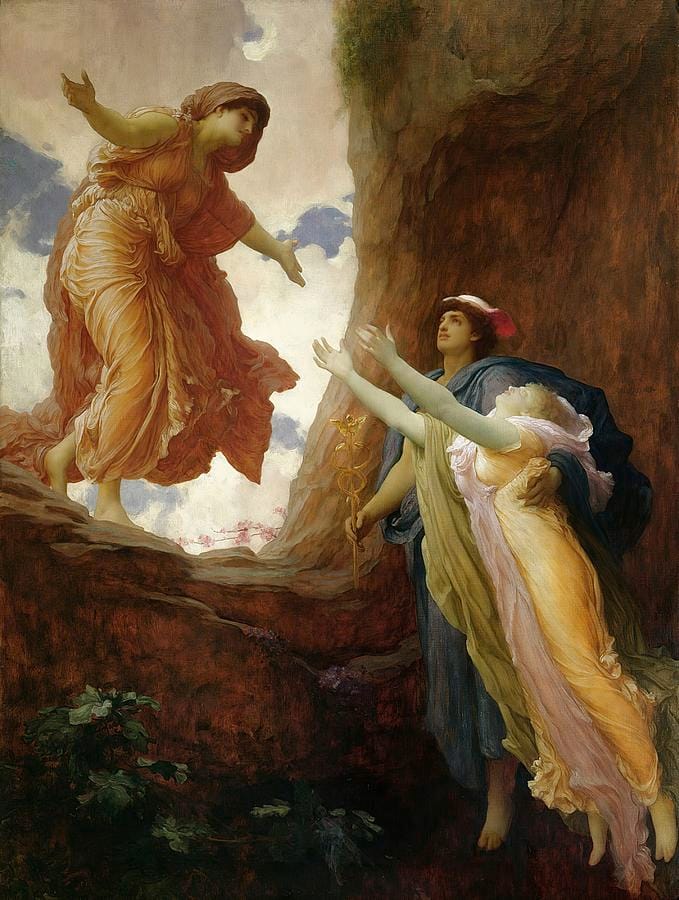
Hermes carries Persephone up out of the underworld toward her mother Demeter, who reaches down from the mouth of the cave in a rush of pale drapery. The dark rock and the cold light of the lower world are on one side, the warmth of the returning spring on the other, and the whole composition is built on the diagonal of the rising figures. Painted around 1891, it is Leighton’s clearest statement of the myth that underlies his whole imagination — that beauty is seasonal, always leaving and always coming back.
Captive Andromache
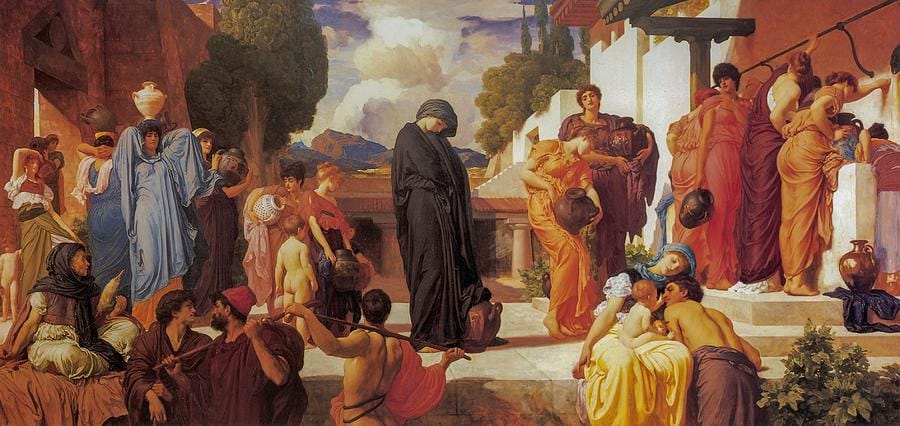
After the fall of Troy, Hector’s widow Andromache was taken into slavery, and Leighton paints her standing veiled in black among the women of her captors’ city, waiting her turn at the public well. Everyone around her is busy, colorful and unbothered; she alone is still, isolated by grief in the middle of a crowd. The frieze-like arrangement across the canvas is one of his finest, and the subject — the loneliness of a foreigner in a busy place — is unusually sharp for a painter often accused of pure decoration. It dates from the late 1880s and belongs to Manchester Art Gallery.
Greek Girls Playing Ball
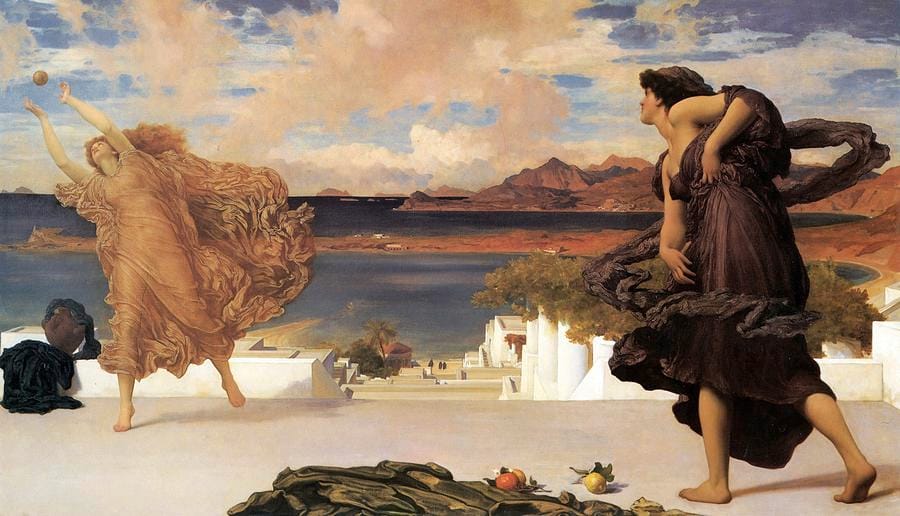
Two young women in windblown drapery play catch on a terrace above a bay, one leaping with her arm flung upward, the other braced and ready. The sky is huge, the horizon low, and the whole picture is really about the way cloth behaves in motion — Leighton’s lifelong obsession, studied endlessly from live models in the studio. Exhibited in 1889, it is one of his most physically alive paintings, and it makes plain how much energy the classical world held for him beyond the marble and the myth.
Winding the Skein
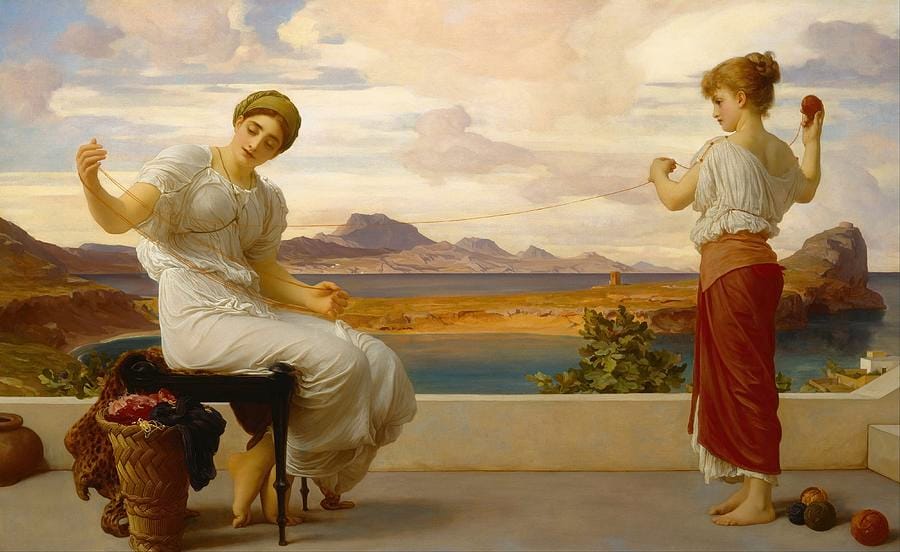
A woman sits winding wool from a skein held out on the raised arms of a girl standing opposite her, the strand of yarn drawn taut between them across a sunlit terrace, with a blue bay and mountains beyond. Painted in the late 1870s, it is one of Leighton’s most companionable pictures: nothing is happening except a small shared task, and the composition is held together by a single thread. Landscapes he had sketched in the eastern Mediterranean supplied the backdrop. It is among the best-known Victorian paintings in Australia, where it now hangs.
Perseus and Andromeda
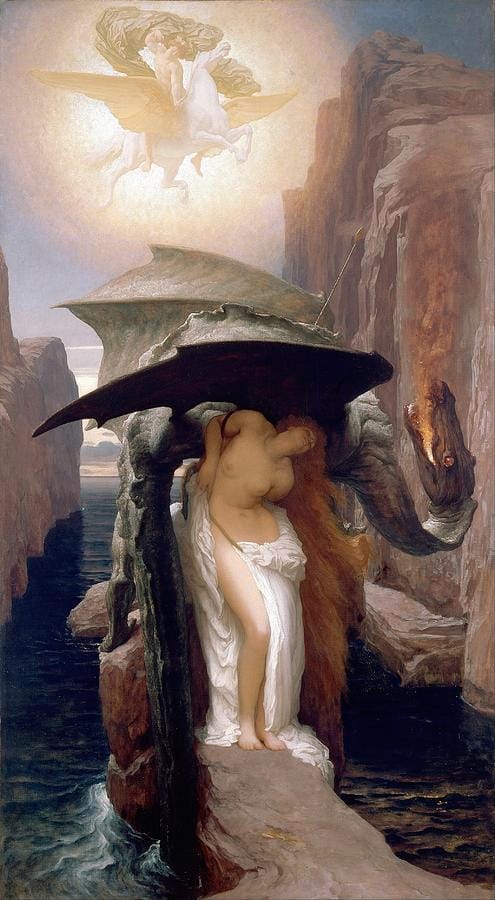
Leighton gives the old rescue story an unusual shape: the sea-dragon fills the bottom of the tall canvas, its black wings folded over the chained Andromeda like a tent, while Perseus appears high above in a burst of golden light, drawing his bow from the back of the winged horse. The eye has to travel a long way down from rescuer to victim, and the dragon is genuinely frightening rather than decorative. Leighton was a capable sculptor as well as a painter, and the heavy, muscular bulk of the dragon shows it. Painted in 1891, the picture belongs to the Walker Art Gallery in Liverpool.
Portrait of May Sartoris
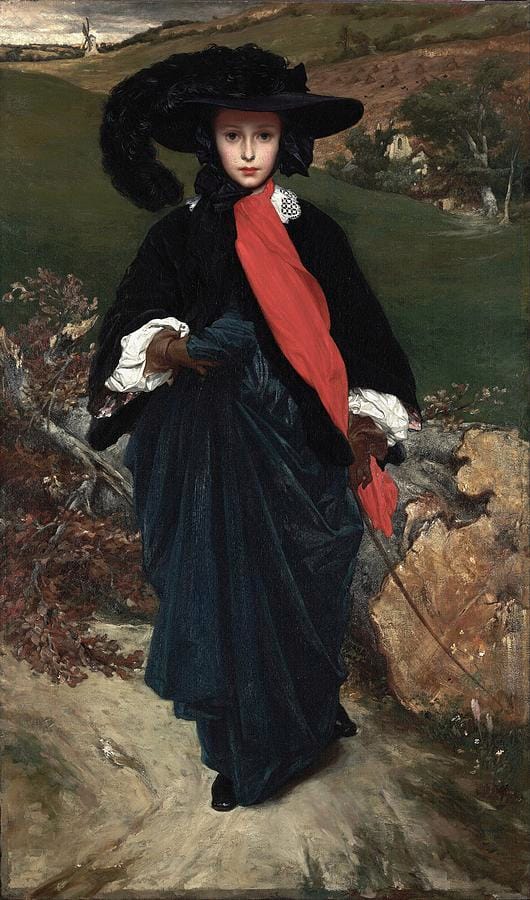
May Sartoris was the daughter of the singer Adelaide Kemble, friends of Leighton’s from his years in Italy, and he painted her as a girl of about eleven or twelve around 1860. She stands in a black riding habit with a brilliant red scarf at her throat and a black hat, one glove off, looking straight out at the painter from an autumnal English landscape. The directness of the gaze and the daring simplicity of the black-and-red costume make it one of the freshest portraits of the Victorian age. It is now in the Kimbell Art Museum in Fort Worth.
Lieder ohne Worte (Songs Without Words)
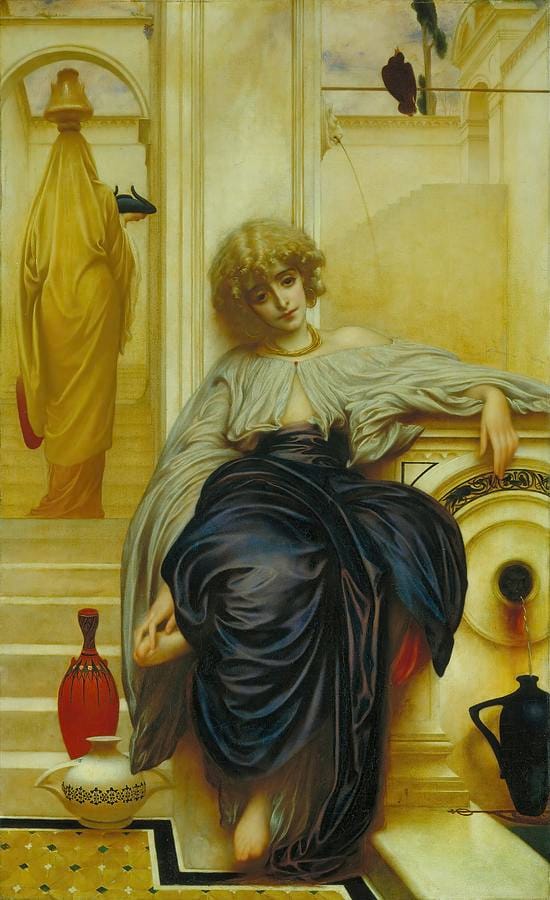
The title borrows from Mendelssohn’s piano pieces, and the point is that the picture should work like music rather than tell a story. A girl sits on the rim of a marble cistern with one bare foot drawn up under her, listening to the water running from a lion-headed spout into the basin while a bird perches on the ledge above; jars in red, black and white stand about her feet, and another woman carries a pitcher up the steps behind. Leighton exhibited it in the early 1860s and defended it as an attempt to give the eye what a melody gives the ear. It was among the first English paintings to argue openly for mood over narrative, and it now belongs to Tate.
The Music Lesson
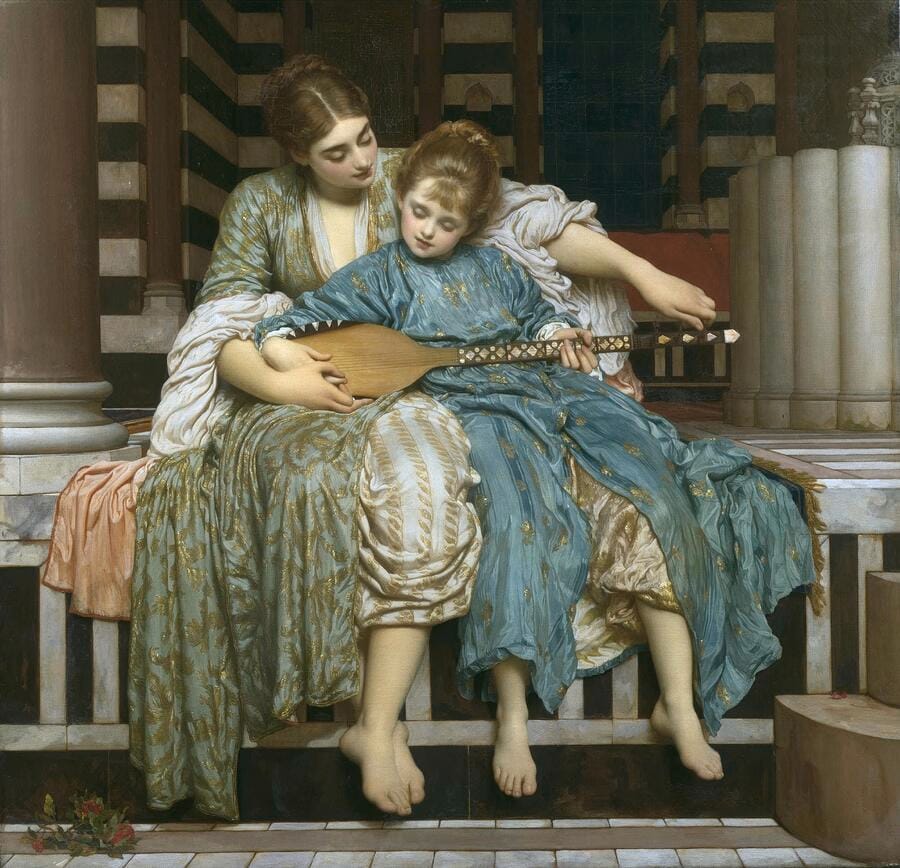
A woman in blue-green silk leans over a girl in her lap, guiding her fingers on the strings of a long-necked instrument, the pair framed by marble columns and a tiled floor drawn from the Damascus interiors Leighton loved. Painted in the 1870s, it is his warmest domestic subject: the older figure’s concentration and the child’s slight impatience are observed exactly. The color scheme — turquoise, coral, pale stone — is as carefully tuned as anything he painted, and the picture has been a favorite in reproduction almost since the day it was shown.
Leighton painted for the long look: perfectly balanced compositions, color tuned like an instrument, and drapery no one else in Britain could match. His pictures suit a room that wants a focal point — a fireplace wall, a landing, a bedroom where Flaming June can do its slow, glowing work.
Shop Frederic Leighton prints here, and explore the rest of our famous paintings collection for more of the world’s most beloved masterpieces.