Eugène Delacroix’s Ten Most Famous Paintings
Revolution, shipwreck, lion hunts and Moroccan horsemen: the ten paintings that made Delacroix the leader of French Romanticism.

Eugène Delacroix (1798–1863) was the great Romantic of French painting and, for thirty years, the acknowledged opposite of Ingres. Where Ingres built pictures out of line and cool finish, Delacroix built them out of color, movement and visible brushwork, and he took his subjects from Byron, Shakespeare, Dante and Scott rather than from classical antiquity. The Salon critics of his youth found him violent and unfinished; the poet Charles Baudelaire thought him the finest painter alive.
A journey to Morocco and Algeria in 1832, in the retinue of a French diplomatic mission, changed his palette permanently — he came home with sketchbooks full of light, costume and horses that he mined for the rest of his life. He also kept one of the most quoted journals any artist has written, and left vast decorative cycles in Paris. Here are ten of his most famous paintings.
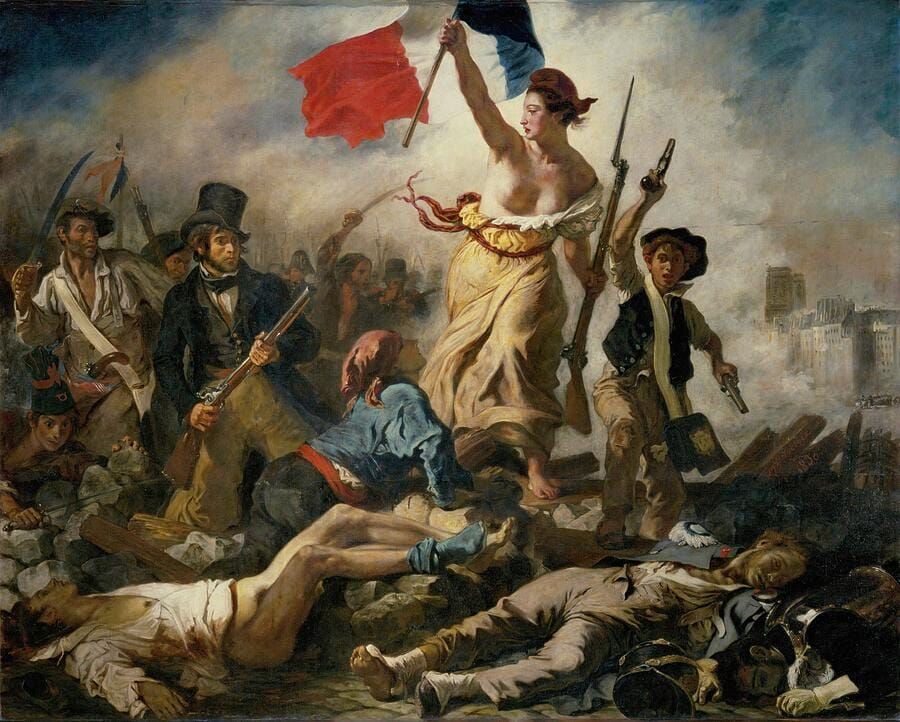
Liberty Leading the People
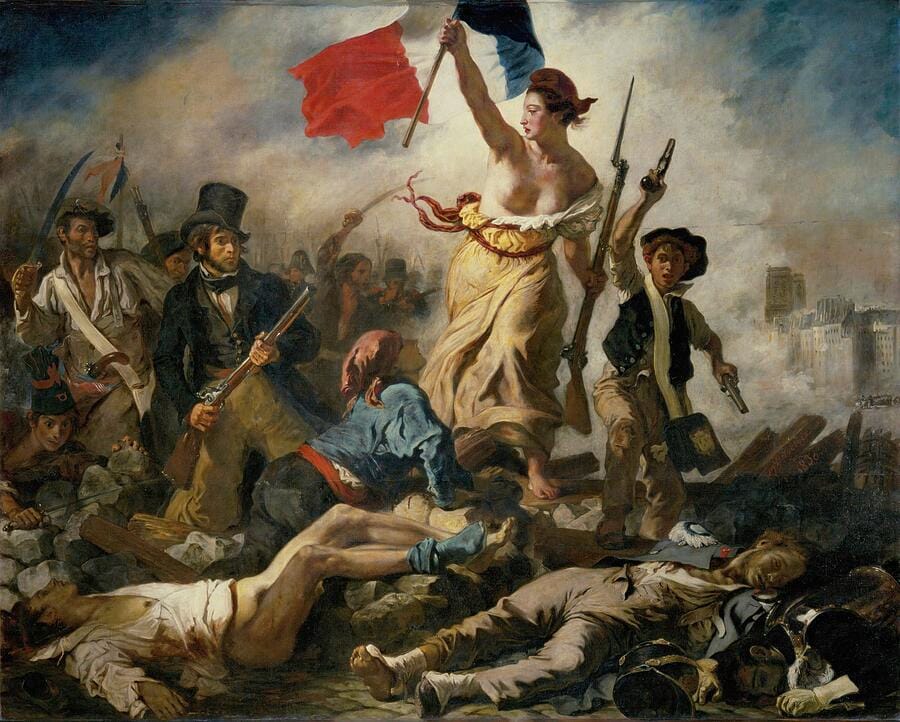
Delacroix painted his most famous canvas in the autumn of 1830, only months after the three days of street fighting that toppled Charles X. Liberty herself, half allegory and half woman of the barricades, strides over the dead with the tricolour raised in one hand and a musket in the other, followed by a top-hatted gentleman with a hunting gun, a boy waving pistols, and a wounded man reaching up from the rubble. The French state bought the painting almost immediately and then kept it out of public view for long stretches, nervous about its power to stir people up. It hangs in the Louvre, and for years its image appeared on the hundred-franc note.
The Death of Sardanapalus
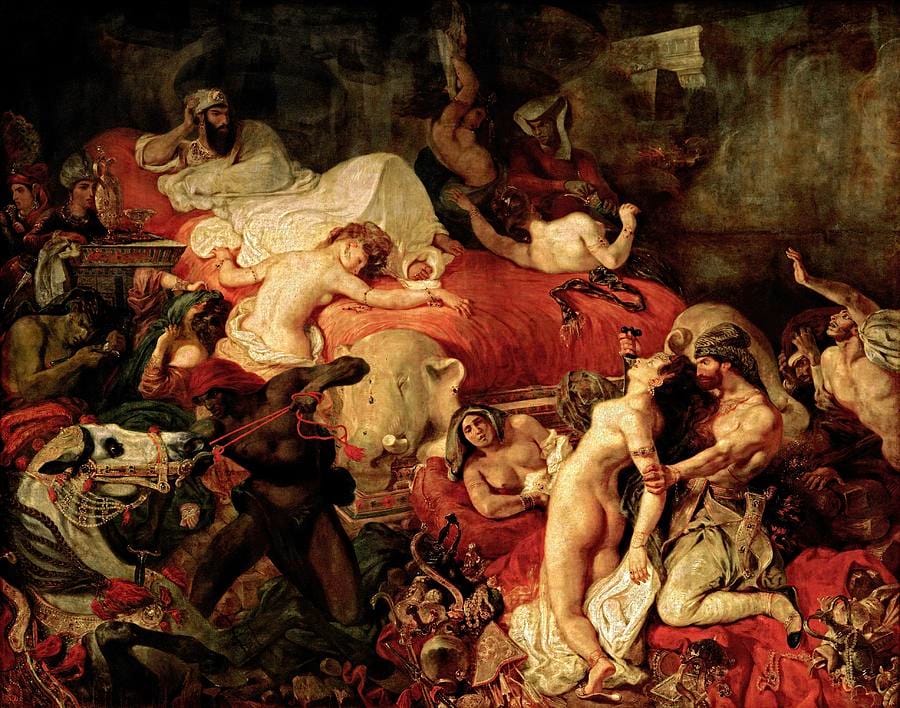
Shown at the Salon of 1827, this enormous picture took a subject from Byron: the last Assyrian king, besieged in his palace, orders everything he owns destroyed before the enemy can take it, and watches from his bed while horses, servants and concubines are killed around him. A red bed cuts the composition on a violent diagonal; bodies, gold and drapery pile up in the light. Critics were appalled by the cruelty and the disorder, and official disapproval cost Delacroix state commissions for years. Today it is the defining statement of French Romanticism at full throttle, and one of the Louvre’s most crowded rooms.
The Abduction of Rebecca
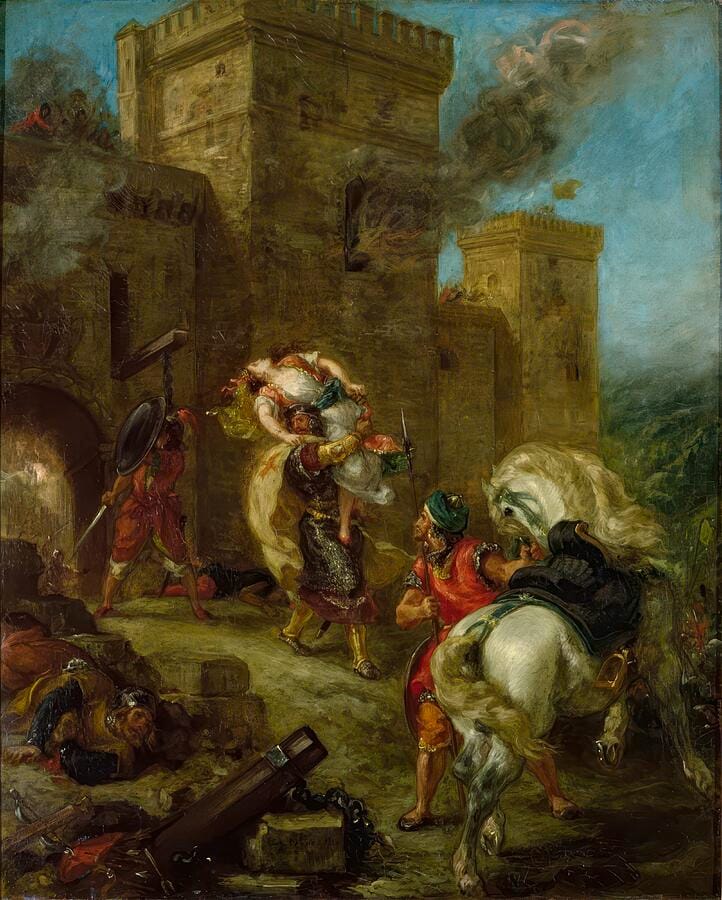
Walter Scott’s Ivanhoe was one of Delacroix’s favorite books, and he twice painted its most turbulent episode — once in 1846 and again in 1858, the version seen here. The castle of Torquilstone rises at the left with smoke rolling from its gate, and in front of it the Templar’s servants heave the Jewish heroine Rebecca, limp in a white gown, onto the back of a rearing white horse while a third man wrestles with the bridle. Every figure is caught mid-effort, and the space is squeezed so tightly that the whole struggle presses forward at the viewer. The later canvas hangs in the Louvre.
Lion Hunt
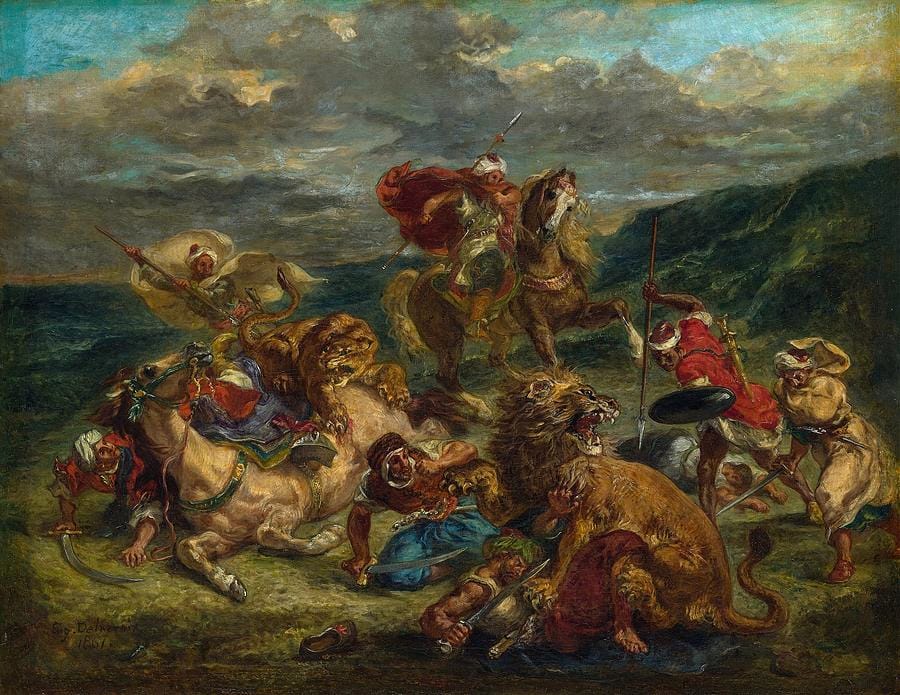
Rubens painted lion hunts in the seventeenth century, and Delacroix spent the last decade of his life answering him. Horsemen in turbans and bright silks are dragged down among their rearing mounts while two lions maul them, the whole tangle of men, horses and cats fused into one churning mass of color beneath a stormy sky. He studied the animals from life at the menagerie in Paris, filling notebooks with sketches of big cats at rest and in motion. Several versions and variants survive, and together they are the most sheerly violent, and most gorgeously painted, works of his late career.
Christ Asleep During the Tempest
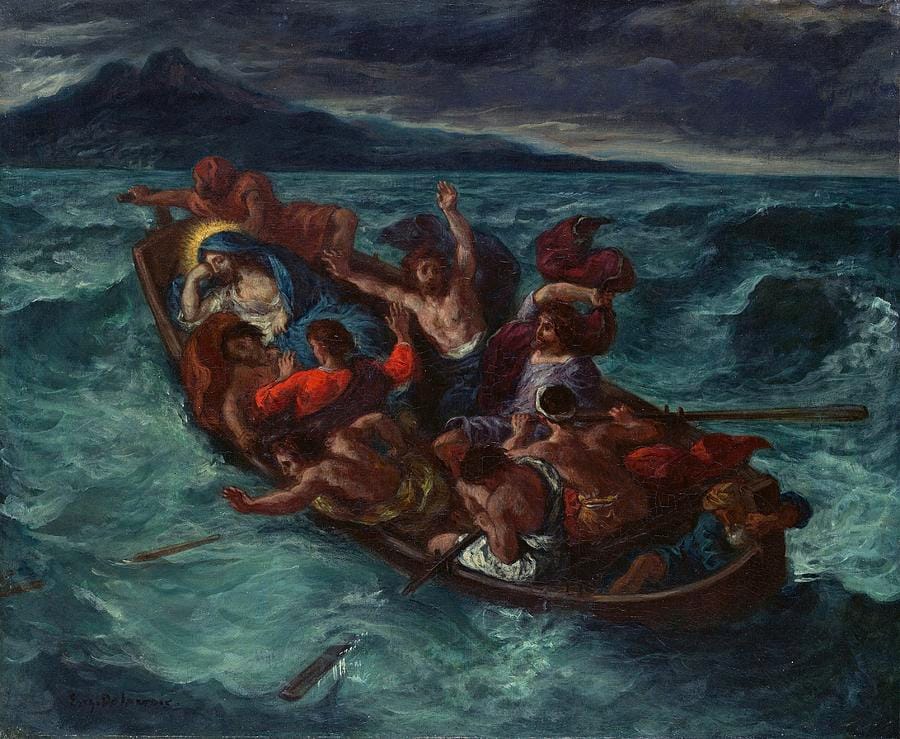
In his last years Delacroix painted the storm on the Sea of Galilee over and over. The formula is always the same: a small boat lifted on a green wall of water, the disciples straining at the oars or throwing up their arms in panic, and Christ asleep in the bow, wrapped in blue and haloed, entirely undisturbed. This version dates from around 1853 and is now in New York. The paint is loose and rapid, the sea built from strokes of green, white and black laid straight over one another, and the picture works as well as a study of terror as it does as a religious image.
The Farewell of Romeo and Juliet
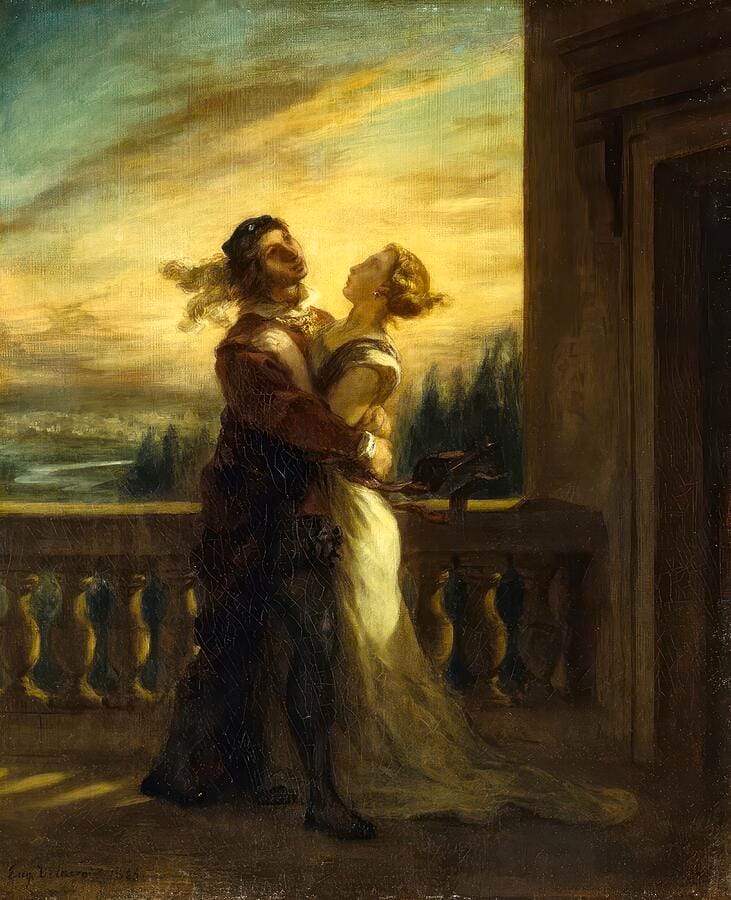
Delacroix read Shakespeare obsessively after an English company performed in Paris in 1827, and he returned to the plays for the rest of his life. Here he takes the dawn parting of Act III: Romeo, banished and about to climb down from the balcony, holds Juliet in a last embrace while the sky behind them is already going gold at the horizon. Her body sags backward over his arm, more collapse than embrace, and their two heads press together at the exact center of the canvas. Delacroix cared little for archaeological accuracy and everything for the emotional pitch of a moment — and this one is Romanticism distilled.
The Natchez
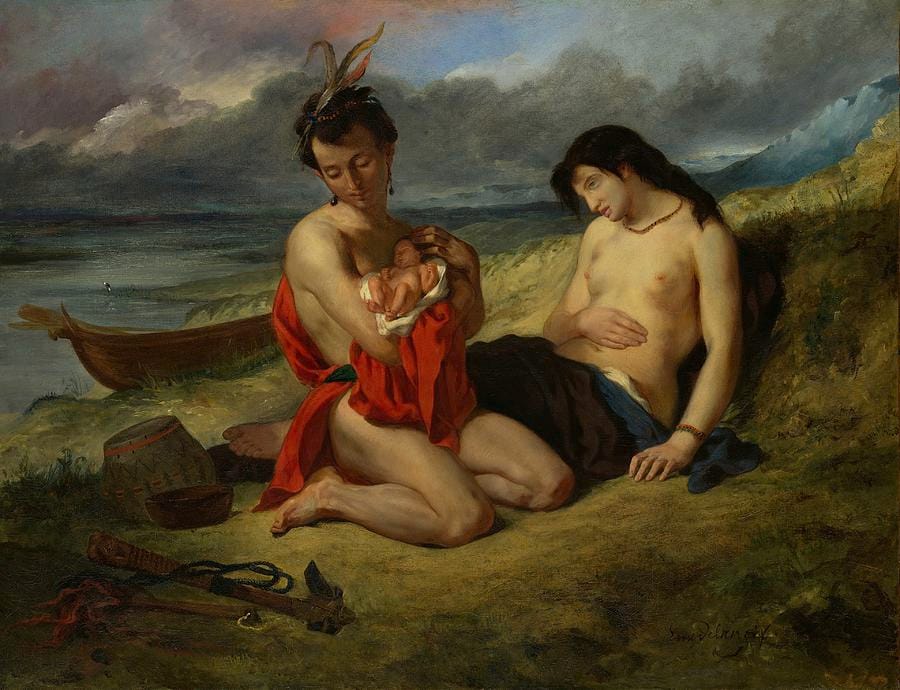
Begun in the 1820s and finally shown at the Salon of 1835, The Natchez comes out of Chateaubriand’s romances of Native American life on the Mississippi. A young couple, the last survivors of a destroyed people, have stopped on a riverbank under a heavy sky; the mother has just given birth, and the father holds the newborn while looking down at her with an expression somewhere between tenderness and dread. Their canoe lies pulled up behind them. It is an unusually quiet painting for Delacroix — no battle, no beasts, just two exhausted people and an enormous empty landscape — and its melancholy is all the sharper for it.
Ovid Among the Scythians
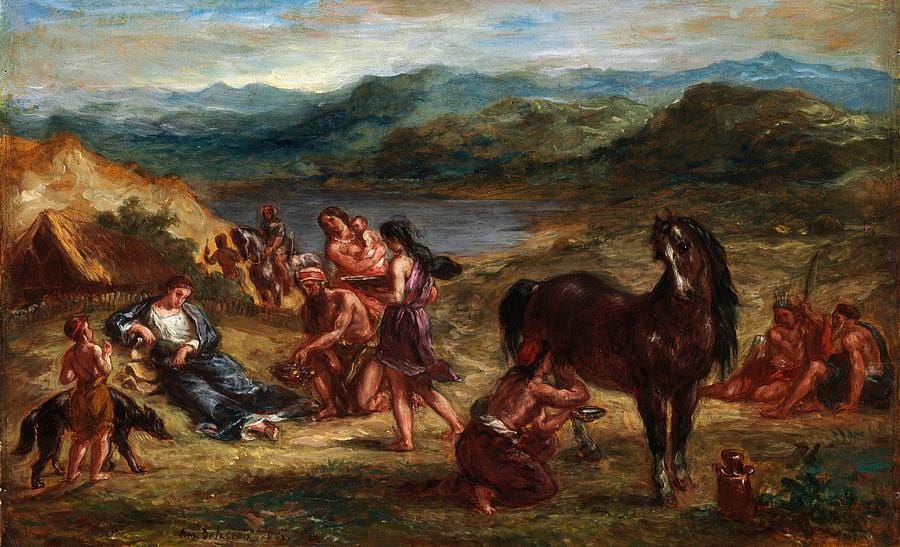
The Roman poet Ovid was banished by Augustus to the Black Sea coast, among people whose language he did not speak, and wrote poems of homesickness there until he died. Delacroix imagined the scene in 1859: Ovid reclining on the grass in a blue robe while curious nomads crouch around him with food and drink, a horse standing patiently at the center of the group and a wide green landscape of lakes and hills opening behind. The mood is gentle rather than dramatic. Painted four years before his death, it shows how soft and atmospheric Delacroix’s late landscapes had become. It now belongs to the National Gallery in London.
The Execution of the Doge Marino Faliero
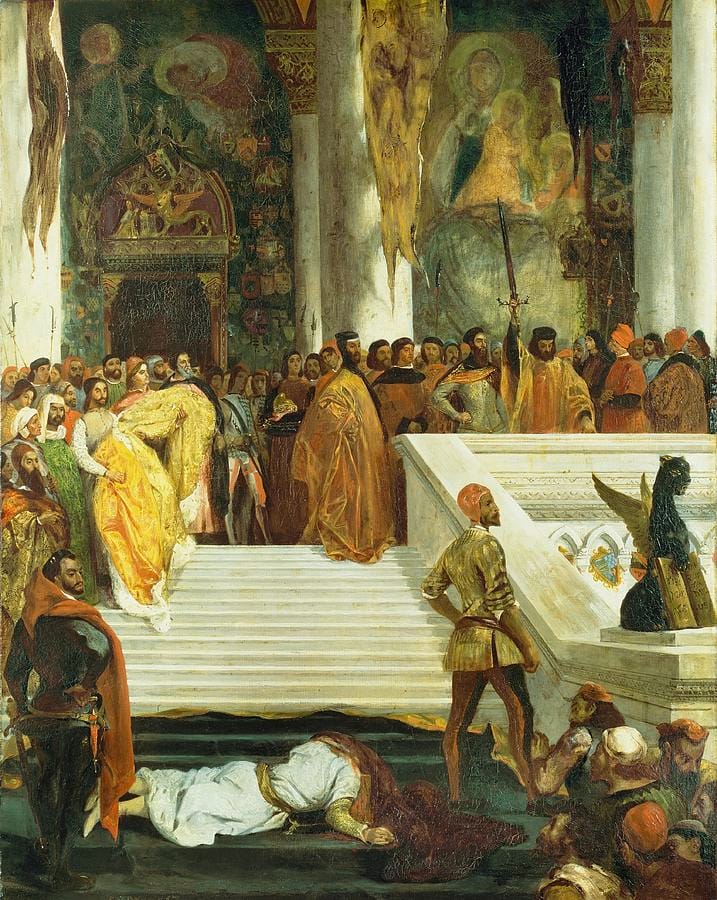
Another Byron subject, painted when Delacroix was still in his twenties. Marino Faliero, doge of Venice, was beheaded in 1355 for conspiring against the republic he governed, and Delacroix stages the aftermath at the top of a great white staircase in the Doge’s Palace: the body lies crumpled at the bottom of the steps, a soldier raises the sword above his head, and a crowd of senators in scarlet and gold looks on from the left, beneath the painted and gilded walls of the palace. The empty flight of stairs down the middle of the picture is the boldest thing in it — a gulf of pale marble separating power from its victim.
Fantasia Arabe
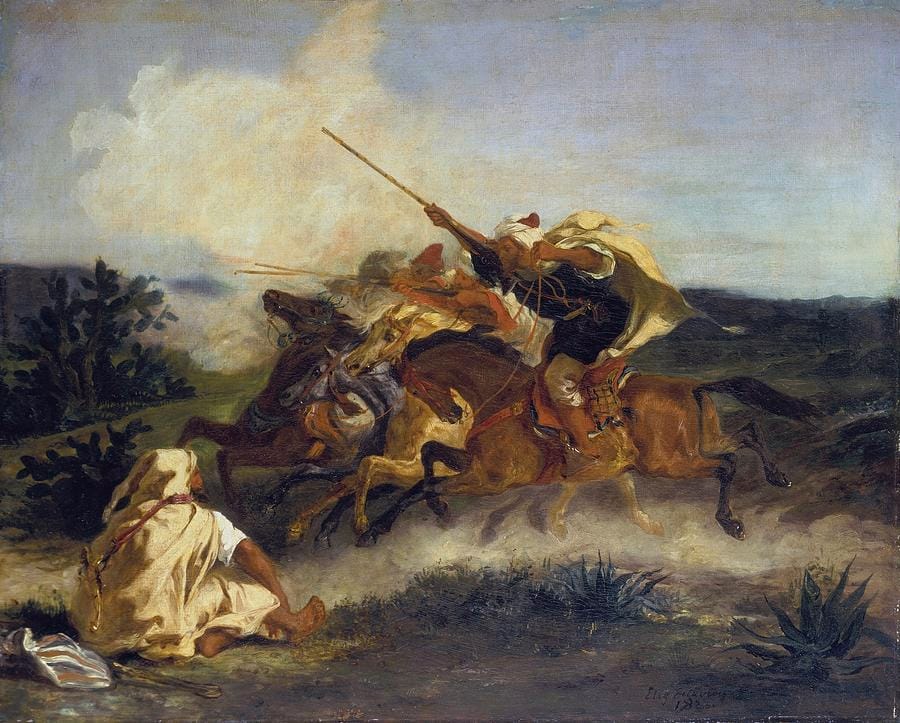
Delacroix traveled to Morocco in 1832 and never got over it. A fantasia is a display of horsemanship in which riders charge at full gallop and fire their muskets into the air, and this canvas, painted the following year, catches a knot of horsemen thundering across open ground in a cloud of dust, one of them rising in his stirrups with a long musket raised, while a lone figure in white robes crouches on the ground at the left, out of their way. The horses are painted with the fierce energy that Delacroix reserved for animals. Pictures like this one persuaded a generation of French painters that North Africa was where color lived.
Delacroix gave European painting permission to be dramatic, and the shock of his color has not worn off in nearly two centuries. A single canvas of his — a rider, a storm at sea, a lion in a landscape — will anchor a room and keep giving something back every time you walk past it.
Shop Eugène Delacroix prints here, and explore the rest of our famous paintings collection for more of the world’s most beloved masterpieces.