Eugene de Blaas’s Ten Most Famous Paintings
Venetian girls at the well, on the balcony, and at the washtub: ten paintings by the great charmer of nineteenth-century Venice.

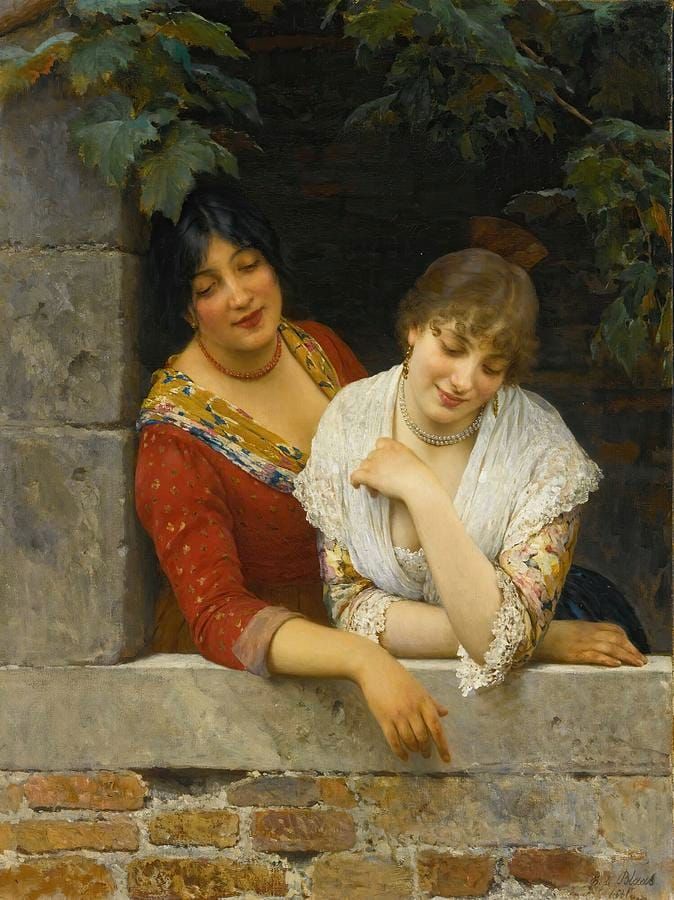
Eugene de Blaas (1843–1932) — also catalogued as Eugen von Blaas, and in Italy as Eugenio de Blaas — was born near Rome to an Austrian painter, Karl von Blaas, who taught him and his brother from childhood. The family moved to Venice when Karl took a post at the Accademia, and Venice held Eugene for the rest of his long life. He taught there himself, kept a studio there, and painted the same handful of streets, wells, and courtyards for sixty years.
His subject was ordinary Venetian life at its most appealing: fisherwomen and flower sellers, laundry days, gossip over a balcony rail, a letter arriving, a young man trying his luck. The technique behind the charm is formidable — crisp drawing, sunlit brickwork, fabrics you can almost hear rustle — and the paintings sold enormously well in Britain and America in his lifetime, which is why so many of them are still household images today. Here are ten of his best-known works.
Venetians at the Balcony
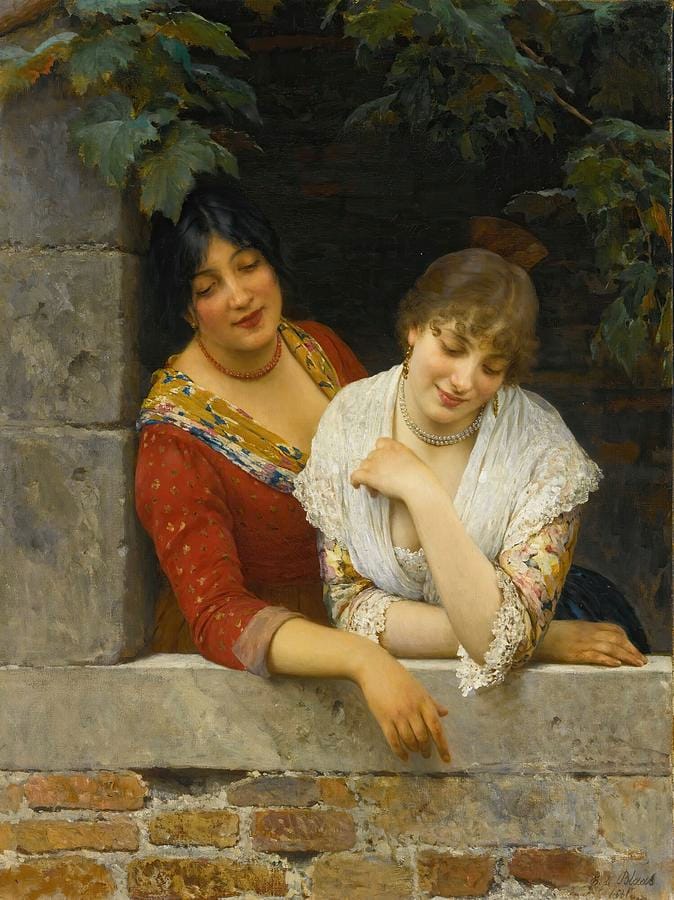
Two young women lean out over a stone balcony ledge under a canopy of vine leaves, watching something in the street below that we are not shown. One, in a red bodice, is laughing openly; the other rests on her folded arms with a slower, more knowing smile. The whole story sits in the difference between the two expressions. De Blaas returned to the balcony again and again — it let him raise his figures above eye level, backlight them against warm brick, and give the viewer the pleasant sense of being the thing being looked at. It is the most characteristic subject he ever painted.
The Love Letter
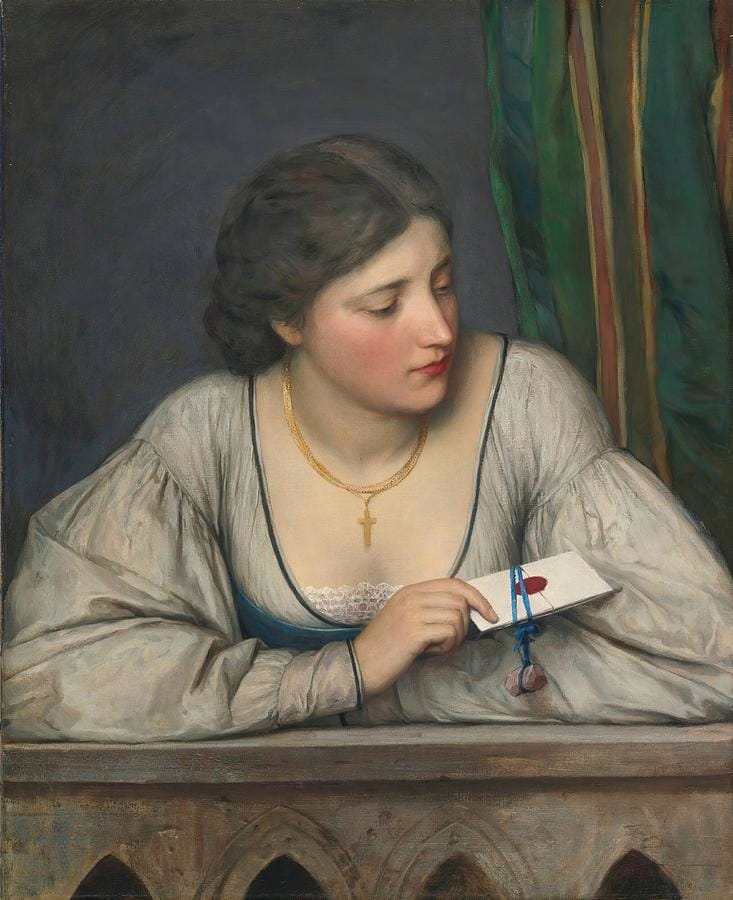
A young woman leans on a windowsill in a soft gray-white dress, a gold cross at her throat, holding a letter closed with a red seal and a blue silk ribbon. Her eyes are lowered and her mouth is doing something very slight and very hard to read — pleasure, doubt, or the beginning of a decision. De Blaas paints almost nothing else: a green curtain, a stone ledge, the tracery of a Gothic window below. The restraint is unusual for him and it works, because everything the picture is about has to be found in one face. Letters arriving and being answered are a running theme across his work.
Sharing the News
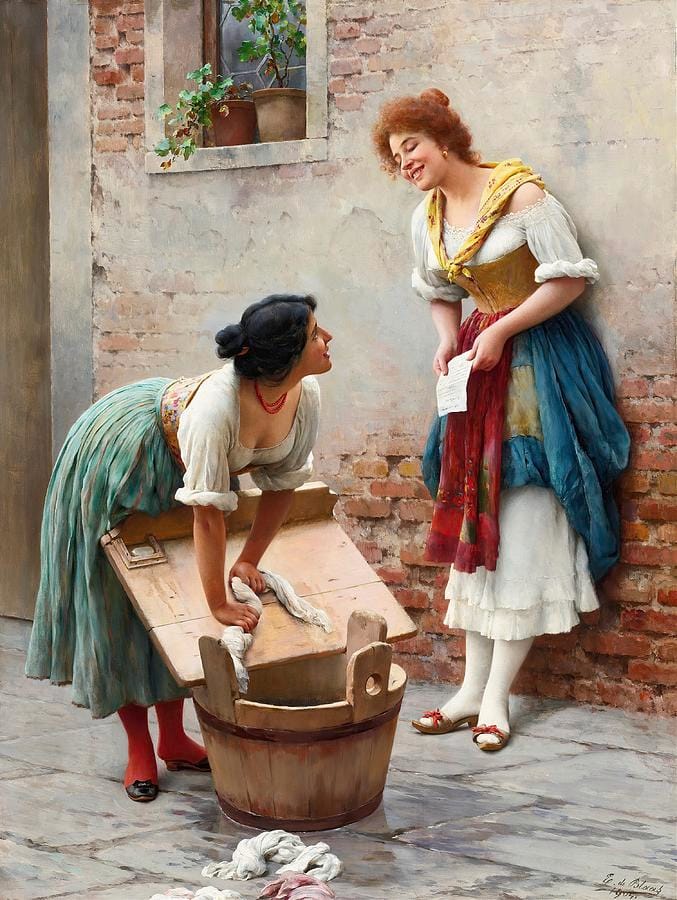
Washing day in a Venetian courtyard, and work has stopped. One woman bends over a washboard in a wooden tub with her sleeves pushed back and red stockings showing; her friend stands against the brick wall with laundry over one arm and a letter open in her hand, laughing as she reads it out. Sunlight rakes across the old plaster and the scrubbed linen. De Blaas built dozens of pictures on this device — a piece of news dropped into the middle of a chore — and the appeal is the same every time: you are watching a private moment among people who have entirely forgotten to be painted.
Secrets
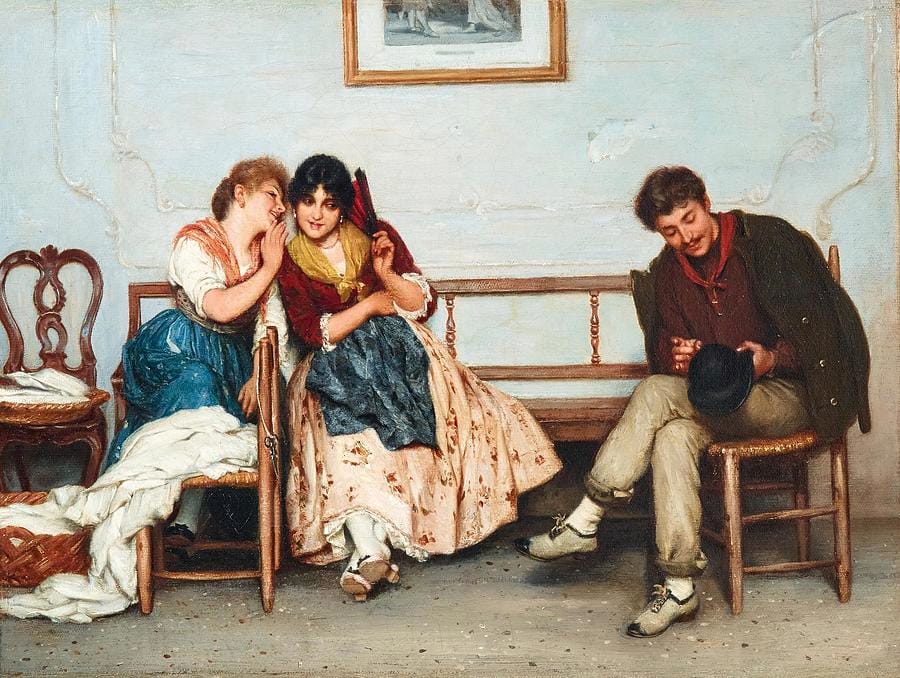
Three young women share a bench in a whitewashed room with a heap of white linen across their laps. Two have their heads together, whispering; the third leans in from the side, determined not to miss anything. On a chair at the end of the bench a young man sits with his cap in his hands and his eyes down, and the joke of the picture is that he is plainly the subject of the conversation and cannot say so. De Blaas was a fine comic storyteller when he wanted to be, and the humor here is affectionate rather than sharp — nobody is being mocked, and everybody is enjoying themselves.
The Water Carrier
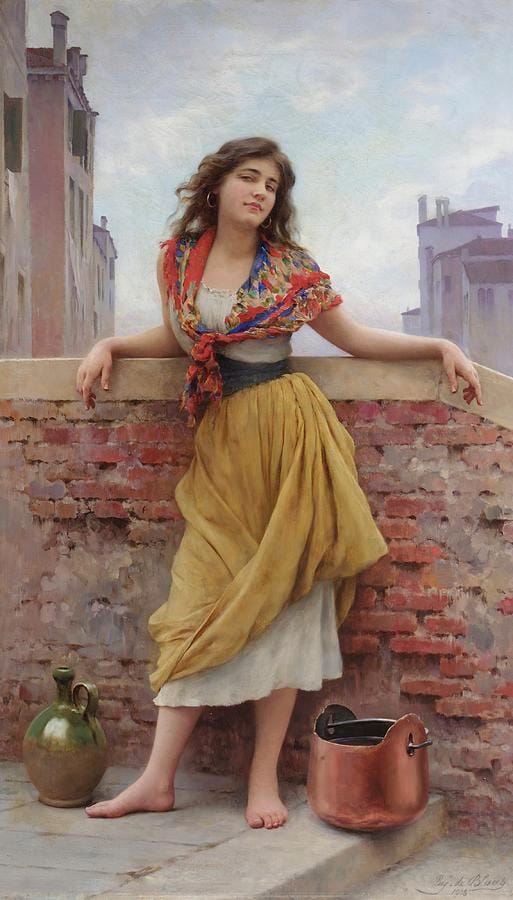
A barefoot girl in a golden skirt and a bright flowered shawl leans back against a low brick parapet, her copper pot and green glazed jug set down at her feet, the roofs and chimneys of Venice rising behind her. She has stopped on the way back from the well and does not seem in a hurry to move. Fetching water was one of the daily errands that structured Venetian working life, and de Blaas used it constantly as a reason to place a figure outdoors in strong sunlight against old brick — the combination of skin, cloth, and weathered wall that he painted better than almost anyone.
The Mandolinist
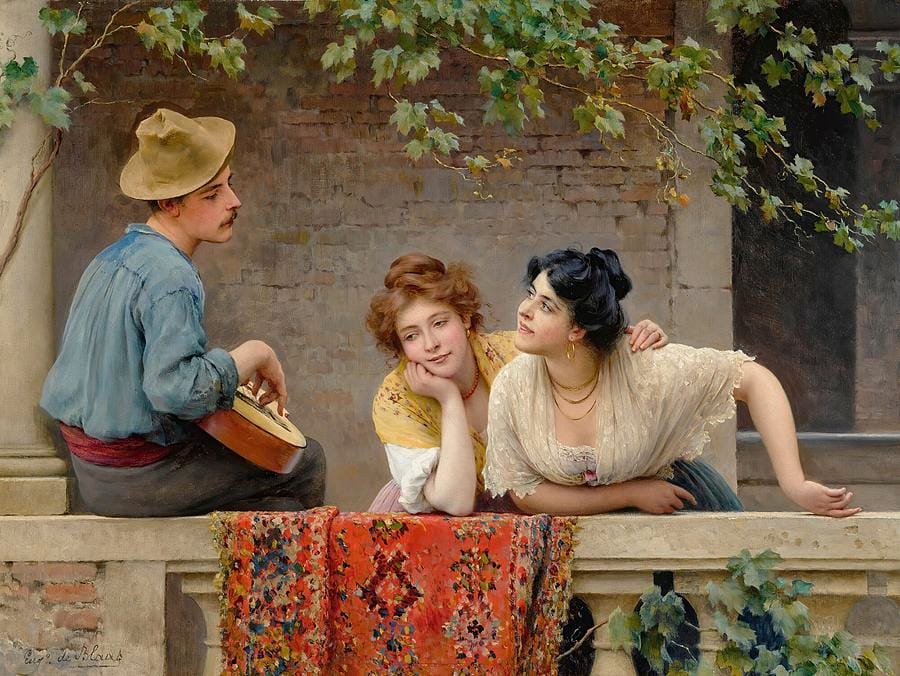
A young man in a straw hat, seen from behind, leans over a ledge draped with a patterned carpet and plays for two girls on the other side. One props her chin on her hand and listens; the other watches him rather than the instrument. Vine leaves hang over the old brick wall behind them and the afternoon is clearly going nowhere. Music was courtship in these pictures, and de Blaas stages the encounter with a theater director’s care — the carpet as a bright horizontal band across the canvas, the figures arranged along it, the whole exchange happening in the small space between the player’s hands and the listeners’ faces.
Goose Plucking
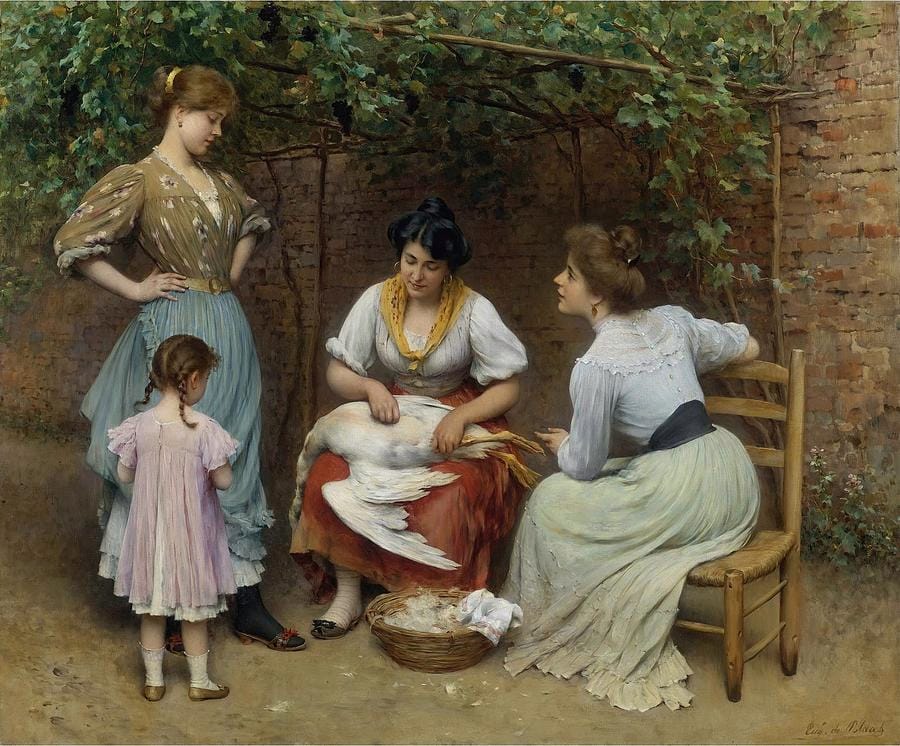
Under a vine-covered wall, three women and a small child work their way through a pile of geese, feathers going into a wide bowl on the ground. One woman is caught mid-sentence, another laughs, the child in a pink pinafore stands watching with her hands still. The scene is genuinely unglamorous — plucking birds is dirty, endless work — and de Blaas neither sentimentalizes it nor makes a point of the hardship. He simply arranges it beautifully, letting sunlight and the white drifts of down carry the picture, which is exactly how he treated every other Venetian chore he painted.
The Awakening
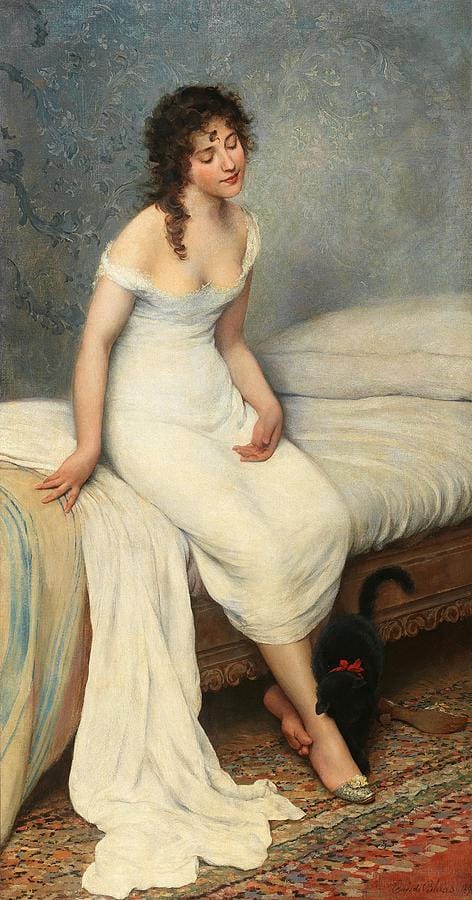
A young woman sits on the edge of an unmade bed in a long white nightdress, leaning forward with one bare foot on a patterned red rug, still half asleep. A black cat has come to greet her and waits at her feet. It is a quieter and more intimate picture than most of de Blaas’s courtyard scenes, and the interest is all in the light — the cool gray wall, the crumpled white linen, and the single warm note of the rug. Compared with the storytelling of his group paintings, this one is content simply to describe an ordinary moment well.
Festival Day, Venice
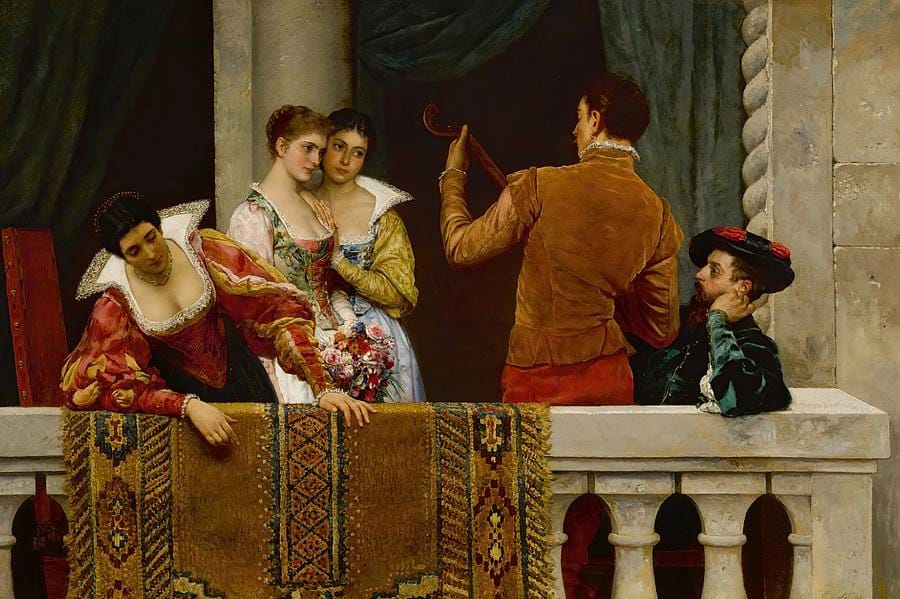
A balcony hung with a richly patterned carpet, a crowd of figures in Renaissance dress pressed against the rail, a man in a brown doublet raising a horn to signal to the crowd below, and a boy in a red cap grinning at the far end. Alongside his scenes of contemporary Venice, de Blaas painted the city’s past, and the historical costume pieces gave him an excuse for gold brocade, velvet, and heavy hanging carpets. The vantage point is the same one he loved in modern dress: we are outside the balcony, level with the revellers, watching a public celebration through a private frame.
An Italian Beauty
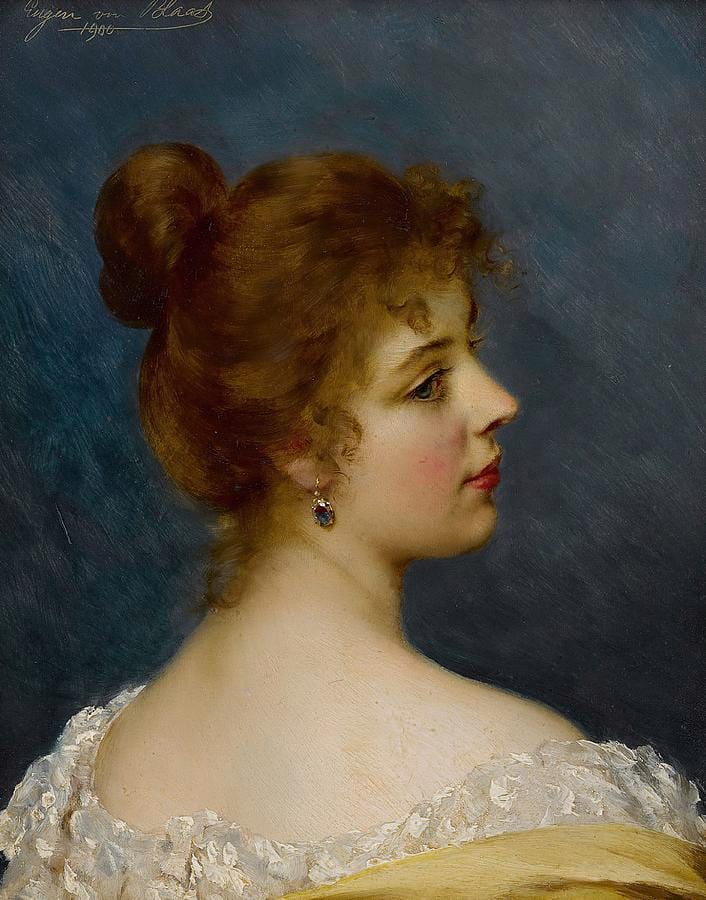
Not every de Blaas is a story. He painted many single-figure studies of young women, and this is one of the finest: a red-haired girl in near profile against a deep blue-green ground, wearing a white blouse trimmed with lace, a gold wrap slipping from one shoulder, a small earring catching the light. The modeling of the face is smooth and academic, but the paint in the hair is loose and quick. Pictures like this were the bread and butter of his career, sold steadily to collectors in London and New York, and they show how much sheer craft sat behind the sentiment.
De Blaas belonged to a generation of painters that the twentieth century dismissed as merely charming, and time has been kinder to him than the critics were. The pictures are beautifully made, generous toward the people in them, and full of the light of a particular city on ordinary weekdays. Hung at home they do what they were always meant to do — warm a room and make you want to know what happens next.
Shop Eugene de Blaas prints here, and explore the rest of our famous paintings collection for more of the world’s most beloved masterpieces.