Egon Schiele’s Ten Most Famous Paintings
Ten defining works by the great Viennese modernist — searing self-portraits, a beloved model, and townscapes of astonishing color.

Egon Schiele (1890–1918) had a career of barely ten years and changed the look of European painting anyway. Born in a small town on the Danube, he entered the Vienna Academy of Fine Arts at sixteen, found its teaching intolerable, and walked out to found his own group of young artists. Gustav Klimt, the reigning star of Viennese art, took him seriously from the start, traded drawings with him and introduced him to patrons — but where Klimt gilded and decorated, Schiele stripped away.
His line is the thing everyone remembers: a hard, nervous contour that pins down a shoulder blade or a rooftop in a single unbroken stroke, filled in with bruised reds, mustard yellows and blacks. He painted himself obsessively, painted the women in his life with unsettling frankness, and painted the crooked hillside towns of Bohemia as though the houses were bodies crowded together. He died in the influenza pandemic of 1918, twenty-eight years old, three days after his pregnant wife. Here are ten of his most famous works.
Self-Portrait with Black Vase and Spread Fingers
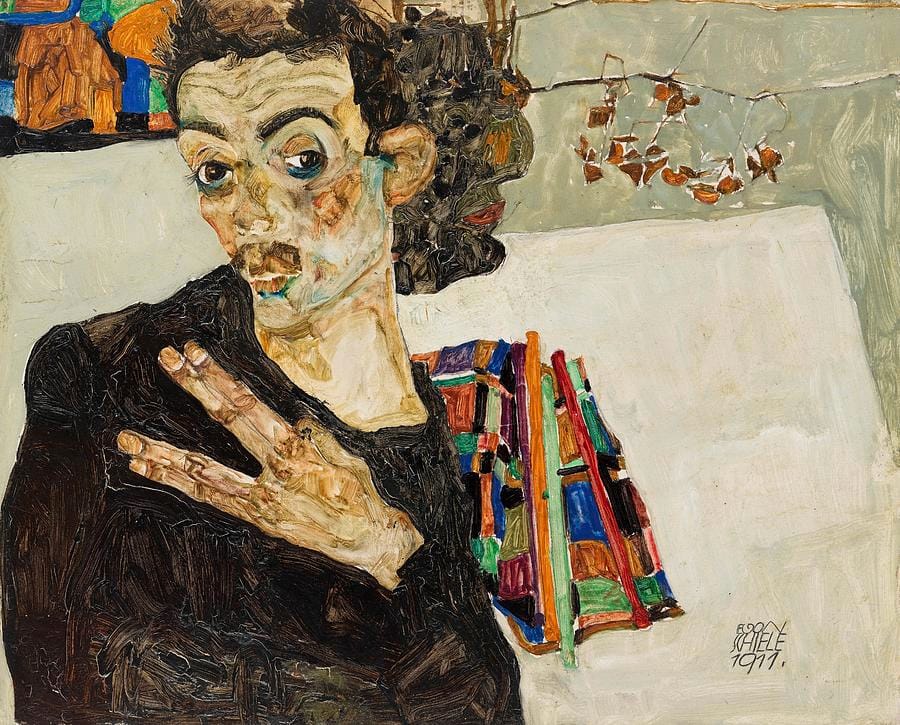
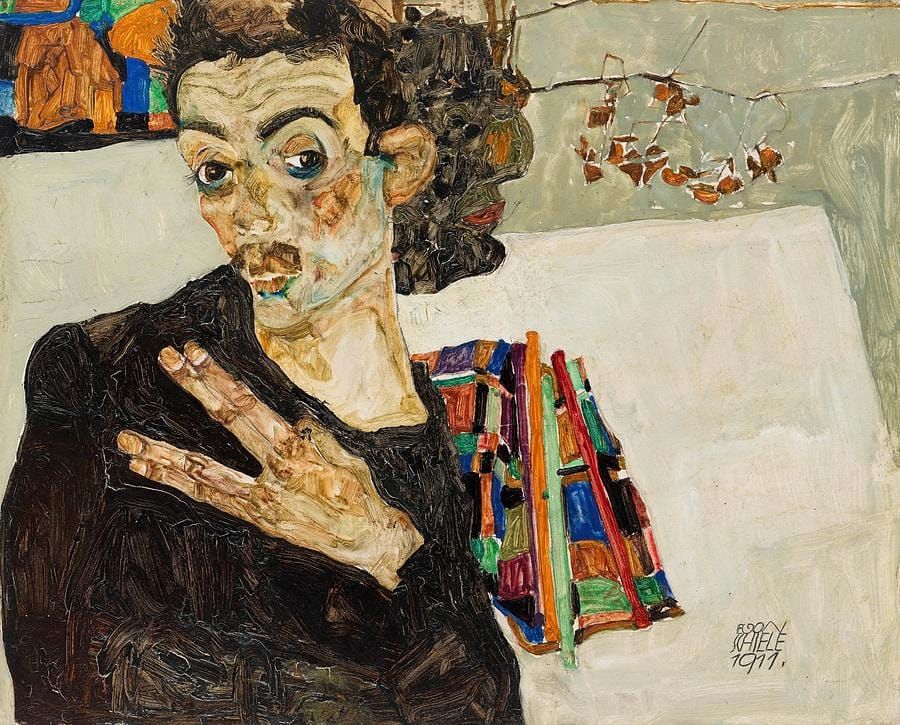
This is the Schiele face the world knows: hair standing on end, cheeks blotched green and orange, the head tipped at an angle that is both wary and theatrical, one hand raised in front of his chest with the fingers splayed into a deliberate, awkward gesture. Behind him sit a black ceramic vase, a folded cloth of hot stripes and checks, and a sprig of orange lantern fruits pinned to the wall. He signed and dated it 1911, at twenty-one, when he had already worked out the entire vocabulary of hands, angles and stares that he would use for the rest of his short life.
Portrait of Wally Neuzil
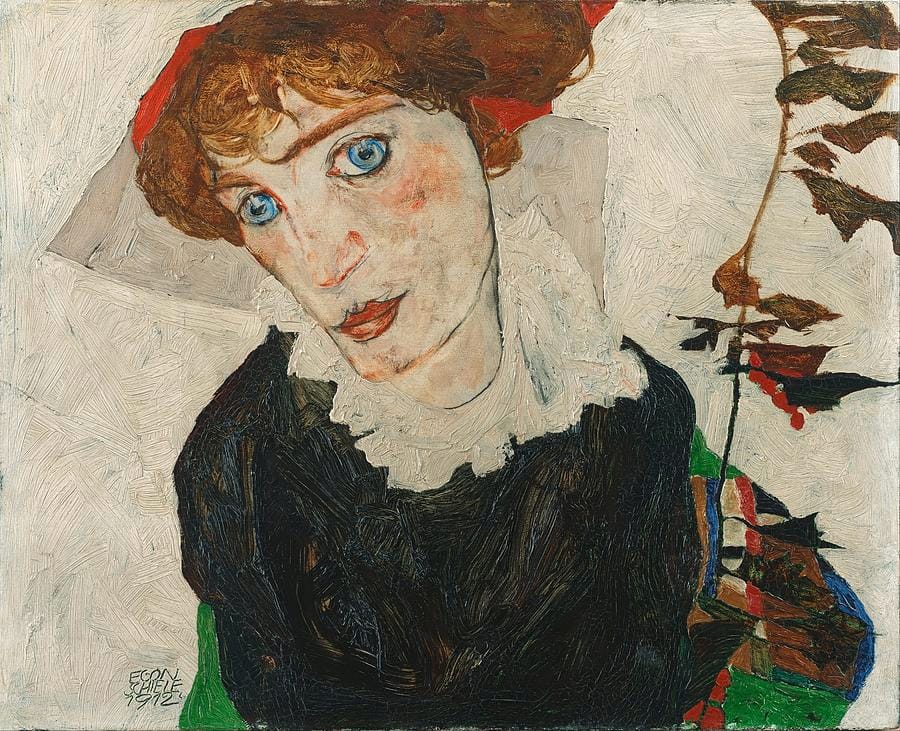
Walburga “Wally” Neuzil was seventeen when she met Schiele, and for four years she was his model, companion and the person who kept his difficult life running. Painted in 1912, she gazes out with enormous blue-gray eyes above a black shirt and a broad white collar, red hair held back by a scarlet band, the background stripped to bare paper and a few dry sprigs of leaves. It is far tenderer than most of his work, and it became one of the most famous portraits in Austrian art — as well as the subject of a long and painful international dispute over its wartime ownership.
Death and the Maiden
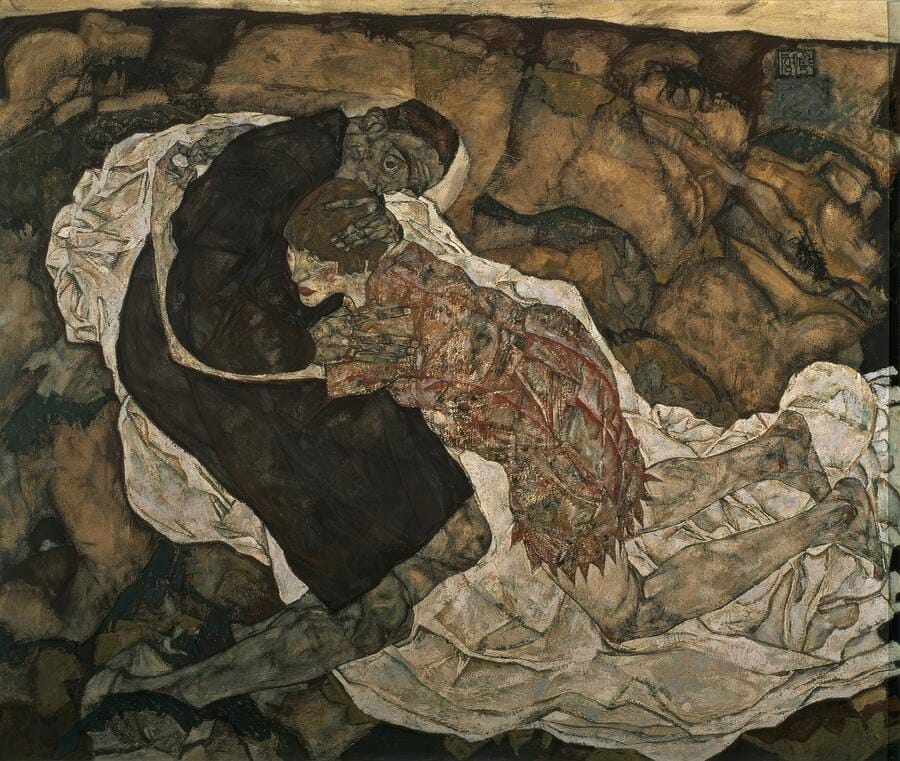
A woman in a white shift clings to a gaunt man in a dark robe, her arms locked around his back, the pair marooned on a rumpled white sheet in a landscape of brown rags. Schiele painted it in 1915, the year he left Wally Neuzil to marry Edith Harms, and the picture has always been read as his farewell to her: the man has Schiele’s own face, and the embrace is already ending even as it happens. It is one of the great pictures of Austrian Expressionism and a centerpiece of the Belvedere in Vienna.
Four Trees
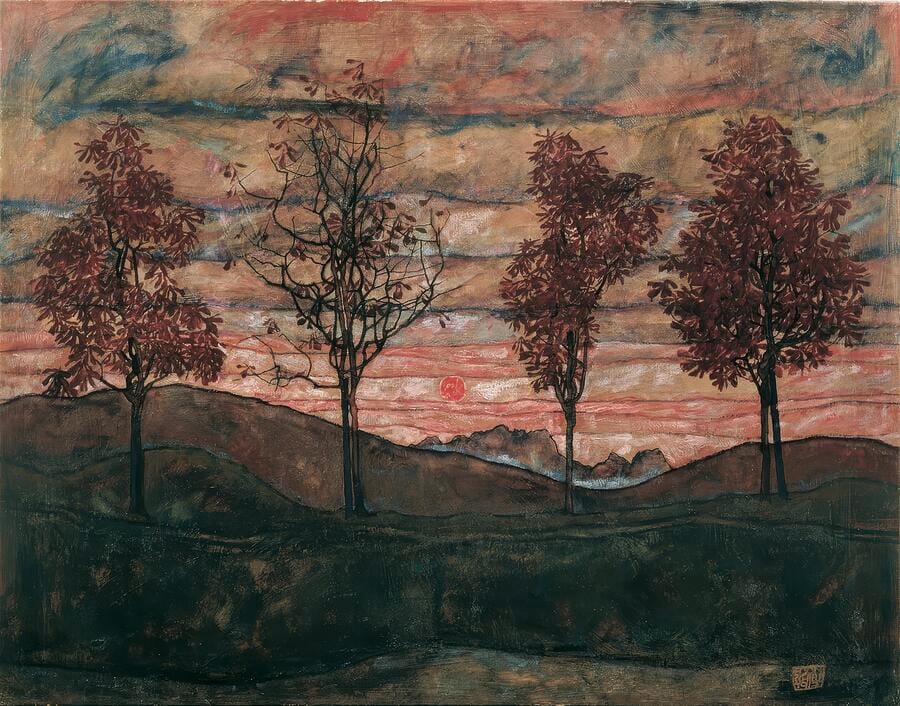
Four chestnut trees stand in a row on a low ridge, dark hills stacked behind them and a sky laid down in flat horizontal bands of rose, orange and violet with a small red disc of sun sitting low between them. Three of the trees still carry their rust-red leaves; the second from the left has lost nearly all of its foliage, which viewers have taken ever since as a quiet emblem of mortality. Painted in 1917, near the end of Schiele’s life, it is calmer and more ordered than almost anything else he made, and it remains a highlight of the Belvedere’s collection.
Houses with Laundry (Suburb II)
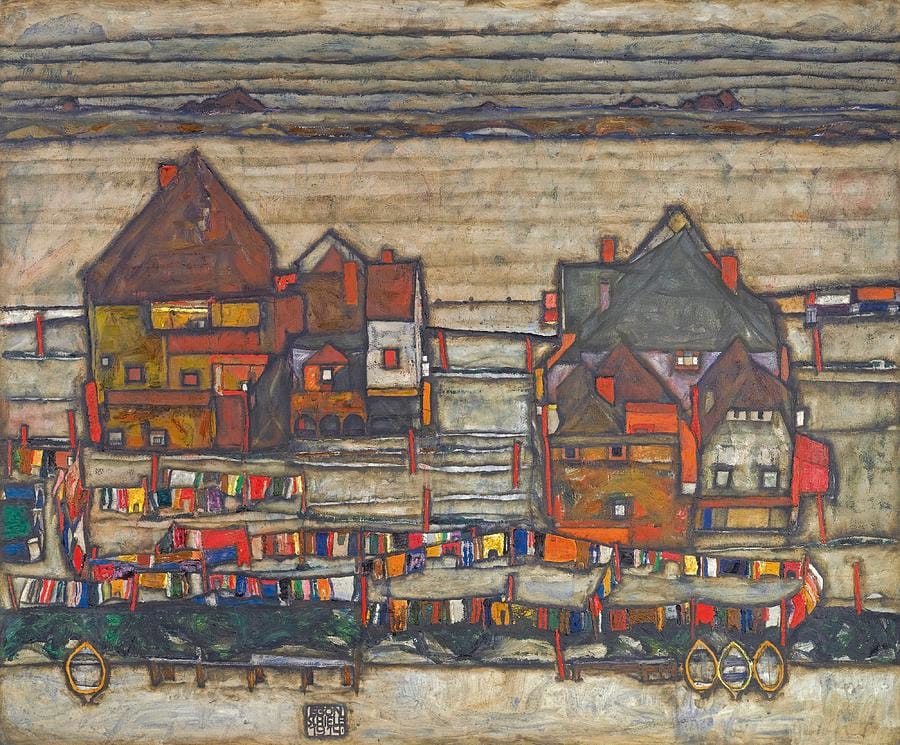
Two blocks of houses sit shoulder to shoulder above a dark river, their fronts a patchwork of ochre, rust and slate, with lines of washing strung across the façades in flickering scraps of red, blue and green. Schiele painted the picture in 1914 from the hill town of Krumau in southern Bohemia, his mother’s birthplace and his favorite subject. He almost never included people in these views — the laundry does the work instead, turning the buildings into something inhabited and faintly human. It is among the most sought-after of all his townscapes.
Portrait of Edith Schiele
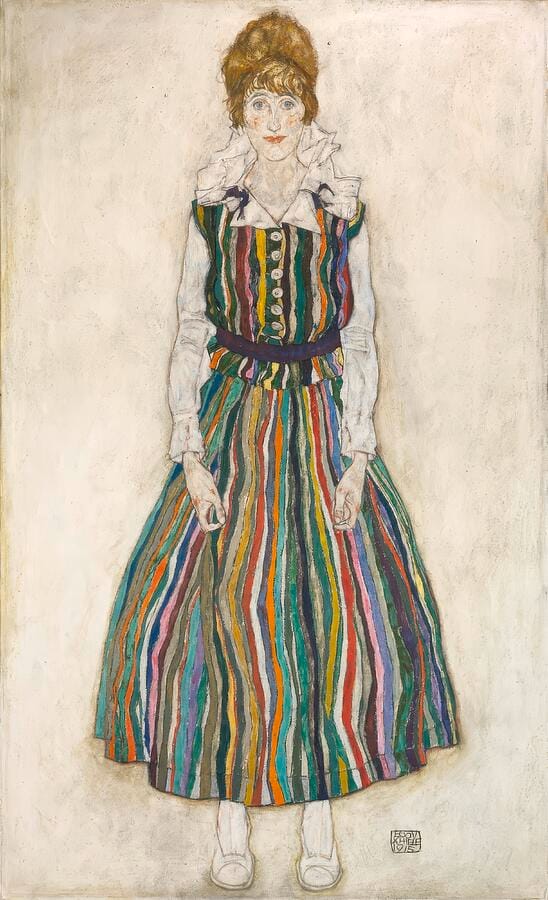
Schiele married Edith Harms in June 1915 and painted her that same year standing full length against an empty ground, hands clasped in front of her, in a long dress of vertical stripes in green, red, blue and white. After the frantic energy of his earlier figures, the portrait is almost still — a young woman planted squarely on her feet, faintly uncertain, looking at her husband. The picture is now in the Kunstmuseum Den Haag in the Netherlands.
The Hermits
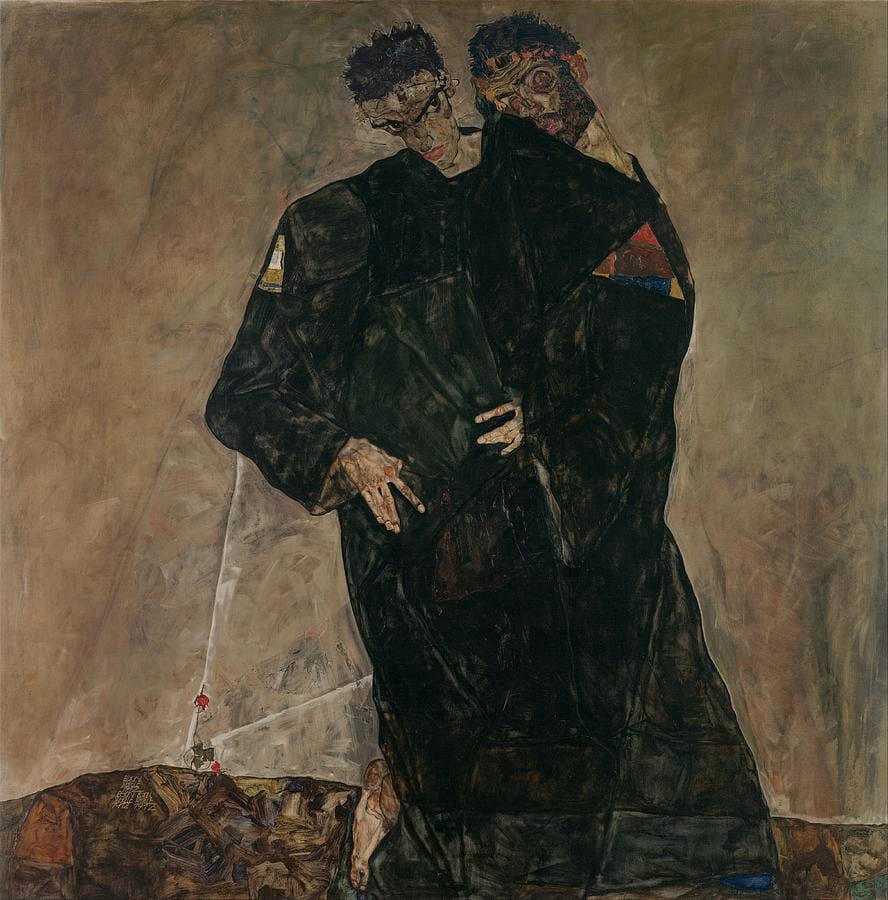
Two men in long black robes stand pressed together, one leaning his head on the other’s shoulder, their bodies merging into a single dark column against a bare background. Painted in 1912, the picture is generally understood as a double portrait of Schiele and Gustav Klimt — the younger artist upright and staring straight out, the older one slumped with his eyes closed. Schiele wrote about the picture as an image of two figures worn out by life, and it reads as both a tribute to his mentor and a declaration that he intended to go his own way. It belongs to the Leopold Museum.
Crescent of Houses (The Island Town)
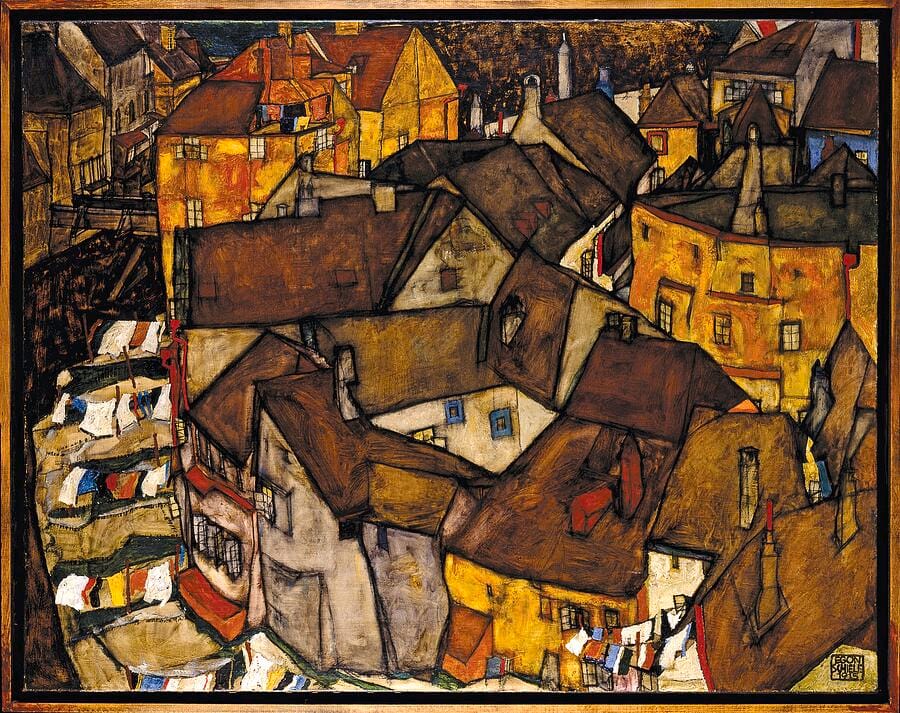
Seen from high above, a curved bank of rooftops crowds in on itself — yellow, orange and black roofs, laundry on the balconies, windows staring out like small dark eyes — with no sky, no horizon and no way in or out. Schiele made it in 1915 from his memories of Krumau, rearranged into something denser and stranger than the real town. Cézanne’s influence sits under the geometry, but the claustrophobia is entirely Schiele’s. It is one of the most striking works in the Leopold Museum and one of the strangest cityscapes of the early twentieth century.
Setting Sun
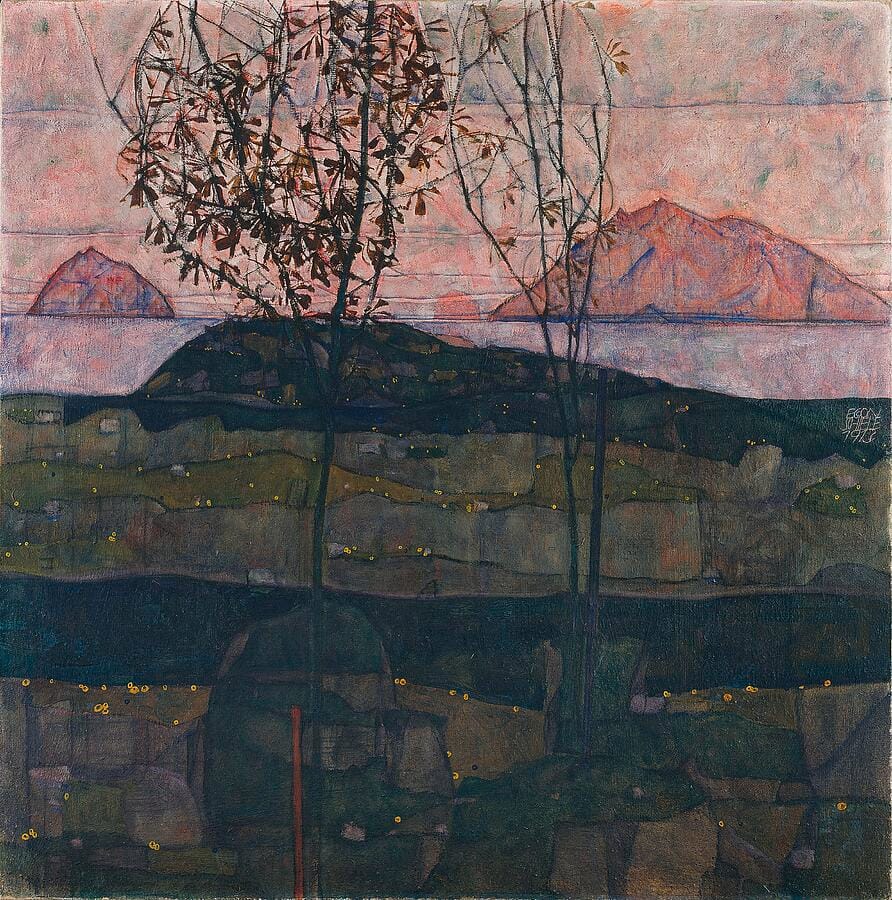
A row of spindly bare trees rises out of a dark plain, their branches scratched into the surface like handwriting, while behind them a low mountain and a band of pink sky close off the horizon. Painted in 1913, Setting Sun shows Schiele treating landscape exactly as he treated the human figure: not as scenery but as a body under strain, everything thin, exposed and slightly starved. The color — deep blue-black earth against a burning sky — is among the most beautiful he ever mixed, and the picture has become a favorite of collectors who find his figures too raw.
Poster for the Schiele Exhibition at the Galerie Arnot
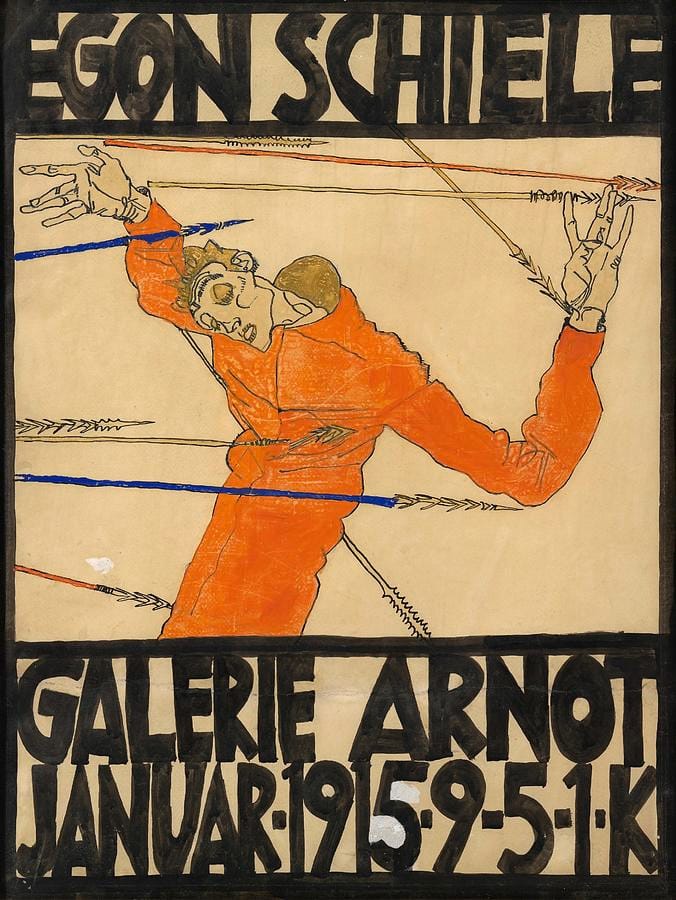
For his January 1915 show at Vienna’s Galerie Arnot, Schiele designed the poster himself and put his own body on it, kneeling in a scarlet smock with arms flung wide and blue arrows piercing him — a self-portrait as Saint Sebastian, martyr and target, framed by his name in hand-lettered block capitals. It is a joke and a boast at once, from an artist who had genuinely been jailed and denounced. Rarely has a piece of commercial printing been so purely an artwork, and the design has since become one of the most recognizable graphic images of Viennese modernism.
A century on, Schiele’s work has lost none of its charge. What once looked like provocation now reads as extraordinary honesty about bodies, cities and the fear of running out of time — and his landscapes and townscapes, with their glowing patchwork color, hang beautifully in a modern interior without ever becoming background noise.
Shop Egon Schiele prints here, and explore the rest of our famous paintings collection for more of the world’s most beloved masterpieces.