Édouard Manet’s Ten Most Famous Paintings
Scandals, barmaids, and picnics that outraged Paris: the ten works that made Manet the reluctant father of modern painting.

Édouard Manet (1832–1883) came from the comfortable Parisian professional class — his father was a judge who wanted him to study law — and he never stopped wanting what that world could give him: Salon medals, official honors, respectability. He got scandal instead. Twice in the 1860s a Manet painting became the joke and the outrage of the season, and the notoriety followed him for the rest of his short life.
He earned it honestly. Manet painted contemporary Paris — barmaids, café drinkers, railway platforms, boating parties — at a scale the age reserved for gods and generals, and he painted it in broad, flat, unblended strokes that skipped the careful shading his teachers demanded. The younger Impressionists treated him as their leader, though he refused to exhibit with them and kept sending work to the official Salon. He died at fifty-one, after a long illness, just as the world was beginning to agree with him. Here are ten of his most famous paintings.
Olympia
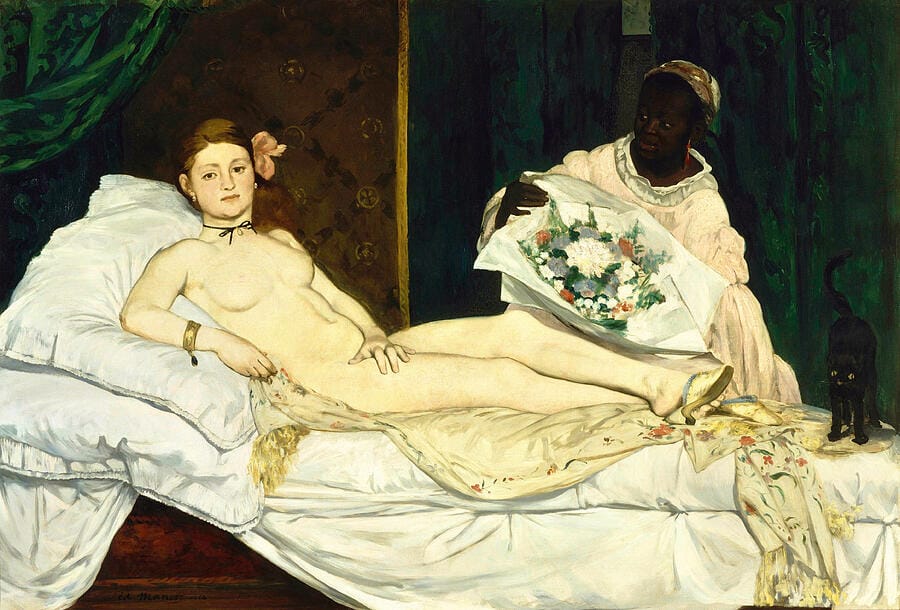
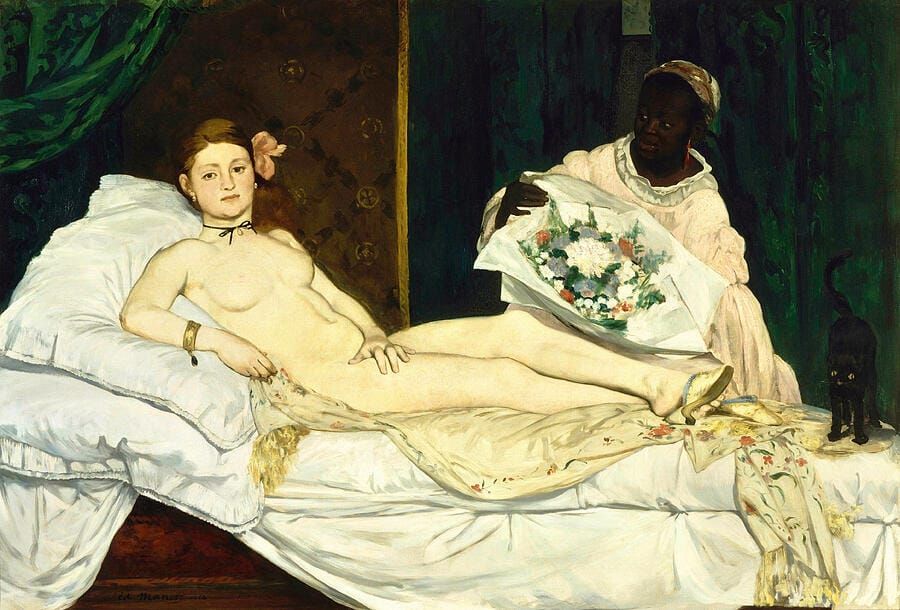
When Olympia was hung at the Salon of 1865 the crowds were so hostile that guards had to be posted beside it. Manet had painted a reclining nude in the pose of a Renaissance Venus, but everything else in the picture announced a modern Parisian courtesan: the orchid in her hair, the ribbon at her throat, the mule dangling from one foot, the servant arriving with a bouquet from a client, and the black cat with its back arched at the end of the bed. What scandalized viewers was not the nakedness but the stare. She looks straight out, entirely unembarrassed, and refuses to be a goddess.
Le Déjeuner sur l’herbe (The Luncheon on the Grass)
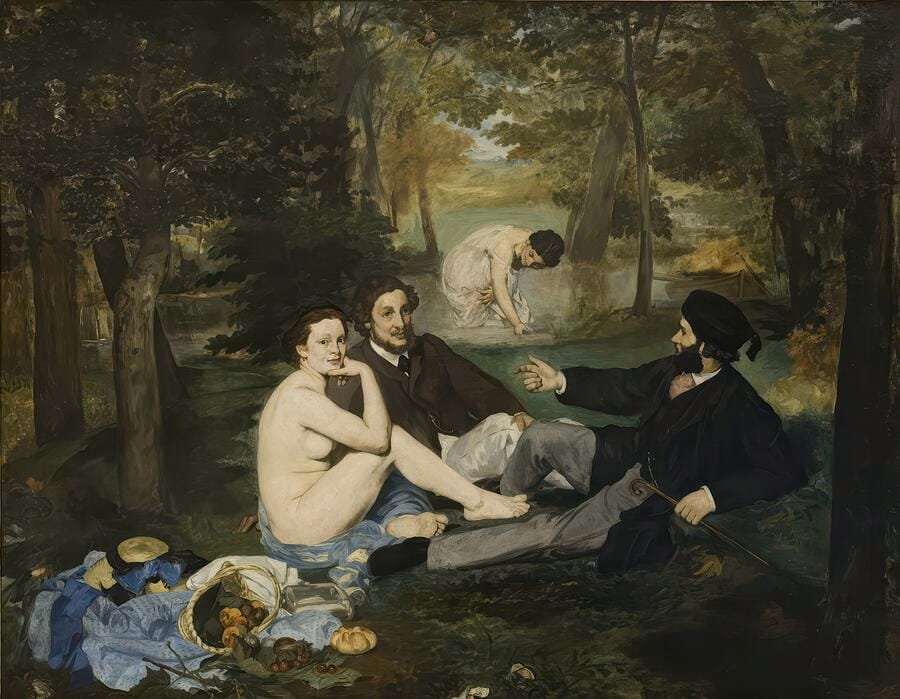
Rejected by the Salon jury of 1863, this large canvas went into the Salon des Refusés — the overflow exhibition Napoleon III ordered for that year’s rejects — and became the sensation of Paris. A naked woman sits on the grass beside two young men in full contemporary dress, one gesturing mid-conversation, while a second woman bathes in the stream behind. Manet borrowed the grouping from a Renaissance engraving, so the arrangement was respectable enough; what appalled people was the collision of a classical nude with two ordinary men in modern clothes, painted in daylight with no story to excuse it.
A Bar at the Folies-Bergère
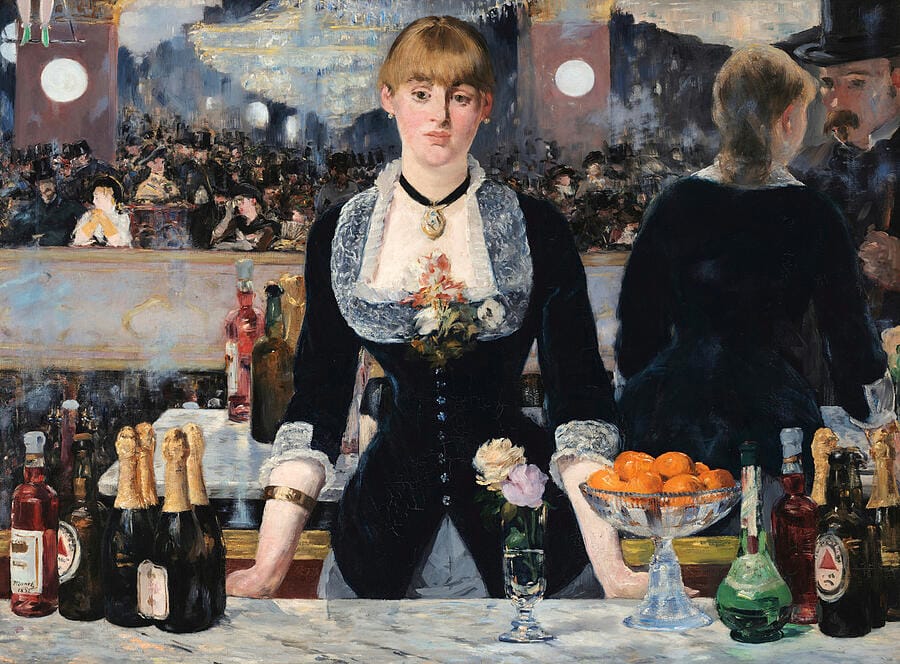
Manet’s last great painting, finished in 1882 while he was already seriously ill, shows a barmaid standing behind a marble counter of bottles, oranges, and roses. Behind her a mirror throws back the whole glittering music hall — chandeliers, a crowd, and in the top left corner a trapeze artist’s green slippers. The reflection makes no geometric sense: the barmaid’s mirrored back is pushed far to the right, and a top-hatted customer appears there who ought to be standing where we are. Scholars have argued about that impossibility for a century. Her expression, tired and unreachable in the middle of all the noise, is the reason the picture lasts.
The Railway
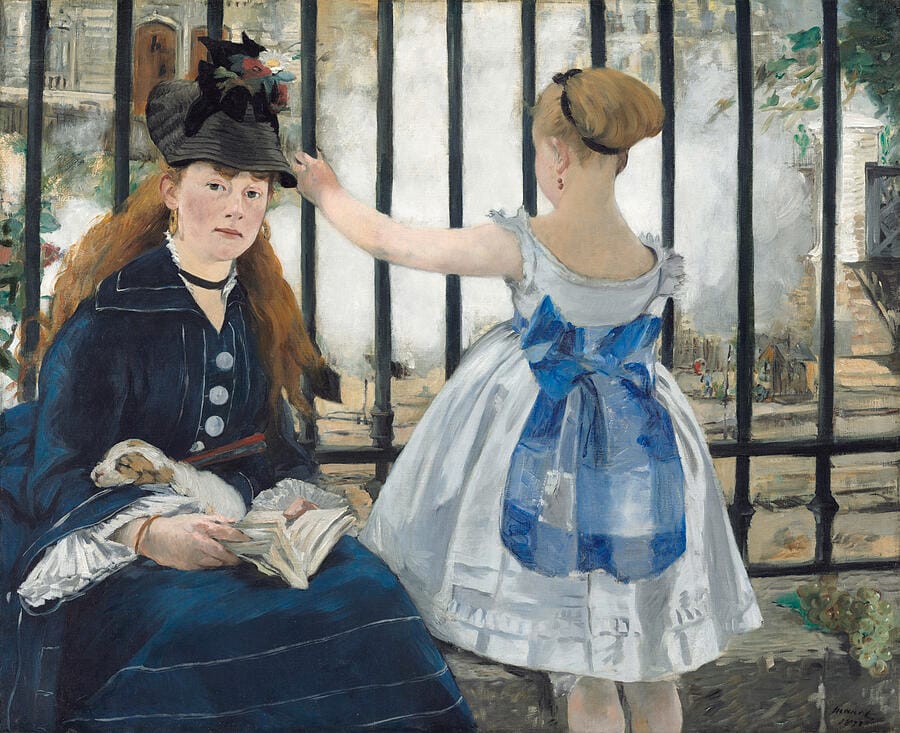
Painted in 1873 near the Gare Saint-Lazare, this is a picture of a train station with no train in it. A young woman in dark blue looks up from her book with a sleeping puppy in her lap, while a little girl in a white dress turns her back on us to watch a cloud of steam rise beyond the iron railings. The model was Victorine Meurent, the same woman who posed for Olympia. Critics complained that Manet had painted a sketch and called it finished. What he had actually done was catch the ordinary rhythm of a modern city — one person interrupted, one person absorbed, and a railing between us and everything interesting.
The Fifer
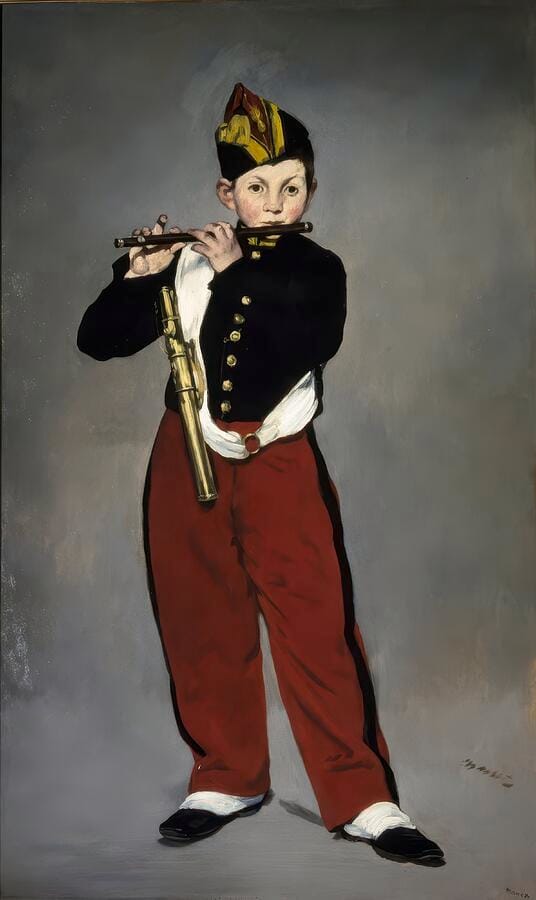
A boy soldier in a red-trousered uniform stands playing his fife against a background of nothing at all — a soft gray-brown void with barely a shadow to place him in space. Manet painted it in 1866, shortly after a trip to Spain that left him besotted with Velázquez, and the flat silhouette also owes something to the Japanese prints then arriving in Paris. The Salon jury rejected it, which prompted Émile Zola to publish a furious defense of Manet and effectively launch his own career as a critic. The picture is now among the best-loved things in French nineteenth-century painting.
Music in the Tuileries Gardens
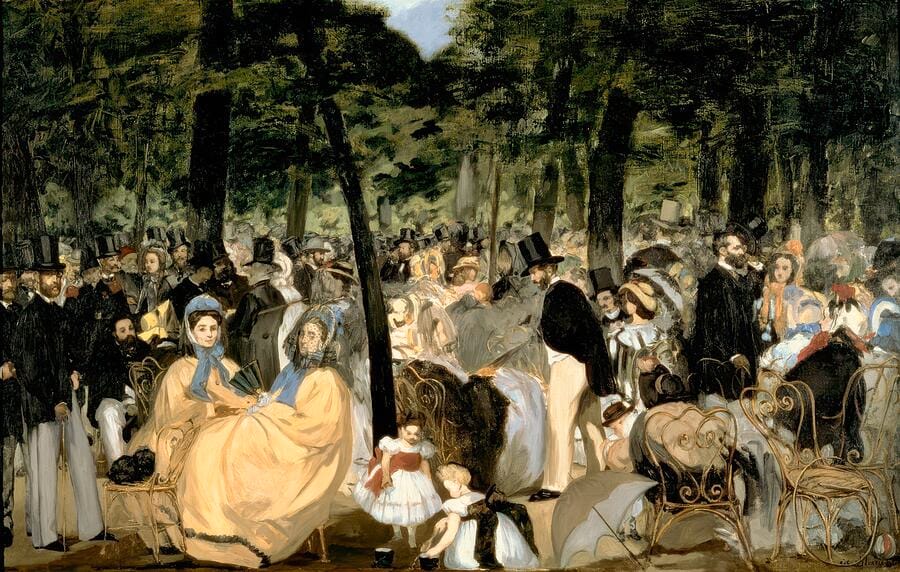
One of Manet’s earliest modern-life pictures, from 1862, this crowded scene shows fashionable Paris gathered under the trees of the Tuileries for an afternoon concert — top hats, crinolines, children playing in the foreground, and not one figure given a proper narrative role. The faces are dabs and smears; the crowd reads as a crowd rather than a cast. Manet put his own friends into it, including the poet Charles Baudelaire, whose call for a painter of modern life the picture answers almost literally. Contemporary viewers found it unfinished and chaotic. It now looks like the opening statement of everything Impressionism went on to do.
The Balcony
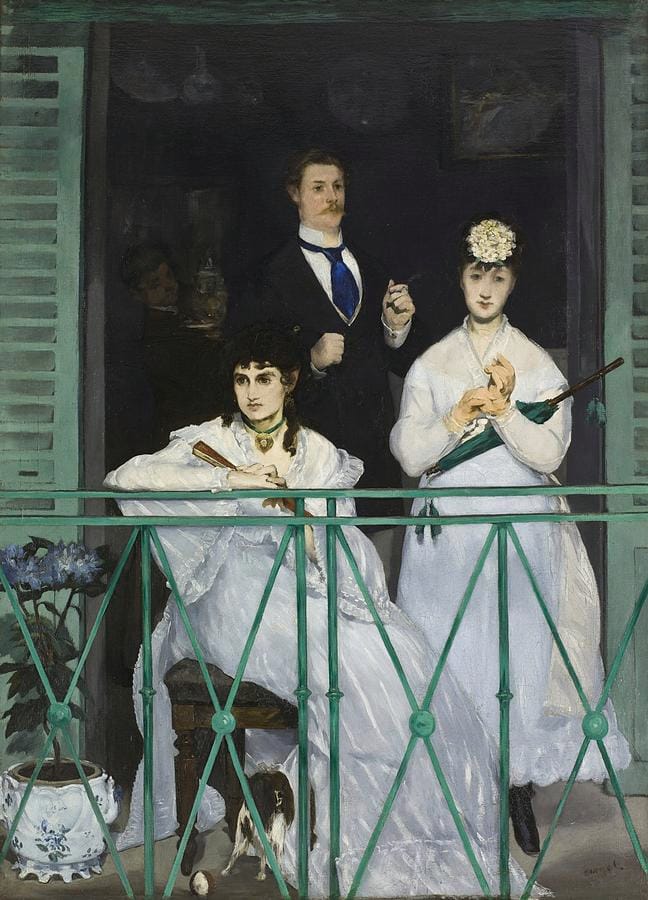
Three figures stand behind a bright green iron railing: a seated young woman with a fan, a second woman drawing on her gloves, and a man in a tie half-lost in the dark room behind them. The seated figure is the painter Berthe Morisot, in her first appearance in Manet’s work. Painted around 1868, the composition takes its cue from Goya’s balcony scenes, but Manet drains it of all flirtation — none of the three looks at any of the others, and the interior behind them is a pit of shadow. The green of the railing, laid on unmixed and bright, was itself considered an offense at the time.
Berthe Morisot with a Bouquet of Violets
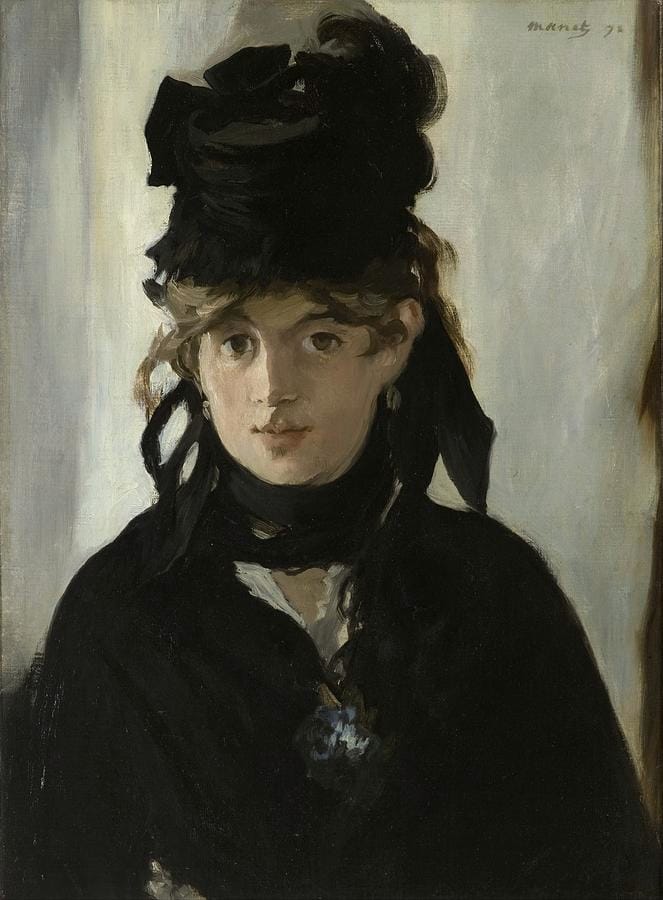
Manet painted Berthe Morisot roughly a dozen times, and this small canvas of 1872 is the finest of them. She wears black — hat, ribbon, coat — against a pale gray ground, with a spray of violets pinned at her breast, and the whole picture is carried by the few strokes that make her eyes. Morisot was a formidable painter in her own right and a founding member of the Impressionist group, and she later married Manet’s brother Eugène. The portrait has the intimacy of one artist looking at another, and its handling of black as a color rather than an absence is a lesson in itself.
Boating
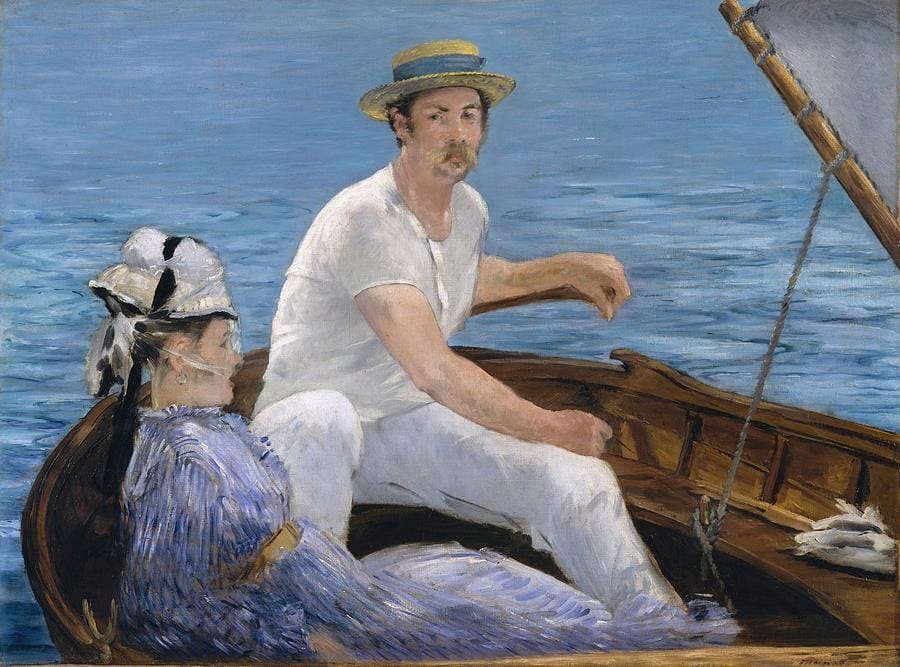
During the summer of 1874 Manet worked alongside Monet and Renoir at Argenteuil on the Seine, and he came back with the sunniest painting he ever made. A man in white boating clothes and a straw hat leans back at the tiller, one arm flung along the gunwale, while his companion, in a white hat trimmed with black ribbon and a pale lavender dress, sits low in the bottom of the boat. The water fills almost the entire canvas as a single sheet of hard blue, cropped so tightly that there is no horizon and no shore. It is Manet at his most relaxed, borrowing the Impressionists’ light without giving up his own broad, decisive brushwork.
The Execution of Emperor Maximilian
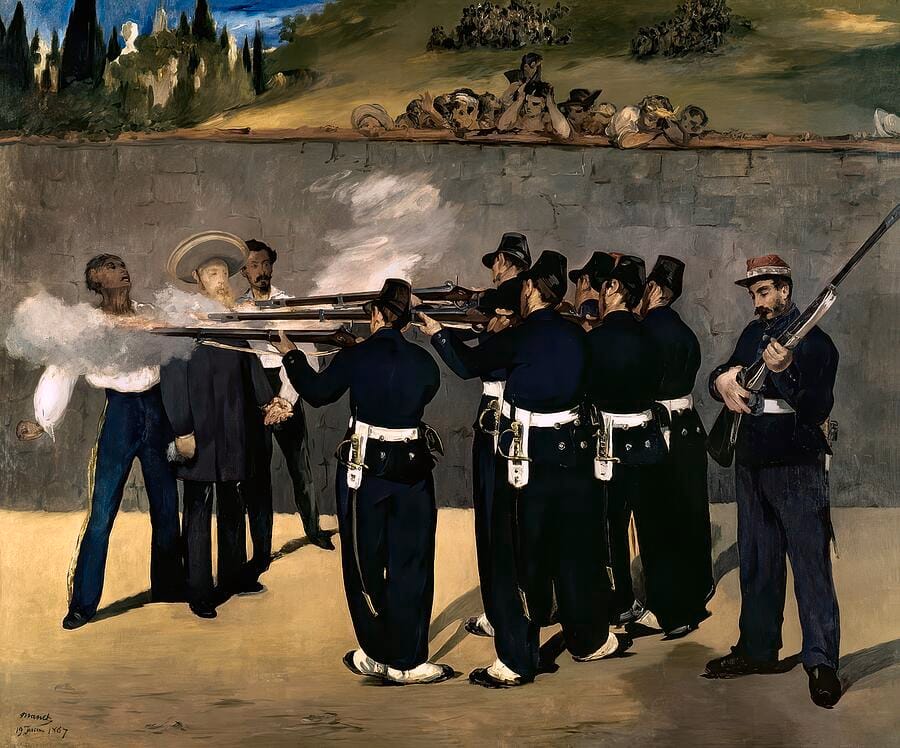
In 1867 Maximilian of Habsburg, installed as emperor of Mexico with French backing and then abandoned by Napoleon III, was shot by a republican firing squad. Manet followed the news obsessively and worked the subject up over two years into several versions, of which this is the largest and most complete. The squad stands close enough almost to touch its victims, a sergeant calmly cocks his rifle at the right, and curious spectators peer over the wall. Manet dressed the soldiers in uniforms resembling French ones, which made the political accusation unmistakable — and ensured the French authorities blocked the painting from public exhibition.
Manet is the hinge between the old world of painting and the new one, and the pleasure of his work is that he never lost the old world’s richness on the way. His blacks are luxurious, his flowers and fruit are delicious, and his people look like people you might pass on a street. A Manet on the wall is companionable in a way that grander pictures rarely are.
Shop Édouard Manet prints here, and explore the rest of our famous paintings collection for more of the world’s most beloved masterpieces.