Edgar Degas’s Ten Most Famous Paintings
Ballet rehearsals, racecourses, and women caught unaware: the ten works that made Degas the great observer of modern life.

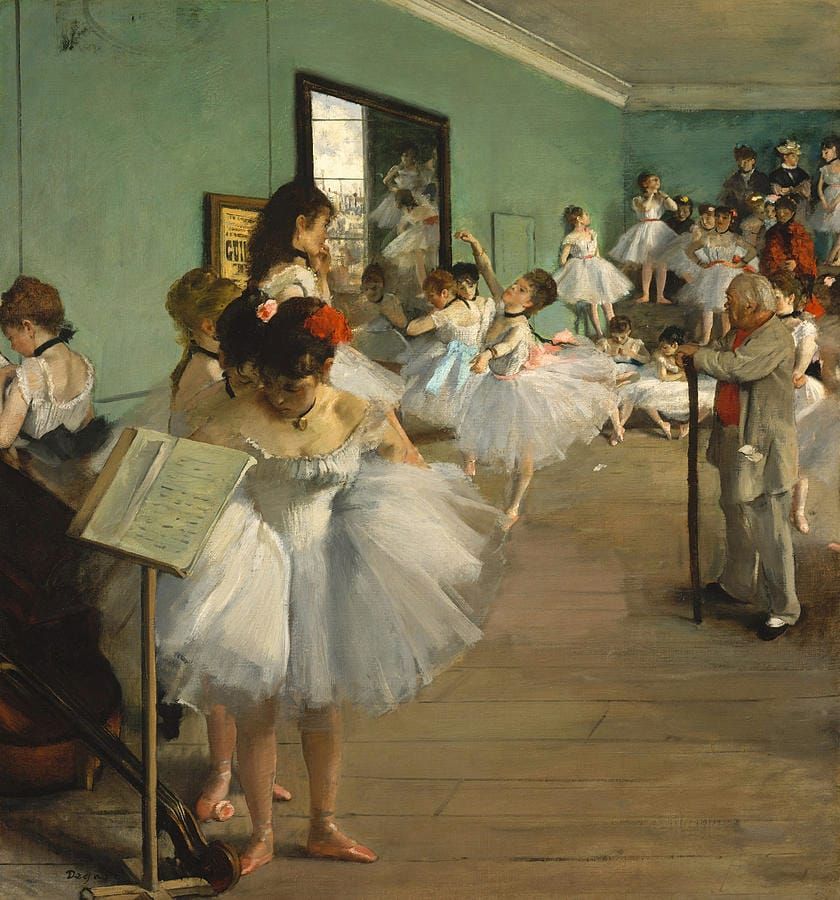
Edgar Degas (1834–1917) exhibited with the Impressionists and shared their subject — modern Parisian life — but he rejected almost everything else about them. He had little interest in painting outdoors, distrusted the word “Impressionist,” and preferred the word “realist.” Where Monet chased sunlight, Degas worked in studios and rehearsal rooms from memory and drawing, building his pictures with the discipline of an Old Master and the eye of a photographer.
His great subject was the human body at work: dancers stretching at the barre, laundresses leaning on their irons, milliners trimming hats, jockeys steadying their horses. He cropped his compositions like snapshots, tilted his floors at strange angles, and put his figures off-center — devices borrowed from Japanese prints and the new art of photography. Here are ten of his most famous works.
The Dance Class
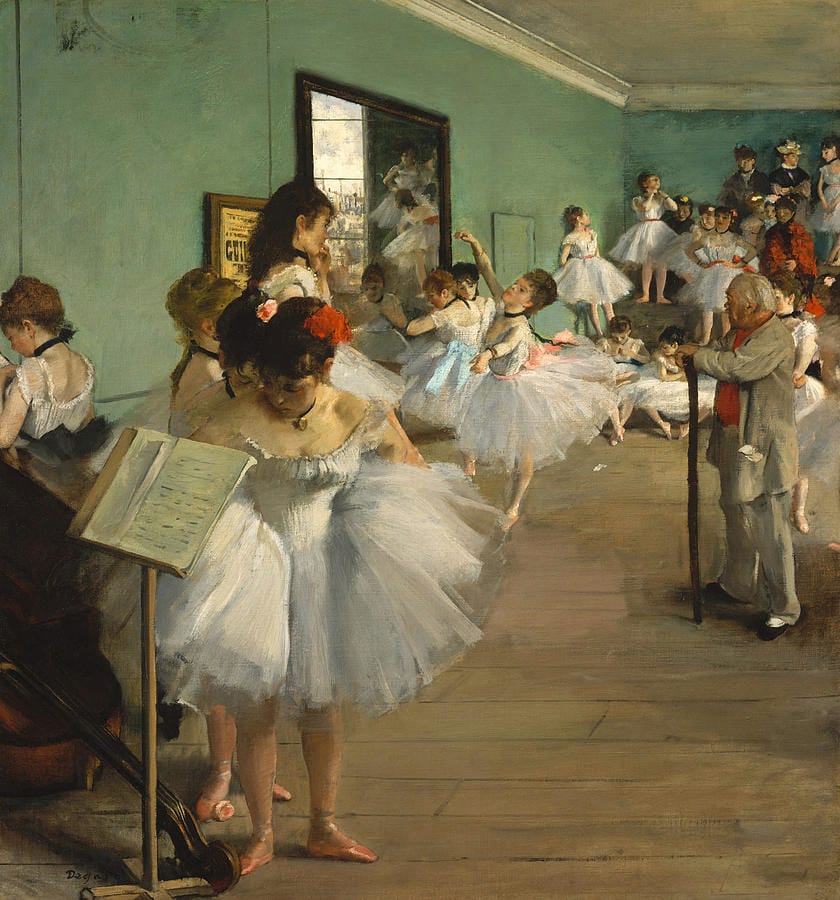
The Dance Class (c. 1873–76) is the most famous of the roughly 1,500 works Degas devoted to ballet. In a high-windowed rehearsal room, the aging ballet master Jules Perrot leans on his long cane while dancers wait their turn — adjusting a slipper, scratching a back, twisting to look at something outside the frame. Almost nobody is dancing. Degas was fascinated less by performance than by the boredom, effort, and physical discomfort behind it, and the painting’s scattered, off-center composition makes the viewer feel like an intruder who has wandered in mid-lesson.
The Rehearsal of the Ballet on Stage
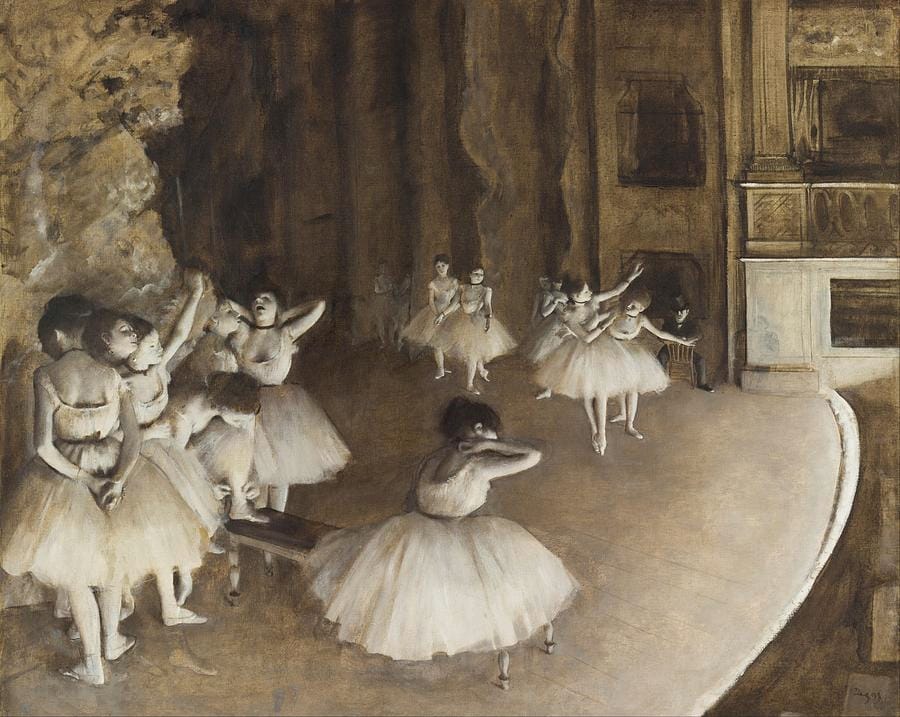
Painted in 1874, The Rehearsal of the Ballet on Stage shows dancers going through their paces on a bare stage, watched by two men in evening dress lounging in the wings — the wealthy subscribers who had backstage privileges at the Paris Opéra. Degas worked the composition up in muted browns and blacks with almost no color, closer to a drawing than a painting. The spiral of dancers sweeping from the front of the stage into the distance is one of his most inventive arrangements, and the scene’s uneasy mix of labor and surveillance is pure Degas.
The Bellelli Family
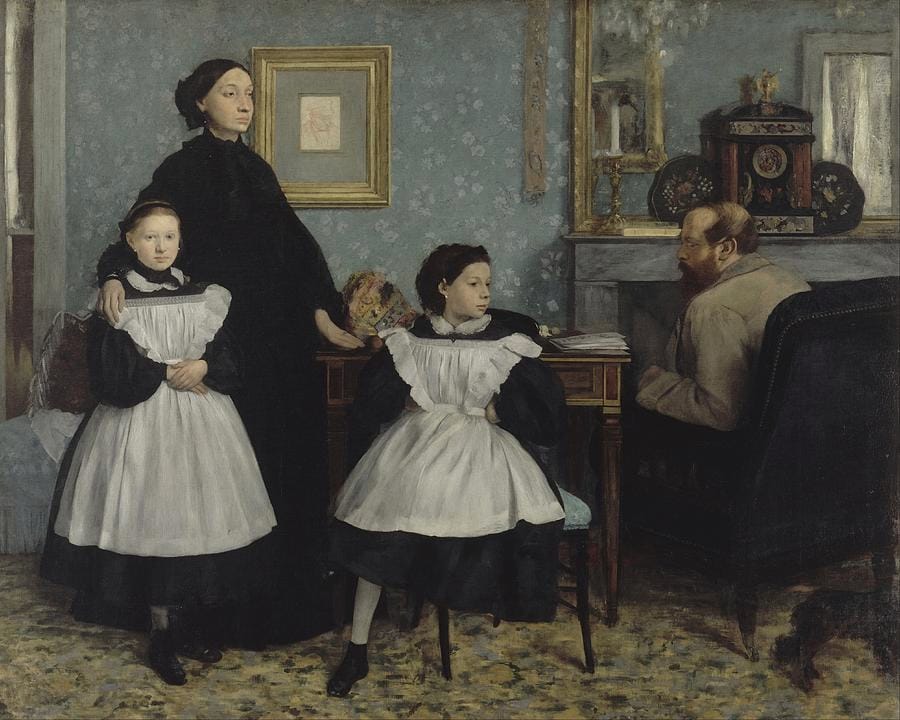
Begun in Florence when Degas was in his mid-twenties and reworked for years afterward, The Bellelli Family is the great achievement of his early career. It portrays his aunt Laura, standing in mourning black for her recently dead father, with her two young daughters and her husband Gennaro, turned away from them in his armchair. The composition splits the family into two camps, and the coolness between husband and wife is unmistakable. Degas said little about it, but the painting remains one of the most psychologically acute family portraits in Western art.
The Millinery Shop
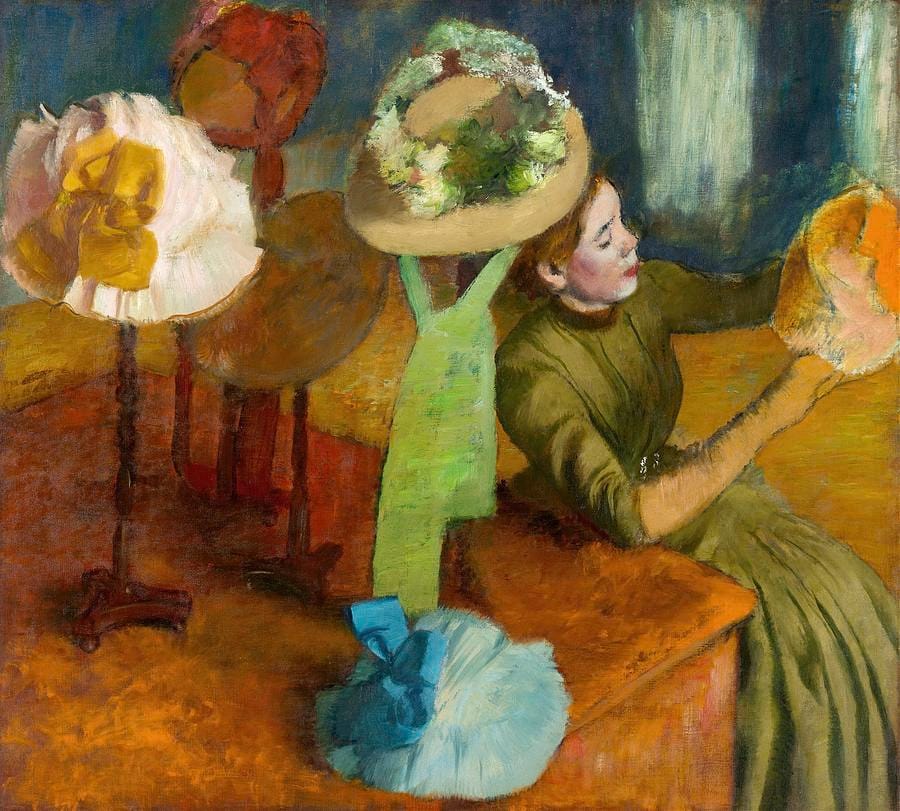
The Millinery Shop (c. 1879–86) belongs to a series Degas made about the women who designed and sold hats in Paris. A milliner leans over a table crowded with finished hats, holding one up to examine it, her mouth pursed in concentration. The hats themselves are painted with the most brilliant color in the picture — greens, yellows, and reds — while the woman is cropped at the edge of the frame and half-absorbed into the background. It is a painting about skilled work and the goods it produces, and about how easily the maker disappears behind them.
Four Jockeys
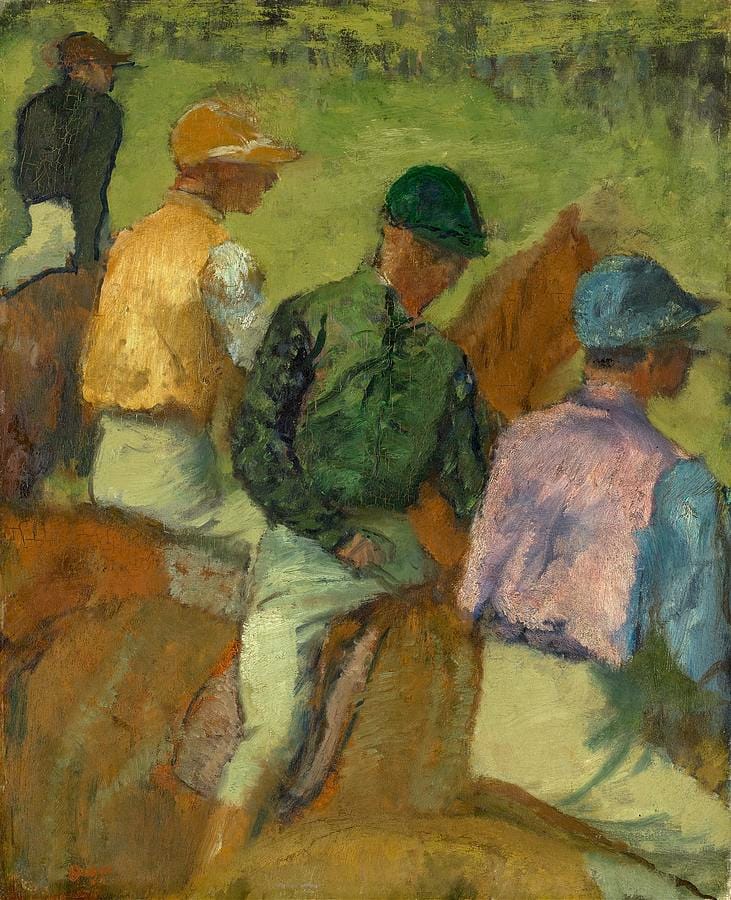
Alongside the ballet, the racecourse was Degas’s favorite arena for studying bodies in motion. In Four Jockeys, riders in bright silks gather before a race, their horses restless, the group arranged across the canvas in the same off-balance way Degas composed his dancers. He studied horses obsessively, working from sculpture, photographs of animal locomotion, and his own wax models. What interested him was never the drama of the finish but the loose, unposed minutes beforehand, when riders and animals are simply waiting.
A Woman Ironing
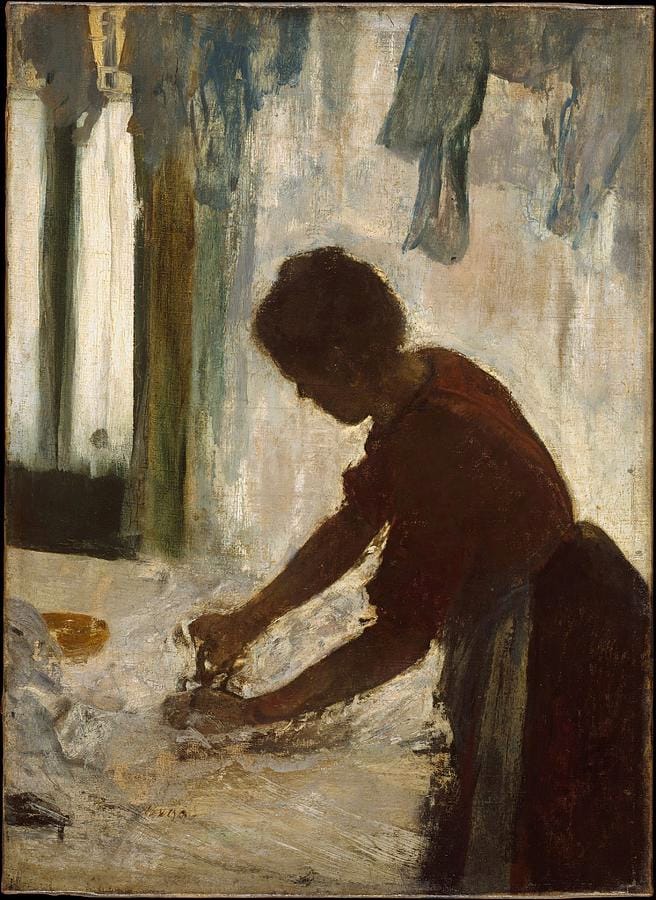
Degas returned again and again to the laundresses of Paris, women whose work was hot, heavy, and endless. In A Woman Ironing, a laundress presses down on her iron with both hands and the whole weight of her upper body, her face lowered and indistinct. There is no sentiment and no protest in the picture, only close attention to the physical facts of the job. Émile Zola, who wrote about the same women in his novels, admired Degas for seeing them clearly, and these paintings are among the most unflinching images of labor in nineteenth-century art.
Russian Dancers
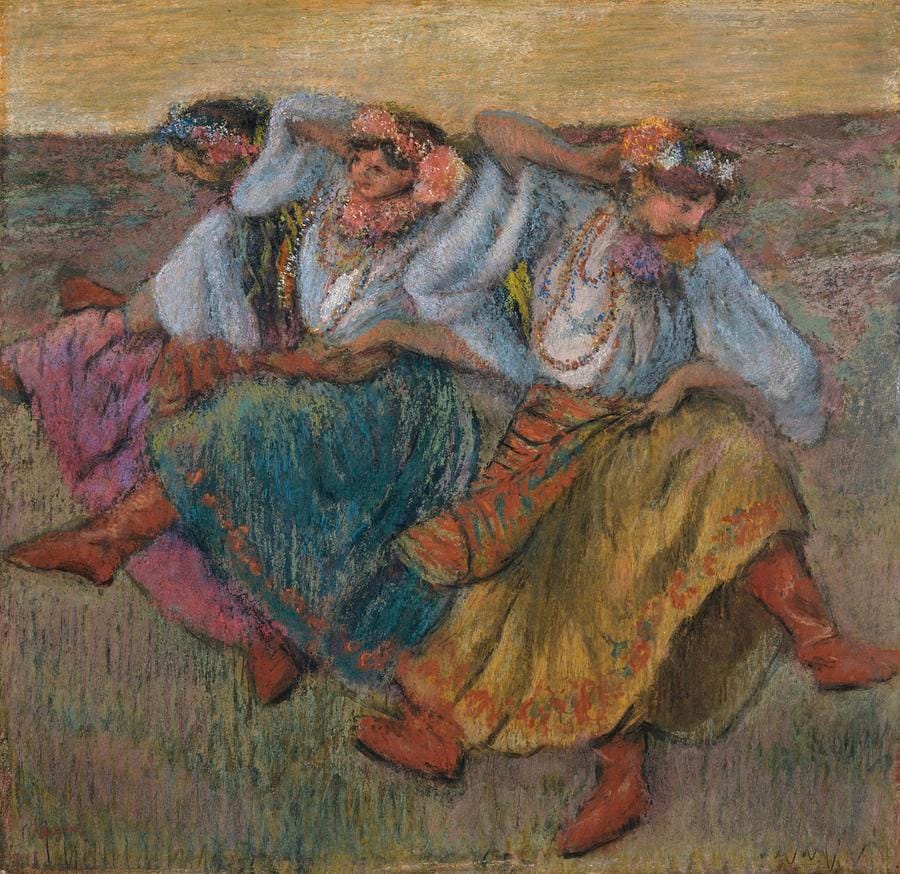
In his final working years Degas produced a series of pastels of dancers in Russian or Ukrainian folk costume — embroidered blouses, bright skirts, ribbons in their hair, and red leather boots — stamping and whirling across a bare landscape. Russian Dancers is the best known of the group. The color is far hotter and freer than anything in his ballet pictures, laid down in thick strokes of orange, green, and violet that almost break loose from the figures. Nearly blind by this point, Degas worked close to the paper and by feel, and these late pastels are among the most physically alive things he ever made.
Interior
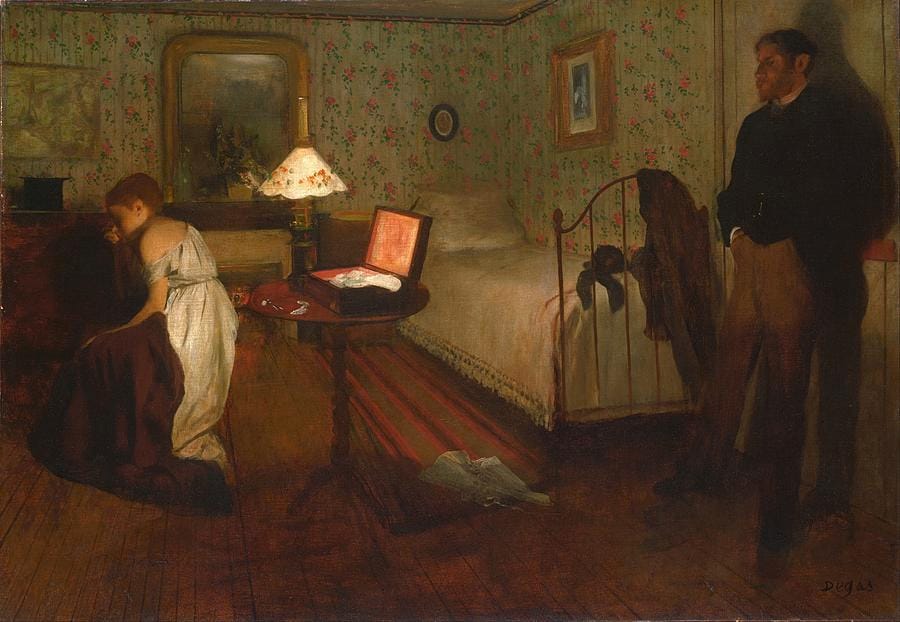
Interior (c. 1868–69) is Degas’s most mysterious painting and his only true narrative scene. In a lamplit bedroom, a man stands against the door with his hands in his pockets while a woman in a white slip turns away from him toward the corner; a small open sewing box sits on the table between them. Degas himself called it simply “my genre picture,” but critics have spent more than a century trying to name the story — most often linking it to a scene from a Zola novel. The tension in the room has never been resolved, which is precisely why it grips.
Woman Combing Her Hair
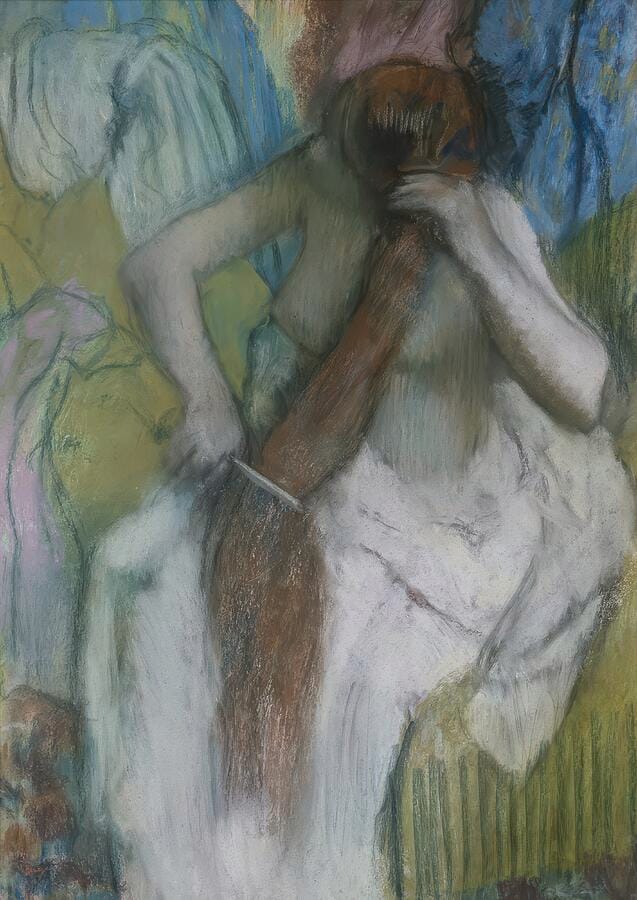
In the last decades of his life, as his eyesight failed, Degas turned increasingly to pastel and to a single subject: women washing, drying, and combing their hair, seen as though through a keyhole. Woman Combing Her Hair shows a figure pulling a comb through a long fall of hair, her body twisted into an awkward, unglamorous curve. Degas said he wanted to show women “deprived of their airs and affectations,” and the pictures are built from dense, hatched strokes of vivid color that make the pastel itself as physical as the pose.
Mary Cassatt at the Louvre
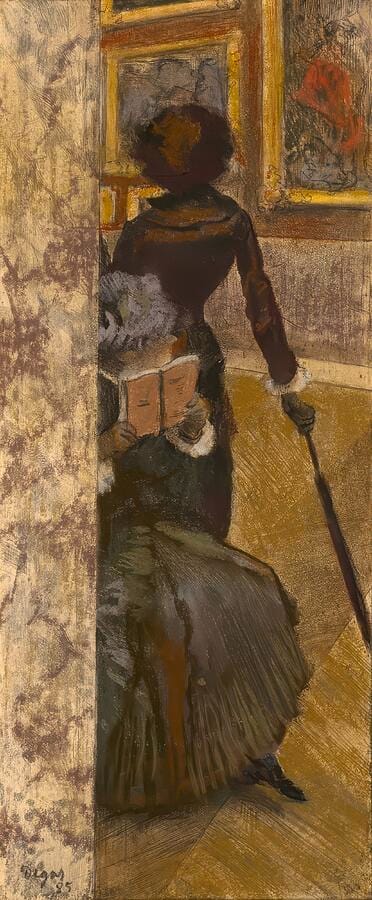
The American painter Mary Cassatt was Degas’s closest artistic friend, and he portrayed her several times at the Louvre, leaning on a furled umbrella as she studies the art on the walls. Her face is barely visible — Degas shows her from behind, a tall dark silhouette of concentration, while a seated companion consults a guidebook beside her. The flattened space, the bold vertical of the umbrella, and the daring crop all reveal how deeply Degas had absorbed Japanese prints, and the image doubles as a portrait of one artist watching another look.
Degas spent sixty years watching people who were not watching him, and the results — his dancers, laundresses, milliners, and bathers — remain some of the most quietly modern images in art. His work suits almost any room, bringing movement and warmth without ever tipping into decoration.
Shop Edgar Degas prints here, and explore the rest of our famous paintings collection for more of the world’s most beloved masterpieces.