Claude Monet’s Ten Most Famous Paintings
Water lilies, haystacks, and the sunrise that named a movement — the ten essential paintings of Impressionism’s founder.

Claude Monet (1840–1926) gave Impressionism its name, its method, and many of its most loved images. Raised in the Normandy port of Le Havre, he learned to paint outdoors as a teenager under the guidance of Eugène Boudin, and he never really stopped — hauling canvases onto beaches, riverbanks, and clifftops for the next sixty years in pursuit of a single question: what does light actually look like at this moment, in this weather, on this surface?
The answer changed constantly, which is why Monet so often painted the same subject over and over. Grainstacks, poplars, a cathedral façade, the Thames, and finally his own water garden at Giverny all became series, each canvas recording a different hour or season. Critics mocked the results as unfinished; today they hang in nearly every major museum on earth. Here are ten of his most famous paintings.
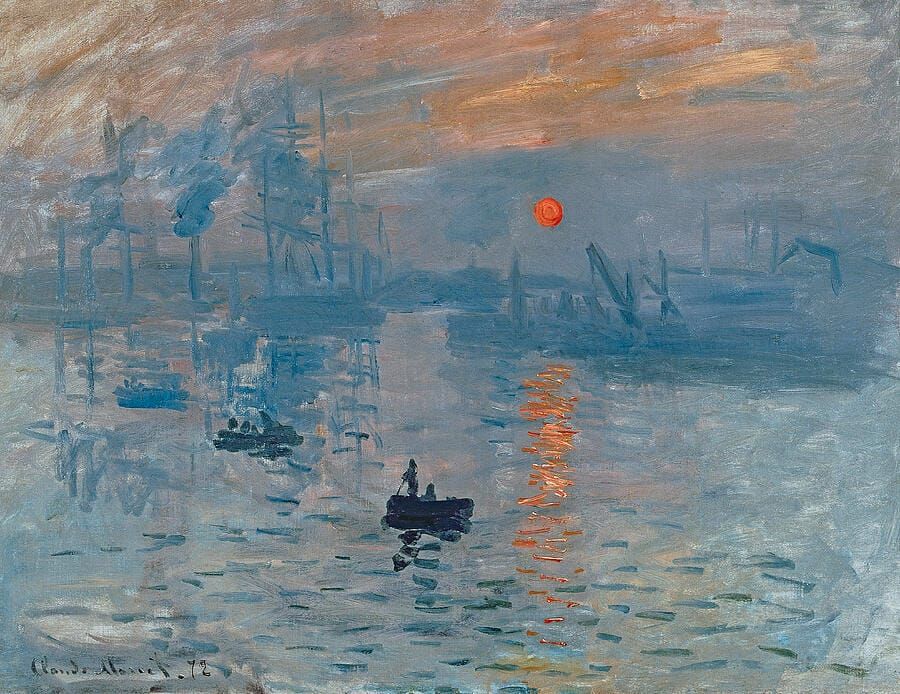
Impression, Sunrise
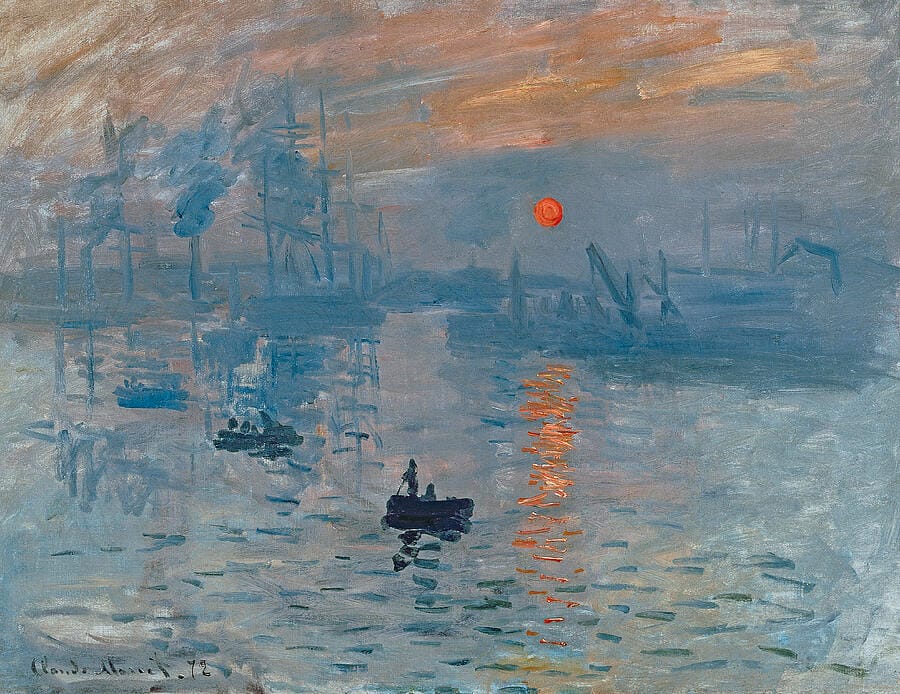
This small, hazy view of the harbor at Le Havre is the painting that named a movement. Monet made it in 1872, catching the sun as a burning orange disc low over blue-gray water, with dockyard cranes and masts dissolving into mist and two rowing boats sketched in a handful of strokes. When it appeared at the group exhibition of 1874, the critic Louis Leroy seized on the title and derided the whole show as “Impressionism.” The insult stuck, the painters adopted it, and one modest canvas of a working port became the founding document of modern painting.
The Water Lily Pond
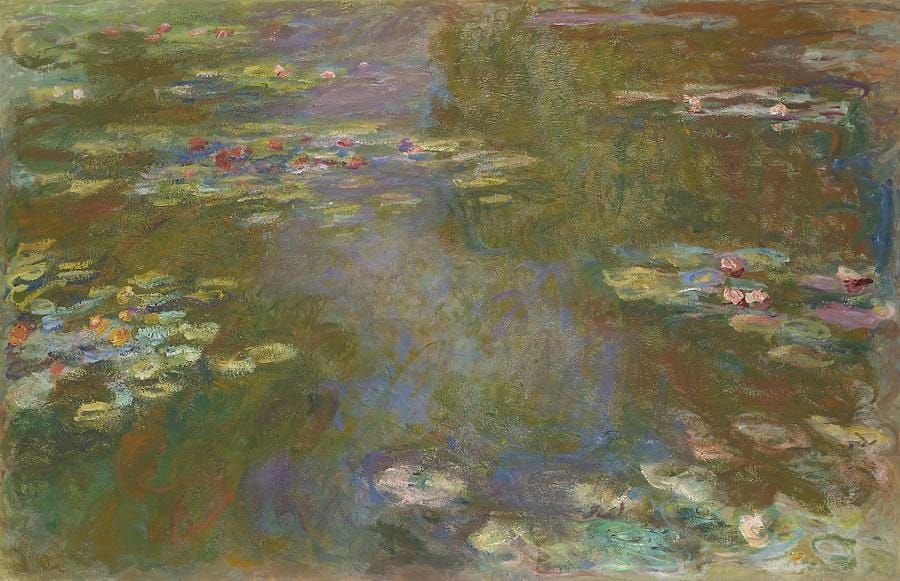
In 1893 Monet bought the land beyond his garden at Giverny, diverted a small tributary of the Epte, and built himself a water garden with a Japanese-style footbridge across it. It became his subject for the rest of his life. In this version the green bridge arcs over a pond crowded with lilies and reflected willows, the composition pressed flat and close so that there is almost no sky and no horizon — just water, leaves, and light. Monet would eventually paint roughly 250 water lily canvases, and it is here, in the enclosed green world he built himself, that the series began.
The Haystacks
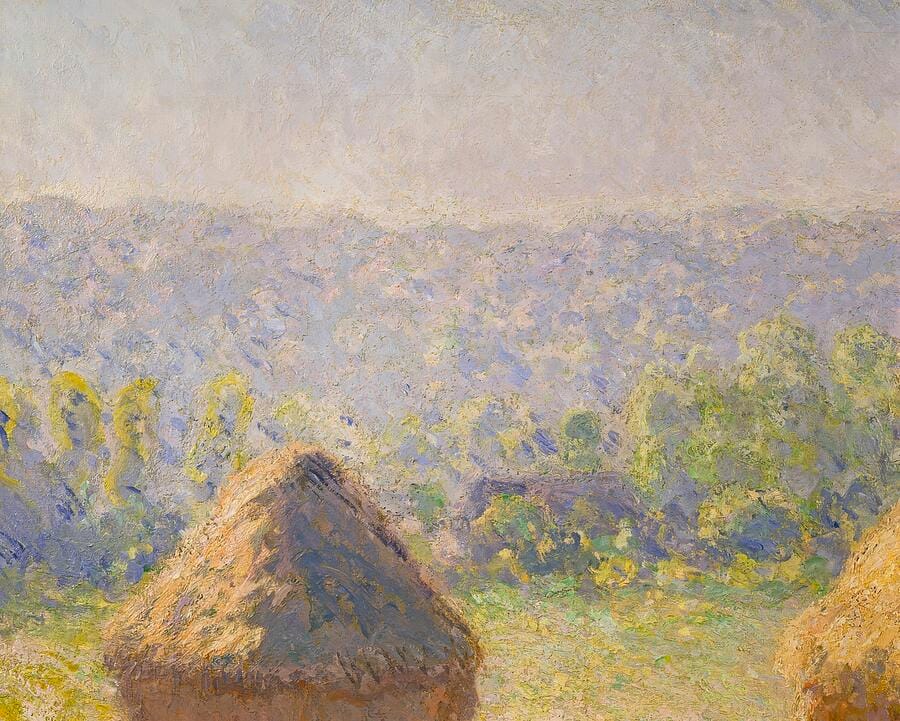
Through the winter of 1890–91 Monet worked in a field near his house on the stacks of harvested wheat that stood there after the threshing. He painted them at dawn, at midday, in snow, in frost, and at sunset, moving from canvas to canvas as the light shifted and carrying them out in a wheelbarrow. The stacks themselves are almost beside the point; what changes is everything around and upon them. When the series was shown in Paris in 1891 it sold out within days, and a young Russian named Wassily Kandinsky later said seeing one of these paintings set him on the road to abstraction.
The Poppy Field
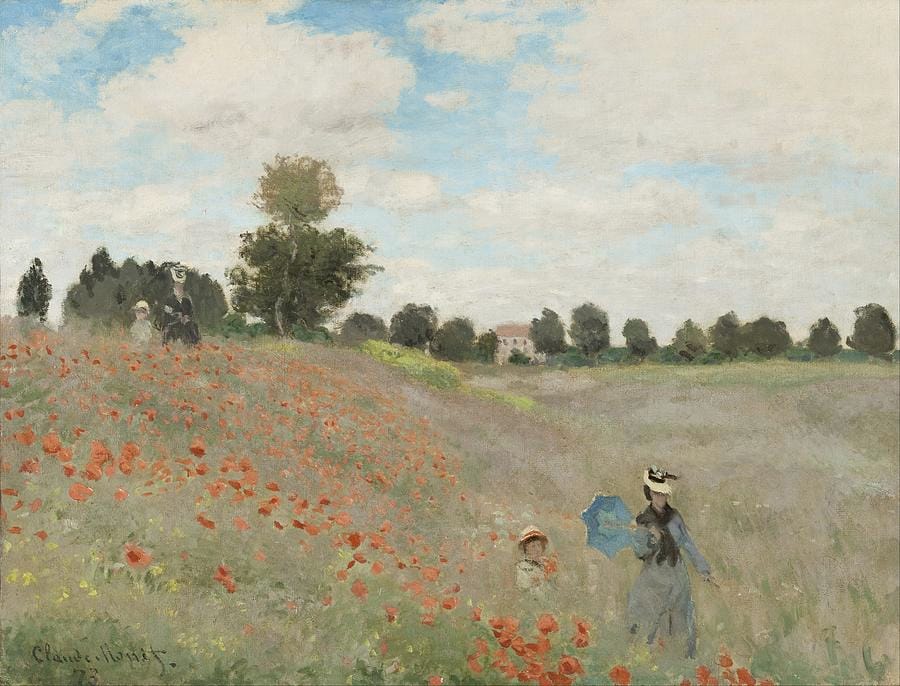
Painted in 1873 near Argenteuil, where Monet was living on the Seine outside Paris, this is Impressionism at its most immediately delightful. A woman with a parasol and a child come down a slope through waist-high grass, and the poppies scattered across the field are laid on in loose dabs of pure red that seem to vibrate against the green. The figures — almost certainly his wife Camille and their son Jean — appear twice, once near and once far, marking the path down the hill. It was among the works Monet showed at the first Impressionist exhibition in 1874.
Rouen Cathedral
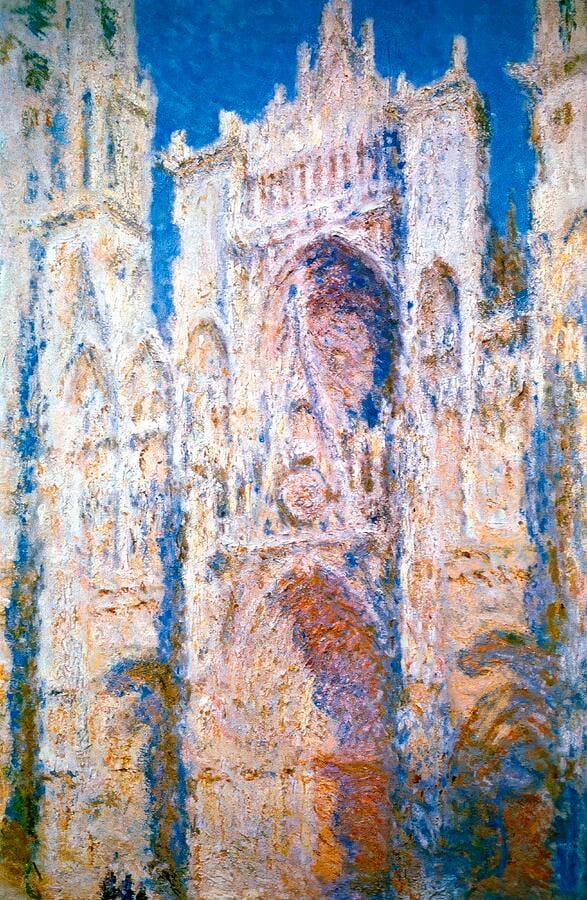
Between 1892 and 1894 Monet rented rooms across the square from Rouen Cathedral and painted its west front some thirty times. He worked on several canvases at once, switching as the sun moved, and the stone shifts from cold blue-gray at dawn to blazing gold at midday to dusty rose at sunset. Almost nothing of the architecture is described in the ordinary sense — the carved porches and towers are built entirely out of crusted, encrusted paint. Monet found the series agonising and wrote that he was having nightmares about the building, but it remains his most radical statement that a subject is only ever the light falling on it.
Woman with a Parasol
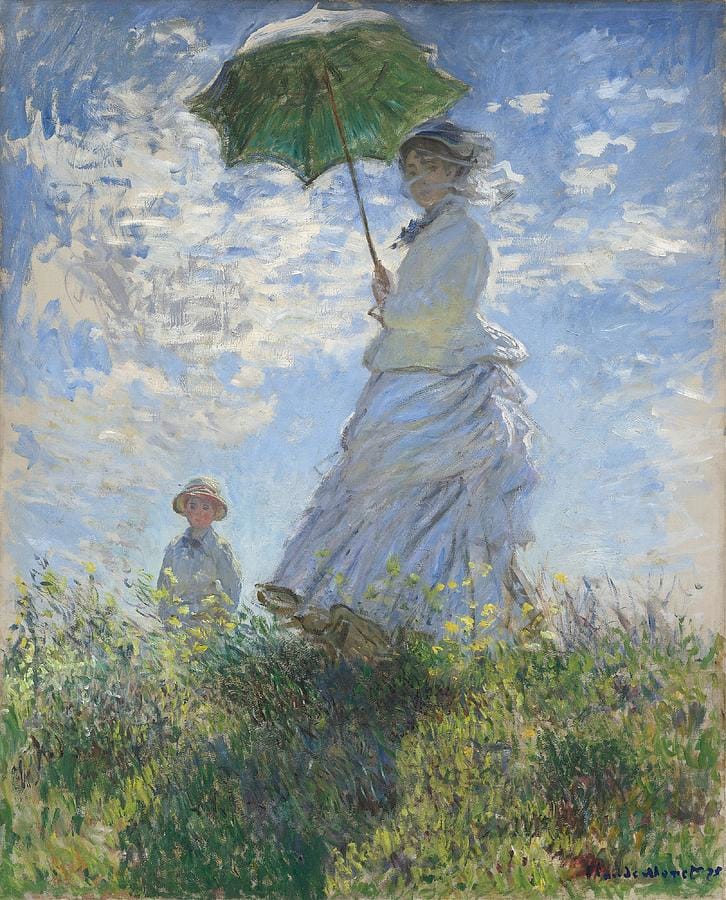
Monet painted this portrait of his wife Camille and their son Jean outdoors in a single session in 1875, and the speed shows in the best possible way. Seen from below against an enormous sky, Camille turns toward the viewer with her veil and skirts blown sideways by the wind, her parasol casting a wash of green shadow across her face. Jean stands further back in the long grass, half-hidden. There is no studio polish anywhere in it; the whole picture is about air and movement. Camille died four years later, at just thirty-two, and this remains the most affectionate image Monet ever made of her.
The Beach at Sainte-Adresse
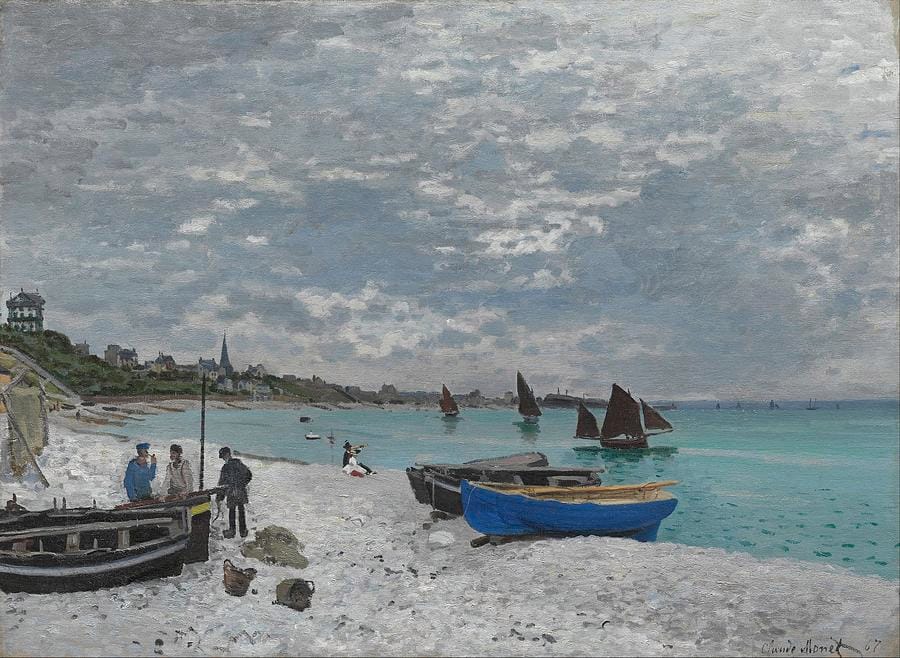
Sainte-Adresse is the seaside town just outside Le Havre where Monet spent childhood summers, and he returned to paint there in his twenties while nearly penniless and staying with relatives. The beach he shows is a working one: fishing boats hauled up on the shingle, figures in dark clothes going about their business, a gray-green Channel running out to a low horizon under a broad, unsettled sky. The handling is broader and heavier than his later work, but the instinct is already fully formed — no anecdote, no picturesque staging, just weather, water, and the particular light of the Normandy coast.
The Artist's Garden at Giverny
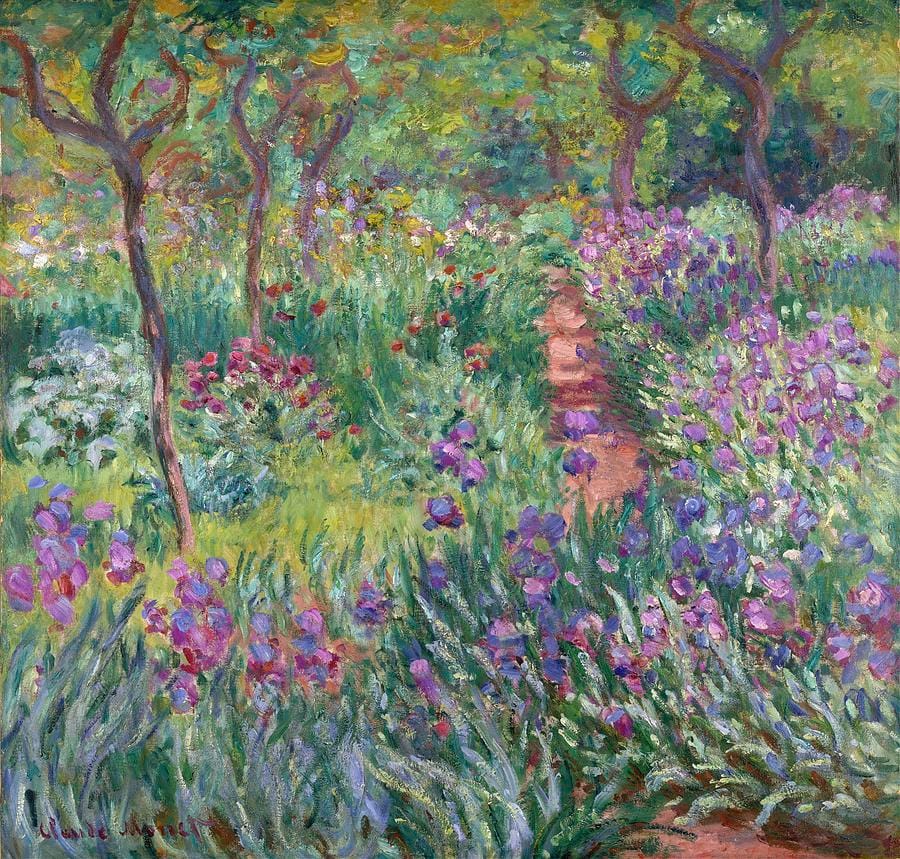
Monet was as serious a gardener as he was a painter, employing a team of gardeners at Giverny and planting specifically for the pictures he intended to make. This canvas from 1900 looks down long rows of irises in flower, the purple and violet blooms running diagonally across the composition beneath a screen of trees, with the paths barely visible between them. The color is extraordinary — banks of violet set against yellow-green foliage — and the perspective is tipped up so steeply that the flowers nearly fill the frame. It is a painting of a garden made by the man who made the garden.
The Houses of Parliament
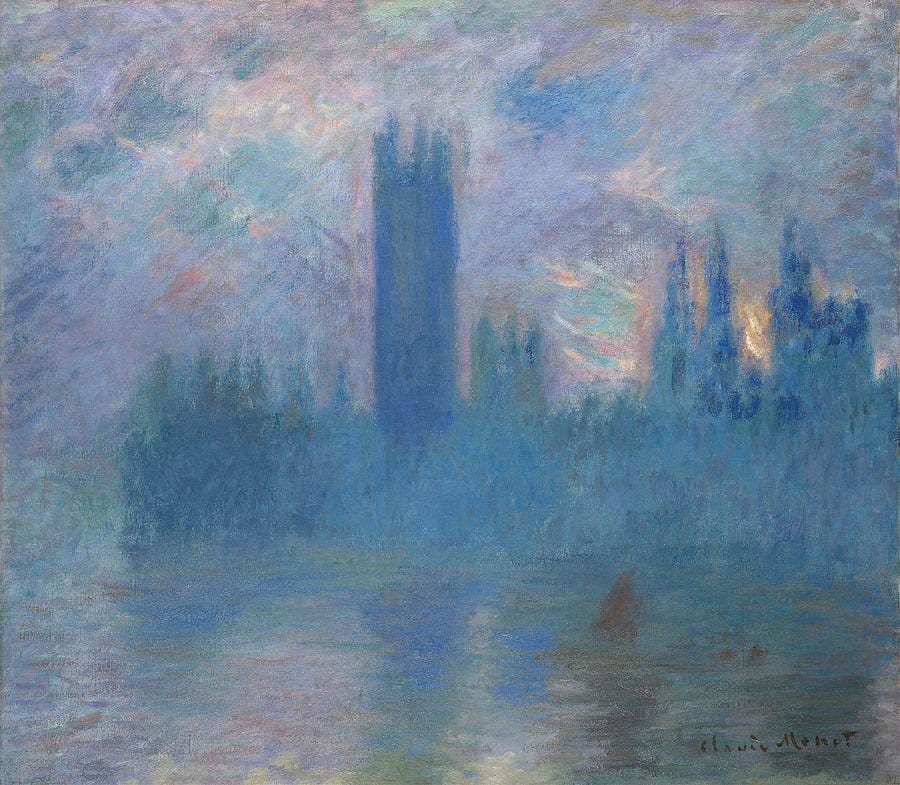
Monet loved London for the same reason most visitors complained about it: the fog. Working from a window at St Thomas’s Hospital across the Thames during a series of winter campaigns between 1900 and 1905, he painted the Palace of Westminster nearly twenty times, its Gothic towers reduced to a violet silhouette floating in colored mist. In this version the sun burns through the haze and lays a broken track of light across the water. “Without the fog,” he said, “London would not be a beautiful city.” The series is among the most atmospheric work of his career.
The Cliff Walk at Pourville
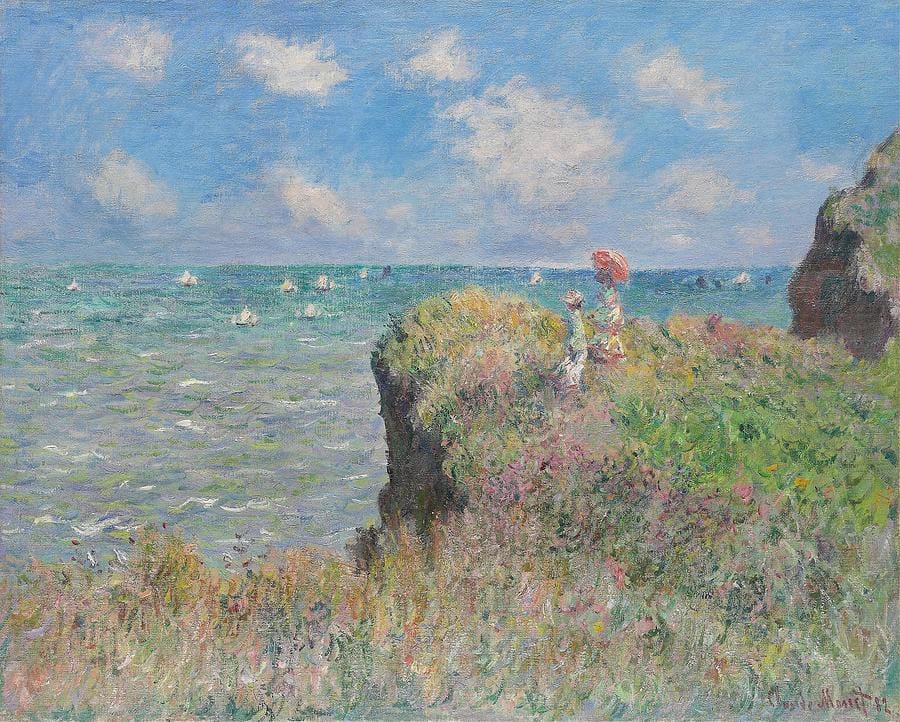
In the summer of 1882 Monet took a house on the Normandy coast at Pourville, near Dieppe, and painted the cliffs above the sea again and again. Here two women in white stand on a grassy headland high above the Channel, their dresses and the flowering grass whipped by the wind, while far below the water lies pale green and streaked with sails. The vantage point is vertiginous — the ground simply drops away at the edge of the canvas — and the whole surface is alive with short, dry, directional strokes. It is one of the most exhilarating landscapes he ever painted.
More than a century after his death, Monet remains the painter people reach for when they want a room to feel calmer and brighter. The reason is not just the subject matter but the method: because he was always painting light rather than things, his canvases carry their own weather with them, and they change with the light in the room where they hang.
Shop Claude Monet prints here, and explore the rest of our famous paintings collection for more of the world’s most beloved masterpieces.