Childe Hassam’s Ten Most Famous Paintings
The Avenue in the Rain, Allies Day, the Isles of Shoals gardens and more: ten works by the painter who brought Impressionism to American cities.

Frederick Childe Hassam (1859–1935) was born in Dorchester, Massachusetts, worked as a wood engraver and illustrator in Boston, and went to Paris in 1886 to study. He came back with the broken brushwork and high-keyed color of French Impressionism and applied it to something the French had largely ignored: the modern American city in bad weather.
He was a founding member of the Ten American Painters, the group that broke away from the Society of American Artists in 1897, and he became the most commercially successful American Impressionist of his generation. Two subjects run through the work. One is the street — Boston and above all New York, wet, crowded, and seen through rain and snow. The other is the Isles of Shoals off the New Hampshire coast, where the poet Celia Thaxter kept a garden that Hassam painted for decades. He produced roughly three thousand works and left his remaining estate to fund the purchase of American art for museums. Here are ten of his most famous paintings.
The Avenue in the Rain
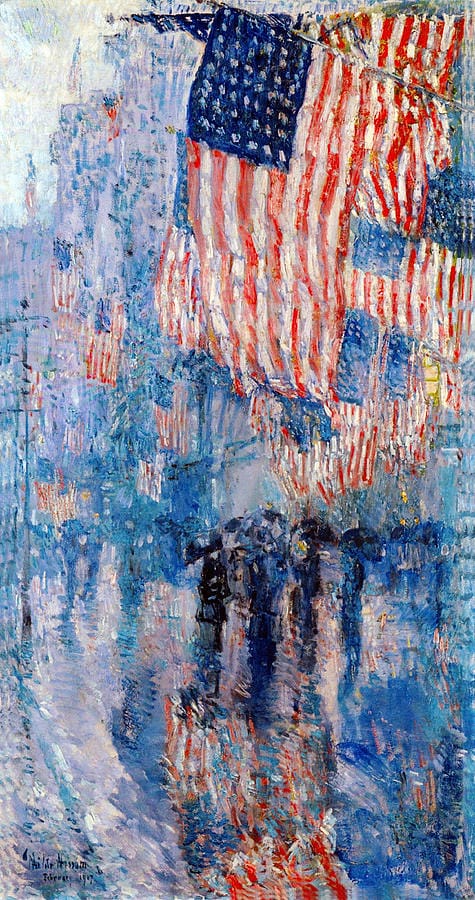
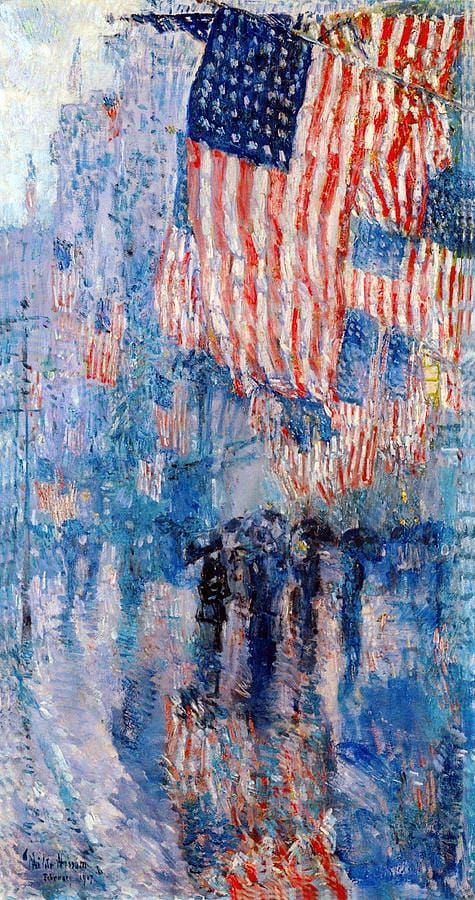
Painted in 1917, shortly after the United States entered the First World War, and the best known of Hassam's flag pictures. Fifth Avenue is hung with American flags that repeat down the length of the street and dissolve into their own reflections on the wet pavement, so that the picture is built almost entirely of red, white, and blue smeared vertically into the roadway. It hangs in the White House and has been borrowed by successive administrations as a backdrop for official photographs, which has made it one of the most widely seen American paintings of the century.
Allies Day
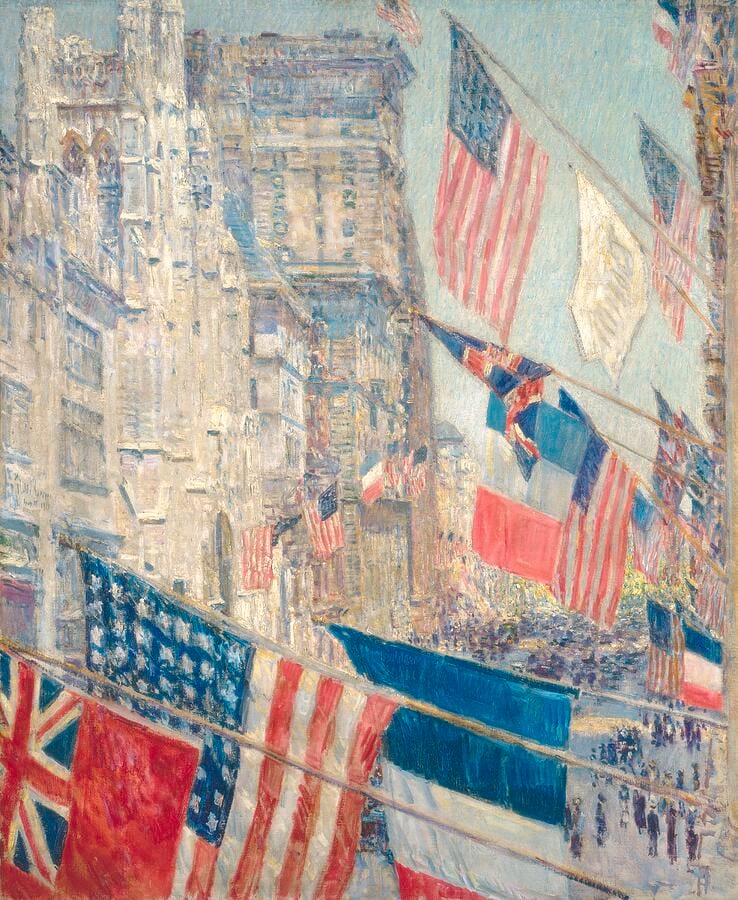
From the same 1917 flag series, and the largest and most formal of them. Hassam looks up Fifth Avenue past the massed banners of the United States, Britain, and France, with the buildings rising on either side and the flags carrying the eye into a hazy distance. He painted around thirty of these Avenue of the Allies pictures between 1916 and 1919, working from the parades and displays that filled the street during the war, and they are his most sustained response to a public event.
Rainy Day, Boston
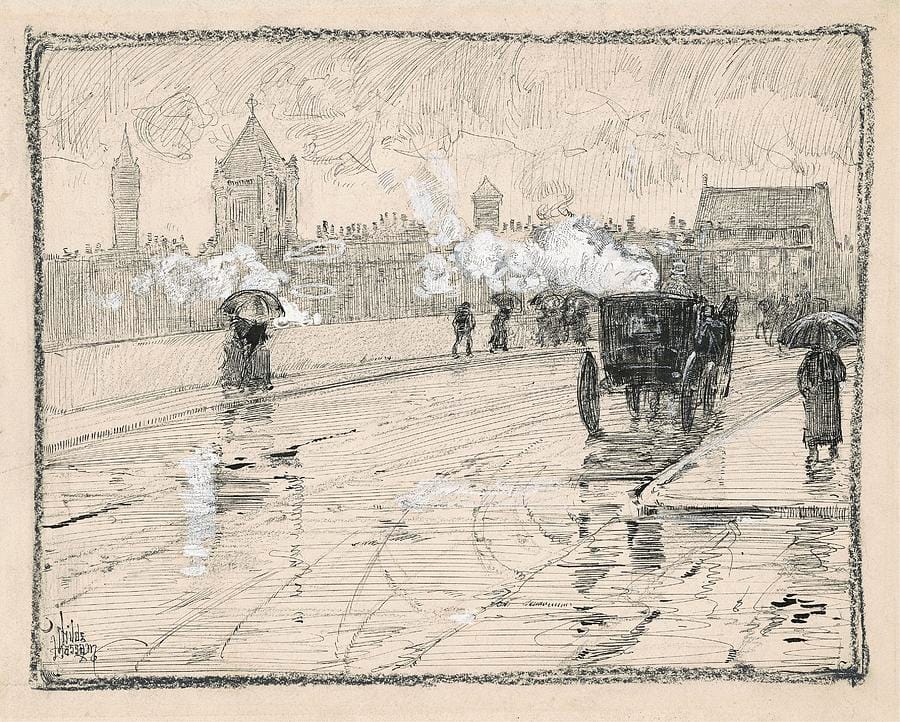
An early canvas from 1885, before Hassam left for Paris, and already the subject he would spend a career on. A wide intersection in the South End is seen under a steady rain, carriages moving across the wet cobbles, figures under umbrellas, the whole scene held together by reflected light on the roadway. The handling is tighter and darker than his later work — this is a tonal picture rather than an Impressionist one — but the instinct for what rain does to a city street was there from the start.
Washington Arch, Spring
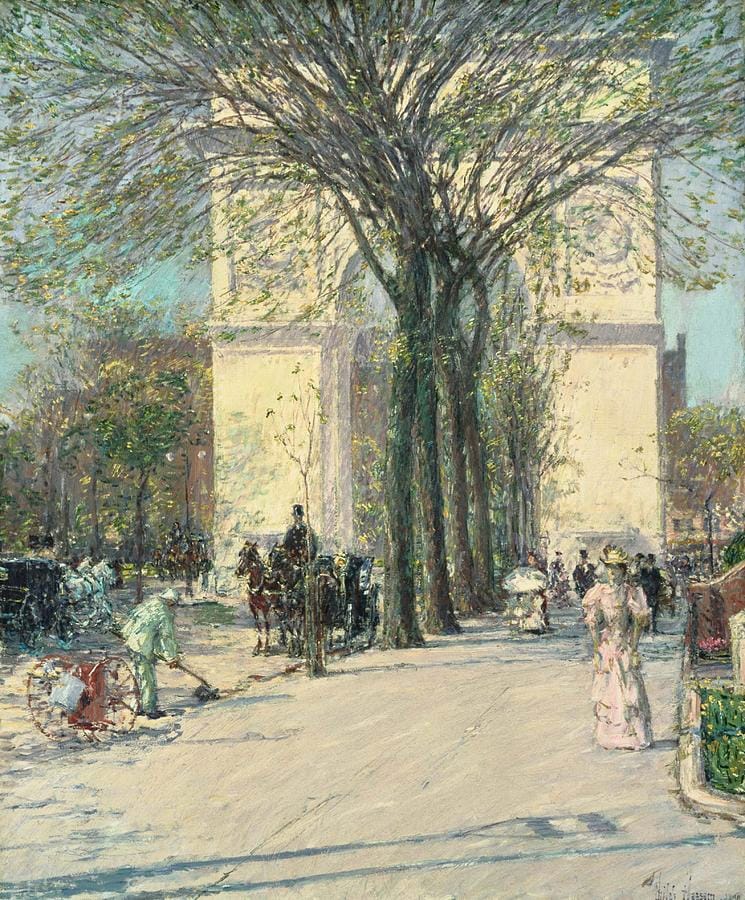
Painted in 1890, soon after Hassam settled in New York. Stanford White's marble arch at the foot of Fifth Avenue was then brand new, and Hassam shows it on an ordinary spring morning with a street sweeper at work in the foreground, carriages passing, and the trees of Washington Square just coming into leaf. The picture is a good demonstration of his method: a monument treated as one more part of daily life rather than as a subject deserving reverence.
Field Of Poppies, Isles Of Shoals
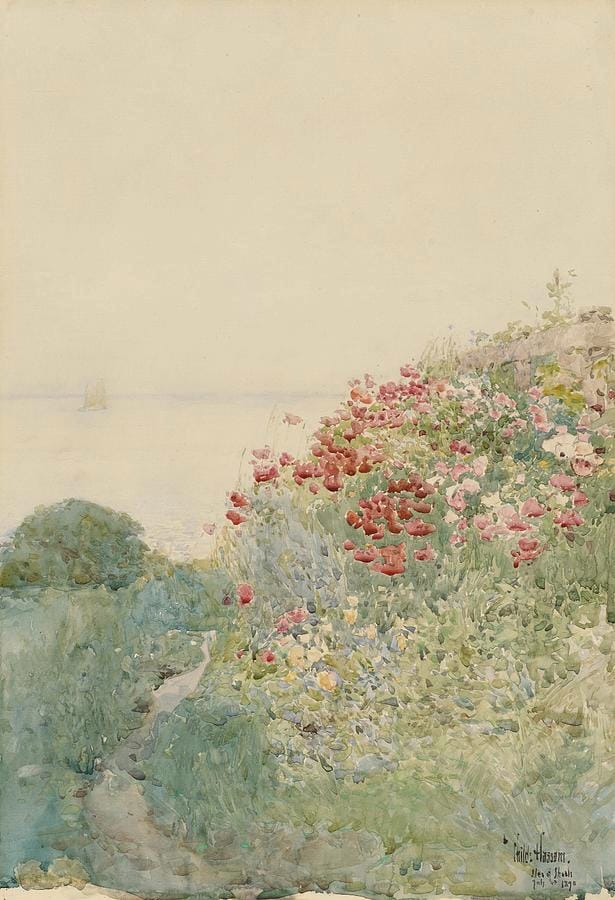
Celia Thaxter's cutting garden on Appledore Island gave Hassam the closest American equivalent to Monet's Giverny, and he painted it every summer for years. Here the poppies are laid in as loose scarlet touches over green, with the sea and sky beyond, and the picture is far more freely handled than his city work. Thaxter's book about the garden was published with Hassam's illustrations, and after her death in 1894 the garden itself was eventually lost.
The Fourth Of July
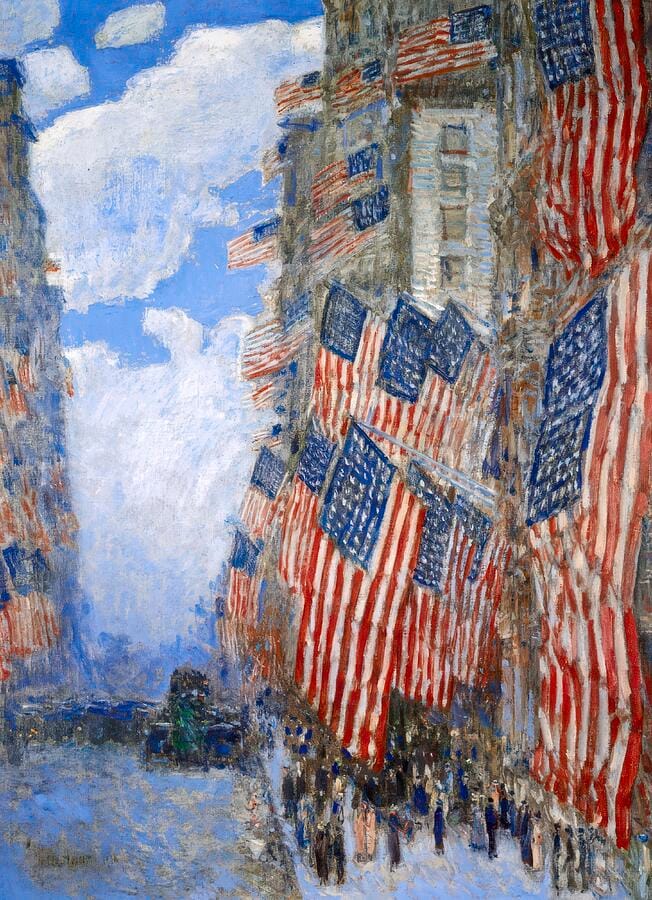
Flags again, but decades before the wartime series — Hassam returned to the subject of a flag-hung American street throughout his career. The holiday gave him a legitimate reason to fill a canvas with bright primary color and to break the architecture into fluttering fragments. Set beside the 1917 pictures, works like this show that the patriotic subject was a formal opportunity long before it became a national mood.
Isles Of Shoals
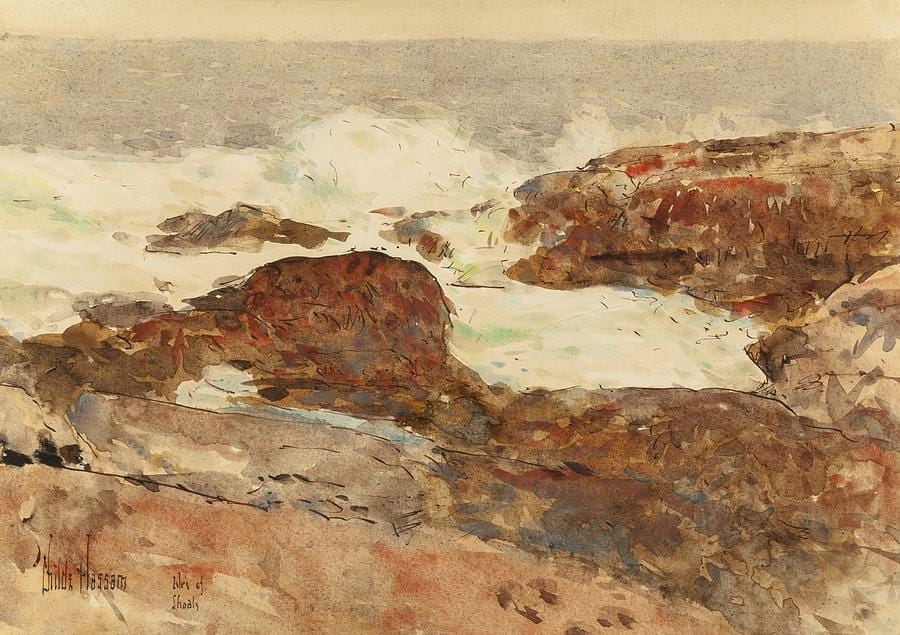
The rocky islands off Portsmouth were Hassam's summer retreat from the 1880s onward, and he painted the shoreline itself as often as the garden. The rocks give him hard geometry and the water gives himcolor — deep blues and greens broken into short strokes, with surf as bare white canvas. These marine subjects are where his brushwork is loosest and his debt to French Impressionism is most direct.
Surf Isles Of Shoals
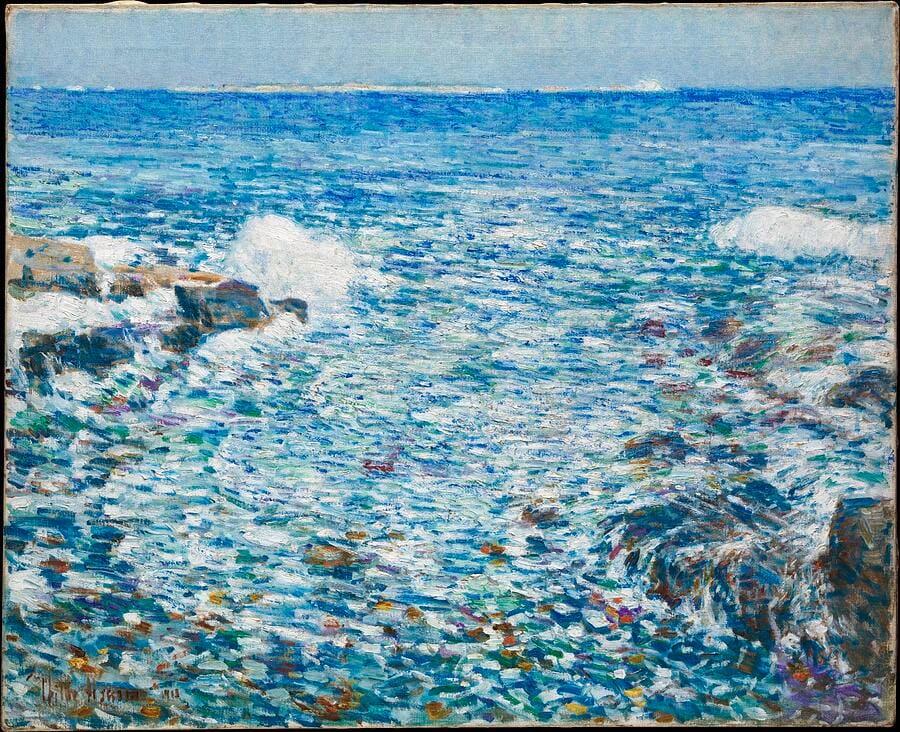
A study of water breaking on the granite ledges of Appledore, with almost no sky and no incident. Hassam was interested in the problem of painting moving water without describing it — laying down enough broken color to suggest weight and motion, and stopping before the strokes resolve into anything literal. The Shoals pictures were painted over some thirty summers, and this kind of close-focus study recurs across all of them.
The Victorian Chair
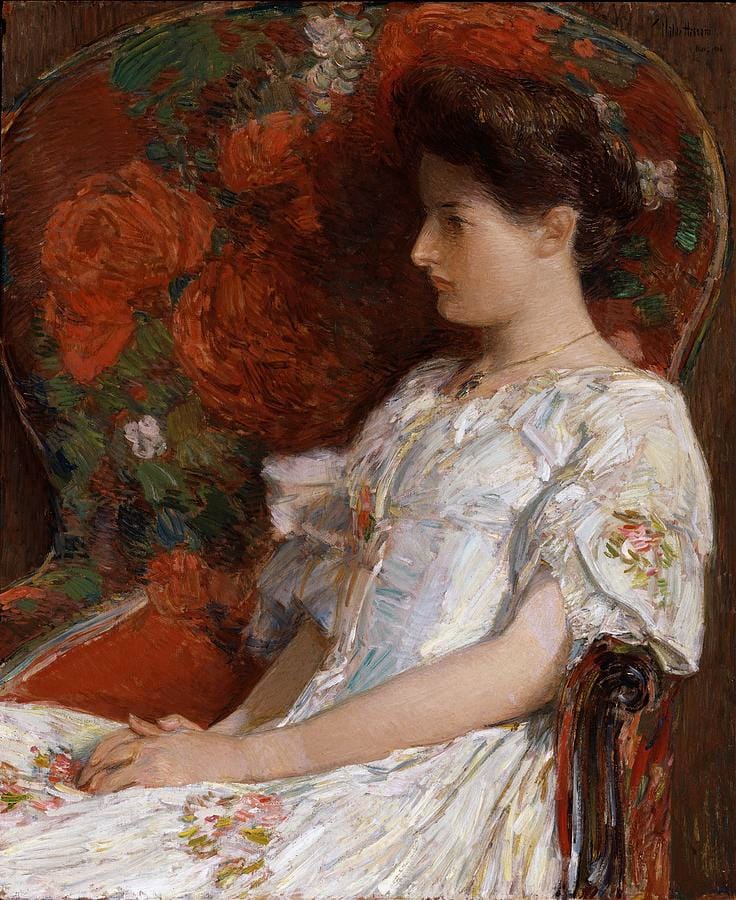
An interior, and a reminder that Hassam painted more than streets and shorelines. A woman sits reading in a patterned chair by a window, the light coming through curtains and breaking across the fabric and the wall. Pictures of this kind — a single figure absorbed in a domestic room, with the real subject being the light — connect him to the American Impressionist interiors of Dewing and Tarbell, and to Vermeer behind them.
Lighthouse, Isle Of Shoals
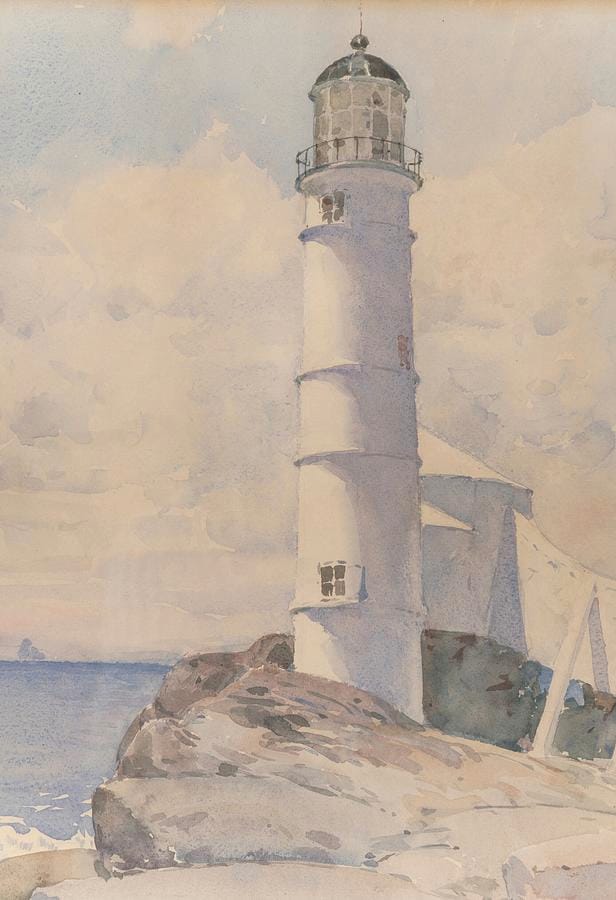
White Island light, seen across open water from the Shoals. Hassam gives the lighthouse itself very little detail and spends the picture on the water and the sky around it, so the structure reads as a vertical accent in an otherwise horizontal composition. Painted in the years when he was summering on Appledore, it belongs to the group of Shoals subjects that he treated most freely and returned to most often.
Hassam died at East Hampton in 1935. He had spent his last decades resisting modernism loudly and successfully, and his reputation dipped afterward before recovering; the flag paintings in particular are now among the most valuable American pictures of their period.
Shop Childe Hassam prints here, and explore the rest of our famous paintings collection for more of the world’s most beloved masterpieces.