Baroque vs Rococo
Baroque persuades you; Rococo entertains you. The dates, the palettes, the patrons and the six-second test for telling the two apart.

Baroque (c. 1600–1750) is dark, dramatic and monumental: harsh light out of deep shadow, violent diagonals, religion and state power. Rococo (c. 1715–1770) is its lighter successor: pastel, playful and private — small canvases, curling asymmetric ornament, flirtation instead of martyrdom. Baroque persuades you; Rococo entertains you.
The difference in one line, and the hinge between them
Baroque is loud and Rococo is light. Both are elaborate, and that is why they get confused — but they are elaborate for opposite reasons. Baroque ornament exists to overwhelm you on behalf of somebody powerful. Rococo ornament exists to charm the person who paid for it, in a room only their friends will see.
The hinge is a specific event. Louis XIV died on September 1, 1715, after seventy-two years on the throne. The French court, which had been held at Versailles under a regime of monumental symmetry, drifted back to Paris and into private townhouses — the hôtels particuliers. Art had to fit rooms rather than basilicas. It got smaller, lighter and much less serious, almost overnight.
So Rococo is not the opposite of the Baroque; it is the last phase of it, running for about fifty years inside and beyond the Baroque’s tail. Its name is a later insult, from the French rocaille — the shell-and-pebble work used in grotto decoration — coined around 1800 by people who thought the whole thing had been contemptible.
Baroque vs Rococo at a glance
| Baroque | Rococo | |
|---|---|---|
| Dates | c. 1600–1750 | c. 1715–1770s |
| Began in | Rome, in the Counter-Reformation | Paris, after the death of Louis XIV in 1715 |
| Who paid | The Church and absolute monarchs | Aristocrats decorating their own townhouses |
| Mood | Awe, drama, conviction, terror | Charm, wit, flirtation, leisure |
| Light | Violent contrast — one hard beam out of blackness | Even, diffuse, silvery, no real shadow |
| Color | Crimson, gold, umber, deep black | Rose, sky blue, mint, ivory, gilt |
| Composition | Strong diagonals, spiralling upward movement | Loose asymmetry, S-curves, scattered accents |
| Scale | Enormous — altarpieces, ceilings, palace façades | Small — overdoors, wall panels, boudoir canvases |
| Subject | Martyrdom, miracles, myth, dynastic portraits | Picnics, swings, lovers, shepherds, mirrors |
| Ornament | Heavy, symmetrical, architectural | Shells, C-scrolls, rocaille — deliberately off-balance |
| Key painters | Caravaggio, Rubens, Rembrandt, Velázquez, Gentileschi | Watteau, Boucher, Fragonard, Tiepolo |
| Ended by | Its own exhaustion, and the taste for lightness | The Neoclassical reaction of the 1760s–80s |
The fastest single row is light. A Baroque picture usually has one bright source and a great deal of darkness; a Rococo picture is lit evenly all over, like an overcast morning.
Baroque: light, weight and the will of the Church
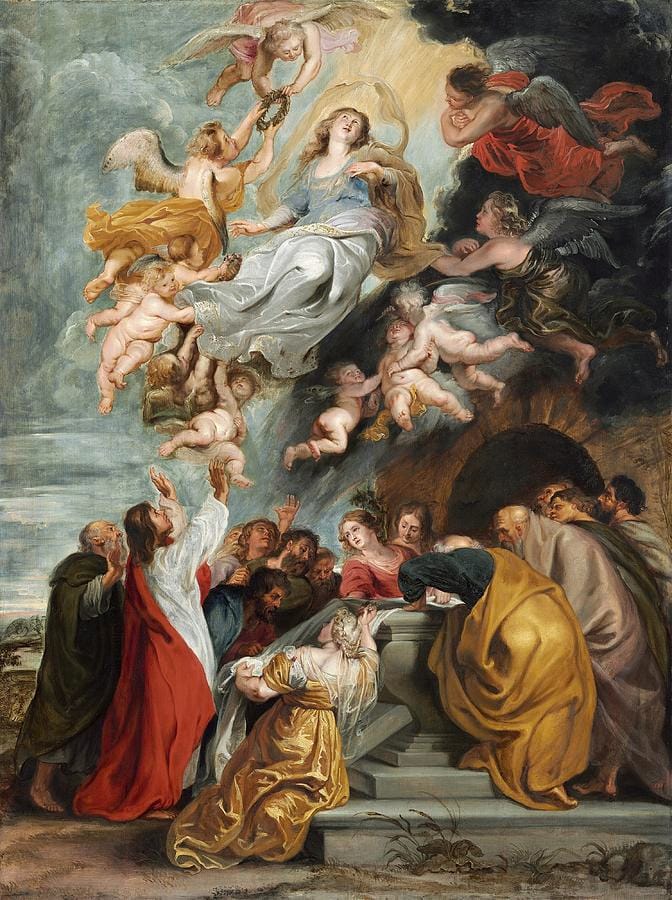
The Baroque was, at the start, a communications strategy. The Council of Trent, which closed in 1563, told the Catholic Church that religious art should be clear, emotionally direct and capable of moving an ordinary viewer — a deliberate answer to Protestant austerity. What came out of Rome forty years later was designed to overwhelm.
Caravaggio supplied the light: tenebrism, a single raking beam falling across figures who emerge from near-total blackness, with the saints given the faces and dirty feet of real Roman street people. Bernini supplied the movement, in marble that appears to be caught mid-event. Rubens supplied scale and abundance — vast canvases of bodies spiralling upward on a diagonal, painted in crimson and gold at a speed only a large workshop could sustain.
It was never only religious. The same language served absolute monarchy — Versailles under Louis XIV is a Baroque instrument — and produced the greatest secular painting of the century in Protestant Amsterdam and at the Spanish court, in Rembrandt and Velázquez. Browse Baroque prints and Caravaggio.
Rococo: pastel, private and pointedly frivolous
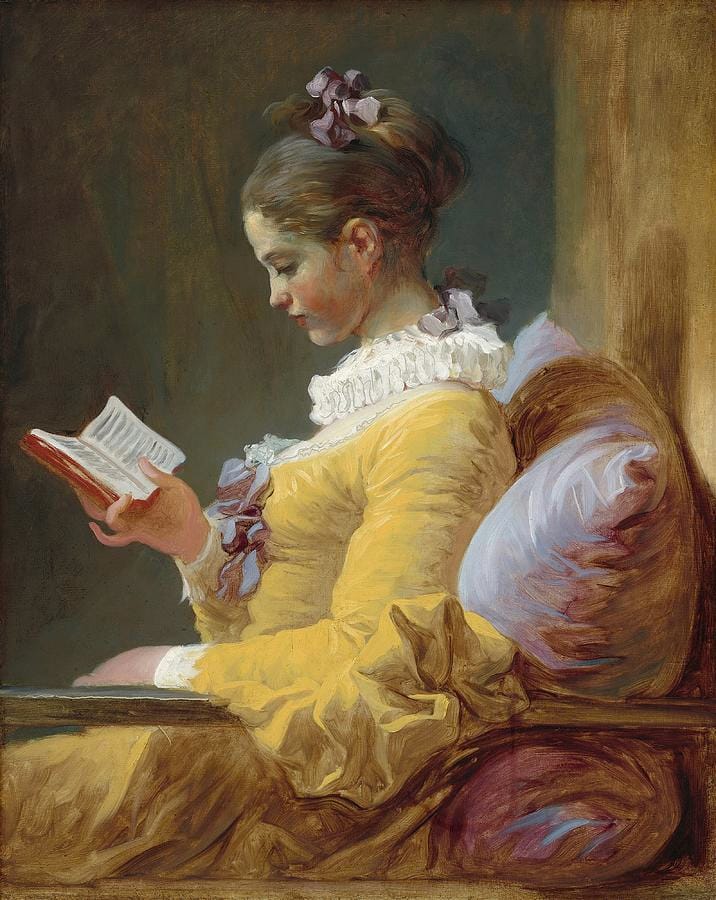
Rococo begins with Antoine Watteau, who painted small, melancholy scenes of elegantly dressed people idling in parkland. The French Academy had no category for these, so in 1717 it invented one — the fête galante — in order to admit him. That is the Rococo in miniature: an art of leisure, taken seriously enough to require a new bureaucratic slot.
François Boucher made it decorative and erotic, working for Madame de Pompadour on overdoors, tapestry cartoons and porcelain designs as much as on paintings. Jean-Honoré Fragonard made it fast and fizzing; his The Swing of 1767 — a woman in pink kicking off a slipper while her lover watches from the shrubbery — is the picture most people have in mind when they say Rococo. In Venice, Giambattista Tiepolo did something rarer: Rococo at Baroque scale, filling whole ceilings with pale blue sky.
The physical facts matter. These are mostly small pictures, made for paneled rooms with white and gold boiseries, mirrors and tall windows, in which nothing was meant to be darker than the walls. Browse Rococo prints and Rococo on canvas.
How to tell them apart at a glance
Six tests, quickest first.
- Count the light sources and measure the darkness. One hard beam and a lot of black is Baroque. Even, shadowless daylight is Rococo.
- Look at the palette. Crimson, gold and umber: Baroque. Rose, powder blue, mint and cream: Rococo.
- Ask how big it was meant to be. Altarpiece or ceiling: Baroque. Something that fits over a door or beside a mirror: Rococo.
- Ask what is happening. Somebody praying, dying, being martyred or being crowned: Baroque. Somebody flirting, picnicking or on a swing: Rococo.
- Check the ornament for symmetry. Baroque ornament balances about a center line. Rococo rocaille — shells and C-scrolls — is deliberately lopsided.
- Look for a diagonal. Baroque composition is built on one, usually rising. Rococo drifts in loose S-curves with no single axis.
What ended it was a change of mood rather than of taste. From the 1760s Rococo was attacked as decadent and un-serious, and Neoclassicism replaced it with straight lines, Roman subjects and civic virtue — a shift you can date precisely to the reception of Jacques-Louis David’s Oath of the Horatii in 1785, four years before the French Revolution made the point permanently.
Frequently asked questions
What is the main difference between Baroque and Rococo?
Baroque art is dark, dramatic and monumental — harsh light against deep shadow, powerful diagonals, and subjects of religion and state power, made for churches and palaces. Rococo is light, pastel and intimate — even illumination, curling asymmetric ornament, and subjects of leisure and flirtation, made for private townhouse rooms.
Is Rococo part of the Baroque period?
Yes, most historians treat Rococo as the final phase of the Baroque rather than a separate era. It emerged in Paris around 1715 while the Baroque was still current elsewhere in Europe, and it keeps the Baroque love of curves, movement and elaborate ornament while dropping its scale, its darkness and its seriousness.
When did Rococo begin and end?
Rococo began in France around 1715, the year Louis XIV died and the court moved back to Paris, and it faded through the 1760s and 1770s under the Neoclassical reaction. It lasted longer in southern Germany and Austria, particularly in church architecture, where it continued past the middle of the century.
Where does the word Rococo come from?
From the French rocaille, the shell-and-pebble decoration used in grottoes and fountains, probably crossed with the Italian barocco. It was coined around 1800 as an insult, meaning fussy and outdated, and only became a neutral art-historical term much later. No one working in the style ever used the word.
Is Versailles Baroque or Rococo?
Both, in layers. The palace built for Louis XIV in the 1660s to 1680s — the façades, the gardens, the Hall of Mirrors — is Baroque: monumental, symmetrical and designed to impress. Several interiors added under Louis XV in the 1730s, including his private apartments, are Rococo, on a far smaller and lighter scale.
Who are the most famous Rococo painters?
Antoine Watteau, who invented the fête galante and effectively began the style; François Boucher, its most decorative practitioner and Madame de Pompadour’s favorite; Jean-Honoré Fragonard, whose The Swing of 1767 is the best-known Rococo picture; and Giambattista Tiepolo in Venice, who worked in Rococo color at Baroque scale.
The practical difference for a wall is scale and contrast. Baroque reproductions need room and low light to work — they were built for dark interiors and they hold a large space alone. Rococo is happiest small, in pale rooms, and hung in groups. Browse Baroque and Rococo prints as canvas, framed or art prints.