Anders Zorn’s Ten Most Famous Paintings
Midsummer nights in Dalarna, Gilded Age drawing rooms, and dazzling watercolors: the ten works that define Sweden’s greatest painter.

Anders Zorn (1860–1920) was born on a farm at Mora, in the Swedish province of Dalarna, the son of an unmarried dairymaid and a German brewer he never met. He entered the Royal Academy in Stockholm at fifteen, grew impatient with it, and left early. What followed was one of the fastest careers in nineteenth-century art: within a decade he was the most sought-after watercolorist in Europe, and within two he was painting American millionaires and presidents at prices only John Singer Sargent could match.
Zorn painted wet, fast, and with an astonishingly narrow range of color — the restricted palette of white, yellow ochre, vermilion, and black associated with his name is still taught in art schools today. He was also one of the great etchers of his age. Yet for all his cosmopolitan success he kept returning to Mora, where he built a house, collected folk buildings, and painted the fiddlers, farm girls, and midsummer nights of his childhood. Here are ten of his most famous works.
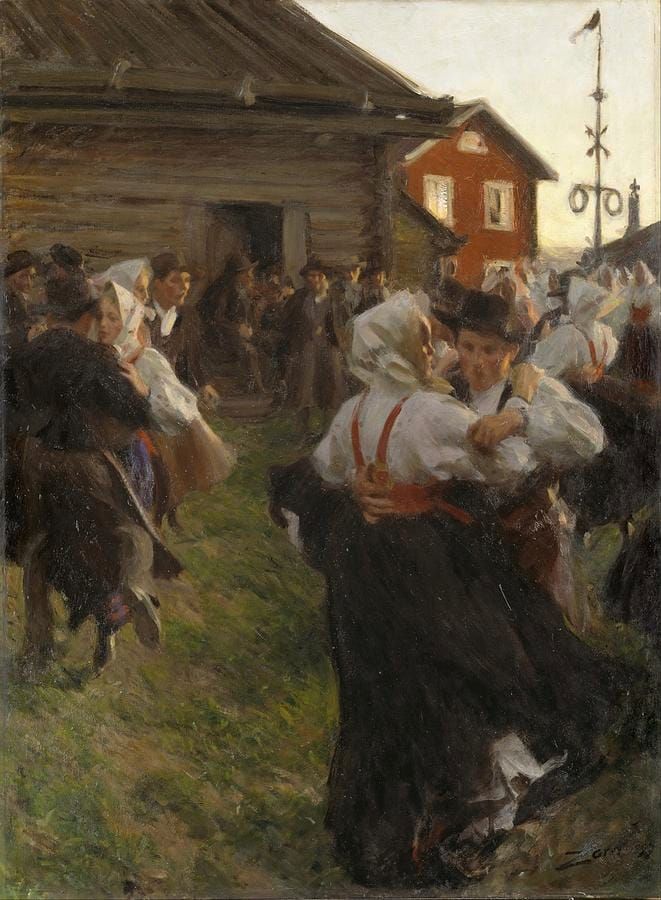
Midsummer Dance
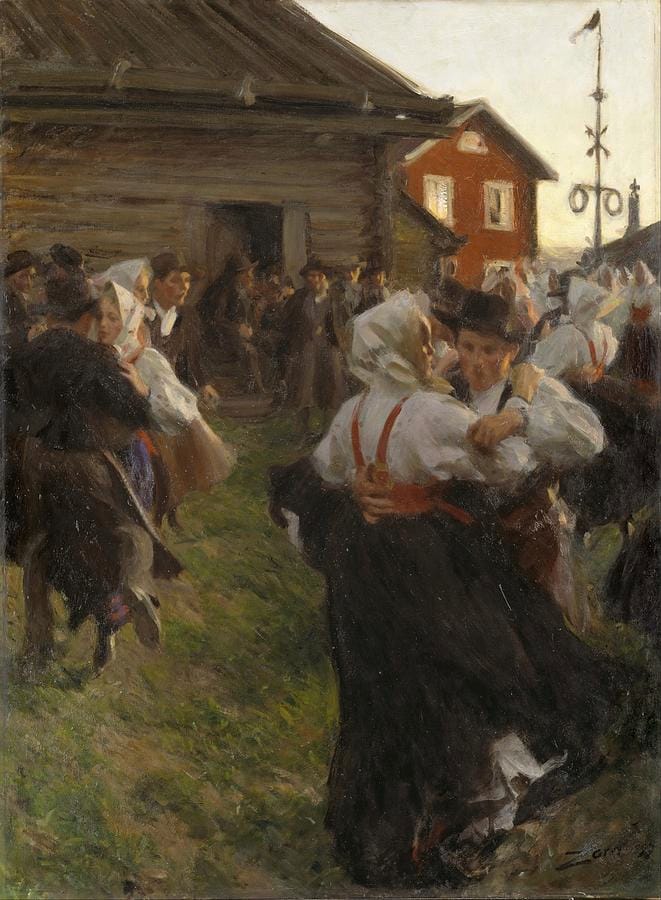
Painted in 1897, Midsummer Dance is the picture most Swedes name first when Zorn is mentioned. Couples whirl on the trodden grass outside a red timber cottage at Mora on midsummer night, the maypole standing at the right, the dancers’ movements blurred by the speed of the brushwork. The real subject is the light: this far north the sun barely sets in June, and Zorn painted the strange, sourceless glow of a summer night with no shadows in it. He worked on the canvas outdoors over several evenings. It hangs in the Nationalmuseum in Stockholm and has become something close to a national image.
Sommarnöje
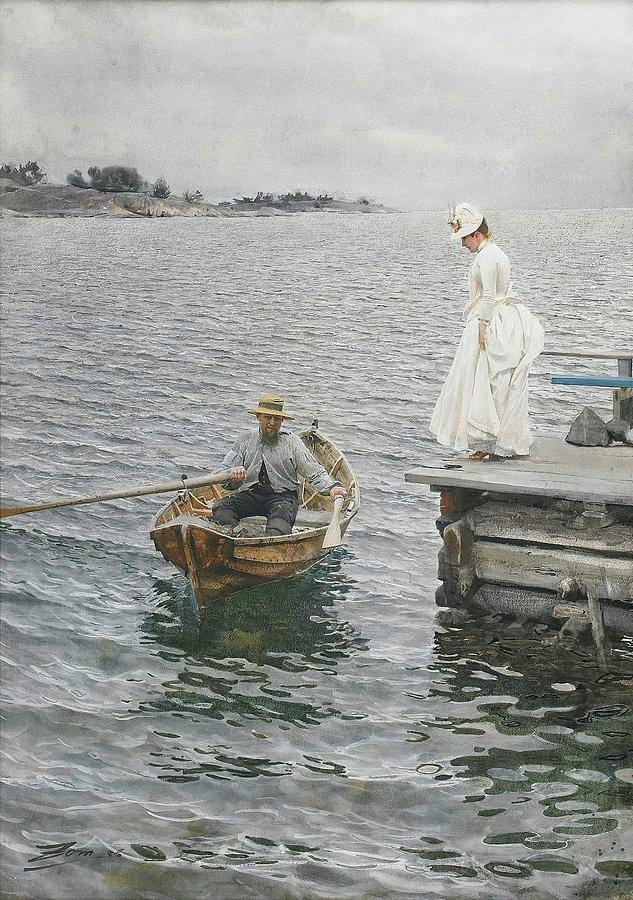
The title translates roughly as “summer pleasure” — the Swedish word for a holiday place by the water. In this 1886 watercolor a young woman in white stands on a jetty in the Stockholm archipelago while a man in a straw hat sits in a rowing boat just below her, the gray Baltic light spreading over the water behind them. Zorn was still primarily a watercolorist at this point, and the sheet is a display of what he could do with the medium: the reflections and the wet stones are laid in with a freedom that looks almost careless until you notice how exactly right every value is.
Hins Anders
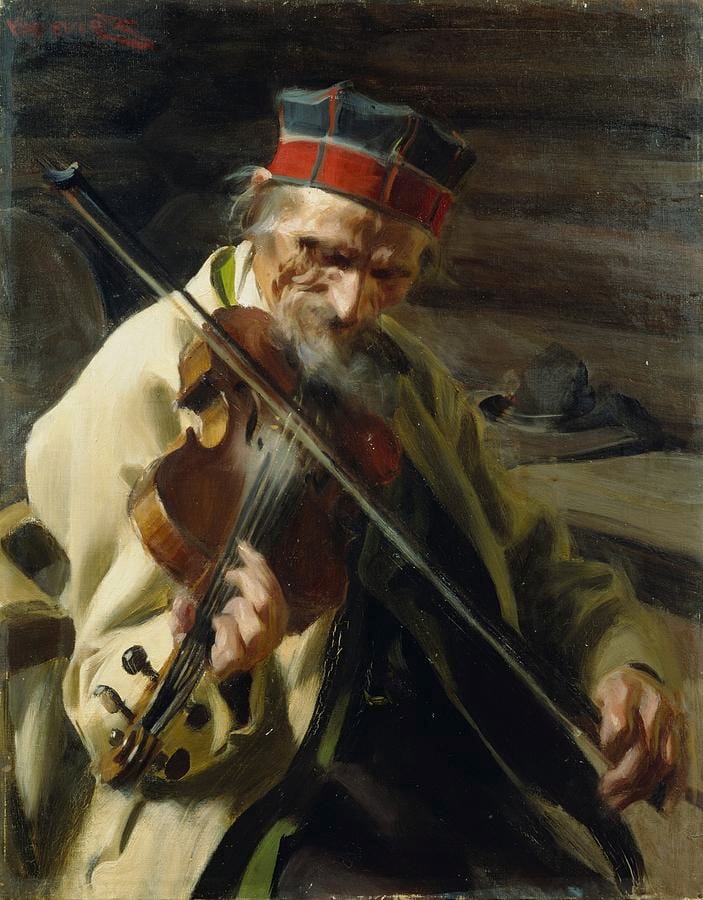
Hins Anders was a fiddler from Zorn’s home district, painted in 1904 in a heavy country coat and a brightly patterned cap, bow poised, looking straight out of the canvas with the amused, slightly challenging expression of a man who knows exactly how good he is. Zorn was a serious champion of Dalarna’s folk music — he helped organize fiddling competitions that revived the tradition when it was close to dying out — and he painted its players as seriously as he painted bankers. The brushwork here is enormously loose; step back and the fiddle, the beard, and the worn braid all snap into focus.
Mrs. Potter Palmer
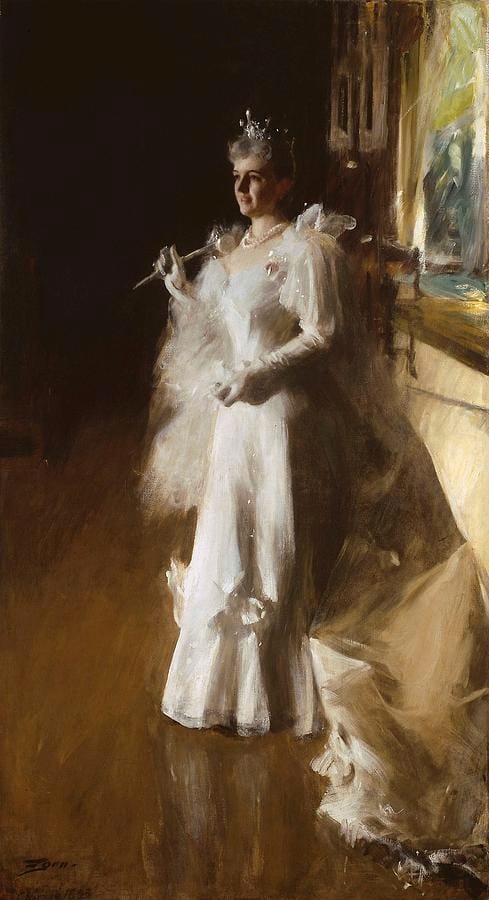
Bertha Honoré Palmer was the reigning hostess of Chicago and the head of the Board of Lady Managers at the 1893 World’s Columbian Exposition, where Zorn served on the Swedish delegation. She sweeps through a doorway in white satin with a jewelled band in her hair, caught mid-turn as though she has just noticed you. Painted in 1893 and now in the Art Institute of Chicago, the portrait launched Zorn’s American career. Palmer was a formidable collector in her own right, and her patronage opened doors that kept Zorn crossing the Atlantic for the next twenty years.
Mrs. Walter Rathbone Bacon
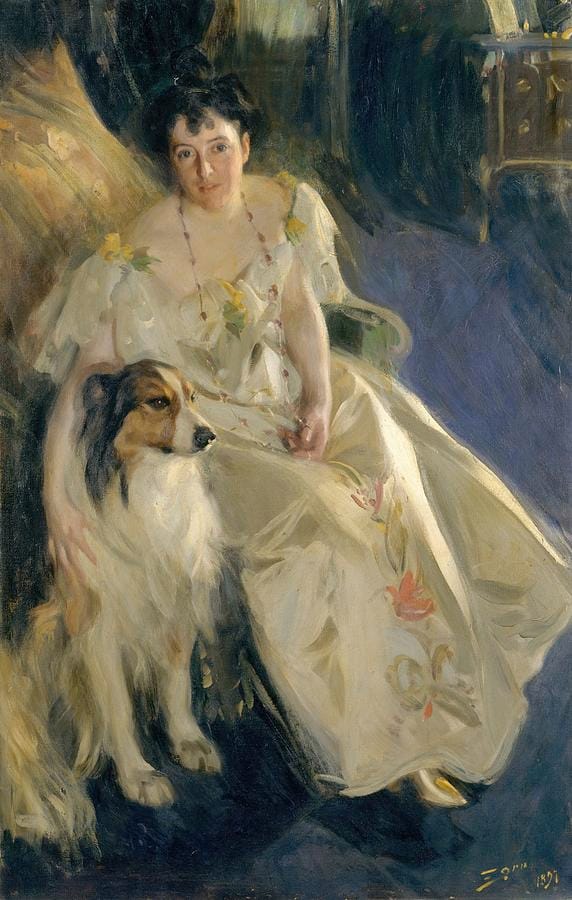
Painted in 1897, this portrait of Virginia Purdy Bacon shows her reclining on a sofa in a pale evening dress with a borzoi stretched out along her side, one arm draped loosely toward the dog. The whole picture is built from long, wet strokes of cream, silver, and blue-gray, and the dog’s coat and the woman’s gown are painted with the same handling, so that the two seem to flow into one another. It now hangs in the Metropolitan Museum of Art in New York — one of a series of society portraits in which Zorn found ways to make formality look relaxed.
William Howard Taft
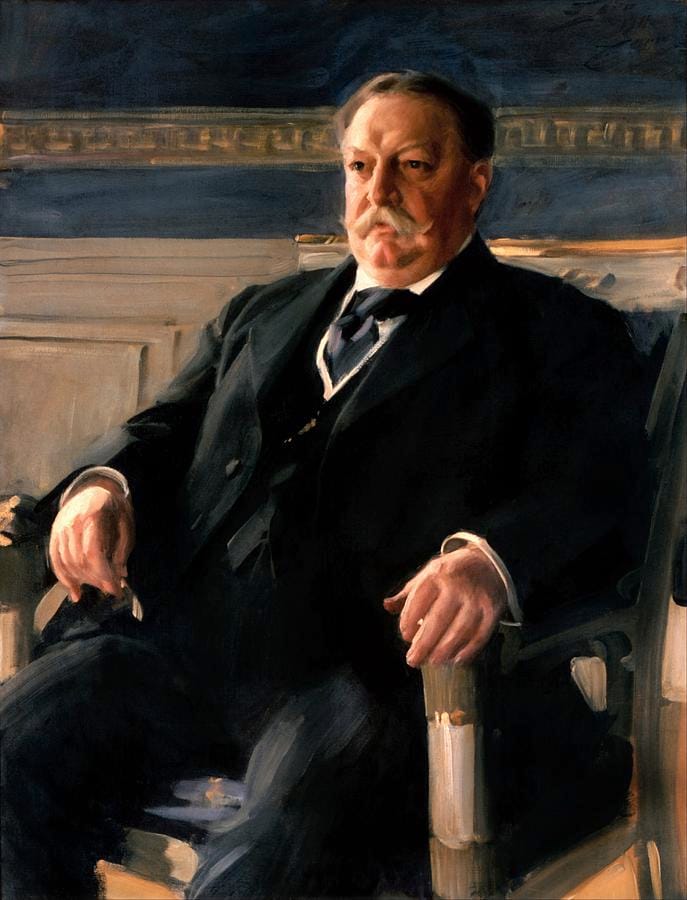
Zorn painted three American presidents, and this 1911 portrait of William Howard Taft is the one that stayed in the White House, where it remains part of the official collection. Taft sits in a dark suit, hands loose, his considerable bulk filling the chair, in a room brushed in with a few strokes of gold and shadow. There is no flattery in it and no unkindness either. What Zorn caught was the good-humored, faintly weary quality of a man who never much wanted the job — a shrewd piece of character reading beneath the very rapid paint.
Grover Cleveland
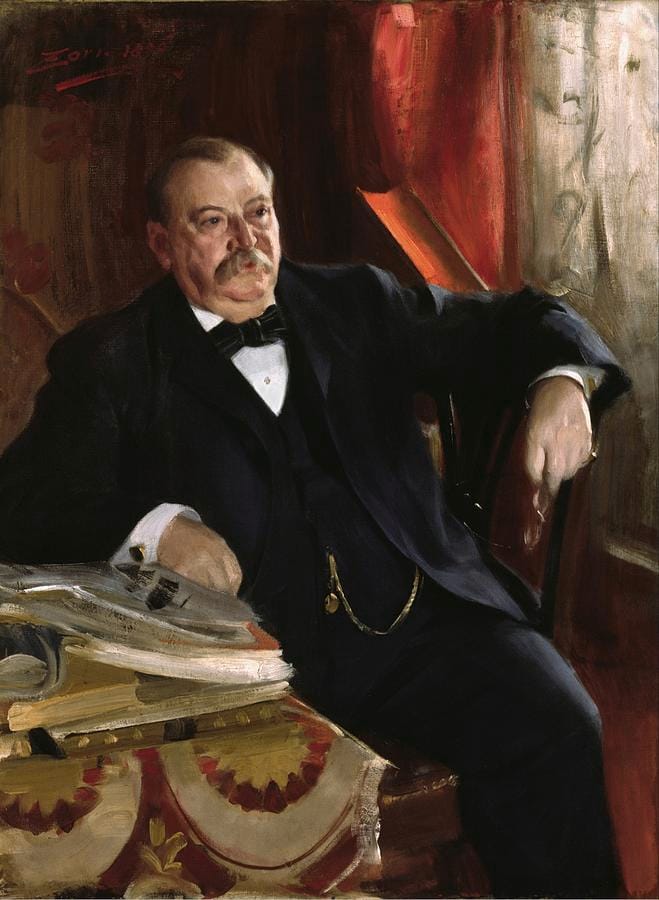
Zorn’s portrait of Grover Cleveland dates from 1899, two years after Cleveland left office at the end of his second, non-consecutive term. The former president sits with a book and papers on the table beside him, his heavy face turned slightly away, the red drapery behind him doing all the ceremonial work the sitter clearly declines to do himself. Zorn typically worked at speed and from life, blocking a head in over a handful of sittings, and the directness of the method suited American subjects, who tended to prefer being painted as themselves rather than as monuments.
Girl from Mora
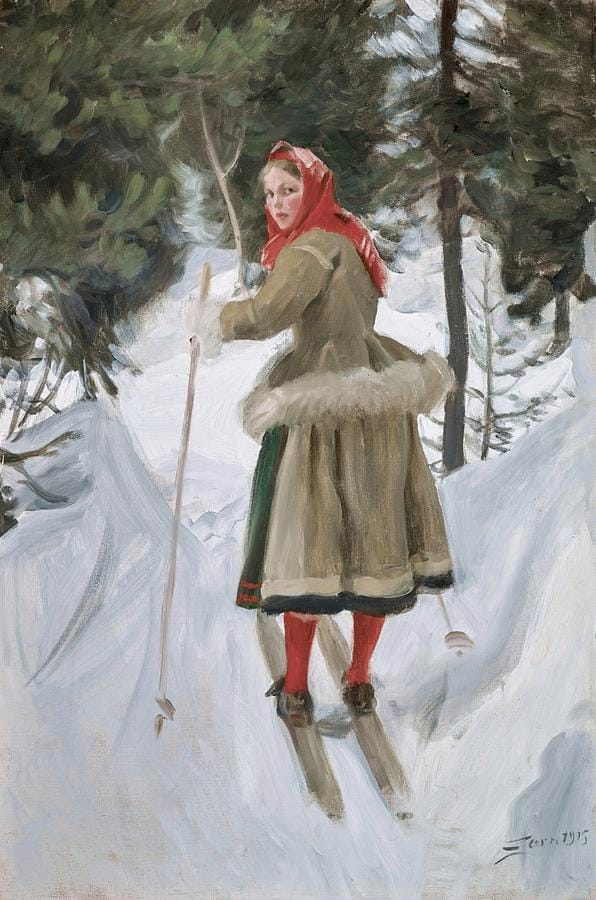
A young woman in a red headscarf and a fur-trimmed jacket stands on skis in a snowy pine wood, poles planted, pausing to look back at the painter. Zorn made many pictures of the people of Mora in their local dress, but this one has an unusual documentary charge: skis in Dalarna were transport, not sport, and the girl is simply on her way somewhere. The color scheme is pure Zorn — a single hot red against a hundred grays and greens — and the snow is painted with the loose, confident touch that made him famous.
Seville
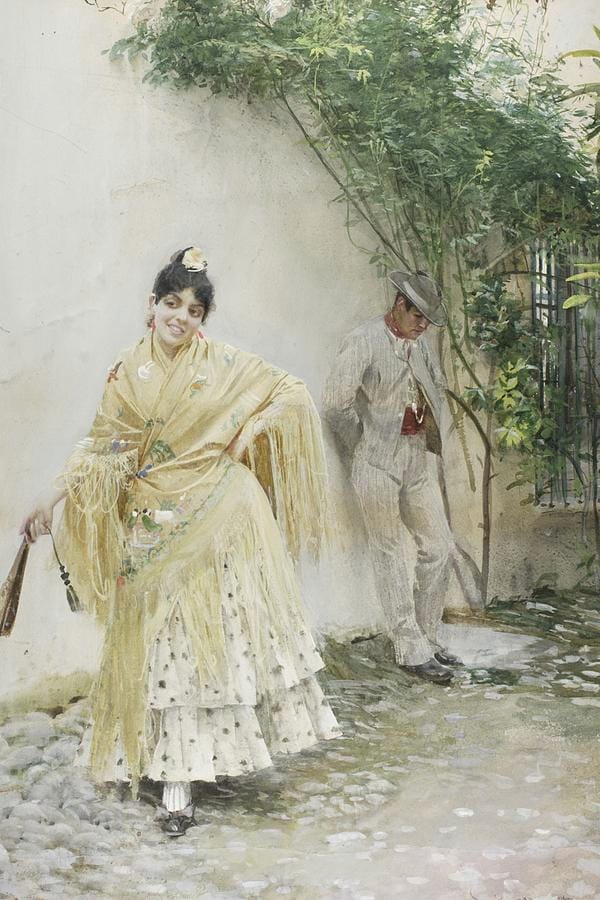
Zorn spent the mid-1880s traveling and building his reputation as a watercolorist, and Spain gave him some of his best subjects. Here a young Andalusian woman in a fringed, embroidered shawl steps away from a whitewashed courtyard wall with a fan half-open in her hand, glancing back at us, while a young man in a wide hat looks down at the ground behind her. The sunlight bouncing off the wall is the whole point of the picture. Watercolor suited that kind of glare perfectly, and Zorn used the white of the paper itself to carry the brightest passages.
In Scotland
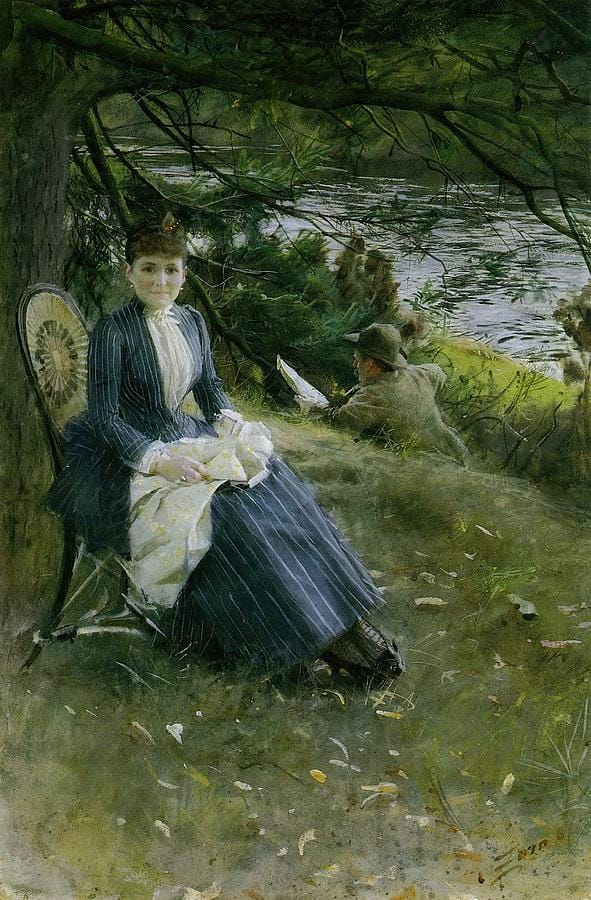
During his years based in London, Zorn traveled through Britain painting watercolors for a growing circle of patrons. In this one a woman in a dark pinstriped dress sits in a folding garden chair under a pine on a riverbank, needlework in her lap, looking calmly out at the viewer, while behind her a man in a soft hat lounges on the grass reading. Zorn builds the whole green world around her from broken, overlapping strokes, and then paints her face with sudden precision. It is a small masterpiece of the kind of unposed, outdoor portrait he would spend the rest of his life refining.
Zorn is at his best when the paint is doing two things at once — describing a face exactly while remaining, up close, a handful of loose marks. That double life makes his pictures wear extremely well on a wall: the midsummer scenes and archipelago watercolors bring northern light into a room, while the portraits reward the kind of looking you only do over years.
Shop Anders Zorn prints here, and explore the rest of our famous paintings collection for more of the world’s most beloved masterpieces.