Amedeo Modigliani’s Ten Most Famous Paintings
Long necks, tilted heads, and eyes left blank: the ten works that made Modigliani the most recognizable portraitist of modern Paris.

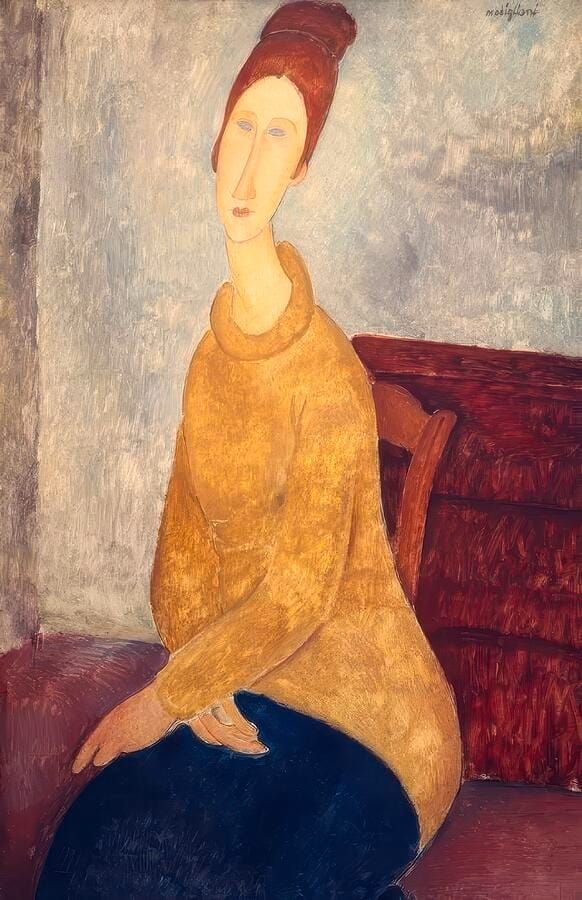
Amedeo Modigliani (1884–1920) was born in Livorno to a Sephardic Jewish family, arrived in Paris in 1906, and within a decade had invented one of the most instantly recognizable images in modern art: the long neck, the small tilted oval head, the almond eyes often left entirely blank. It looks like a mannerism until you see the range of people he put through it — poets, dealers, painters, servants, farm boys, the woman he loved — each one unmistakably themselves.
The style did not come from nowhere. Modigliani spent five years trying to be a sculptor, carving elongated stone heads under the influence of Constantin Brâncuși, African masks, and the Cycladic figures he studied in the Louvre; when dust and poor health forced him back to painting, the sculpture came with him. He died of tubercular meningitis at thirty-five, and his companion Jeanne Hébuterne died two days later, which has burdened the work with a great deal of legend. The paintings themselves are calmer and more disciplined than the legend suggests. Here are ten of his most famous.
Jeanne Hébuterne in a Yellow Sweater
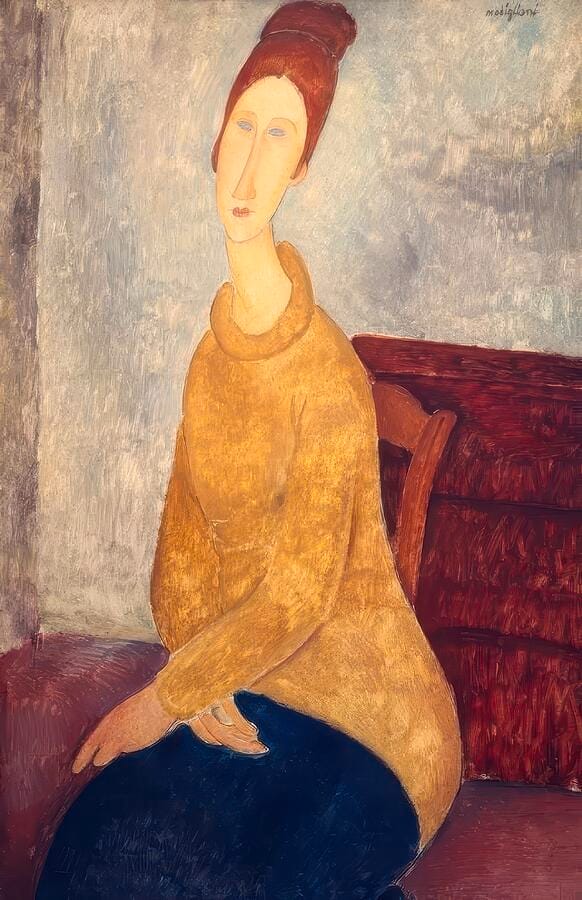
Jeanne Hébuterne was an art student of nineteen when she met Modigliani, and she became the central subject of his last two years. Painted around 1918–19, this portrait seats her against a red couch with her hands folded in her lap, auburn hair swept up, the whole figure drawn into one long S-curve that runs from her tilted head down through the yellow sweater to the dark skirt. Her eyes are flat blue-gray ovals with no pupils at all. Asked about that habit, Modigliani is said to have answered that he would paint the eyes when he knew the soul. The picture now hangs in the Guggenheim Museum in New York.
Reclining Nude
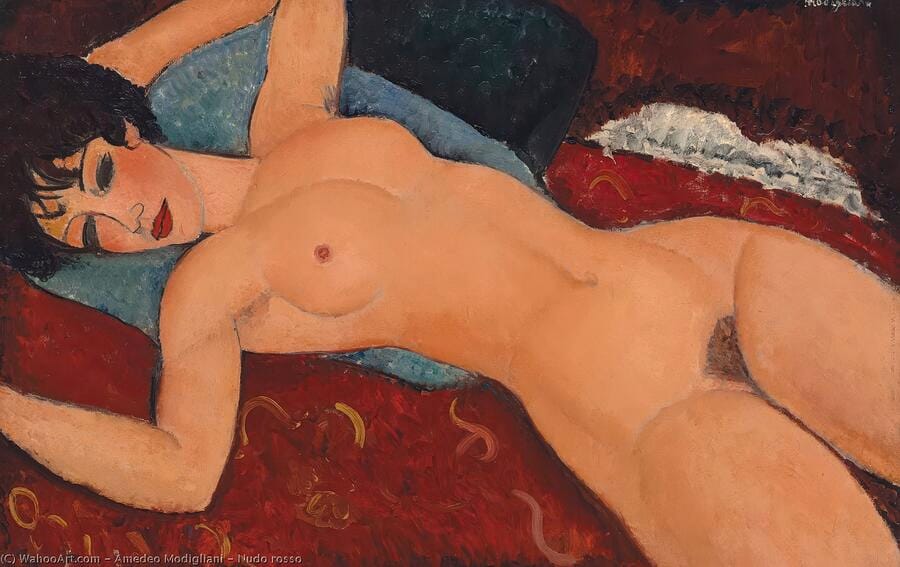
Between 1916 and 1919 Modigliani painted a series of large reclining nudes that are now the most valuable works he made; one sold at auction in 2015 for more than $170 million. This version, from about 1917, lays a woman diagonally across a red couch and a blue cushion, her body running edge to edge across the canvas, her head tipped back and her eyes half closed. The flesh is built in thin, even layers with almost no shadow, so the figure reads as one warm continuous shape. When a group of these paintings was shown at a small Paris gallery in 1917, police ordered the window display taken down on opening day — it was the only solo exhibition he ever had.
Self-Portrait as Pierrot
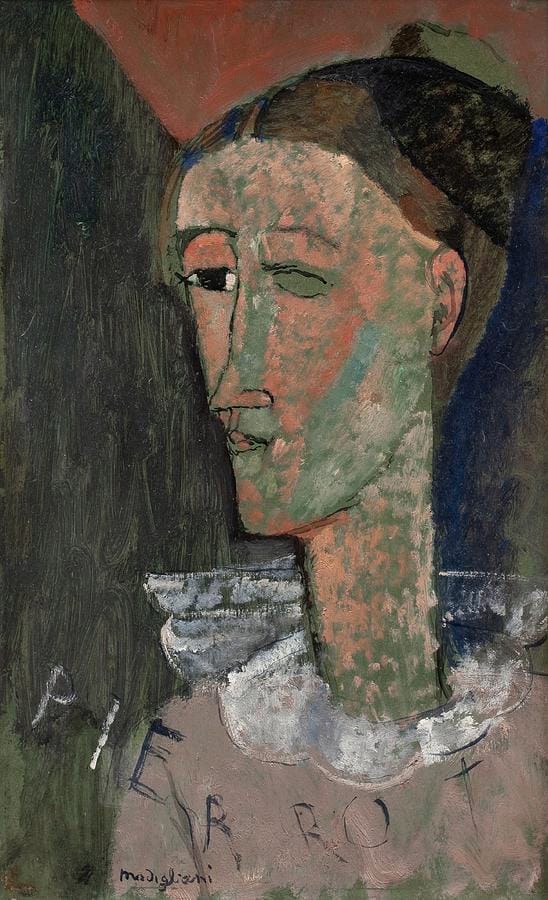
Modigliani painted himself only a handful of times, and this small canvas of 1915 is the strangest of them. He appears as Pierrot, the melancholy clown of the commedia dell’arte and of Parisian cabaret, in a white ruff with the character’s name lettered clumsily across the paint below. The face is pushed into a mask of flat green and pink planes, one eye dark and staring, the other a blind slot. That is rather the point: a painter who spent his life looking hard at other people shows himself only in costume. It was made in wartime, when he was broke, drinking heavily, and had been turned down for military service on medical grounds.
Portrait of Juan Gris
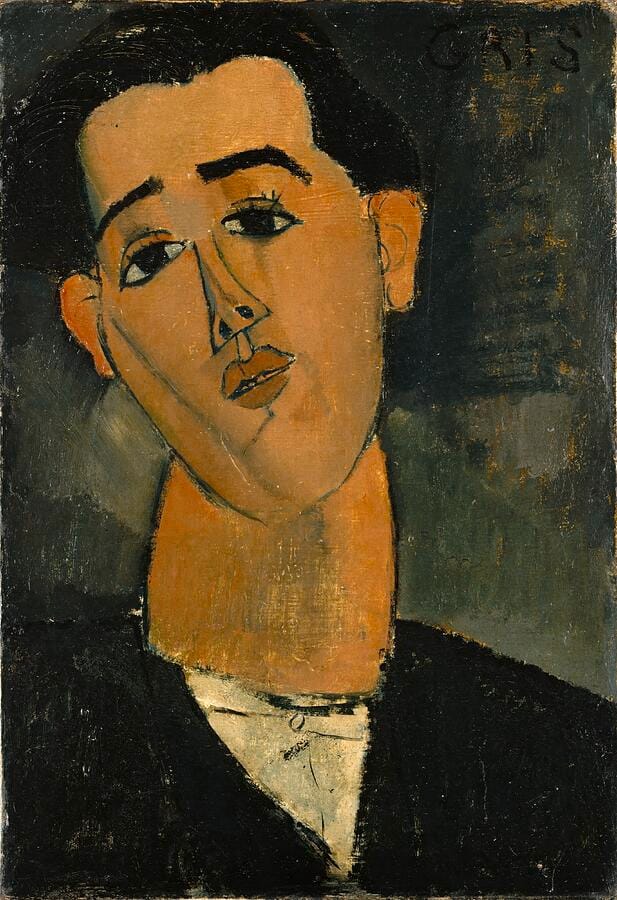
The Spanish painter Juan Gris was one of the leading Cubists in Paris and a neighbor in Montparnasse. Modigliani portrayed him in 1915 with dark hair, heavy brows, and enormous eyes, the name GRIS blocked in at the top right corner like a label stencilled on a crate. Modigliani never became a Cubist himself, but he had clearly been watching: the head is assembled from simple planes and the nose is a single long ridge running the height of the face. What keeps it a portrait rather than an experiment is the expression — wary, tired, faintly amused. The painting is now in the Metropolitan Museum of Art.
Max Jacob
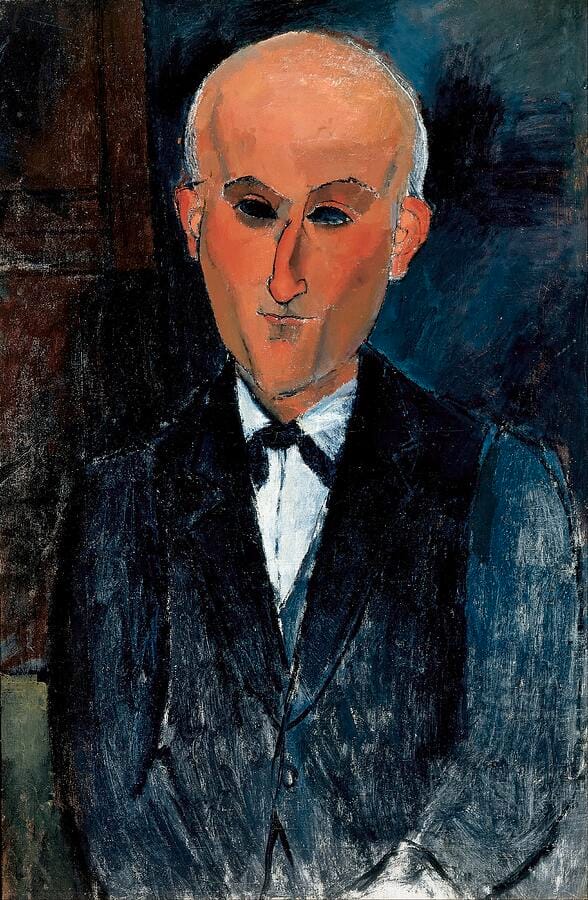
The poet Max Jacob was one of Modigliani’s closest friends and one of the few people who could hold him in conversation. This 1916 portrait sets him against a deep blue-black ground in a dark suit, white collar, and black bow tie, his bald head lit like a piece of carved stone, his eyes narrowed to two dark slits in an expression of dry, private amusement. Jacob was a Jewish writer who converted to Catholicism and lived between mysticism and wit; he died in a French internment camp in 1944. Modigliani gives him the compact dignity of a Renaissance portrait bust and none of the usual bohemian theater.
Portrait of Paul Guillaume
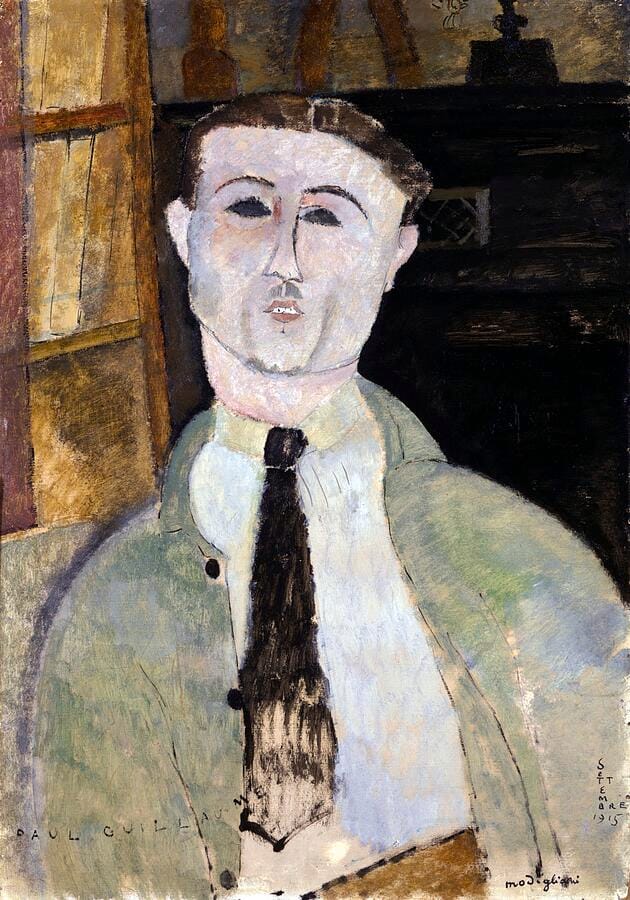
Paul Guillaume was barely in his twenties when he started dealing in modern art, and for a stretch around 1915 and 1916 he was Modigliani’s dealer and one of his few reliable sources of money. Modigliani painted him more than once. Here the young dealer is all confidence: a pale, sharp-featured face above a high white collar and dark tie, the body angled back as though he were appraising the painter rather than the other way round. Guillaume went on to assemble one of the great private collections of modern painting in France, much of which now hangs in the Musée de l’Orangerie in Paris.
Beatrice Hastings
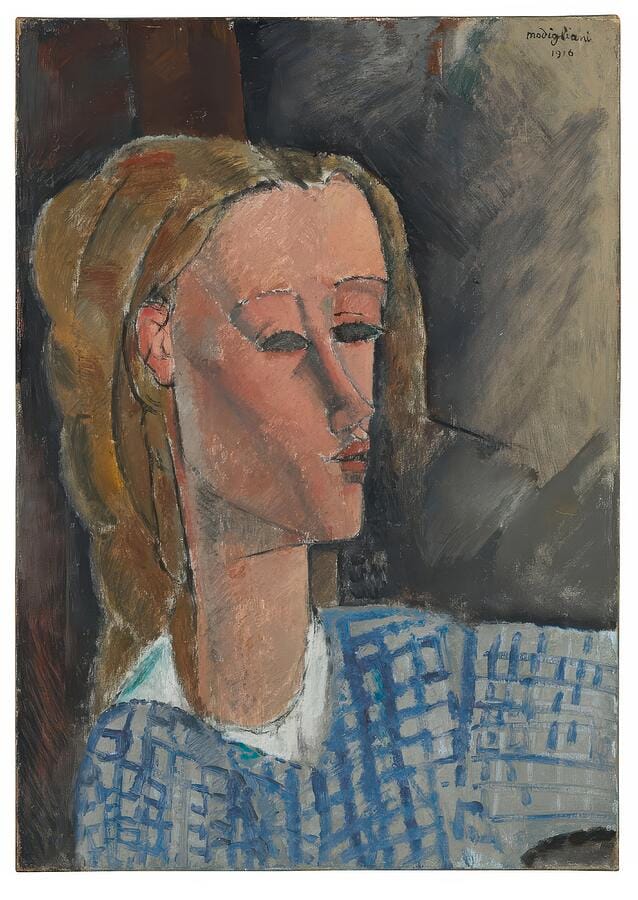
Beatrice Hastings was a South African-born writer and critic who wrote for the London magazine The New Age, and from 1914 she spent roughly two years as Modigliani’s lover and the stormiest presence in a life not short of storms. He painted her more than a dozen times. In this portrait she wears a blue-checked blouse under a loose gray wrap, her fair hair pulled back, her long face narrowed almost to a blade, one eye a dark almond and the other left blank. The relationship was famously combustible and ended badly; the paintings record something quite different — steady, unhurried attention to a face he knew by heart.
The Cellist
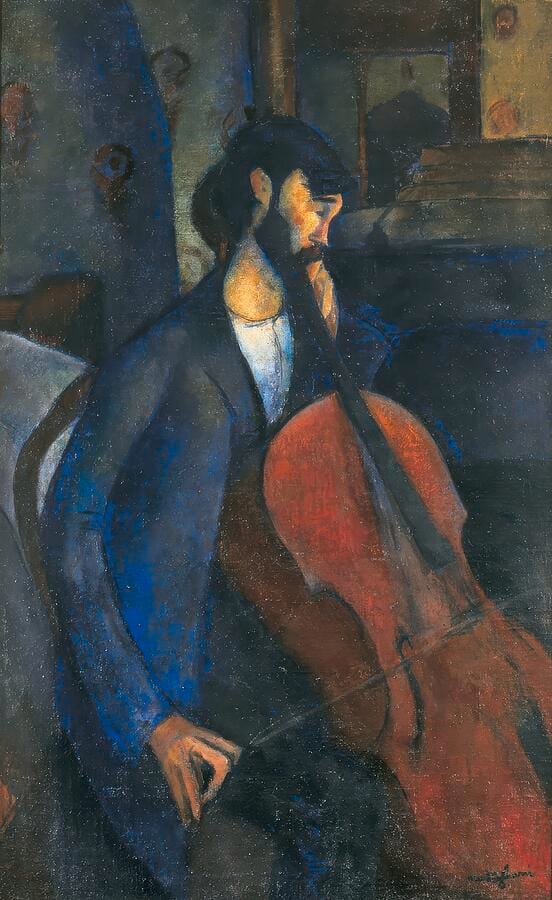
Painted in 1909, The Cellist comes from the years before Modigliani’s manner hardened into its famous formula, and the debt to Cézanne is plain in the blocky planes and muted blues and browns. A musician bends over his instrument with his head lowered, the great curve of the cello sweeping down through the middle of the picture in a warm red-brown that is the strongest color on the canvas. Shown at the Salon des Indépendants in 1910, it drew the first serious praise of his career. Almost immediately afterward he put painting aside for several years to carve stone, and the paintings that followed the sculpture look nothing like this one.
The Young Apprentice
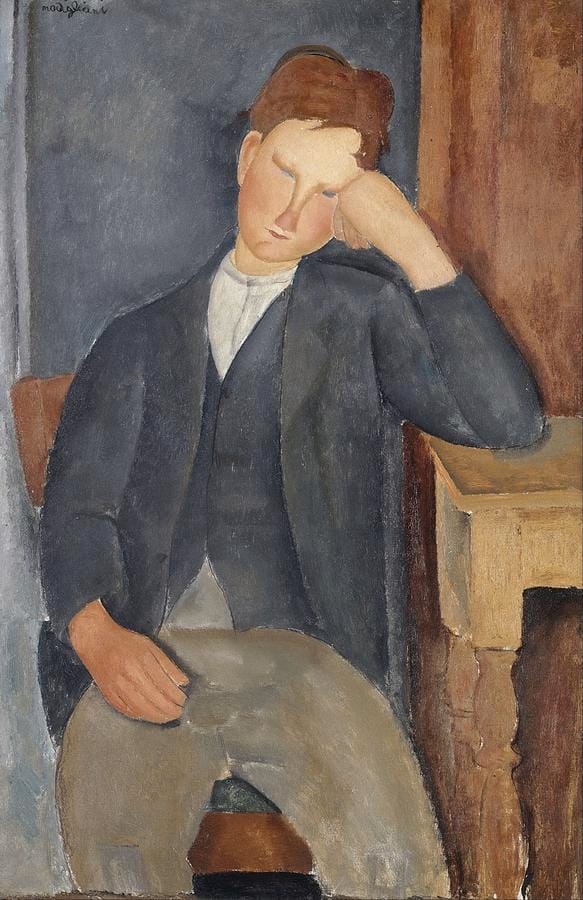
A boy in a blue workman’s jacket sits at a table with his head propped on one hand, elbow out, sleeve rumpled, his mouth set in the specific boredom of someone waiting to be told what to do next. Made around 1918 or 1919, The Young Apprentice belongs to a run of pictures in which Modigliani painted children, servants, and working people — the kind of sitters who could not pay him — with exactly the seriousness he gave to poets and dealers. It hangs today in the Musée de l’Orangerie, and it is among the warmest and least mannered things he ever painted.
Landscape in the South of France
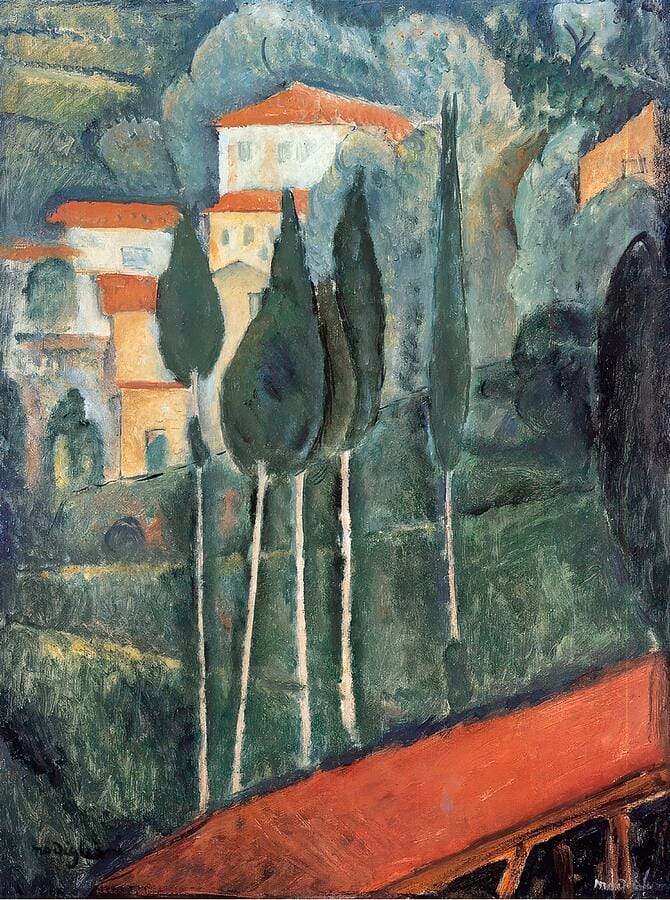
Modigliani painted the human figure almost to the exclusion of everything else; landscapes account for only a handful of canvases, all of them made during his stay in the south of France in 1918 and 1919, where friends had taken him in the hope that sun and quiet would repair his health. This one gives a cluster of pink and ochre houses behind a screen of tall dark cypresses, put down in short choppy strokes with none of the smooth finish of the portraits. Coming from a painter so single-mindedly devoted to faces, these few landscapes are a real surprise — and the trees have the same stretched, leaning verticals as his sitters.
Modigliani died before he turned thirty-six, with a body of work that amounts to little more than a decade of painting, and yet almost anyone can recognize one of his portraits across a room. The pictures are quiet, warm in color, and built on a single elegant line — qualities that make them unusually easy to live with. A Modigliani head brings a room the calm of a carved sculpture and the intimacy of a friend’s face.
Shop Amedeo Modigliani prints here, and explore the rest of our famous paintings collection for more of the world’s most beloved masterpieces.