Albert Bierstadt’s Ten Most Famous Paintings
Thunderheads over the Rockies, golden light in Yosemite, and buffalo on the plains: the ten paintings that sold America its own West.

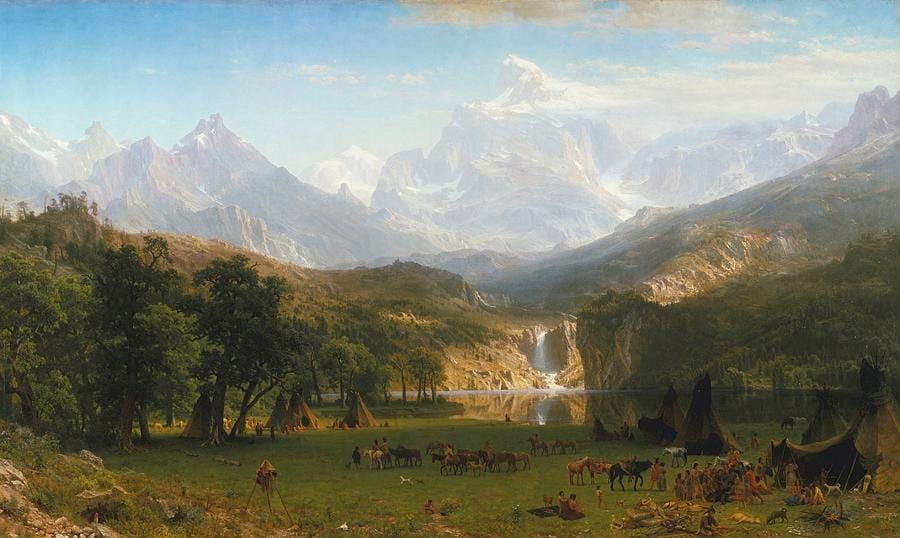
Albert Bierstadt (1830–1902) was born in Germany and raised in New Bedford, Massachusetts, and he learned to paint back in the old country, at the academy in Düsseldorf, where students were taught to build vast landscapes out of carefully drawn parts. In 1859 he talked his way onto a government survey expedition heading west along the overland trail, and came home with a portfolio of sketches and photographs that would keep him busy for forty years.
What he did with them made him rich and famous. Bierstadt turned his western studies into enormous canvases — some over twelve feet across — that were exhibited one at a time in darkened halls, curtained like a stage, with an admission charge at the door. Audiences who would never cross the Mississippi lined up to see the Rockies glowing through storm light. Critics eventually turned on him for exaggerating, and he died out of fashion, but the pictures are back in favor now. Here are ten of his most famous paintings.
The Rocky Mountains, Lander’s Peak
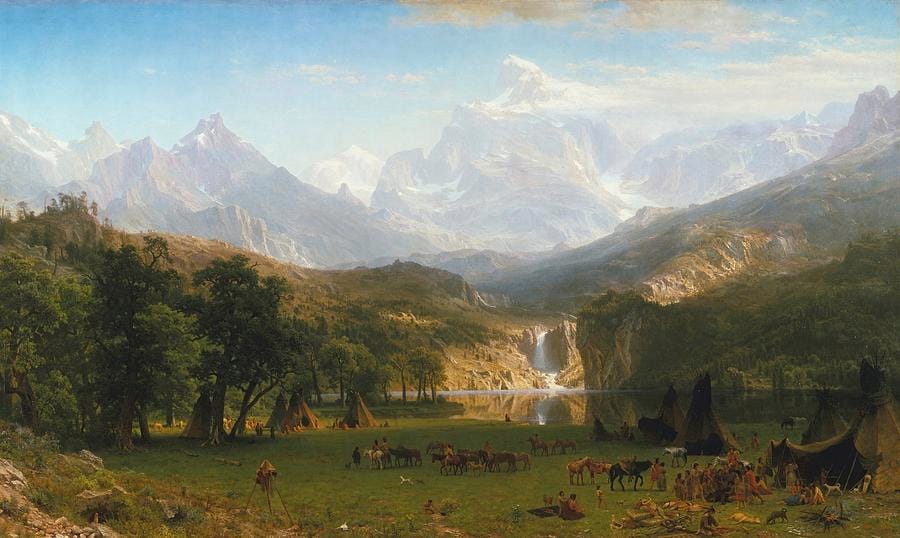
Finished in 1863 from sketches made on the survey expedition, this is the painting that made Bierstadt’s name. A Shoshone encampment spreads across a sunlit meadow in the foreground — tipis, horses, drying racks, figures at work — while behind them a waterfall drops from a shelf of rock and a colossal snow peak floats in the haze above. He named the mountain for Frederick Lander, the engineer who had led the expedition. Toured as a paid attraction and sold for a then-astonishing sum, it was shown in 1864 alongside Frederic Church’s Heart of the Andes — the two great showpieces of American landscape painting, hung as rivals.
Among the Sierra Nevada, California
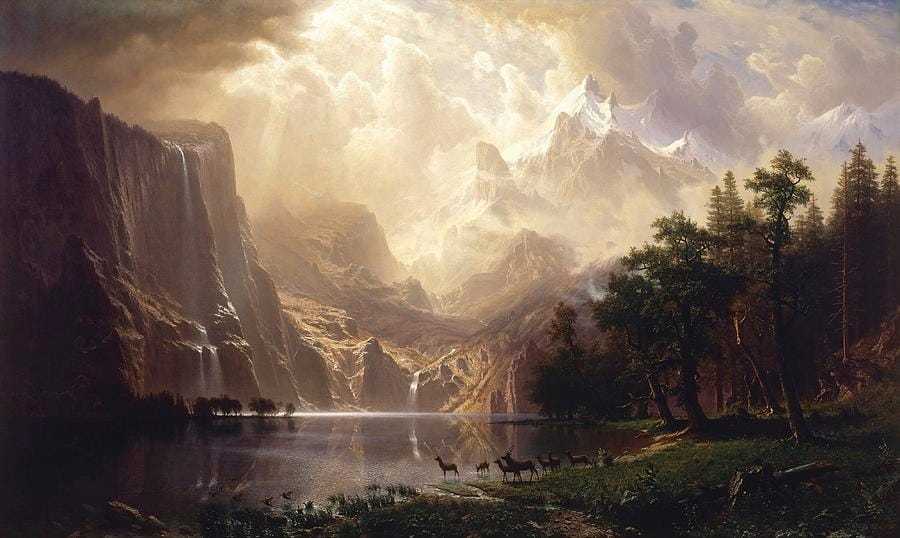
Bierstadt painted this ten-foot canvas in Rome in 1868 and then toured it around Europe, where it was a triumph. A glassy lake lies in the center with deer at the water’s edge and waterfalls threading down from the cliffs, while the whole upper half of the picture dissolves into a blaze of backlit cloud and light. No single spot in California looks quite like this. It is a composite — his own studies rearranged into an ideal — and the glowing sky owes as much to seventeenth-century European landscape as to the Sierra. That was rather the point: he was painting the West as a promised land.
A Storm in the Rocky Mountains, Mt. Rosalie
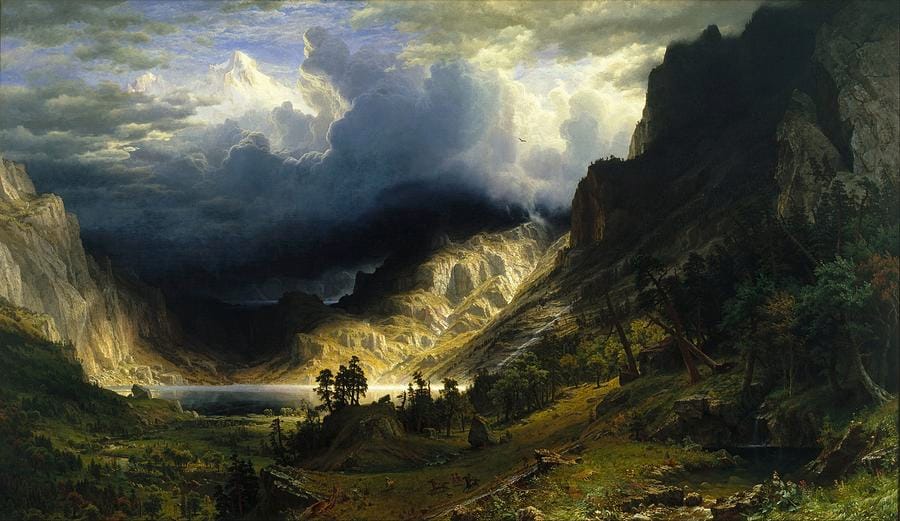
A black wall of storm cloud rolls into a mountain basin, dragging its shadow across the valley floor while sunlight breaks through in a single shaft on the meadow below. Painted in 1866, this is Bierstadt at his most theatrical, and the drama is helped along by an off-center composition that makes the eye chase the light. He named the peak Mount Rosalie after Rosalie Osborne, then the wife of a friend and later his own. The canvas is roughly seven by twelve feet, built to be seen from across a hall rather than at arm’s length.
Valley of the Yosemite
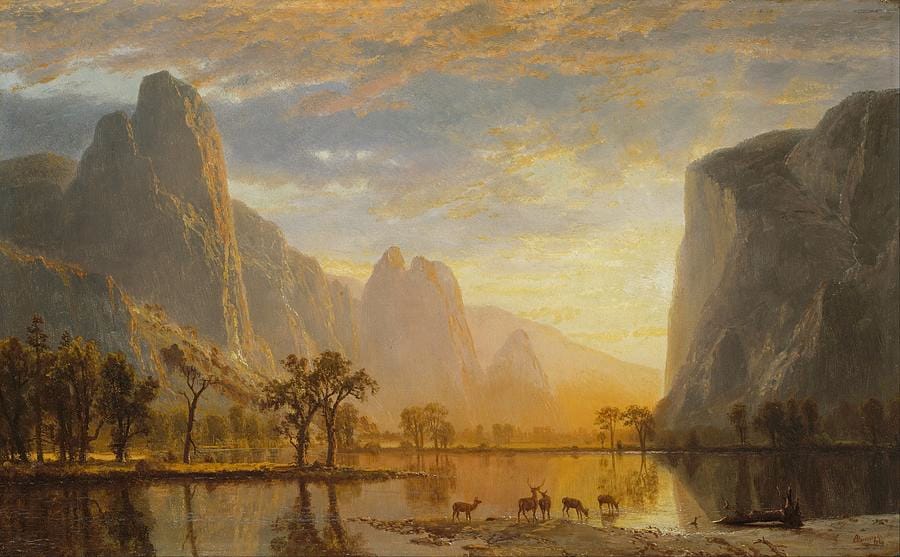
Bierstadt first saw Yosemite in 1863 and never really got over it. This small, warm panel, painted the following year, looks down the valley in the late light, granite walls rising on both sides, a mirror-still stretch of river in the middle, and a few deer stepping down to drink. Everything is dissolved in gold. He painted the valley many times at every scale, and this modest version is often preferred to the grander ones — there is no crowd, no drama, and no argument being made, just a quiet place at the end of the day.
Mount Corcoran
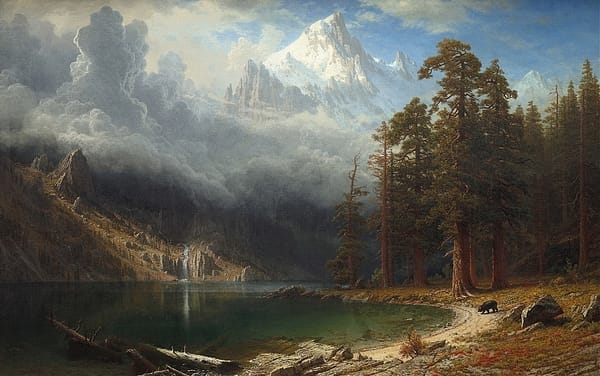
A dark green lake sits in a bowl of pine and granite, mist tearing off the snowfields above. The painting comes with one of the best stories in American art: Bierstadt wanted the Washington collector William Wilson Corcoran to buy it, so he attached Corcoran’s name to the unnamed Sierra peak in the picture and let the flattery do its work. It sold. Painted in the mid-1870s, it shows how carefully he could handle a quieter register: a stand of tall conifers anchors the right side, a bank of cloud the left, and a black bear picks its way down to the water on the far shore.
Puget Sound on the Pacific Coast
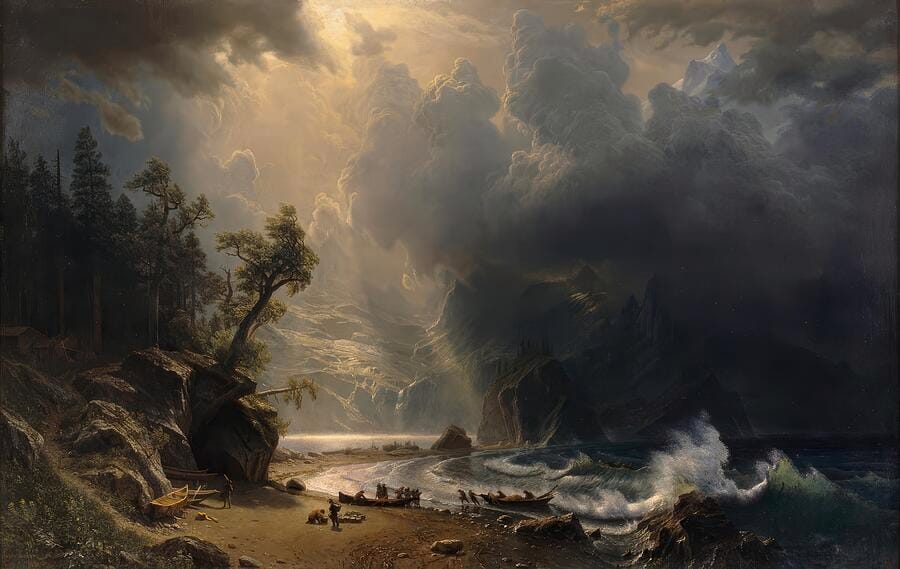
For once the weather wins. Painted in 1870 after a trip to the Pacific Northwest, this canvas gives most of its height to a churning gray sky, with surf breaking white against the rocks and a handful of figures and their canoes drawn up on the beach, dwarfed by the whole business. There is no inviting meadow and no promise of easy country — just cold water, wind, driving cloud, and a thin band of pale light where the storm begins to break. It is a reminder that Bierstadt, so often accused of prettifying the West, could also paint it as something indifferent and dangerous.
The Oregon Trail
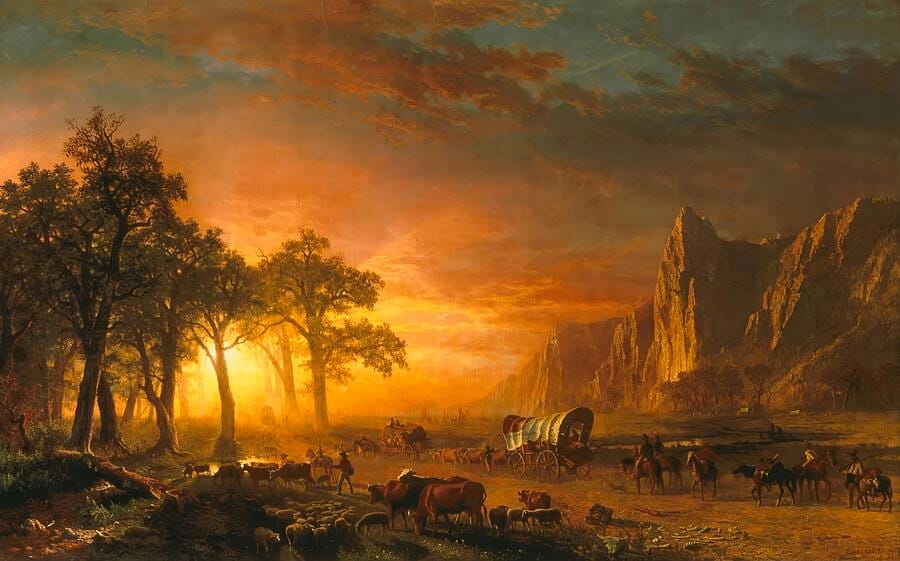
Emigrant wagons come on through an oak grove while the sun goes down in a furnace of orange behind the trees, cliffs closing in on the right. Cattle and sheep drift ahead of the train, mounted riders work the flanks, and the whole scene is soaked in the same molten light. Bierstadt had traveled the overland route himself in 1859, so the details of the outfit are drawn from life even though the scene is composed. Painted in 1869 — the year the transcontinental railroad was completed, which would soon make wagon crossings obsolete — it is a picture of the westward journey already turning into legend.
The Last of the Buffalo
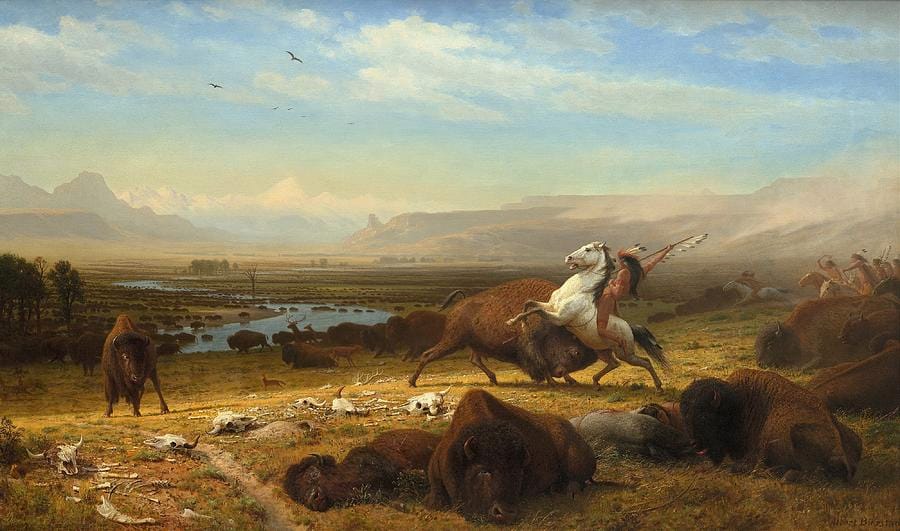
A mounted hunter drives his lance into a charging bull while dozens of bison move across the plain behind him and skulls and carcasses litter the foreground. Painted in 1888, when the wild herds had been shot down from tens of millions to a few hundred animals, it was Bierstadt’s late statement on what had been lost. American juries thought it old-fashioned and left it out of the Paris Exposition of 1889, a rebuff that stung. History has been kinder: the painting is now read as one of the earliest widely seen images of an American extinction in progress.
Sunrise on the Matterhorn
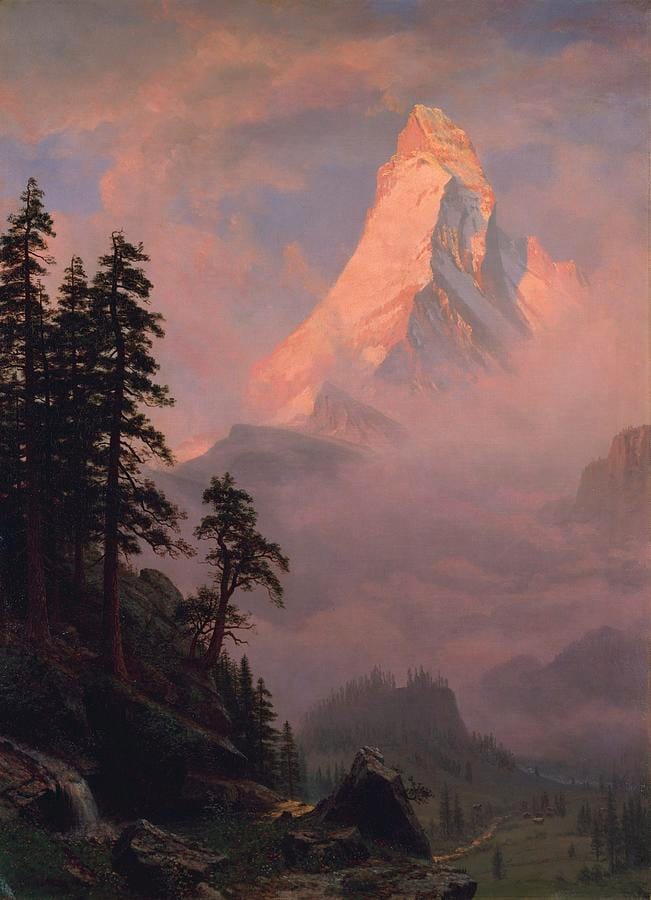
Bierstadt returned to Europe repeatedly and painted the Alps with the same appetite he brought to the Rockies. Here the Matterhorn’s famous hooked summit catches the first light and turns rose pink above a valley still drowned in violet shadow, with dark firs in the foreground for scale. The picture dates from the 1870s, the decade after the mountain’s first ascent had made it the most talked-about peak in the world. It is a straightforward piece of alpenglow, and it demonstrates that his instinct for a mountain silhouette against colored air worked on either side of the Atlantic.
Sunlight and Shadow
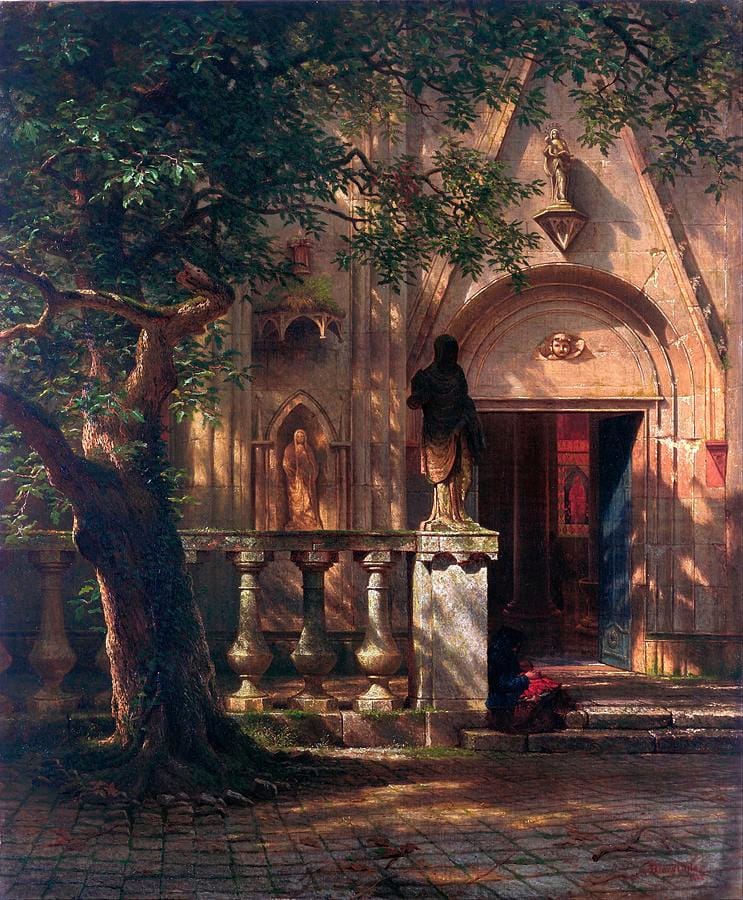
The odd one out, and one of his best. Instead of a mountain, Bierstadt paints the porch of an old stone church: a gnarled tree at the left, a low balustrade, a dark arched doorway with a small figure standing just inside it, and sunlight coming through the leaves to scatter across the stonework in coins of light. He made it in the early 1860s from studies gathered during his European years. The whole picture is an exercise in dappled light on masonry, and the patience of that observation is exactly what he later brought to granite cliffs and storm clouds.
Bierstadt was a showman, and a certain kind of critic has never forgiven him for it. But the appetite behind the work is genuine, and the pictures still do what they were built to do: open a wall into deep space, weather, and light. A Bierstadt landscape gives a room a horizon, which is why they suit hallways, offices, and anywhere that could use the feeling of somewhere much larger just beyond.
Shop Albert Bierstadt prints here, and explore the rest of our famous paintings collection for more of the world’s most beloved masterpieces.