William Merritt Chase’s Ten Most Famous Paintings
Beach days on Long Island, a crowded Manhattan studio, and America’s most dazzling brushwork: ten paintings by William Merritt Chase.

William Merritt Chase (1849–1916) was born in small-town Indiana, trained in Munich, and came home to become the most conspicuous artist in America. He kept a greyhound, wore a top hat and a flower in his lapel, and filled an enormous studio in New York with tapestries, armor, and stuffed birds — a performance that was also a serious argument that American art deserved to be taken as seriously as European art.
He was, by common consent, the finest teacher his country has produced. Chase taught at the Art Students League, founded his own school in New York, and ran a summer school at Shinnecock on eastern Long Island where students painted outdoors in the dunes; Georgia O’Keeffe, Edward Hopper, Charles Demuth, and Marsden Hartley all passed through his classes. His own paintings move easily between the dark bravura of his Munich years and the bright, breezy sunlight of his Long Island summers. Here are ten of his most famous works.
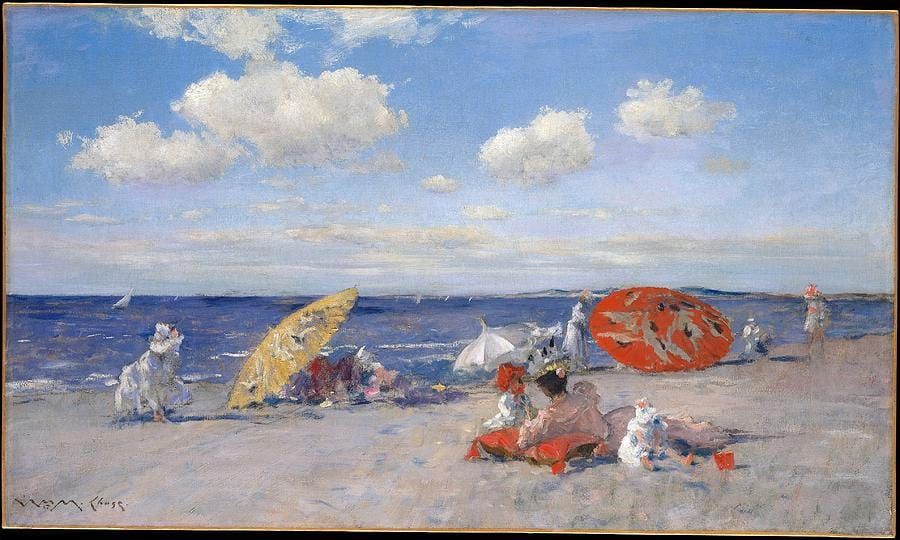
At the Seaside
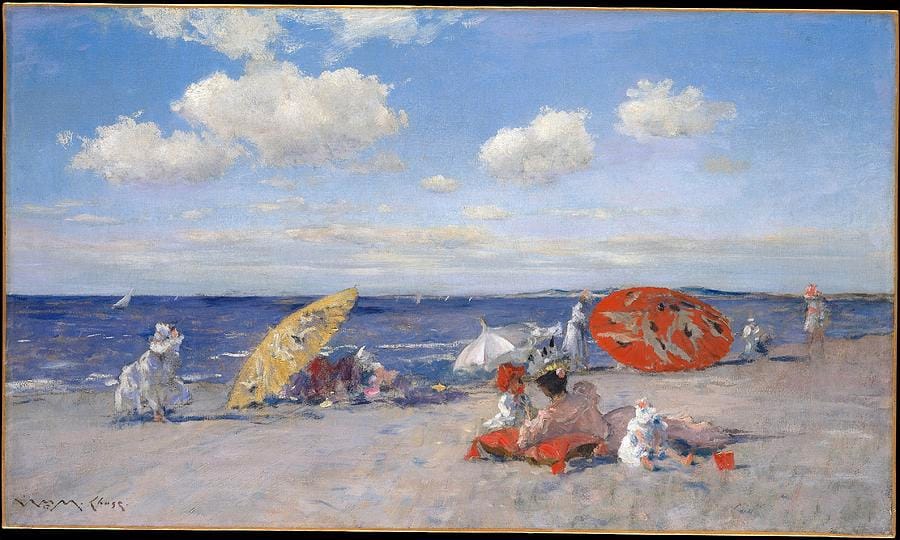
Under a wide sky full of scudding clouds, women and children cluster on the sand beneath a scarlet parasol and a yellow one, the shoreline running away in a long pale band toward distant sails. Painted around 1892 and now in the Metropolitan Museum of Art, it is the picture that best captures Chase’s Long Island years — sunlight, leisure, and paint applied with astonishing economy. The figures are barely more than deft touches of white and red, yet each reads instantly as a person doing something. It is American Impressionism at its most immediately likable.
A Friendly Call
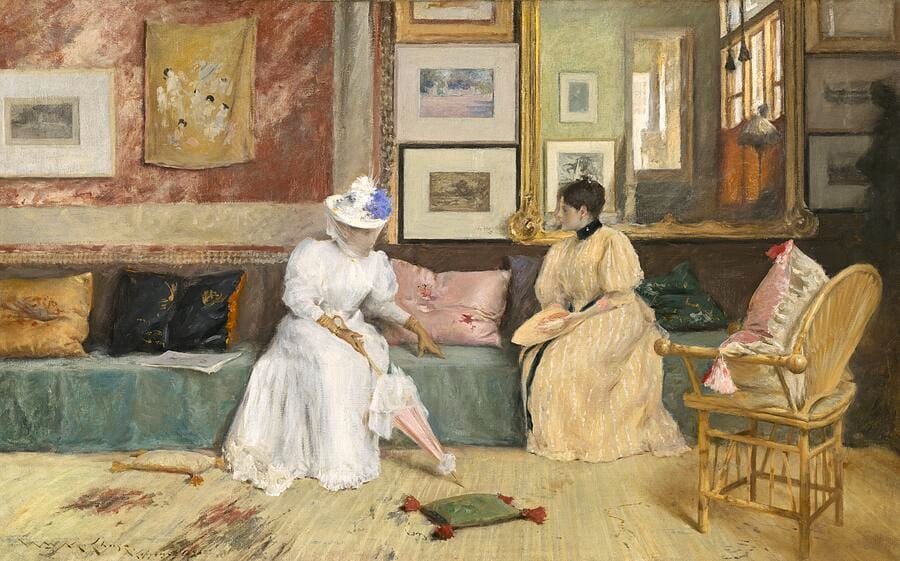
Two women sit on a daybed in a Shinnecock sitting room: the visitor still in her hat, veil, and white summer dress, parasol in hand; the hostess turned toward her, listening. A large mirror on the back wall reflects the rest of the room, doubling the space and slyly revealing a third figure’s worth of information about it. Completed in 1895 and now in the National Gallery of Art, the painting is Chase’s most quietly sophisticated work — a study of manners, light, and social ritual in which the real subject is everything left unsaid between the two women.
The Tenth Street Studio
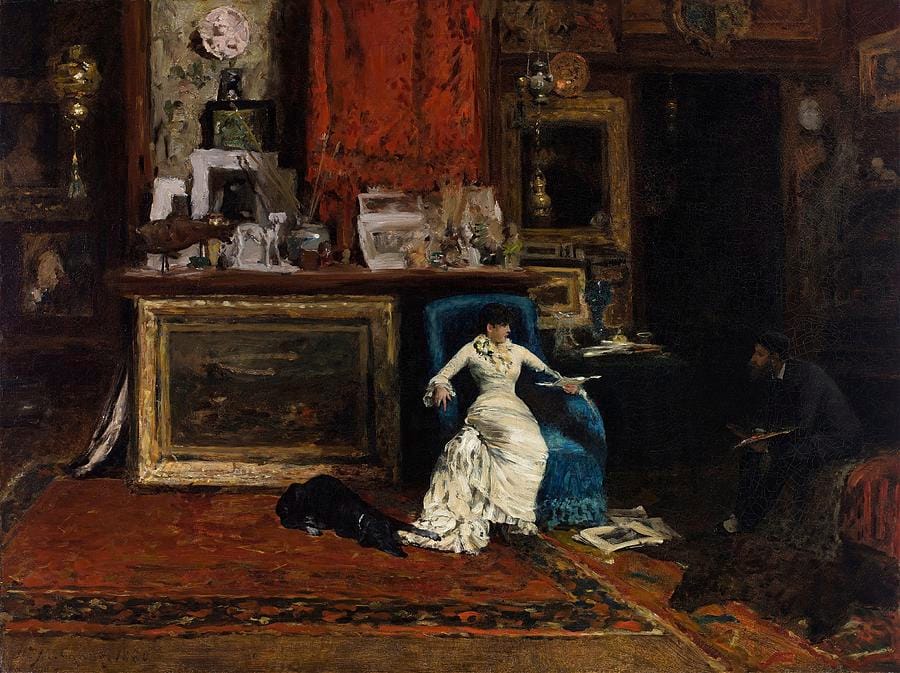
Chase took a grand room in New York’s Tenth Street Studio Building in 1878 and spent years turning it into the most famous artist’s space in America: Persian rugs, brass, carved chests, framed pictures propped everywhere, and a visitor in white lounging on the floor to examine a canvas. He painted the room repeatedly. It functioned as a showroom, a salon, and an advertisement, and these interiors are as much self-portraits as anything he made — a picture of a man who had decided that being an artist in America should look at least as glamorous as being one in Paris.
Portrait of Dora Wheeler
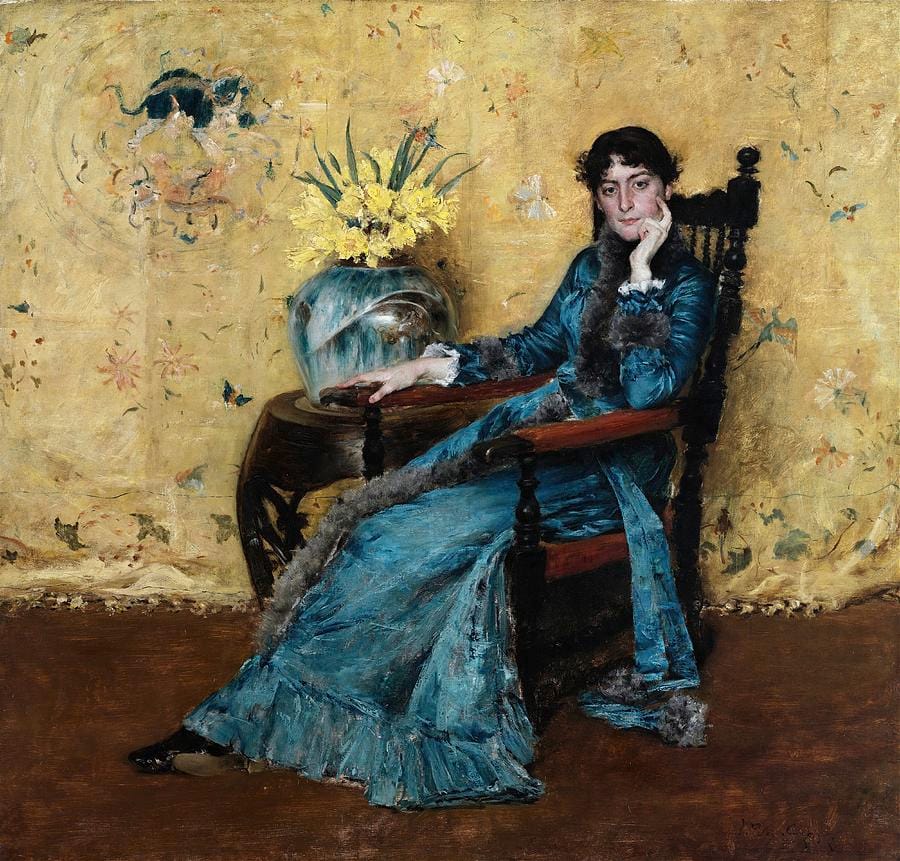
Dora Wheeler was Chase’s student and a successful designer in her own right, and he painted her in 1882–83 seated in a red chair against a gold-figured hanging, chin resting on her hand, a vase of yellow flowers beside her. The color scheme — gold, blue-green, and a bank of dark shadow — owes a good deal to Whistler, but the confident modeling of the head is pure Chase. Shown at the Paris Salon, it made his reputation as a portraitist on both sides of the Atlantic, and it now belongs to the Cleveland Museum of Art.
Carmencita
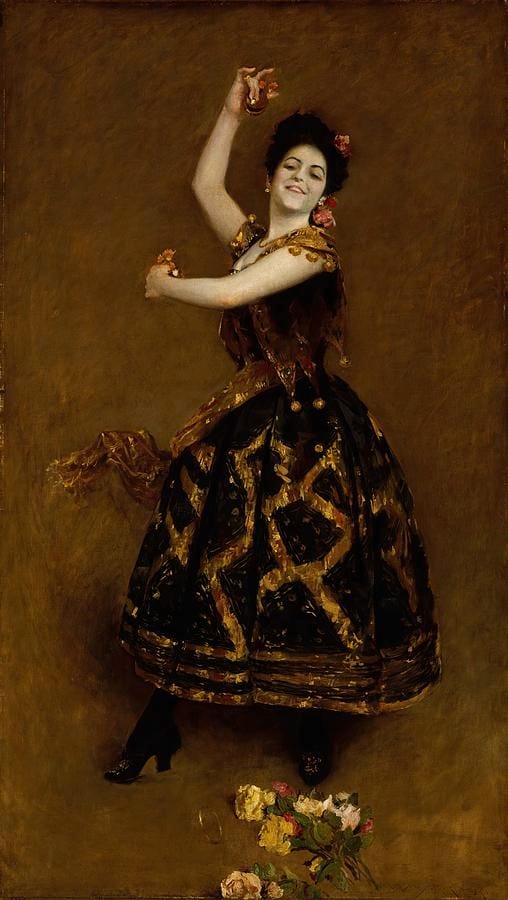
The Spanish dancer Carmencita took New York by storm in 1890, and the city’s painters competed to get her into their studios. Chase shows her at full height and mid-step, both arms lifted and fingers snapping, in a black skirt slashed with gold embroidery that flares out like a bell; roses are pinned in her hair and scattered on the floor at her feet, and the background is left as a plain wash of olive gold. Her eyes are almost closed and she is plainly enjoying herself. John Singer Sargent painted her in the same season, and the rivalry was open. Chase’s version, now in the Metropolitan Museum of Art, catches the swagger of a performer who knew precisely how good she was.
James Abbott McNeill Whistler
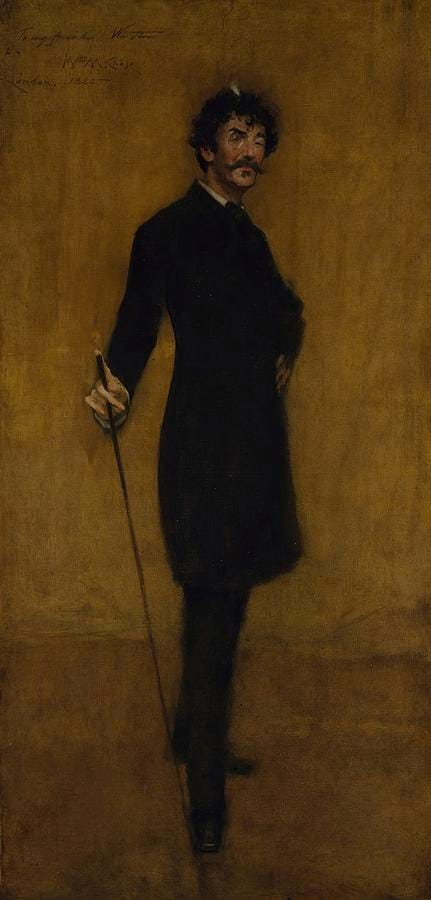
In the summer of 1885 Chase went to London so that he and Whistler could paint each other’s portraits. Chase finished his: the older artist stands full-length in a black frock coat against a warm gold ground, thin as a cane, holding a slender wand-like stick, all elegance and nerve. Whistler was appalled, considering it a caricature, and the friendship never recovered. The painting survived the quarrel and hangs today in the Metropolitan Museum of Art, where it remains one of the sharpest likenesses ever made of the most quarrelsome artist of the nineteenth century.
An Open-Air Breakfast
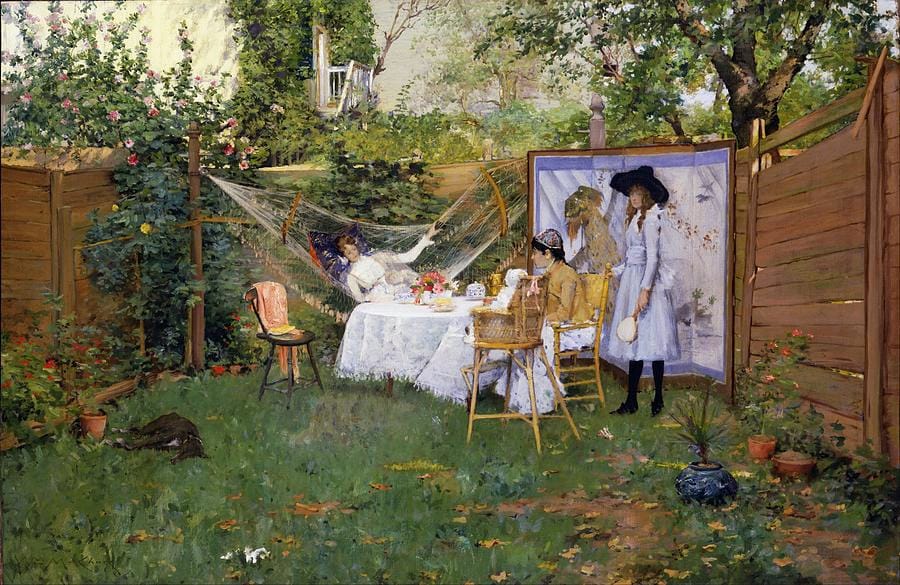
In the walled backyard of Chase’s Brooklyn house, a table is set with white linen under the apple trees; a woman lies in a hammock, a child in a pinafore stands beside a Japanese screen, and a dog dozes in the grass. Painted around 1888, it is a family picture — his wife Alice, her sister, and their small daughter — but arranged with all the care of a formal composition, the screen and the fence carving the garden into panels. Few American paintings of the period feel so completely at ease with their own good fortune.
Study of Flesh Color and Gold
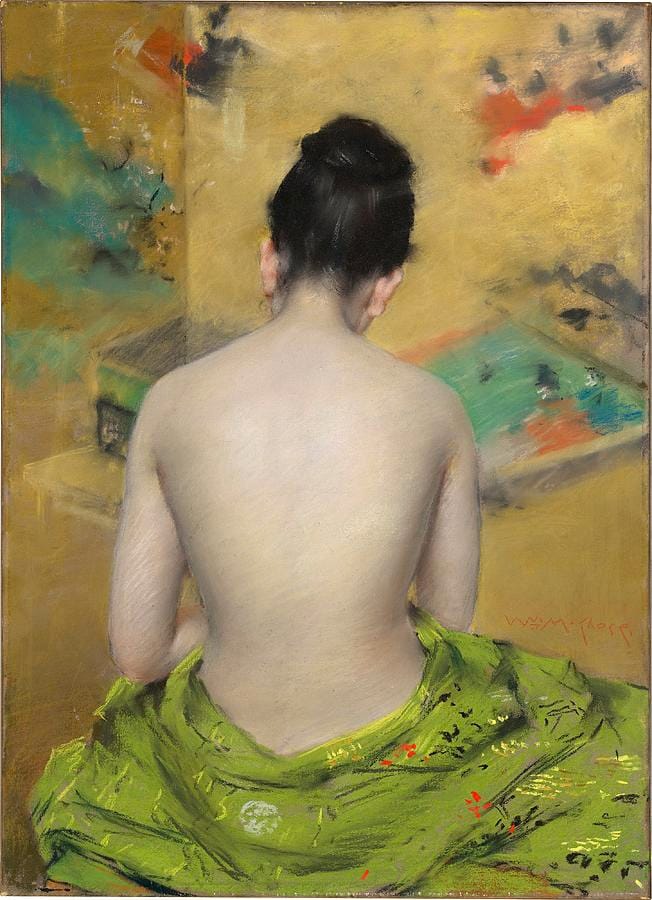
A woman sits with her back to us, bare to the waist, a green silk kimono pooled around her hips, in front of a screen scattered with bright decorative motifs. The title is a deliberate borrowing of Whistler’s habit of naming pictures after their color harmonies rather than their subjects, and the painting really is an argument about paint — warm flesh against cool green, both set off by gold. Made around 1888, when Chase was at his most Japanese-influenced, it is his finest nude and one of the boldest American paintings of its decade.
Still Life: Fish
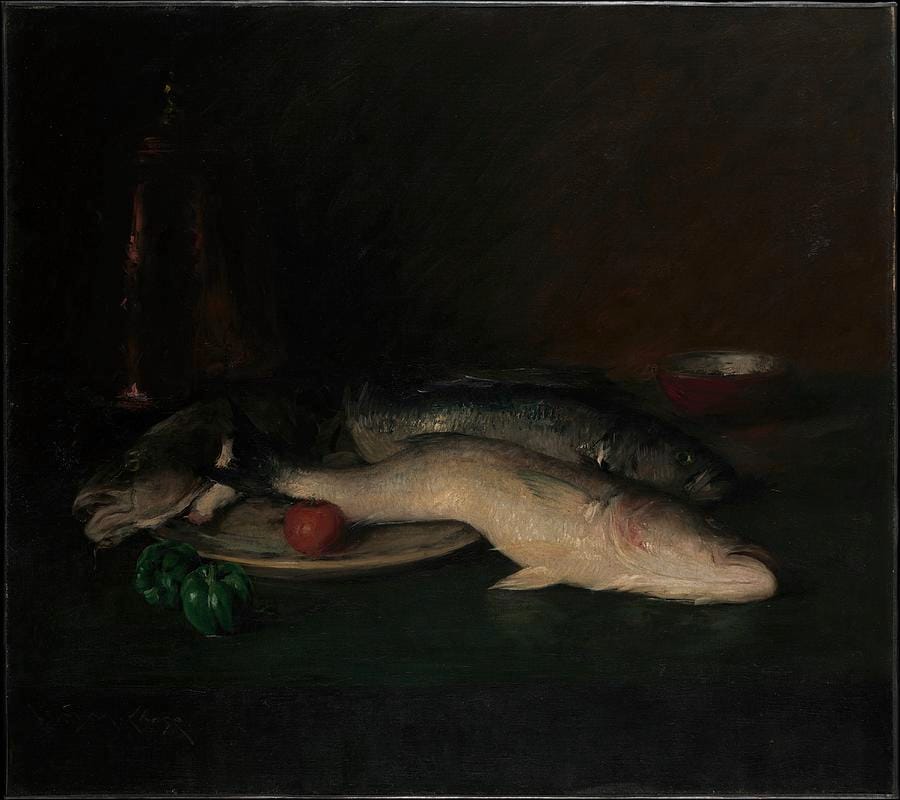
Two fish lie across a shallow dish on a dark table — a heavy pale one in front, a slimmer silver-backed one behind — with a red tomato and two green peppers beside them and the dull gleam of a copper vessel in the shadows. Chase painted fish obsessively in his later years, often finishing one at a single sitting to demonstrate to students how much could be done with a loaded brush and no second thoughts. These canvases are the clearest surviving evidence of the technical gift that made his reputation — bravura handling in the Munich tradition, applied without apology to a subject that cost him a few cents at the market.
Landscape: Shinnecock, Long Island
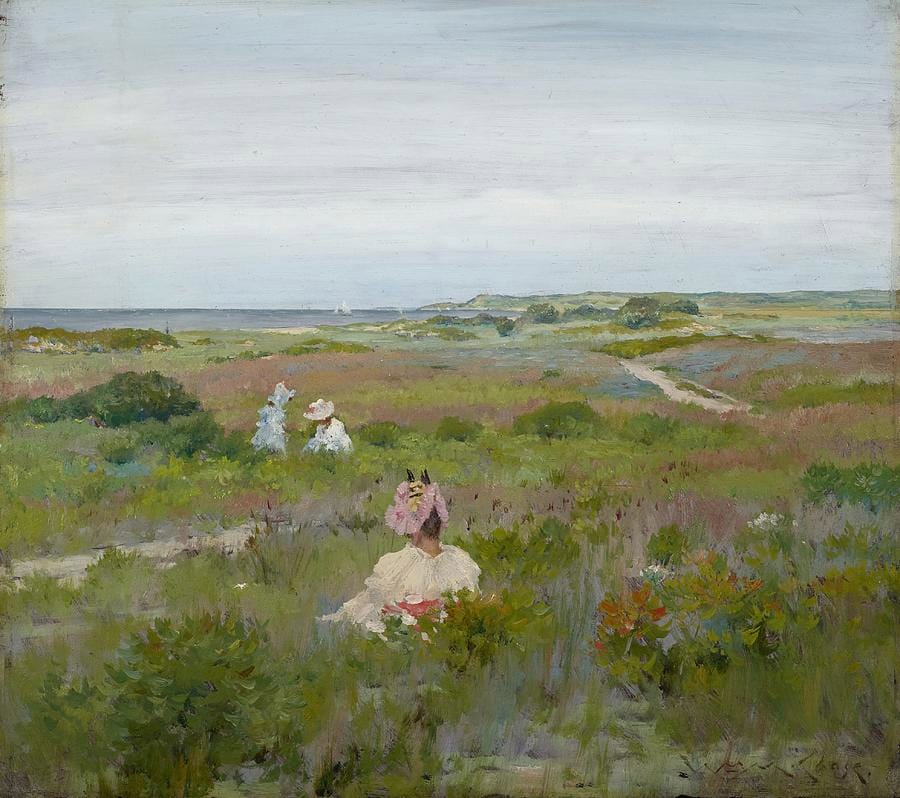
A woman in white with a wide pink-flowered hat sits in the scrub grass in the foreground, two smaller white figures rest further off, a sandy track winds away toward the dunes, and beyond them a single sail crosses a strip of pale water. Chase ran his summer school here from 1891, and between classes he produced scores of these luminous, quickly painted landscapes, often with his own family as the figures. Nothing in American art of the 1890s conveys the sensation of a hot, breezy afternoon near the Atlantic so directly — the horizon sits low, the sky takes a third of the canvas, and the whole picture seems to have been painted in one long breath.
Chase’s work is generous in a way that has never gone out of fashion: sunlit beaches, gleaming interiors, people you would like to have known, and brushwork that rewards standing close. His Shinnecock landscapes in particular bring air and light into a room, which is precisely what most rooms need.
Shop William Merritt Chase prints here, and explore the rest of our famous paintings collection for more of the world’s most beloved masterpieces.