Théophile Alexandre Steinlen’s Ten Most Iconic Posters and Paintings
The black cat of Montmartre, the chocolate poster, the laundresses at night: ten works by the great chronicler of working Paris.

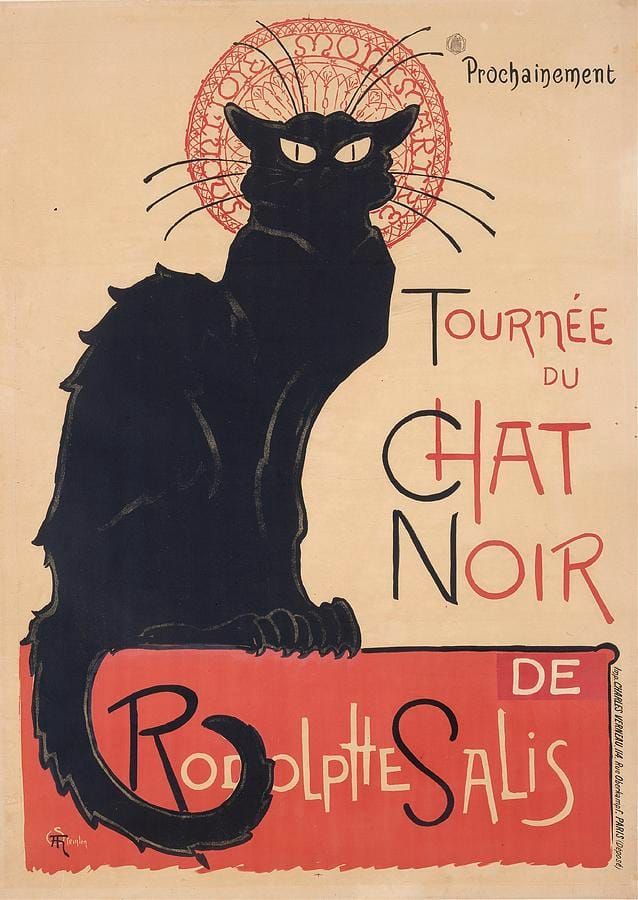
Théophile Alexandre Steinlen (1859–1923) was born in Lausanne, trained briefly as a textile designer, and moved to Paris at twenty-two, settling on the slope of Montmartre where he stayed for the rest of his life. He fell in almost at once with the crowd around the Chat Noir cabaret, and within a few years he was one of the most prolific illustrators in France, turning out thousands of drawings for Gil Blas illustré, Le Rire, L’Assiette au Beurre, and a dozen other papers.
Two things run through everything he made. The first is politics: Steinlen had deep sympathies with the Paris poor, and he drew laundresses, street singers, strikers, and refugees with a directness almost no one else in commercial illustration attempted. The second is cats. He kept a houseful of them, drew them obsessively, and gave the world the most recognizable cat in the history of graphic design. Here are ten of his most iconic works.
Tournée du Chat Noir
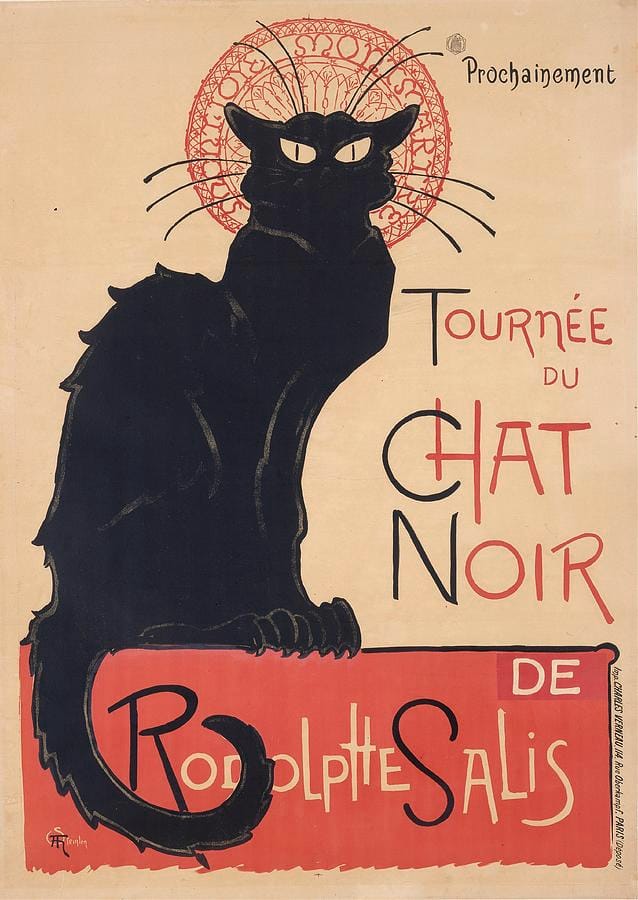
A black cat sits bolt upright against a cream field, ears cocked, whiskers fanning out like rays, its eyes narrowed to two pale slits, with a red rosette behind its head that looks unmistakably like a cathedral rose window. Made in 1896 to advertise the touring show of Rodolphe Salis’s Chat Noir cabaret, it is the most reproduced poster of the Belle Époque and probably the best-known image of Montmartre anywhere. Steinlen strips the design to four elements — cat, halo, hand-lettered type, and a block of scarlet — and the result reads at fifty yards. More than a century on, it still hangs in kitchens and cafés all over the world.
Compagnie Française des Chocolats et des Thés
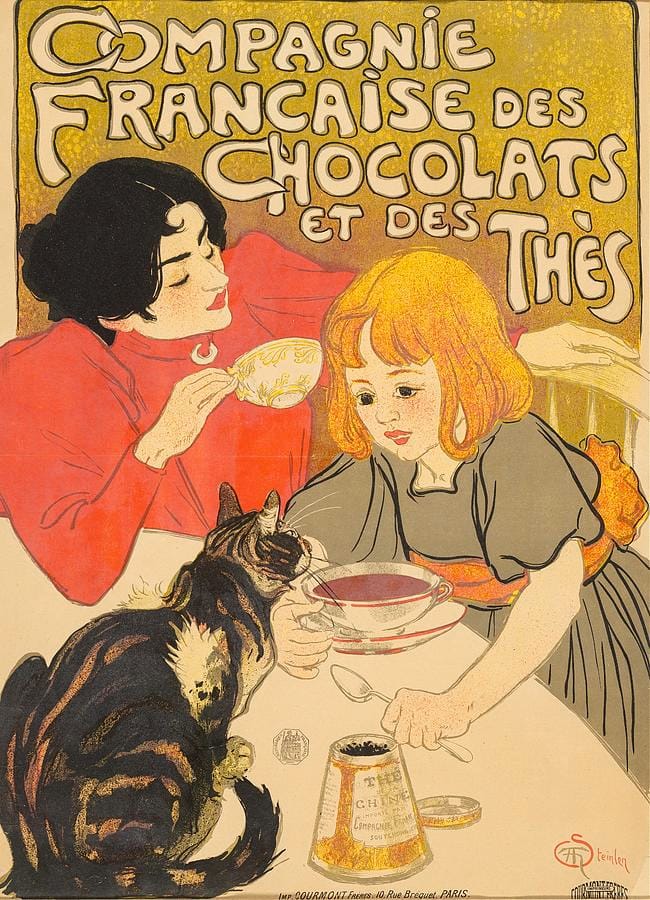
A red-haired girl in a gray pinafore lifts a wide bowl of drinking chocolate while a tabby cat leans across the table toward it, whiskers almost in the cup; behind her a dark-haired woman in a red blouse sips from her own. Made in the mid-1890s for a French chocolate and tea company, it is the warmest of all Steinlen’s advertising work. The cat does the selling — it turns a product poster into a domestic scene anyone recognizes — and the flat pattern of its striped coat against the girl’s plain dress shows how much Steinlen had learned from Japanese prints.
Motocycles Comiot
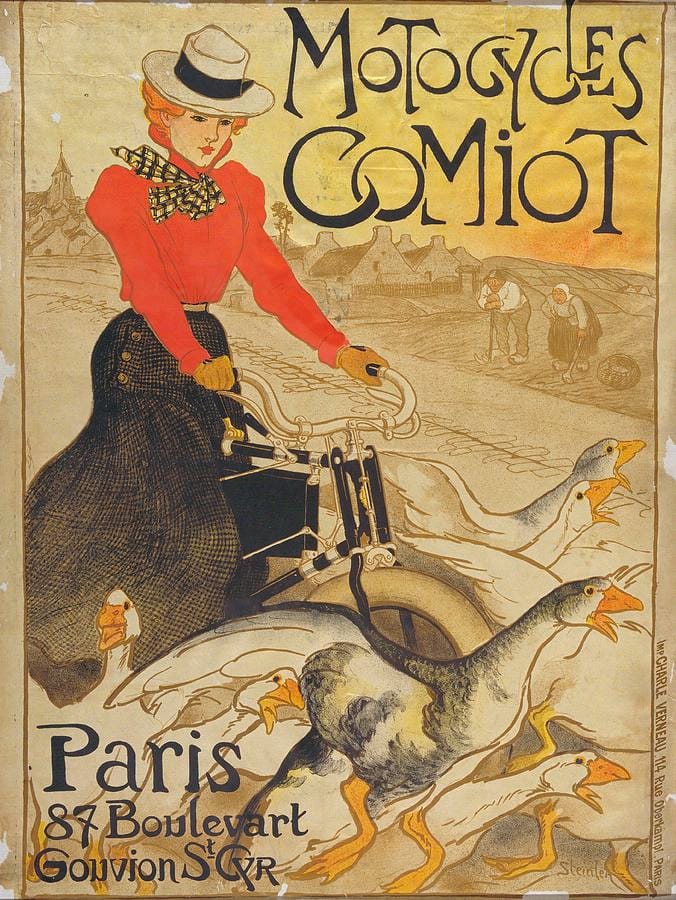
A young woman in a red jacket and broad white hat rides a motorized tricycle straight at the viewer while a flock of geese scatters in panic under her wheels, one of them tumbling beak over foot. Made in 1899 for a Paris manufacturer of motorcycles, it is Steinlen at his funniest and most modern: the machine is new, the rider is a woman, and the countryside is having none of it. The scattering geese give the poster its motion — a static advertisement made to feel like it is traveling at speed.
Ambassadeurs: Yvette Guilbert
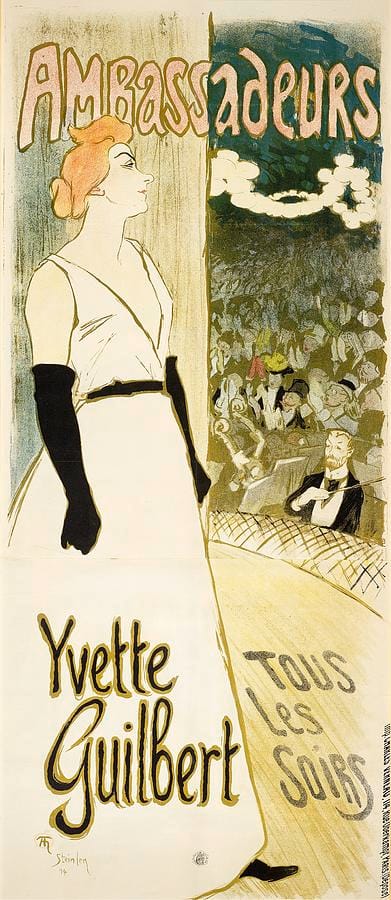
The singer Yvette Guilbert stands at the edge of the stage in a plain white gown and her trademark long black gloves, chin lifted, while behind her a haze of gaslight and a packed house dissolve into scribble. Steinlen made the poster in 1894 for her season at the Ambassadeurs café-concert on the Champs-Élysées. Guilbert was the most famous diseuse in Paris and was drawn by half the artists in the city, Toulouse-Lautrec among them; Steinlen’s version is the calmest of them, giving her the whole left half of a tall narrow sheet and letting the gloves supply all the drama.
Le Journal: “Paris” by Émile Zola
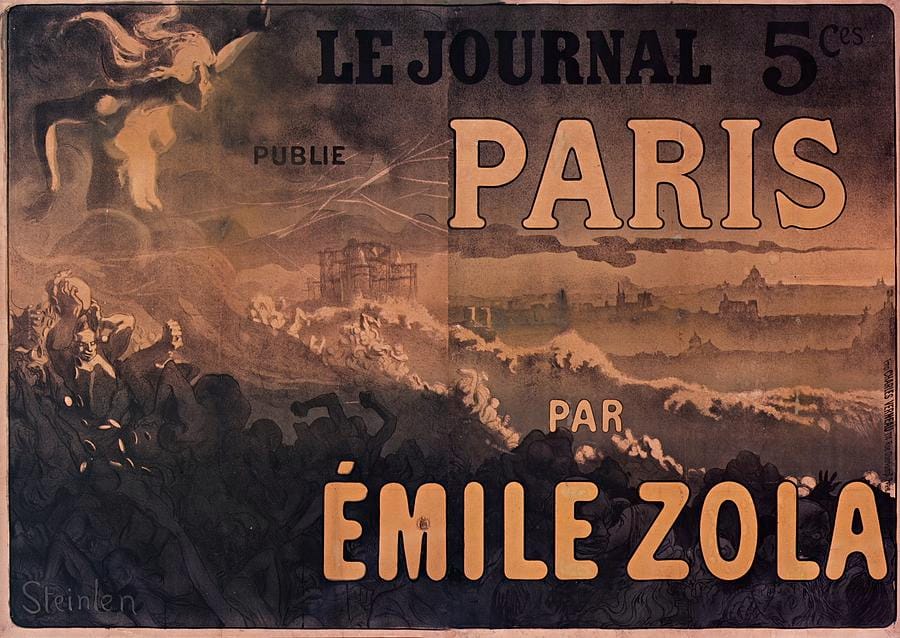
Zola’s novel Paris was serialized in the newspaper Le Journal in the late 1890s, and Steinlen designed the poster announcing it. A winged figure streams across the top left, scattering something over a dark crowd of upraised arms and heads, while the city itself lies hazy and low along the horizon behind them. The whole sheet is worked in smoky sepia and orange, closer to a lithographic drawing than an advertisement. The commission came at the height of Zola’s fame, in the years when he was fighting publicly over the Dreyfus affair — a context that gives the surging crowd in the foreground a particular charge.
Le Journal: “Le Coupable” by François Coppée
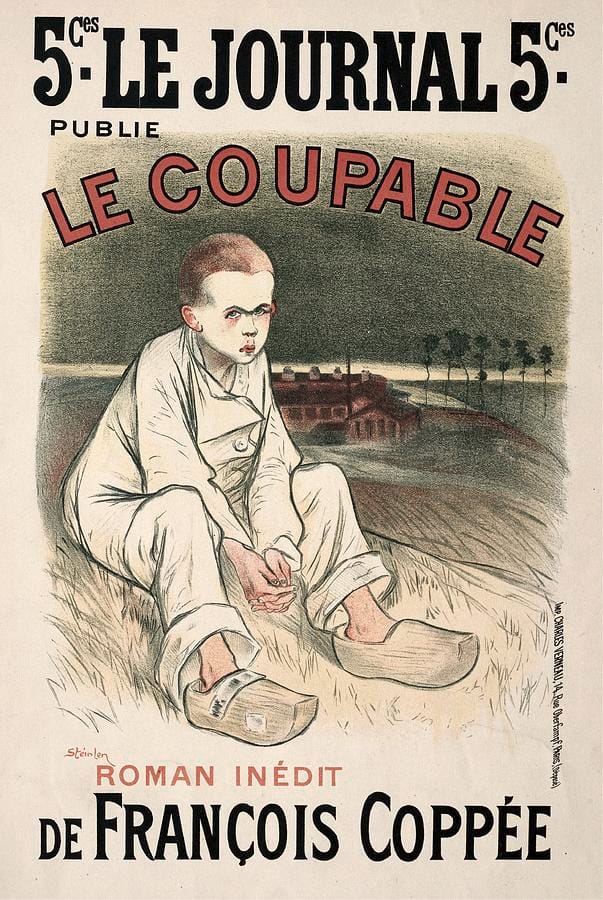
A boy with a shaved head sits alone in a field of dry grass in the coarse uniform and wooden clogs of a reformatory, hands hanging between his knees, the institution he has come from squatting on the horizon behind him. Steinlen made the poster in 1896 to advertise the serialization of François Coppée’s novel Le Coupable in Le Journal. It is an unusually bleak image for a piece of newspaper advertising, and that is exactly what makes it Steinlen: given a commercial brief, he produced a portrait of institutional childhood that would not be out of place in a social documentary.
Save Serbia, Our Ally
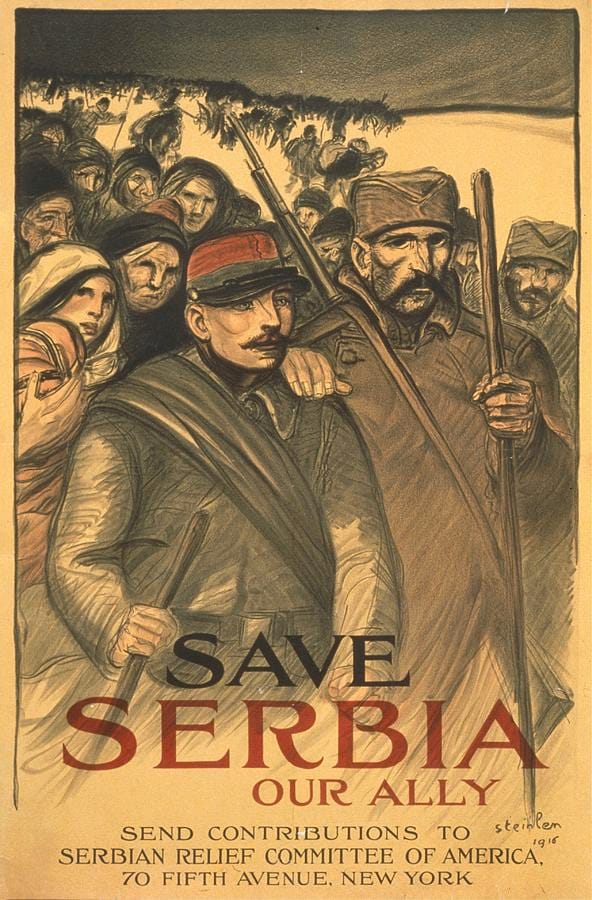
A column of soldiers and civilians presses forward out of the poster — a moustached soldier in a red-banded cap leaning on a staff, bearded men and headscarved women crowding behind him, the rest receding into darkness — under the words SAVE SERBIA OUR ALLY. Steinlen designed it in 1916 for the Serbian Relief Committee of America, whose New York address is printed at the foot. Serbia had been overrun and its people scattered, and Steinlen, who spent the war years drawing the displaced, gave the appeal the density and grain of a charcoal drawing rather than the clean shapes of his cabaret work.
Deux Chats Couchés sur un Canapé (Two Cats on a Sofa)
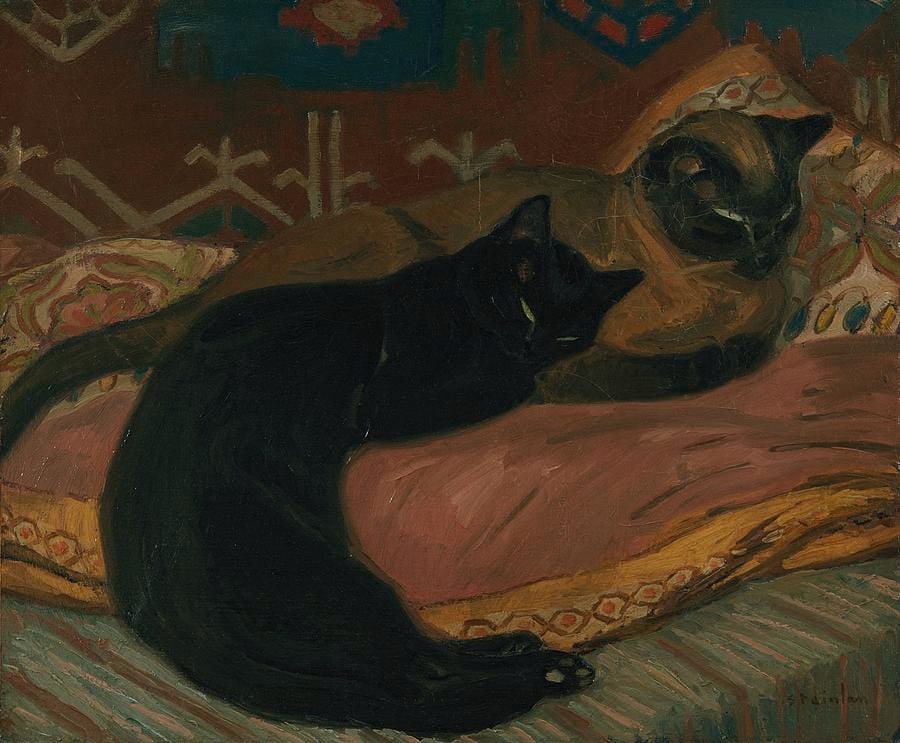
Two cats lie curled against each other on a heap of embroidered cushions — one glossy black, the other a warm tawny brown with a dark mask — in front of a wall hung with a patterned kilim. This is Steinlen the oil painter rather than the poster designer, and the handling is loose and unfussy, the color built from deep reds, russets, and greens. The pose is exact: anyone who has lived with cats will recognize the black one’s half-open eye, watching without lifting its head. He kept a large household of cats and drew them daily for forty years.
The Cats: Tsching, Batzar and Blanc-Blanc
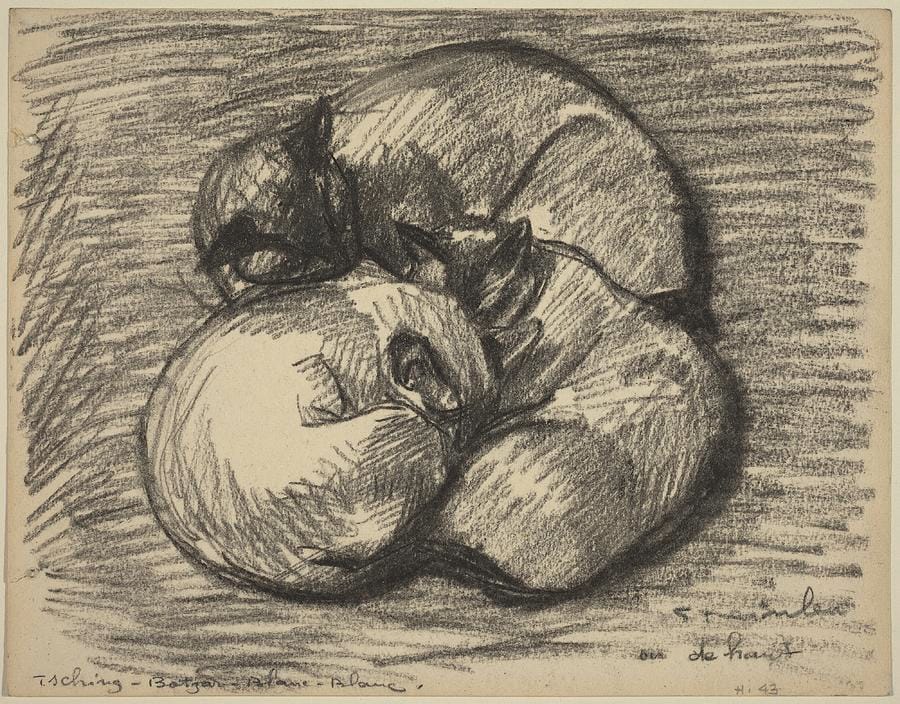
Three of Steinlen’s own cats, named in his handwriting along the lower edge, sleep in a single interlocking heap of fur so tightly packed it takes a moment to work out where one animal ends and the next begins. Drawn in charcoal and crayon with almost no line wasted, it is a study rather than a finished picture, and it shows how thoroughly he understood feline anatomy — the arc of a spine, the tuck of a chin over a paw. Steinlen’s cats made him famous, but drawings like this one show why they convince.
The Laundresses
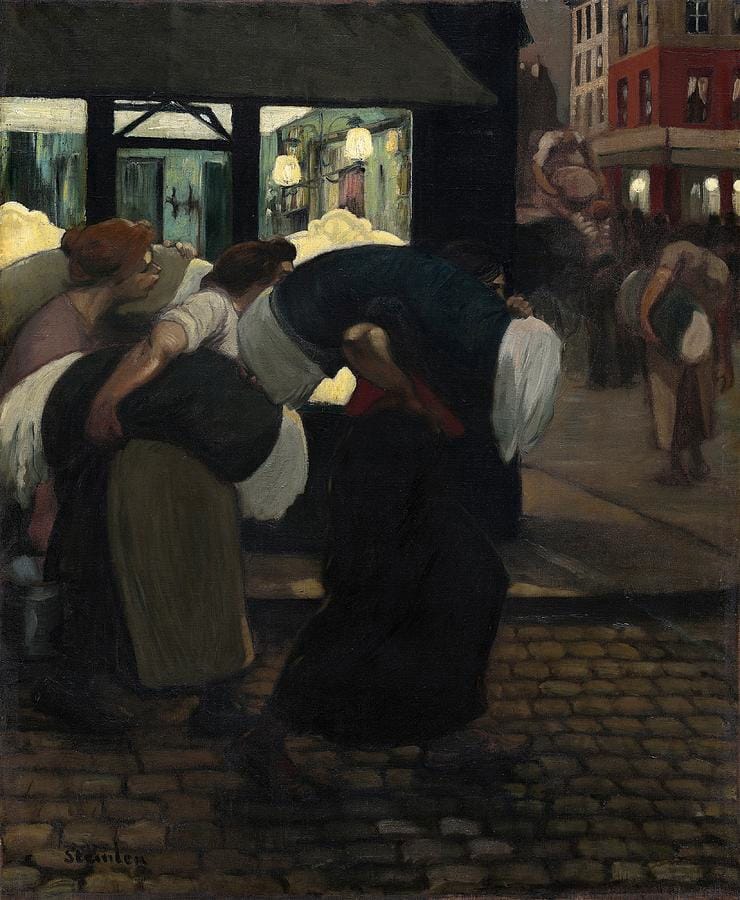
Women bent almost double under vast white bundles of washing haul their loads across wet cobbles at night, past the green-lit window of a shop and on toward a red corner building further up the street. This is one of Steinlen’s Montmartre oil paintings, and it is the perfect counterweight to the Chat Noir poster: same neighborhood, same artist, no charm at all. The whites of the linen are the only bright notes in a picture of browns, blacks, and gaslight, and the labor is described entirely through posture — not a single face is turned toward us.
Steinlen’s range is the surprise. The same hand that produced the most cheerful cat in the world also made some of the most unsentimental images of poverty in French art, and both halves are worth living with. A Chat Noir or a chocolate poster brings graphic punch and a lot of warmth to a kitchen or a hallway; the drawings and paintings reward a quieter spot.
Shop Théophile Alexandre Steinlen prints here, and explore the rest of our famous paintings collection for more of the world’s most beloved masterpieces.