Raphael’s Ten Most Famous Paintings
The School of Athens, the Sistine Madonna, the Transfiguration and more: the ten works that made Raphael the most imitated painter in Europe for three hundred years.

Raffaello Sanzio (1483–1520) was born in Urbino, the son of a court painter, and was orphaned by eleven. He learned quickly and borrowed shamelessly: from Perugino, whose manner he absorbed so completely that early works are still argued over; from Leonardo, whose pyramidal groupings and soft modeling he took up in Florence; from Michelangelo, whose muscular figures he studied while the two men worked in the same building and cordially disliked each other.
What he added was a quality contemporaries called grace — an apparently effortless balance that makes his compositions feel inevitable rather than constructed. He ran a large, efficient workshop, was made architect of St. Peter's, and died in Rome at thirty-seven. For three centuries afterward, European academies taught drawing by copying him, which is why his name became a synonym for the ideal and, eventually, something for the modern movement to rebel against. Here are ten of his most famous paintings.
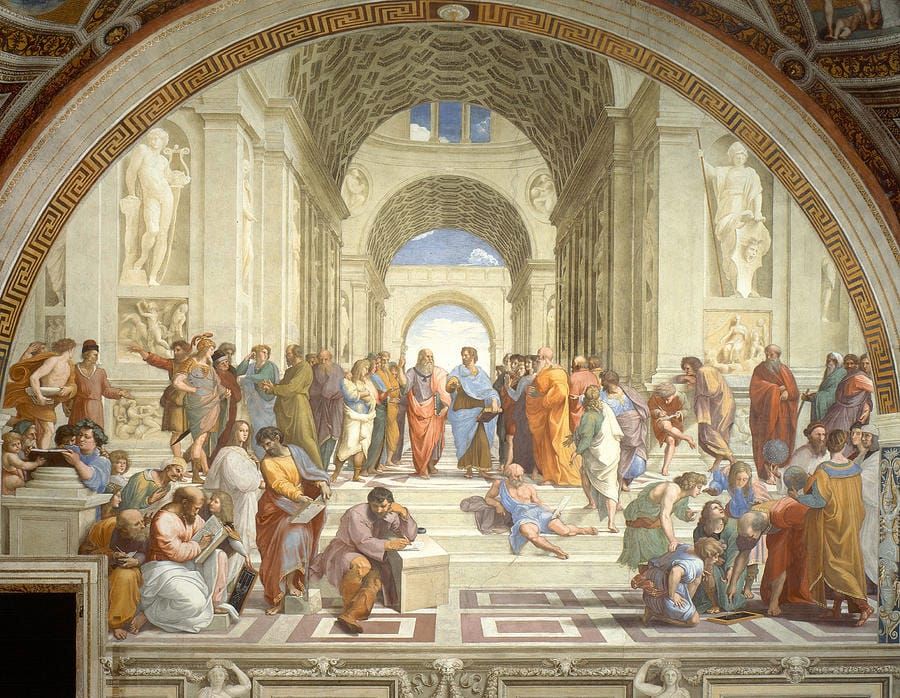
The School of Athens
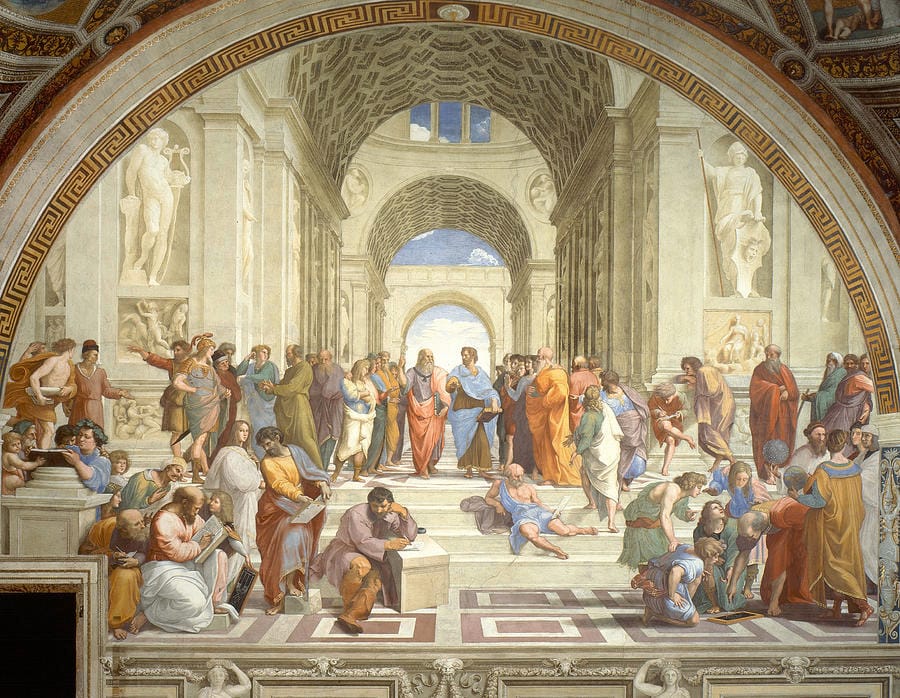
Painted between about 1509 and 1511 for the room where Pope Julius II kept his personal library, The School of Athens gathers the philosophers of antiquity under a vast barrel-vaulted hall. Plato and Aristotle walk toward us at the center, one pointing up toward the world of forms, the other gesturing out at the world in front of him — the whole argument of Western philosophy compressed into two hands. Around them Raphael scatters mathematicians, astronomers, and skeptics, several of them portraits of his own contemporaries. The building they stand in was never built; it is closer to the design for the new St. Peter's than to anything in Athens.
The Sistine Madonna
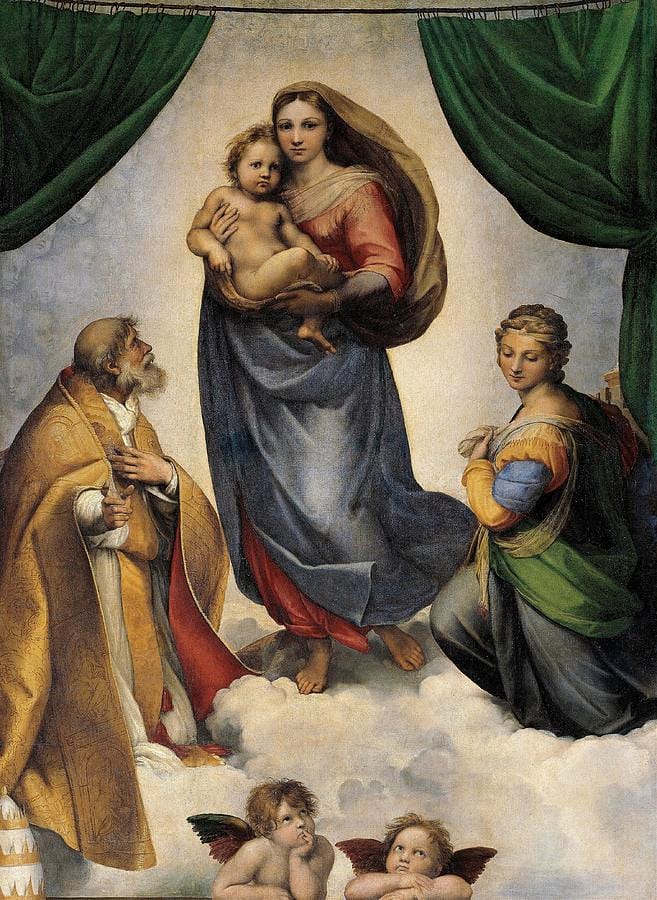
Commissioned around 1512 for a church in Piacenza, this is an altarpiece staged like a theater. Painted curtains part at the top, and the Virgin steps forward through them across the clouds, carrying a Christ child whose expression is startlingly grave. Saint Sixtus gestures out of the picture toward the congregation; Saint Barbara looks down. The two bored cherubs leaning on the frame at the bottom edge have long since escaped the painting altogether and turned up on greeting cards, mugs, and umbrellas worldwide — probably the most reproduced fragment of any Renaissance picture.
The Transfiguration
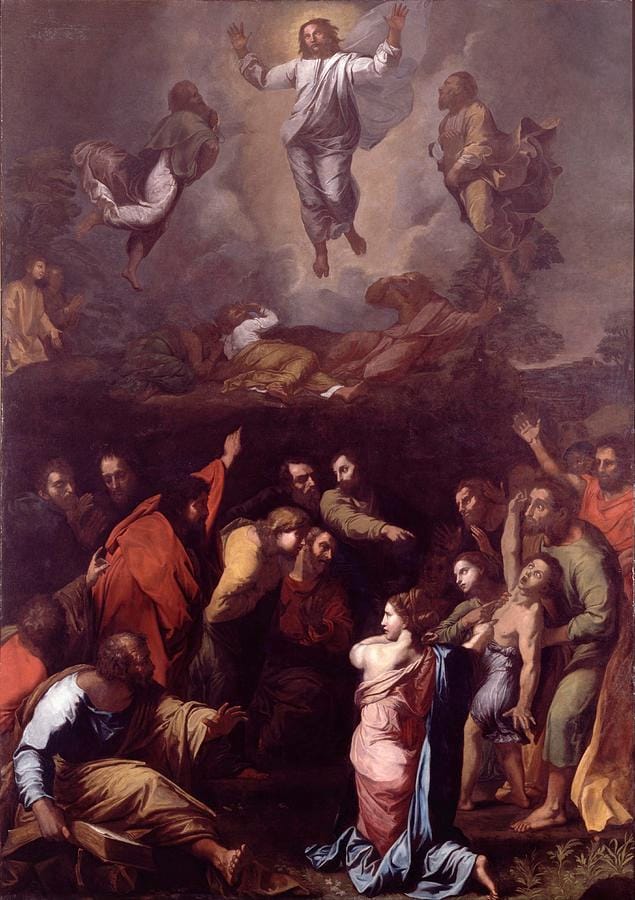
Raphael's last painting, begun around 1516 and unfinished at his death in 1520, splits into two worlds. Above, Christ rises in white light between Moses and Elijah while the apostles fall back dazzled. Below, in shadow, a crowd struggles with a boy in the grip of a seizure whom the remaining disciples cannot heal. The upper half is serene and the lower half is chaos, and the pointing arms of the crowd connect them. It was carried in his funeral procession, and for centuries afterward was widely regarded as the single greatest painting in Rome.
Madonna del Cardellino
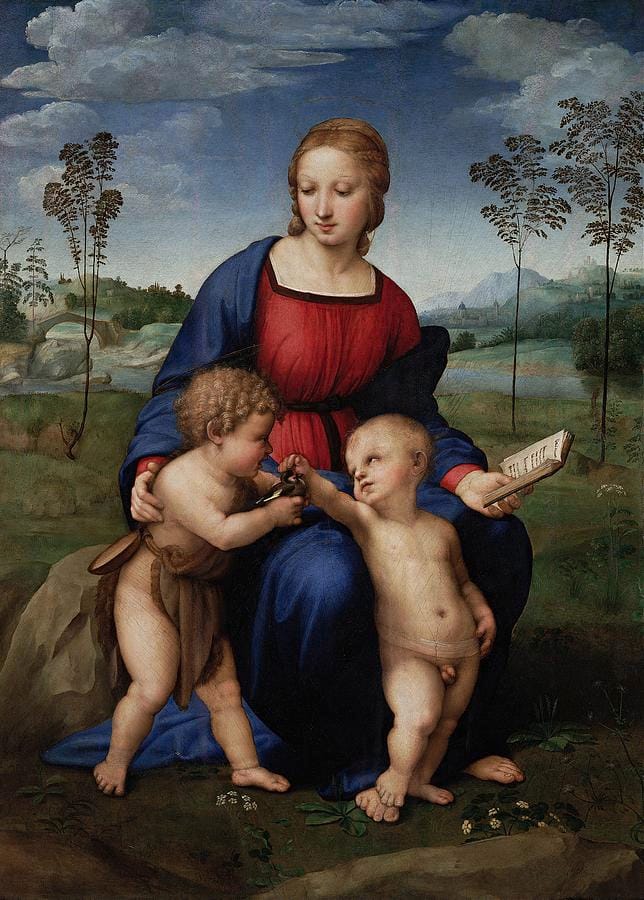
The Madonna of the Goldfinch, painted around 1506 during Raphael's Florentine years, shows the Virgin looking up from her book as the young John the Baptist offers a goldfinch to the Christ child. The bird is not decoration: the goldfinch feeds among thorns and was a traditional emblem of the Passion, so the gentlest possible domestic scene carries a warning inside it. The three figures lock into the stable pyramid Raphael learned from Leonardo. The panel was shattered when the owner's house collapsed in the sixteenth century and has been pieced back together and restored more than once since.
Madonna della Seggiola
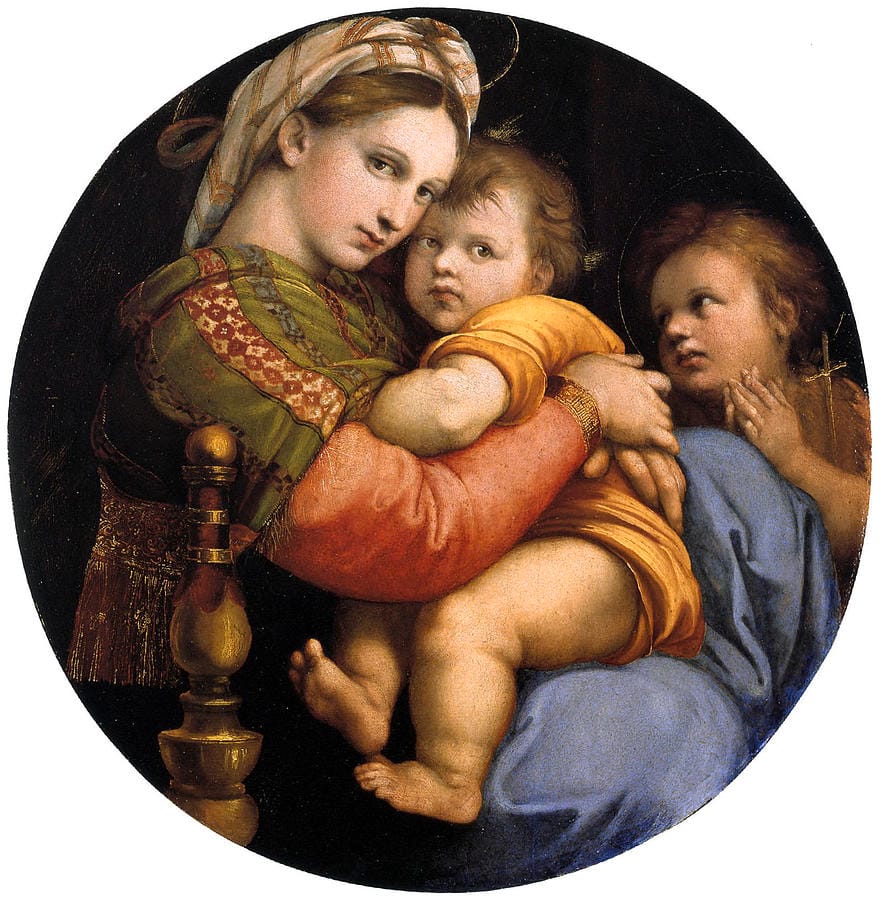
The Madonna of the Chair, painted around 1513–14, is a tondo — a circular panel — and Raphael uses the shape as a compositional problem to solve. The Virgin curls around the child to fit the circle, her shoulder and his body following the curve of the frame, so that the embrace and the format become the same gesture. She is dressed less like a queen of heaven than like a young Roman woman in a shawl, and she looks directly out at the viewer. It became one of the most copied images in Europe.
The Alba Madonna
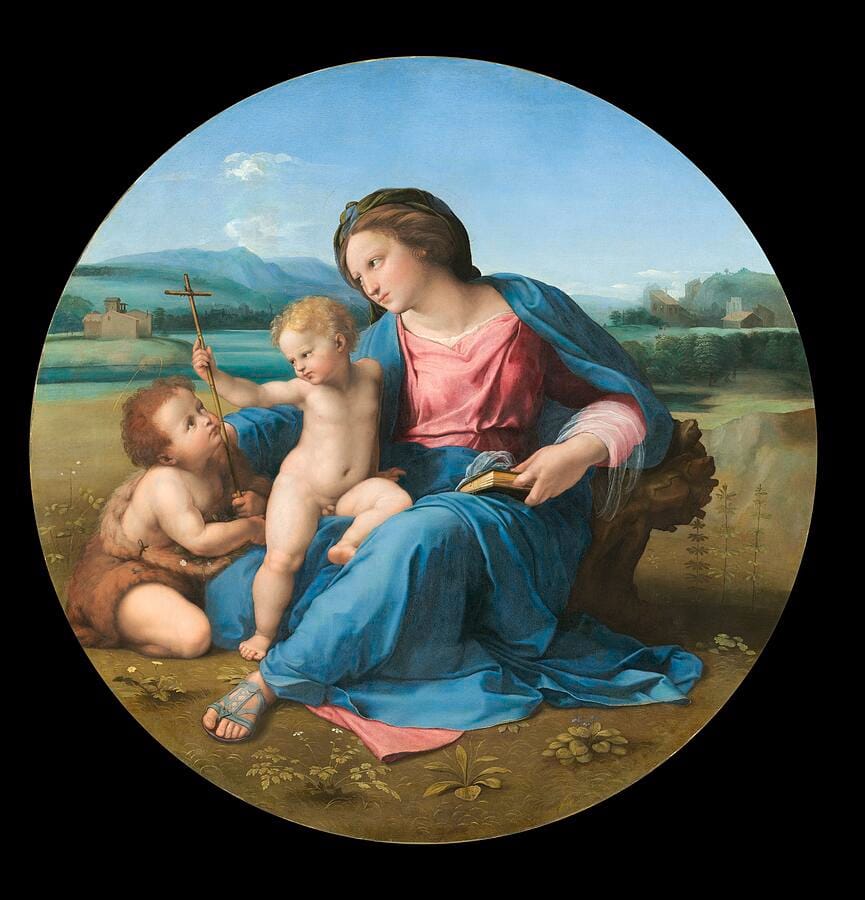
Another tondo, painted around 1510, and one of the most quietly accomplished. The Virgin sits on the ground — the pose is called the Madonna of Humility — in an open Roman landscape, with Christ and the infant John the Baptist beside her. All three look at the small cross John is holding out, and the diagonal of the Virgin's arm and leg turns the circular panel into a slow rotation. The painting takes its name from the Spanish ducal house that owned it for generations before it left for Russia and eventually Washington.
Woman with a Veil
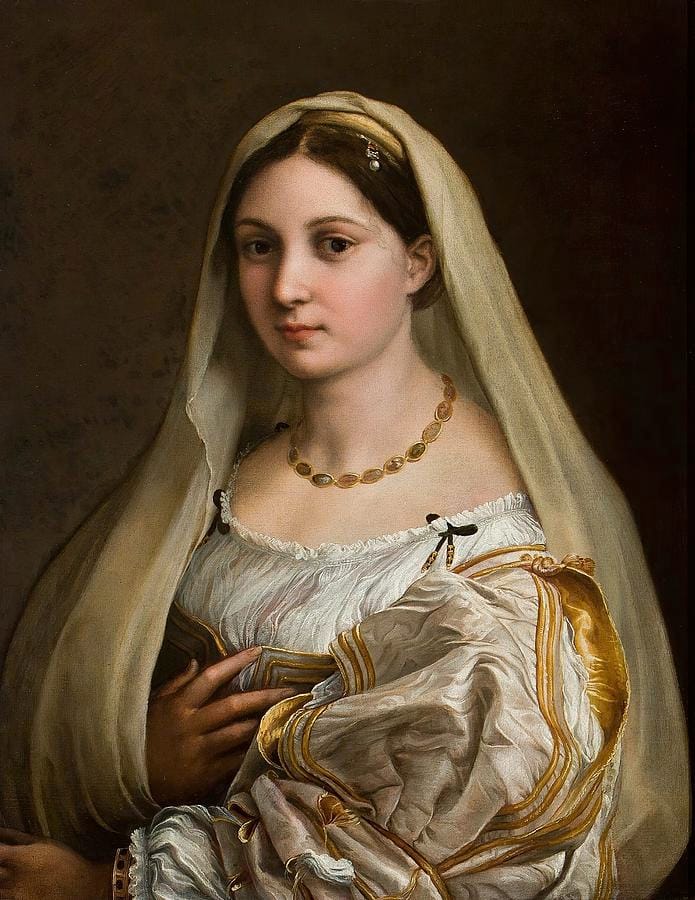
La Donna Velata, painted around 1516, is Raphael's most sympathetic portrait: a young woman in a heavy silk sleeve and a fine veil, turning slightly toward the viewer with an expression that gives away nothing. The paint handling in the sleeve alone — the weight and slither of the fabric — is a demonstration of technical control. The sitter has traditionally been identified with a woman Raphael loved, and the same face appears in the Sistine Madonna, though the identification rests more on later legend than on documentation.
Saint George and the Dragon
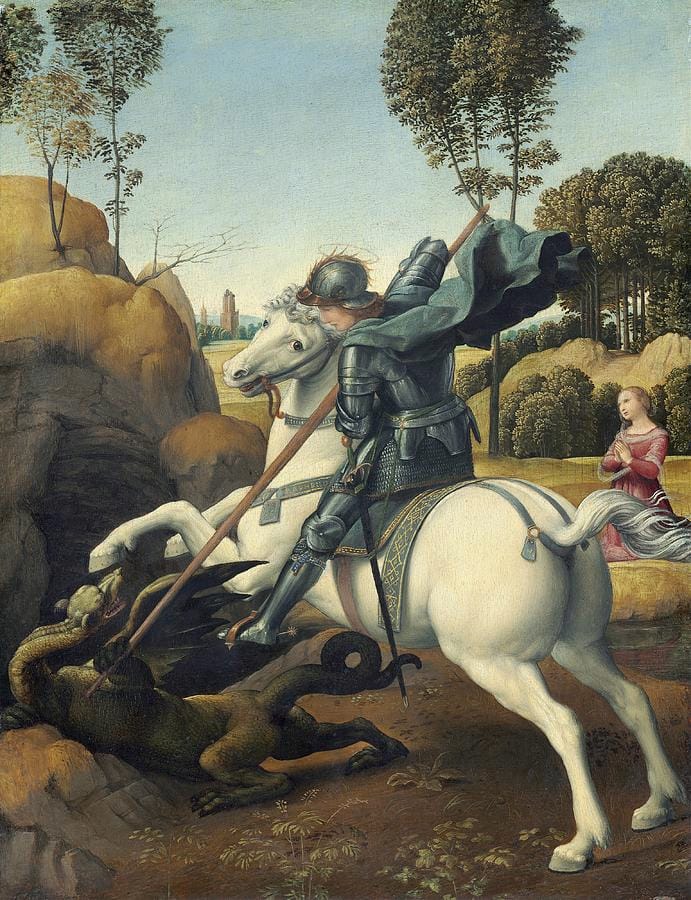
A small panel from around 1506, painted with the precision of a miniature. George's white horse rears, the lance has already splintered, and the saint draws his sword as the dragon twists beneath the hooves; the princess flees into the middle distance. Raphael packs a great deal of violent movement into a picture not much larger than a sheet of paper, and every element — the broken lance, the horse's turning head, the coiling tail — pushes the eye around the same tight circle.
Self Portrait
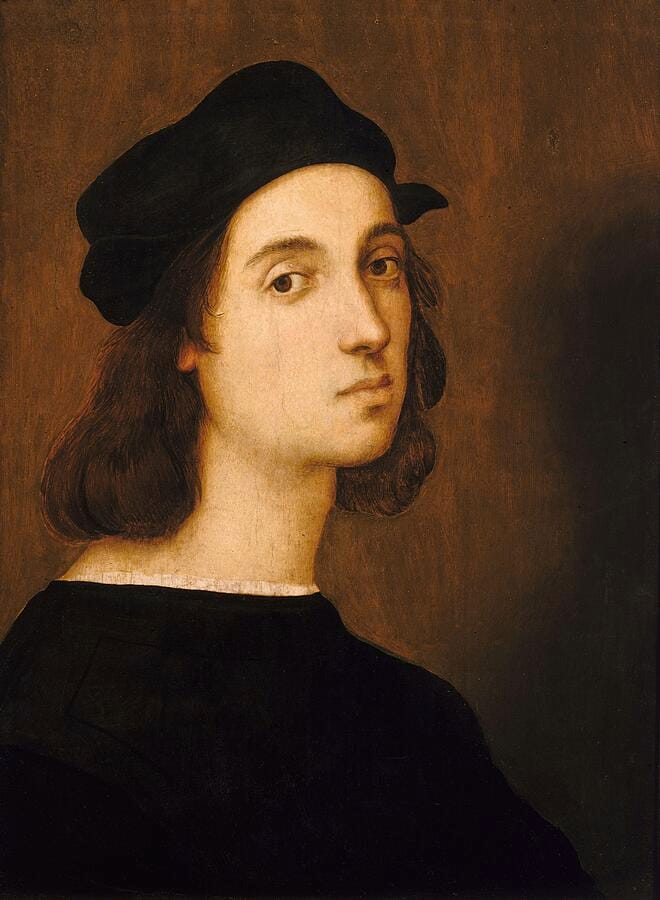
Painted around 1506, when he was in his early twenties, this shows a dark-eyed young man in a plain black cap and coat, turned three-quarters toward the viewer against a neutral ground. There is no display of status and no studio props — no brushes, no palette. Compared with the ambitious self-images painters of the period often produced, it is strikingly reticent, and it fixed the way later generations pictured him: unassuming, watchful, and very young.
The Miraculous Draught of Fishes
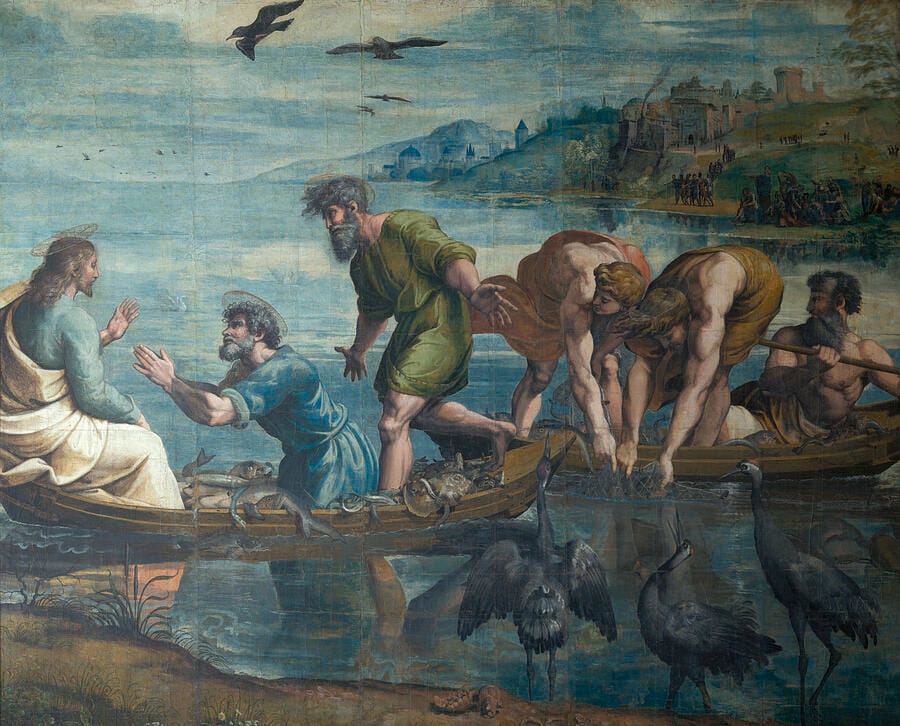
This is a cartoon — a full-size design made to be transferred to a tapestry loom — from the series Raphael produced around 1515–16 for the lower walls of the Sistine Chapel. Christ sits in a boat so heavily loaded with fish that it rides low in the water, while Peter falls to his knees in front of him and the other fishermen strain at the nets. In the foreground a row of cranes stands watching, entirely unbothered. Because the tapestries were woven from behind, the cartoons are mirror images of the finished hangings.
Raphael died in Rome in 1520, still in his thirties, and was buried in the Pantheon. His workshop finished the Transfiguration; his compositions were engraved, copied, and taught for the next three hundred years, until a group of young English painters called themselves the Pre-Raphaelites specifically to get out from under him.
Shop Raphael prints here, and explore the rest of our famous paintings collection for more of the world’s most beloved masterpieces.