Maurice Prendergast’s Ten Most Famous Paintings
Venetian bridges, Boston beaches and Central Park crowds: ten works by the American painter who turned holiday crowds into mosaics of color.

Maurice Prendergast (1858–1924) was born in Newfoundland, grew up in Boston, and began his working life lettering show cards for shop windows. He did not reach Paris until he was in his thirties, and what he found there — Post-Impressionist color, Japanese prints, the flat decorative patterning of Bonnard and Vuillard — settled the direction of everything he did afterward. He became one of the finest watercolorists America has produced.
His subject almost never changed: people at leisure in public places. Crowds on a bridge, families on a beach, children in a park, promenaders under parasols — always seen from a slight distance, always massed into bands of pattern and color rather than described as individuals. In 1908 he exhibited with The Eight, the group that broke away from the National Academy, and in 1913 he showed at the Armory Show. Here are ten of his best-known works.
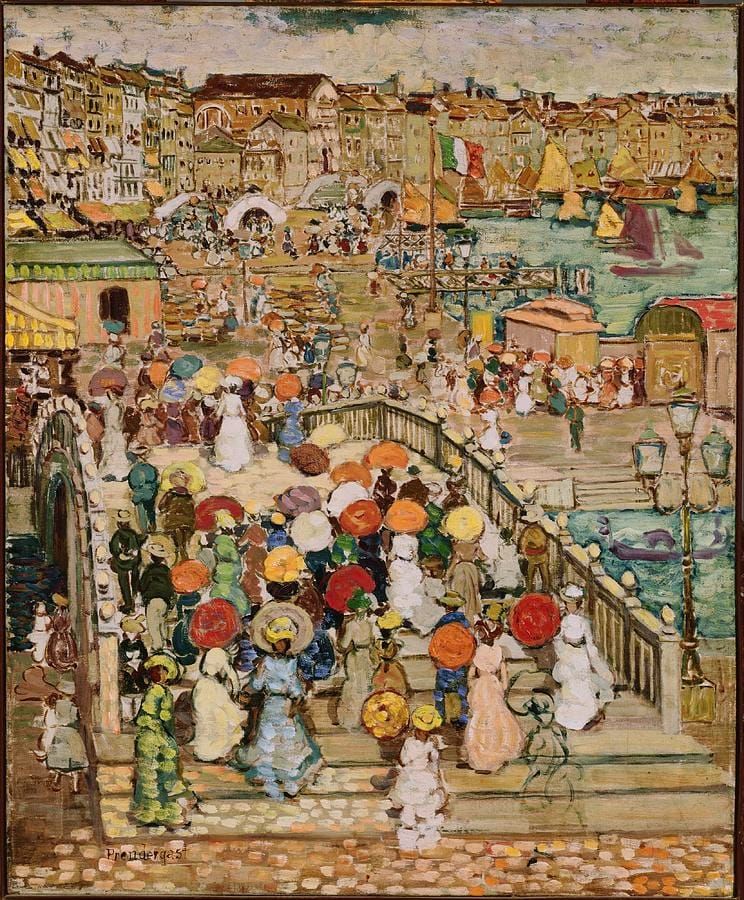
Ponte della Paglia
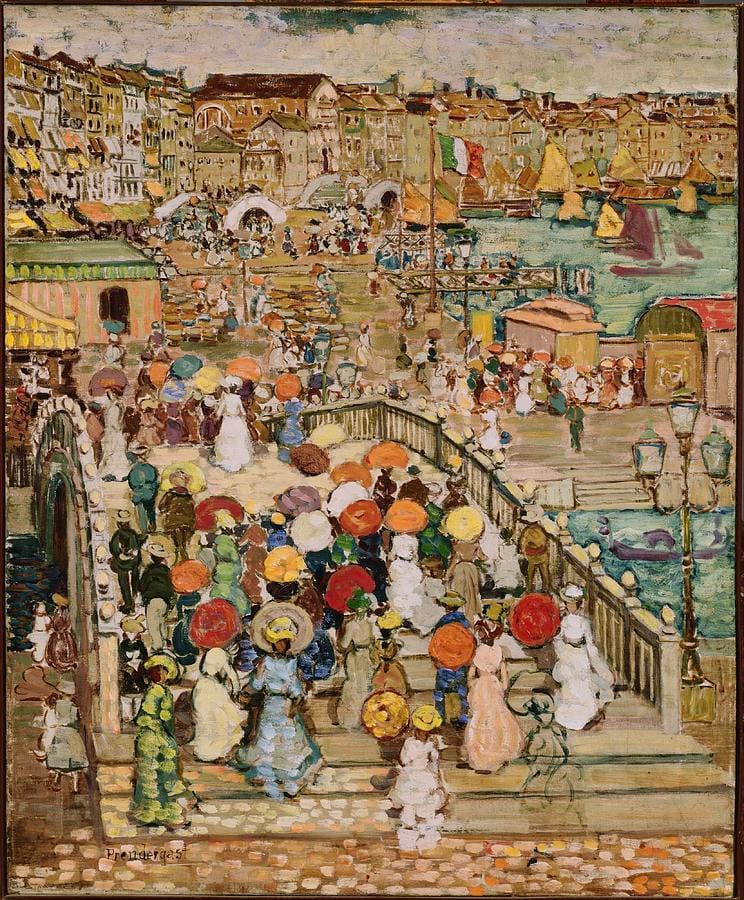
Prendergast’s finest Venetian picture began during his long stay in Italy in 1898–99 and was reworked years later. The Ponte della Paglia is the little bridge beside the Doge’s Palace from which every visitor photographs the Bridge of Sighs, and he painted it packed with people: a rising tide of orange, red and white parasols climbing the steps, women in pale summer dresses, the waterfront and its buildings running away behind in stripes of pink and green. Nobody has a face. The crowd becomes a single decorative surface, which is exactly the quality that made his contemporaries call his work mosaic-like.
Umbrellas in the Rain
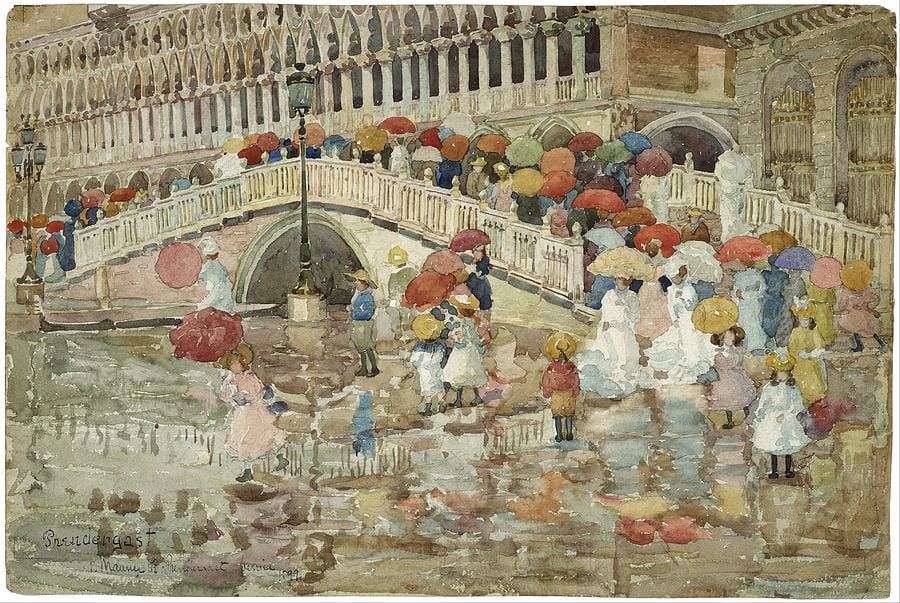
Painted in Venice in 1899, this watercolor returns to the same crowded bridge beside the Doge’s Palace and gives it weather. Figures stream up and over the steps under a scatter of red, blue and yellow umbrellas, the arcade of the palace running along behind them, while the wet pavement in the foreground throws everything back in long soft reflections. Rain suited Prendergast: it let him pool his washes into broad shining areas and gave him an excuse for the round shapes he loved. The sheet is now in the Whitney Museum of American Art, and it remains one of the best-loved American watercolors of its decade.
Central Park
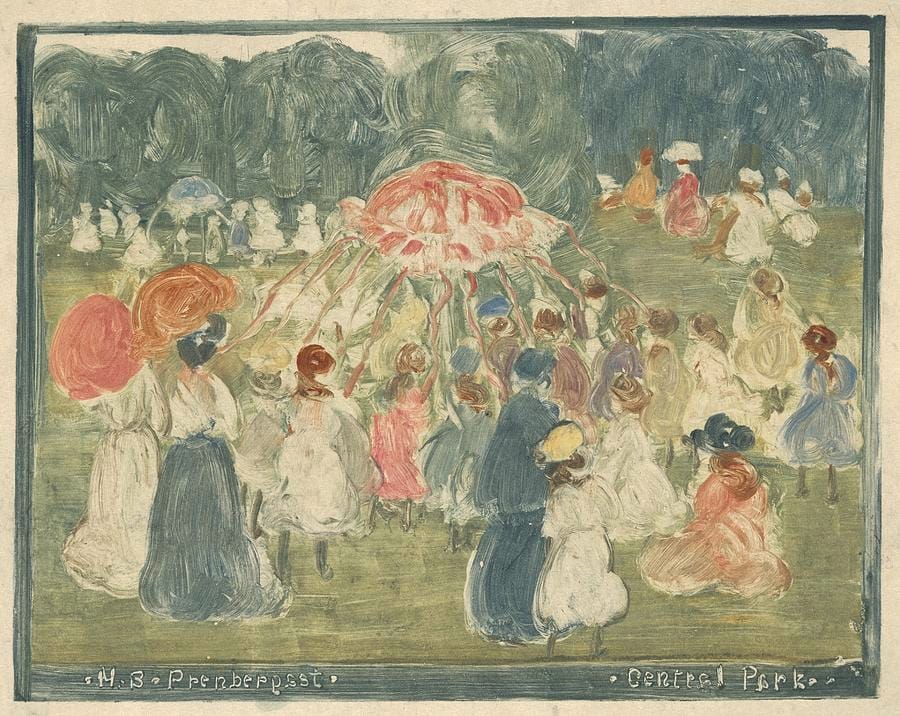
Around the turn of the century Prendergast made a series of watercolors in Central Park, and this is the best known of them. Women in white summer dresses and enormous hats gather beneath a great pink parasol, with more parasols of coral and rose opening on either side; children in pale frocks weave among the adults, and behind them a screen of dark green trees closes the scene off like a stage flat. The pencil underdrawing shows through the washes in places, and the whole sheet has the sunlit, slightly faded look of a memory. He signed it and lettered the title along the bottom edge.
Revere Beach
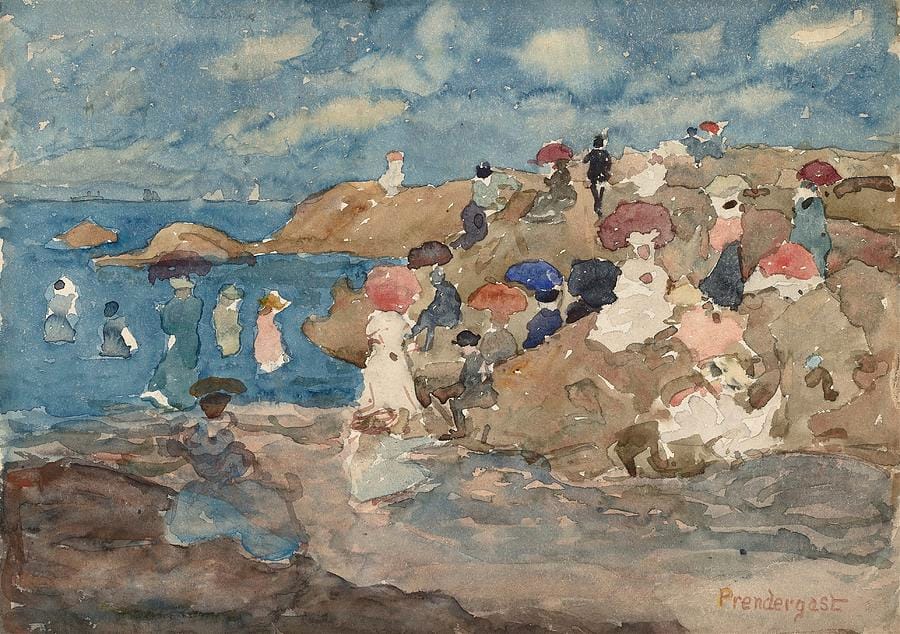
Revere Beach, just north of Boston, was one of America’s first public beaches and Prendergast went there constantly in the 1890s. This watercolor looks along a shoulder of brown rock with the sea beyond it, bathers wading out into the shallows in dark costumes, and a row of women in white dresses arranged along the rocks under bright parasols. The composition is built in horizontal bands — sand, rock, water, sky — and the figures are placed along them like beads. It is the beginning of the pattern-making that would dominate the rest of his career.
Sunlight on the Piazzetta
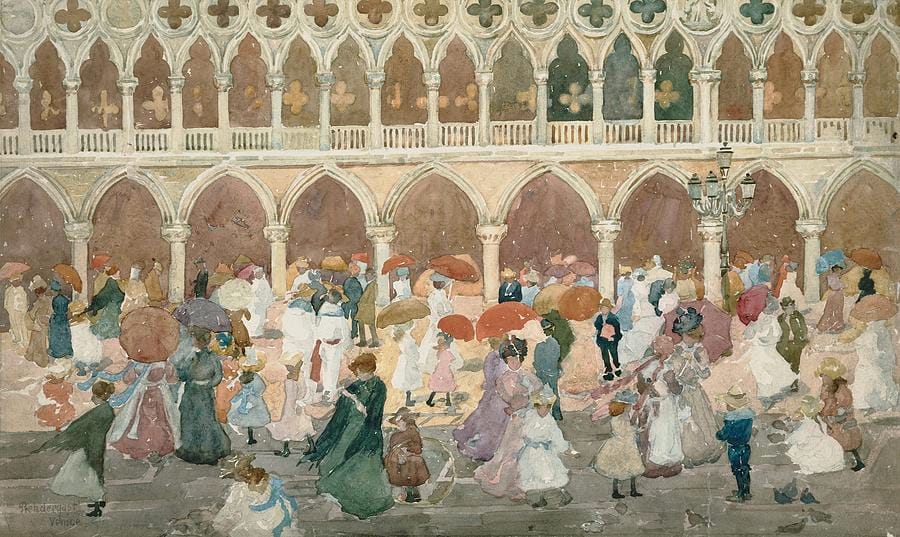
The Piazzetta is the small square that opens from Piazza San Marco to the lagoon, and Prendergast painted it with the Gothic arcade of the Doge’s Palace running the full width of the sheet like a length of lace. Beneath it a crowd moves from right to left in lilac, rose and white, parasols tilting, children scattered through the adults, everything drenched in the flat bright light of an Italian noon. The architecture is drawn with real accuracy while the people are barely more than colored marks — a contrast he used again and again in Venice, and never more elegantly than here.
In the Luxembourg Gardens
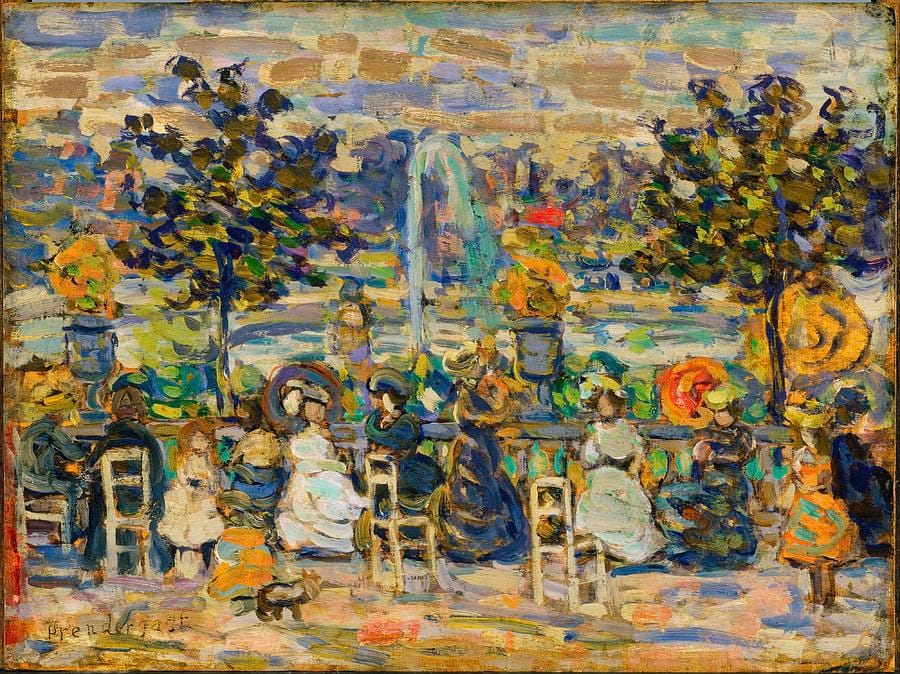
The Luxembourg Gardens were a favorite haunt of Prendergast’s in Paris, and this later painting shows the park in full summer: a fountain playing in the middle distance, garden chairs pulled together in groups, women seated in blue and white dresses, children and a small dog crossing the foreground, and a canopy of blue-green trees closing overhead. The paint is dabbed on in thick separate touches so that the whole surface flickers. Compared with the transparency of his early watercolors, this is a denser, more woven kind of picture — the style of his maturity, closer to tapestry than to any kind of report.
The Paris Omnibus
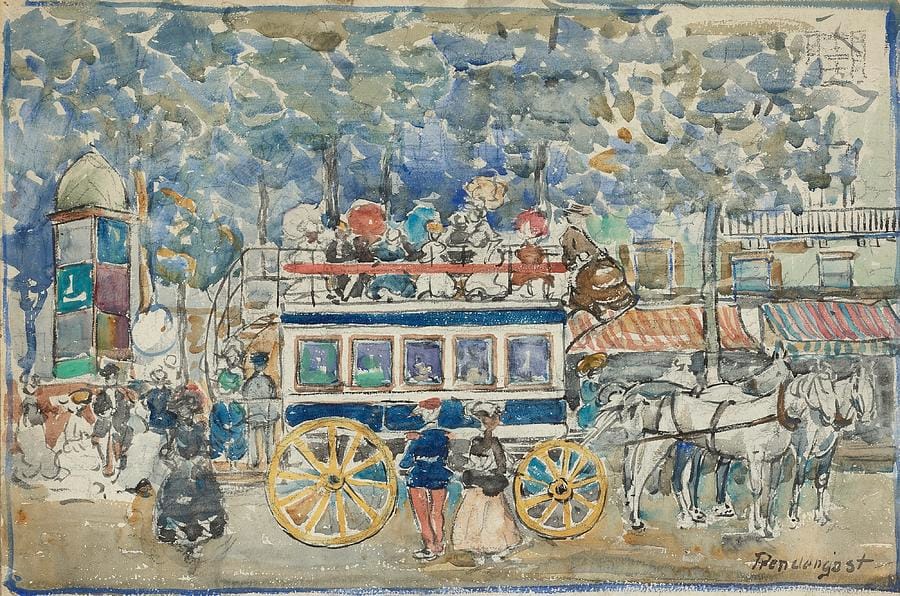
During his first years in Paris, in the early 1890s, Prendergast filled sketchbooks with the traffic of the boulevards. Here a green-and-blue horse-drawn omnibus fills the center of the sheet, drawn by a pair of pale horses with a driver up front and passengers riding on the open upper deck, while shoppers under a striped awning crowd the pavement beside it. Yellow wheels and small touches of red punctuate all that blue. Pictures like this one belong to the same world as Toulouse-Lautrec’s posters, and they show how quickly the young American absorbed what Paris had to teach him.
Low Tide
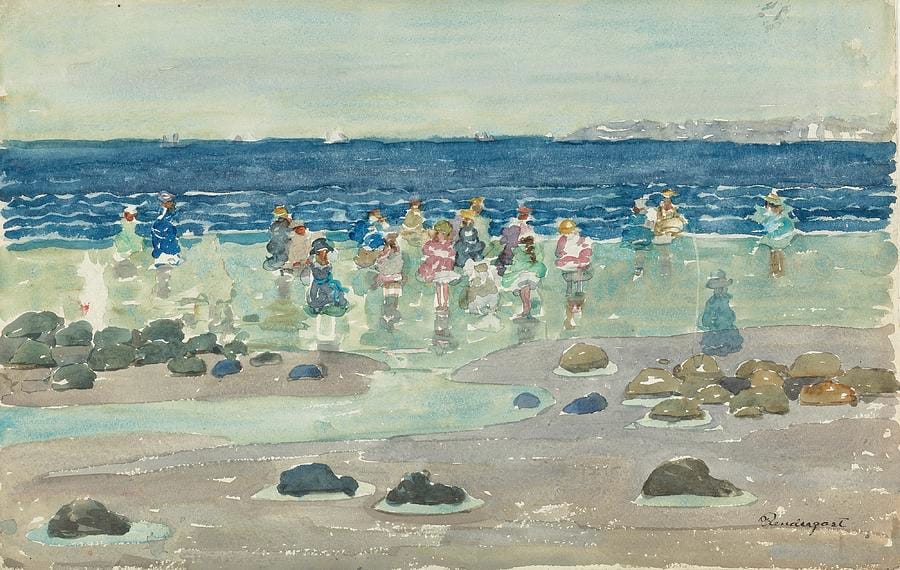
Low tide on the New England coast gave Prendergast an enormous pale foreground of wet sand, and he uses it here as a mirror. A band of deep blue sea runs across the top beneath a pale sky; small figures in pink, blue and white are strung along the water’s edge; dark rocks punctuate the sand in the foreground. Almost nothing is described in detail and nothing is happening, yet the sheet is beautifully balanced, with each little group of bathers weighted against the next. Watercolors like this are why he is still regarded as one of the great American painters of the seashore.
Skipping Rope
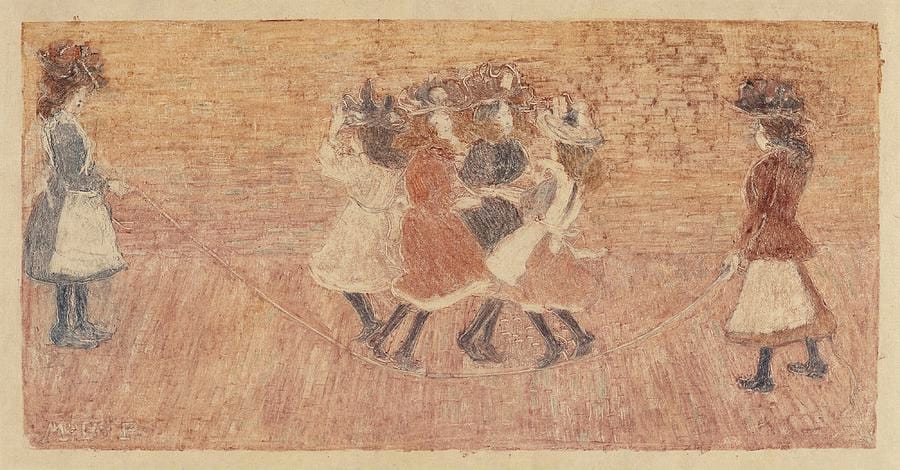
Alongside his watercolors Prendergast made a couple of hundred monotypes — images painted onto a plate and printed while the paint was still wet, which normally yields only one good impression. Skipping Rope is a fine example: on a warm pink ground, a knot of little girls in dark hats and long dresses turn a rope while two more figures stand at either edge like parentheses. The color is soft and blotted, the drawing nearly abstract. He kept the plates deliberately simple, knowing that the printing would blur and soften everything, and the results have a tenderness his other work rarely reaches.
Under the Trees
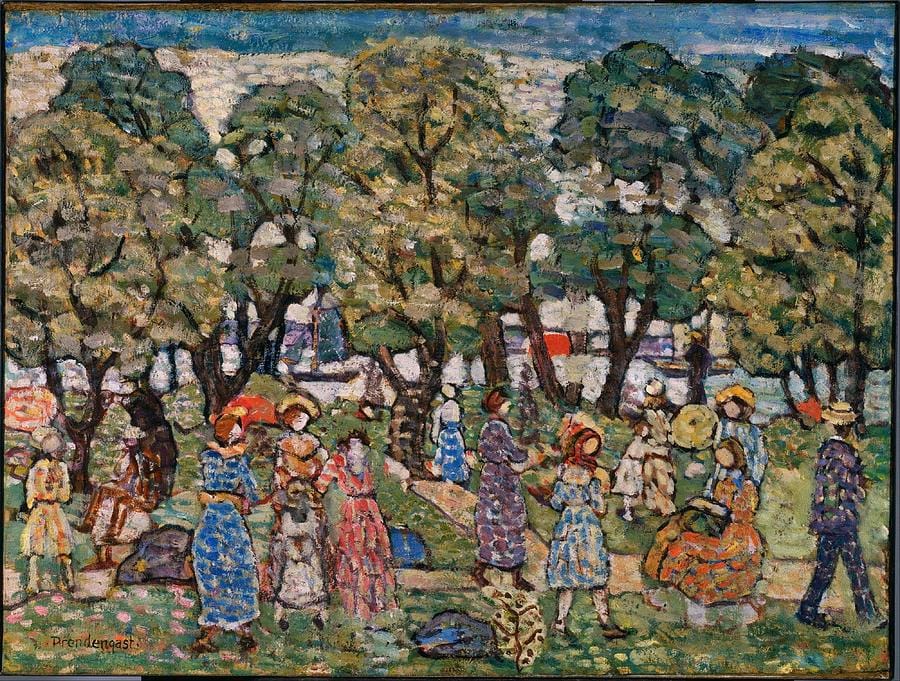
In his final decade Prendergast worked mostly in oil, building large park and shore scenes out of dense, chopped brushstrokes. Under the Trees lines up a row of heavy dark green trees across the top of the canvas, with a scattered company of women and children below them in red, gold, blue and white, and a band of deep blue closing the top edge. Depth is deliberately shallow: the figures are stacked up the canvas rather than set back into it, and everything is pressed into a single glittering surface. Younger American modernists admired these late oils, and they remain the most purely decorative pictures he made.
Prendergast painted holidays — the bright, ordinary business of a crowd enjoying itself on a bridge or a beach — and he did it with a color sense that has aged extremely well. His pictures are cheerful without being sentimental, and they bring light and movement to a room in the way a good textile does.
Shop Maurice Prendergast prints here, and explore the rest of our famous paintings collection for more of the world’s most beloved masterpieces.